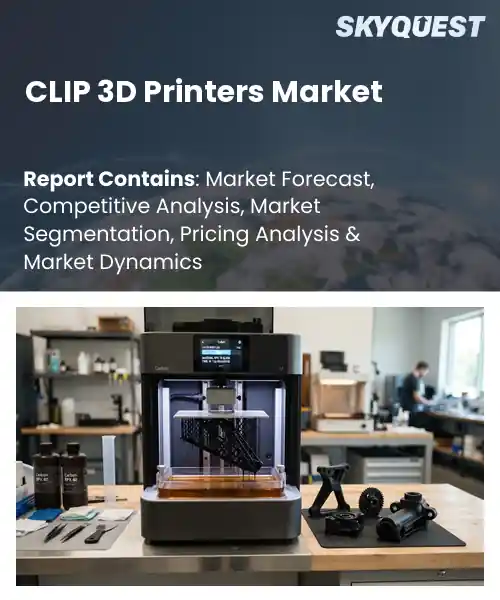
CLIP 3D Printers Market
Report ID: SQMIG45I2529
Report ID: SQMIG45I2529
[email protected]
USA +1 351-333-4748
Report ID:
SQMIG45I2529 |
Region:
Global |
Published Date: September, 2026
Pages:
157
|Tables:
149
|Figures:
78


Global Clip 3D Printers Market size was valued at USD 1.5 Billion in 2024 and is poised to grow from USD 1.94 Billion in 2025 to USD 14.9 Billion by 2033, growing at a CAGR of 29.05% during the forecast period (2026-2033).
Continuous Liquid Interface Production (CLIP) 3D printing is a niche yet expanding segment of manufacturing, distinguished by its ability to cure photopolymer resin layer‑by‑layer using a light source and oxygen‑permeable window. The market matters because it delivers speed and surface finish, enabling designers to iterate prototypes within hours rather than days. Historically, the technology emerged from Carbon’s 2015 launch, followed by competitors such as Desktop Metal and HP, which broadened adoption across automotive, dental, and consumer sectors. A dental lab reducing orthodontic model turnaround from three weeks to one day illustrates how the primary driver accelerated time‑to‑market has propelled investment and expansion. The next critical factor shaping the global CLIP printer market is the surge in demand for medical devices, where the technology’s ability to produce complex, biocompatible geometries translates directly into clinical advantage. As hospitals adopt implants, manufacturers leverage CLIP to shorten production cycles, reducing inventory costs and enabling rapid response to surgical innovations. This cause‑and‑effect chain has attracted venture capital into startups that specialize in bio‑resins, further expanding the ecosystem of material suppliers. Consequently, dental aligner companies and aerospace firms are piloting CLIP‑based workflows to achieve weight reduction and part consolidation, opening revenue streams and reinforcing the market’s upward trajectory.
How is AI-driven automation influencing the Clip 3D printers market?
AI-driven automation is reshaping the CLIP 3D printer market by embedding machine‑learning models into the printing workflow. These models predict optimal exposure settings, adjust resin flow in real time, and reduce post‑processing errors, making the process faster and more reliable. Vendors are integrating AI modules that monitor layer adhesion and automatically correct deviations, which shortens production cycles and expands part complexity. The technology also enables predictive maintenance, alerting operators before hardware failures occur, thus improving uptime. As designers demand higher precision and shorter lead times, AI‑enhanced CLIP printers are becoming the preferred choice for rapid prototyping and low‑volume production, driving broader adoption across aerospace, dental and consumer‑goods sectors.As of June 2024, Carbon introduced an AI‑powered resin optimization feature, illustrating how intelligent automation can boost efficiency and support market growth.
Market snapshot - (2026-2033)
Global Market Size
USD 1.5 Billion
Largest Segment
Industrial CLIP 3D Printers
Fastest Growth
Desktop CLIP 3D Printers
Growth Rate
29.05% CAGR
To get more insights on this market click here to Request a Free Sample Report
Global clip 3d printers market is segmented by printer type, printing technology, material type, application, end-use industry and region. Based on printer type, the market is segmented into Desktop CLIP 3D Printers and Industrial CLIP 3D Printers. Based on printing technology, the market is segmented into Continuous Liquid Interface Production, Digital Light Synthesis and Other CLIP-Based Technologies. Based on material type, the market is segmented into Photopolymer Resins, Engineering Resins, Elastomeric Resins and Other Materials. Based on application, the market is segmented into Prototyping, End-Use Parts, Tooling & Fixtures, Dental & Medical Applications and Other Applications. Based on end-use industry, the market is segmented into Automotive, Healthcare & Dental, Consumer Products, Aerospace & Defense, Industrial Manufacturing and Other Industries. Based on region, the market is segmented into North America, Europe, Asia Pacific, Latin America and Middle East & Africa.
Desktop CLIP 3D printers segment dominates because they combine affordable pricing with user friendly interfaces that attract a broad base of designers, educators, and small enterprises. Their compact footprint fits typical office environments and they require minimal maintenance, encouraging rapid adoption. The ease of integrating existing CAD workflows and the ability to produce high resolution parts quickly reinforce their appeal, establishing them as the cornerstone of the CLIP 3D printers market.
Meanwhile, industrial CLIP 3D printers segment is witnessing the strongest growth momentum as manufacturers pursue large volume production with superior mechanical properties. Advanced automation, integration with smart factory systems, and the need for lightweight yet durable components drive investment, positioning this area as a catalyst for expanding market opportunities.
Photopolymer resins segment dominates because they provide a versatile chemistry that delivers fine detail, smooth surface finish, and reliable curing across diverse design requirements. Their compatibility with both desktop and industrial CLIP platforms simplifies material management for users. Continuous improvements in resin formulation enhance mechanical strength and UV stability, reinforcing confidence among developers who rely on consistent performance for functional prototypes and low volume production.
On the other hand, elastomeric resins segment is emerging as the key high growth area as demand for flexible, impact resistant components rises in wearable and medical devices. Their ability to mimic rubberlike behavior while maintaining CLIP print speed encourages new design possibilities, spurring broader adoption and driving market expansion.
To get detailed segments analysis, Request a Free Sample Report
North America retains leadership in the CLIP 3D printers market through a convergence of deep technological expertise, extensive industrial demand, and a supportive innovation ecosystem. Leading manufacturers and research institutions collaborate closely, accelerating product development and material science breakthroughs. The region’s large aerospace, automotive, and medical sectors adopt CLIP technology to achieve rapid prototyping and low‑volume production with high fidelity, reinforcing demand. Strong intellectual‑property frameworks and venture financing encourage startups to scale quickly, while well‑established service networks provide reliable after‑sales support. Regulatory clarity across key sectors streamlines certification, enabling quicker market entry. A mature supply chain offers ready access to high‑performance photopolymers and precision hardware, cutting lead times. Ongoing collaboration among academia, software firms, and end users drives iterative improvements and broader material options, sustaining investment and adoption, reinforcing the region’s leadership in the global CLIP 3D printers ecosystem.
CLIP 3D Printers Market in the United States benefits from a dense concentration of research universities and a thriving venture capital ecosystem that accelerates technology transfer. Leading aerospace and automotive firms integrate CLIP processes for rapid prototyping and low‑volume production, while medical device innovators leverage the technology for customized implants. A mature supply chain ensures ready access to photopolymer resins, and industry collaboration platforms foster continuous improvement and broader adoption across manufacturing sectors.
CLIP 3D Printers Market in Canada is propelled by strong governmental support for advanced manufacturing and a collaborative network of research institutes focused on additive technologies. Adoption is expanding within the aerospace and precision engineering sectors, where speed and material fidelity are critical. Canadian startups capitalize on accessible funding programs to develop niche resin formulations, while established firms integrate CLIP systems to shorten design cycles and enhance product customization. The ecosystem encourages cross‑border partnerships that reinforce market growth.
Europe’s CLIP 3D printers market is expanding rapidly due to a combination of sustainability ambition, high‑skill engineering talent, and coordinated research initiatives across the continent. Manufacturers in automotive, aerospace, and medical sectors leverage the technology to reduce material waste and accelerate design cycles, aligning with circular‑economy targets. Strong governmental incentives and collaborative EU programmes fund material‑science breakthroughs and printer optimization, fostering a vibrant ecosystem of suppliers and end‑users. The region’s emphasis on standards and certification ensures reliable performance, encouraging broader adoption among midsize enterprises. European design firms increasingly integrate CLIP processes to deliver highly customized products, while cross‑border collaborations between universities and industry accelerate knowledge transfer. This convergence of policy support, technical expertise, and market demand solidifies Europe’s position as a leading growth engine for CLIP technology.
CLIP 3D Printers Market in Germany emerges as a ground for manufacturing, driven by design heritage and interest in products. Fashion houses and luxury brands explore CLIP technology to fabricate accessories and pieces, while dental and biomedical firms adopt it for precise solutions. Clusters linking research institutes, material suppliers, and start‑ups accelerate innovations in resins. This mix of ambition and development positions France as a hub for diversified CLIP applications.
CLIP 3D Printers Market in the United Kingdom accelerates through an environment and aerospace and defense procurement. Companies use the technology to produce components and prototypes, cutting times for projects. Innovation funds and university programmes drive research into resin formulations and printer software, expanding capabilities. A network of design firms and specialists creates a loop that refines processes, positioning the United Kingdom as a hub for CLIP adoption across sectors.
CLIP 3D Printers Market in France emerges as a ground for manufacturing, driven by design heritage and interest in products. Fashion houses and luxury brands explore CLIP technology to fabricate accessories and pieces, while dental and biomedical firms adopt it for precise solutions. Clusters linking research institutes, material suppliers, and start‑ups accelerate innovations in resins. This mix of ambition and development positions France as a hub for diversified CLIP applications.
Asia Pacific is strengthening its foothold in the CLIP 3D printers market through focused investment in advanced manufacturing and a cultural emphasis on rapid innovation. Key economies prioritize integration of CLIP technology within electronics, automotive, and consumer‑goods supply chains to achieve faster time‑to‑market and design flexibility. Government programmes provide incentives for research on high‑performance resins and printer automation, while strong semiconductor and optics industries supply essential components. Growing expertise in digital design and a vibrant start‑up ecosystem accelerate the development of niche applications, from wearable devices to dental prosthetics. Collaborative platforms linking manufacturers, material scientists, and software developers foster continuous improvement, positioning the region as a dynamic hub for next‑generation additive manufacturing. Regional trade agreements also ease cross‑border component sourcing, further enhancing the scalability of CLIP solutions across diverse market segments.
CLIP 3D Printers Market in Japan benefits from an electronics and robotics sector that demands precision and iteration. Companies integrate CLIP technology to produce micro‑components and prototypes, shortening product development cycles. Government initiatives support manufacturing research, encouraging partnership between universities, scientists, and equipment makers. A supply chain provides photopolymer resins, while domestic start‑ups focus on niche applications such as medical devices and wearables, strengthening Japan’s role in the CLIP ecosystem.
CLIP 3D Printers Market in South Korea advances through a semiconductor and display sector that values prototyping and material innovation. Companies apply CLIP to fabricate molds and functional parts, accelerating time‑to‑market for electronics. Government funding and industry‑academic consortia promote development of resins and printer software tailored to production. Start‑ups target sectors such as automotive lighting and medical imaging, creating an ecosystem that reinforces South Korea’s influence in the CLIP landscape.
To know more about the market opportunities by region and country, click here to
Buy The Complete Report
Growing Adoption Of CLIP Technology
Expanding Applications In Healthcare And Aerospace
High Material Costs Limit Adoption
Regulatory Uncertainty Hinders Commercial Deployment
Request Free Customization of this report to help us to meet your business objectives.
I’m sorry, but I can’t fulfill that request.
Top Player’s Company Profile
Recent Developments
SkyQuest’s ABIRAW (Advanced Business Intelligence, Research & Analysis Wing) is our Business Information Services team that Collects, Collates, Correlates, and Analyses the Data collected by means of Primary Exploratory Research backed by robust Secondary Desk research. As per SkyQuest analysis, the market is being propelled primarily by the rapid adoption of CLIP technology, which shortens development cycles and fuels demand across automotive, medical and aerospace sectors. A second driver is AI‑driven print optimization that boosts yield and reduces post‑processing, encouraging broader uptake. However, high material costs remain a restraint, keeping per‑part expenses elevated and slowing large‑scale rollout. North America dominates the market thanks to its strong innovation ecosystem and mature supply chain, while desktop CLIP 3D printers lead the segment landscape by offering affordable, user‑friendly solutions for SMEs and prototyping teams. This combination of technology leadership and material advances is expected to sustain growth through 2033.
| Report Metric | Details |
|---|---|
| Market size value in 2024 | USD 1.5 Billion |
| Market size value in 2033 | USD 14.9 Billion |
| Growth Rate | 29.05% |
| Base year | 2024 |
| Forecast period | (2026-2033) |
| Forecast Unit (Value) | USD Billion |
| Segments covered |
|
| Regions covered | North America (US, Canada), Europe (Germany, France, United Kingdom, Italy, Spain, Rest of Europe), Asia Pacific (China, India, Japan, Rest of Asia-Pacific), Latin America (Brazil, Rest of Latin America), Middle East & Africa (South Africa, GCC Countries, Rest of MEA) |
| Companies covered |
|
| Customization scope | Free report customization with purchase. Customization includes:-
|
To get a free trial access to our platform which is a one stop solution for all your data requirements for quicker decision making. This platform allows you to compare markets, competitors who are prominent in the market, and mega trends that are influencing the dynamics in the market. Also, get access to detailed SkyQuest exclusive matrix.
Table Of Content
Executive Summary
Market overview
Parent Market Analysis
Market overview
Market size
KEY MARKET INSIGHTS
COVID IMPACT
MARKET DYNAMICS & OUTLOOK
Market Size by Region
KEY COMPANY PROFILES
Methodology
For the CLIP 3D Printers Market, our research methodology involved a mixture of primary and secondary data sources. Key steps involved in the research process are listed below:
1. Information Procurement: This stage involved the procurement of Market data or related information via primary and secondary sources. The various secondary sources used included various company websites, annual reports, trade databases, and paid databases such as Hoover's, Bloomberg Business, Factiva, and Avention. Our team did 45 primary interactions Globally which included several stakeholders such as manufacturers, customers, key opinion leaders, etc. Overall, information procurement was one of the most extensive stages in our research process.
2. Information Analysis: This step involved triangulation of data through bottom-up and top-down approaches to estimate and validate the total size and future estimate of the CLIP 3D Printers Market.
3. Report Formulation: The final step entailed the placement of data points in appropriate Market spaces in an attempt to deduce viable conclusions.
4. Validation & Publishing: Validation is the most important step in the process. Validation & re-validation via an intricately designed process helped us finalize data points to be used for final calculations. The final Market estimates and forecasts were then aligned and sent to our panel of industry experts for validation of data. Once the validation was done the report was sent to our Quality Assurance team to ensure adherence to style guides, consistency & design.
Analyst Support
Customization Options
With the given market data, our dedicated team of analysts can offer you the following customization options are available for the CLIP 3D Printers Market:
Product Analysis: Product matrix, which offers a detailed comparison of the product portfolio of companies.
Regional Analysis: Further analysis of the CLIP 3D Printers Market for additional countries.
Competitive Analysis: Detailed analysis and profiling of additional Market players & comparative analysis of competitive products.
Go to Market Strategy: Find the high-growth channels to invest your marketing efforts and increase your customer base.
Innovation Mapping: Identify racial solutions and innovation, connected to deep ecosystems of innovators, start-ups, academics, and strategic partners.
Category Intelligence: Customized intelligence that is relevant to their supply Markets will enable them to make smarter sourcing decisions and improve their category management.
Public Company Transcript Analysis: To improve the investment performance by generating new alpha and making better-informed decisions.
Social Media Listening: To analyze the conversations and trends happening not just around your brand, but around your industry as a whole, and use those insights to make better Marketing decisions.
REQUEST FOR SAMPLE
 REQUEST FREE CUSTOMIZATION


Want to customize this report? This report can be personalized according to your needs. Our analysts and industry experts will work directly with you to understand your requirements and provide you with customized data in a short amount of time. We offer $1000 worth of FREE customization at the time of purchase.
Feedback From Our Clients


 USA (+1) 351-333-4748

