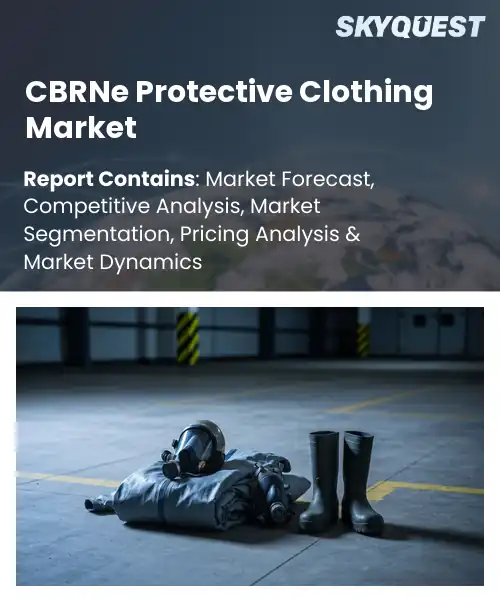
CBRNe Protective Clothing Market
Report ID: SQMIG25K2252
Report ID: SQMIG25K2252
[email protected]
USA +1 351-333-4748
Report ID:
SQMIG25K2252 |
Region:
Global |
Published Date: August, 2026
Pages:
157
|Tables:
148
|Figures:
78


Global Cbrne Protective Clothing Market size was valued at USD 3.18 Billion in 2024 and is poised to grow from USD 3.42 Billion in 2025 to USD 6.15 Billion by 2033, growing at a CAGR of 7.6% during the forecast period (2026-2033).
The CBRNe protective clothing market provides a shield for staff from chemical, biological, radiological, nuclear, and explosive dangers. A big part of why it matters is that it helps maintain health and keeps people operational for military units, first responders, and also industrial workers who are working where risk is possible. Right now, the main thing driving demand is the stronger feeling of asymmetric threats, like the increase in terrorist use of chemical agents and the spread of hazardous material events that can pop up in many places.
Moreover, the CBRNe protective clothing market growth forward is the progress in textile technologies that blend sensors with decontaminating layers. With these updates, exposure levels can be monitored more closely, which in turn can shorten evacuation periods and support more precise medical triage. This is seen in the U.S. Army’s adoption of bio‑sensor‑embedded suits for chemical reconnaissance missions. Because of that, manufacturers are putting more effort into R&D collaborations with science partners. They are also moving toward modular designs that can be reconfigured for different hazard profiles, so the market isn’t only defense anymore; it’s also showing up in petrochemical plants and waste-management sites.
Market snapshot - (2026-2033)
Global Market Size
USD 3.18 Billion
Largest Segment
Fully Encapsulated Suits
Fastest Growth
Splash Protection Suits
Growth Rate
7.6% CAGR
To get more insights on this market click here to Request a Free Sample Report
The global CBRNe protective clothing market is segmented by product type, protection type, material, end user, reusability and region. Based on product type, the market is segmented into Fully Encapsulated Suits, Splash Protection Suits, Escape Suits and Coveralls. Based on protection type, the market is segmented into Chemical, Biological, Radiological, Nuclear and Explosive. Based on material, the market is segmented into Butyl Rubber, Polyethylene, Activated Carbon Fabric and Composite Fabrics. Based on end user, the market is segmented into Military, First Responders, Law Enforcement and Industrial Hazmat Teams. Based on reusability, the market is segmented into Disposable and Reusable. Based on region, the market is segmented into North America, Europe, Asia Pacific, Latin America and Middle East & Africa.
As per the CBRNe protective clothing market analysis, the fully encapsulated suits dominate the conversation because they offer this top-tier isolation from chemical, biological, radiological, nuclear and explosive threats, and they reduce skin contact, plus they stop permeation through seams too. Their integrated air-purifying respirators and sealed entry points are tuned for strict military and hazmat standards, so in missions where the exposure is extreme, these suits get picked more often. Then there are continuous updates in lightweight composite materials and more ergonomic layouts, which quietly keep them ahead; also, they support adding advanced sensor modules for real-time exposure monitoring.
On the other hand, Splash Protection Suits are moving with the strongest growth momentum, mainly because many organizations want quick-response equipment for short-duration events where full encapsulation isn’t necessary. New breathable membrane technology helps cut heat stress, while still keeping barrier performance intact, so first responders and industrial teams are more willing to adopt them. That responsiveness broadens market reach and also pushes future product innovation forward.
According to the CBRNe protective clothing market forecast, the Butyl Rubber segment dominates because its impermeable molecular structure gives unmatched resistance against a large set of toxic chemicals and volatile agents, so it becomes the central material for high-threat CBRNe ensembles. The material remains flexible and lasts longer, which makes it easier to wear for longer periods, and it fits the strict military and hazmat certification requirements. R&D keeps improving ageing resistance too, and that locks in its position across protective garment lines, plus it works well with advanced sensor modules for real time exposure monitoring.
Meanwhile, Activated Carbon Fabric is rising fast as the key high-growth area, mostly due to its dual role: it adsorbs chemical vapors while still letting the fabric breathe. Manufacturers are putting nanostructured carbon layers inside, and those layers improve filtration efficiency, making it appealing for first-responder agencies that want lighter reusable gear. This shift basically feeds new product pipelines, and it expands the overall market opportunity too.
To get detailed segments analysis, Request a Free Sample Report
As per the CBRNe protective clothing market regional forecast, North America seems to stick together on a bunch of defense procurement frameworks, plus advanced textile engineering skills and all that emergency response infrastructure, as a package. In practice, government agencies keep pushing readiness for chemical, biological, radiological, nuclear and explosive incidents, so the money keeps flowing into high‑performance protective outfits. There is also a mature industrial base that feeds sophisticated barrier fabrics, sensor hookups and ergonomic designs, while universities and research centers keep the “new ideas” part alive, even when it feels a little chaotic.
Regulatory standards come in fairly strong , making sure what gets produced is reliable and that both civilian and military users can trust it. Public sector programs, private manufacturers and specialized testing labs also connect and speed things up so that cutting‑edge research turns into market-ready solutions not too slowly. That overall setup is one reason North America keeps pointing at itself as a leader in the global market. The region also has a talent pool of engineers focused on hazardous materials protection, and the joint exercises help confirm product performance under realistic threat situations. And on top of that, a proactive method for standard harmonization across the United States and Canada helps cross-border procurement feel simpler, which means faster deployment and wider market reach.
United States CBRNe Protective Clothing Market
The CBRNe Protective Clothing sector in the United States is anchored by a supply chain that ties defense contractors, specialized textile firms, and federal testing agencies together. The emphasis sits on modular designs and integrated sensor technology, so it can handle the different operational needs of the armed forces and also first‑responder agencies. Continuous work with research universities supports innovation in lightweight fabrics, while field trials keep verifying compliance with safety standards, reinforcing the country as a leading source for protective solutions.
Canada CBRNe Protective Clothing Market
The CBRNe Protective Clothing industry in Canada takes advantage of close alignment between national defense procurement policies and a domestic web of high‑technology fabric manufacturers. The focus tends to land on cold‑weather performance and interoperability with United States specifications, so joint development programs can move along. Federal research agencies back improvements in chemical filtration media, and provincial safety regulators keep product certification consistent. This collaborative ecosystem helps new protective concepts get integrated quickly into military units, and also into civilian emergency services across the country.
Europe is seeing a combined push from strict regulatory frameworks, higher security attention , and a lively network of specialized manufacturers that keeps expanding CBRNe protective Clothing demand. EU directives on occupational health and cross‑border safety create a fairly uniform need for high‑grade protective ensembles across civilian and defense sectors. Collaborative research efforts, including university groups and industry clusters, keep feeding improvements in lightweight barrier technologies and integrated monitoring systems. Public investment in emergency preparedness keeps growing, and the presence of big multinational defense contractors adds depth to the market. Also , a sustainability angle encourages recyclable materials and eco‑friendly production methods, which positions Europe like a forward‑looking hub for advanced protective solutions. When member states align regulations, manufacturers get smoother certification pathways, so scaling offerings across the region becomes less frustrating.
Germany CBRNe Protective Clothing Market
The CBRNe Protective Clothing Market penetration in Germany is driven by a dense concentration of engineering firms and a long tradition of precision manufacturing. Close cooperation with federal defense agencies ensures product specifications meet tough national standards. Research partnerships with technical universities accelerate the development of high‑performance barrier materials and integrated communication devices. Germany’s export-quality mindset also makes local manufacturers preferred suppliers for NATO partners and allied security forces.
United Kingdom CBRNe Protective Clothing Market
The CBRNe Protective Clothing Market in the United Kingdom benefits from an agile innovation ecosystem that links defense contractors with leading materials science research centers. Government programs provide incentives for rapid prototyping of lightweight multi‑threat garments, while civilian emergency services pull demand for adaptable solutions. Strong intellectual property protections support start‑ups that want to commercialize novel filtration technologies. The emphasis on modularity, plus quick redeployment, supports the United Kingdom’s ambition to grow its export footprint across European and Commonwealth markets.
France CBRNe Protective Clothing Market
The CBRNe Protective Clothing Market in France is emerging mainly through strategic investment in joint civil‑military research initiatives. Partnerships between national defense laboratories and textile startups speed up the creation of breathable , chemically resistant fabrics. The French regulatory environment also supports faster certification pathways for new protective solutions, so manufacturers can bring products to market more quickly. Meanwhile, rising awareness of terrorist threats and industrial hazards among public safety agencies keeps increasing demand for flexible high‑performance protective garments.
Asia Pacific is locking in its role through a mix of quick industrial build up, more security worries, and bigger defense modernization programs, at the same time. Countries like Japan and South Korea put a lot of money into advanced material science, and they push lightweight composite structures plus smart sensor tie ins for next‑generation protective clothing. There’s close working together between government research bodies and local manufacturers, and it speeds up tech transfer, also it lowers dependence on outside suppliers in a very obvious way. As cities keep expanding and large scale industrial sites become more common, the need for hardy emergency response tools feels more urgent. Regional trade agreements help move goods across borders, and the local cultural stress on safety plus resilience makes both public and private organizations lean toward all‑round CBRNe protection solutions. Meanwhile, innovation clusters in Tokyo and Seoul keep acting like incubators for start ups dealing with nanofiber filtration and autonomous hazard detection, and training programs boost readiness of first responders across the whole region.
Japan CBRNe Protective Clothing Market
The Japanese CBRNe Protective Clothing Market benefits from the country’s high level manufacturing precision, plus a fairly strong government mindset around disaster readiness. Deals and partnerships between the Ministry of Defense, research universities, and big textile players speed up the creation of lightweight, multi-layered garments, with integrated environmental monitoring. Ergonomic emphasis is not treated as optional; it targets both military staff and civilian responders in a place that faces natural events and industrial hazards too. Export-oriented plans also make Japanese products look like the go-to choice for regional security cooperation.
South Korea CBRNe Protective Clothing Market
The South Korean CBRNe Protective Clothing Market is supported by a fast defense industry, plus a national push toward new technology. Government-backed research consortia collaborate with automotive and electronics makers, so protective ensembles can carry smart sensing and communication features. A main factor is reducing mass while holding chemical resistance steady, because it matches needs from armed forces and also urban emergency operations. Export incentives give Korean firms a strong nudge to supply regional partners, especially those hunting for high-tech and dependable protective gear.
To know more about the market opportunities by region and country, click here to
Buy The Complete Report
Increasing Threats Of CBRNe Incidents
Adoption Of Lightweight Advanced Materials
High Production Costs Of Specialized Textiles
Regulatory Complexities Across Jurisdictions
Request Free Customization of this report to help us to meet your business objectives.
The Global CBRNe Protective Clothing market is intense and competitive, with established players using acquisitions, building strategic alliances and pushing rapid technology rollouts, to hold onto market share. Like, 3M’s 2020 acquisition of Scott Safety helped expand its full body suit portfolio, while Honeywell’s 2022 partnership with the Defense Innovation Unit sped up smart-fabric development. Then DuPont’s 2023 collaboration with the U.S. Army Natick Labs on advanced polymer barriers, shows how innovation-led competition keeps pushing everyone forward.
Top Player’s Company Profile
Recent Developments in the CBRNe Protective Clothing Market
SkyQuest’s ABIRAW (Advanced Business Intelligence, Research & Analysis Wing) is our Business Information Services team that Collects, Collates, Correlates, and Analyses the Data collected by means of Primary Exploratory Research backed by robust Secondary Desk research.
As per SkyQuest analysis, the market is mainly propelled by the rising frequency and the growing sophistication of CBRNe threats, which basically forces governments and industries to pursue more advanced protective apparel. Another catalyst is the gradual shift toward lightweight, high‑performance materials; these improve mobility and reduce wearer fatigue, so more military and civilian responders are willing to adopt them. North America leads; this region benefits from strong defense procurement, solid textile capabilities, and coordinated regulatory frameworks. Looking at product types, fully encapsulated suits dominate because they deliver the highest isolation for extreme hazard missions, but growth is a bit slowed by the high production costs of specialized textiles, which can limit adoption in programs that are tight on budgets.
| Report Metric | Details |
|---|---|
| Market size value in 2024 | USD 3.18 Billion |
| Market size value in 2033 | USD 6.15 Billion |
| Growth Rate | 7.6% |
| Base year | 2024 |
| Forecast period | (2026-2033) |
| Forecast Unit (Value) | USD Billion |
| Segments covered |
|
| Regions covered | North America (US, Canada), Europe (Germany, France, United Kingdom, Italy, Spain, Rest of Europe), Asia Pacific (China, India, Japan, Rest of Asia-Pacific), Latin America (Brazil, Rest of Latin America), Middle East & Africa (South Africa, GCC Countries, Rest of MEA) |
| Companies covered |
|
| Customization scope | Free report customization with purchase. Customization includes:-
|
To get a free trial access to our platform which is a one stop solution for all your data requirements for quicker decision making. This platform allows you to compare markets, competitors who are prominent in the market, and mega trends that are influencing the dynamics in the market. Also, get access to detailed SkyQuest exclusive matrix.
Table Of Content
Executive Summary
Market overview
Parent Market Analysis
Market overview
Market size
KEY MARKET INSIGHTS
COVID IMPACT
MARKET DYNAMICS & OUTLOOK
Market Size by Region
KEY COMPANY PROFILES
Methodology
For the CBRNe Protective Clothing Market, our research methodology involved a mixture of primary and secondary data sources. Key steps involved in the research process are listed below:
1. Information Procurement: This stage involved the procurement of Market data or related information via primary and secondary sources. The various secondary sources used included various company websites, annual reports, trade databases, and paid databases such as Hoover's, Bloomberg Business, Factiva, and Avention. Our team did 45 primary interactions Globally which included several stakeholders such as manufacturers, customers, key opinion leaders, etc. Overall, information procurement was one of the most extensive stages in our research process.
2. Information Analysis: This step involved triangulation of data through bottom-up and top-down approaches to estimate and validate the total size and future estimate of the CBRNe Protective Clothing Market.
3. Report Formulation: The final step entailed the placement of data points in appropriate Market spaces in an attempt to deduce viable conclusions.
4. Validation & Publishing: Validation is the most important step in the process. Validation & re-validation via an intricately designed process helped us finalize data points to be used for final calculations. The final Market estimates and forecasts were then aligned and sent to our panel of industry experts for validation of data. Once the validation was done the report was sent to our Quality Assurance team to ensure adherence to style guides, consistency & design.
Analyst Support
Customization Options
With the given market data, our dedicated team of analysts can offer you the following customization options are available for the CBRNe Protective Clothing Market:
Product Analysis: Product matrix, which offers a detailed comparison of the product portfolio of companies.
Regional Analysis: Further analysis of the CBRNe Protective Clothing Market for additional countries.
Competitive Analysis: Detailed analysis and profiling of additional Market players & comparative analysis of competitive products.
Go to Market Strategy: Find the high-growth channels to invest your marketing efforts and increase your customer base.
Innovation Mapping: Identify racial solutions and innovation, connected to deep ecosystems of innovators, start-ups, academics, and strategic partners.
Category Intelligence: Customized intelligence that is relevant to their supply Markets will enable them to make smarter sourcing decisions and improve their category management.
Public Company Transcript Analysis: To improve the investment performance by generating new alpha and making better-informed decisions.
Social Media Listening: To analyze the conversations and trends happening not just around your brand, but around your industry as a whole, and use those insights to make better Marketing decisions.
REQUEST FOR SAMPLE
 REQUEST FREE CUSTOMIZATION
Global Cbrne Protective Clothing Market size was valued at USD 3.18 Billion in 2024 and is poised to grow from USD 3.42 Billion in 2025 to USD 6.15 Billion by 2033, growing at a CAGR of 7.6% during the forecast period (2026-2033).
The Global CBRNe Protective Clothing market is intensely competitive, with incumbents leveraging acquisitions, strategic alliances and rapid technology rollouts to secure market share. 3M’s 2020 acquisition of Scott Safety expanded its full‑body suit portfolio, while Honeywell’s 2022 partnership with the Defense Innovation Unit accelerated smart‑fabric development. DuPont’s 2023 collaboration with the U.S. Army Natick Labs on advanced polymer barriers underscores innovation‑driven competition. 'Avon Protection plc', 'MSA Safety Incorporated', 'Honeywell International Inc.', 'DuPont de Nemours, Inc.', 'Ansell Limited', 'Lakeland Industries, Inc.', 'Drägerwerk AG & Co. KGaA', 'Respirex International Ltd.', 'Kappler, Inc.', 'Blücher GmbH', 'Paul Boyé Technologies', 'Sioen Industries NV', 'Seyntex NV', 'Cooneen Protection', 'Lion Protects', 'W. L. Gore & Associates, Inc.', 'Survitec Group Limited', 'Teijin Limited', '3M Company', 'Saint-Gobain S.A.'
The rising frequency and sophistication of chemical, biological, radiological, nuclear and explosive threats across geopolitical hotspots drive governments and industries to prioritize protective solutions. Organizations perceive CBRNe incidents as severe operational risks, prompting procurement of advanced clothing that meets stringent safety standards. This heightened awareness encourages continuous product innovation and expands the customer base, reinforcing demand for garments that combine durability, ergonomics and multi‑hazard resistance, thereby accelerating market expansion globally. The collective emphasis on safety and compliance further motivates stakeholders to allocate resources toward specialized apparel, ensuring growth momentum.
Advanced Nanofiber Integration: Manufacturers are increasingly embedding nanofiber technologies into CBRNe protective garments, delivering superior barrier performance while maintaining breathability and flexibility. These ultra‑fine fibers create a dense, yet lightweight, membrane that can block chemical agents, biological pathogens, and radiological particles without compromising wearer comfort. The resulting apparel supports longer operational durations and reduces fatigue, making it attractive for first responders and military units seeking high‑efficiency protection in diverse threat environments under extreme temperature conditions and during prolonged exposure scenarios while preserving functionality.
Why does North America Dominate the Global CBRNe Protective Clothing Market? |@12


Want to customize this report? This report can be personalized according to your needs. Our analysts and industry experts will work directly with you to understand your requirements and provide you with customized data in a short amount of time. We offer $1000 worth of FREE customization at the time of purchase.
Feedback From Our Clients


 USA (+1) 351-333-4748

