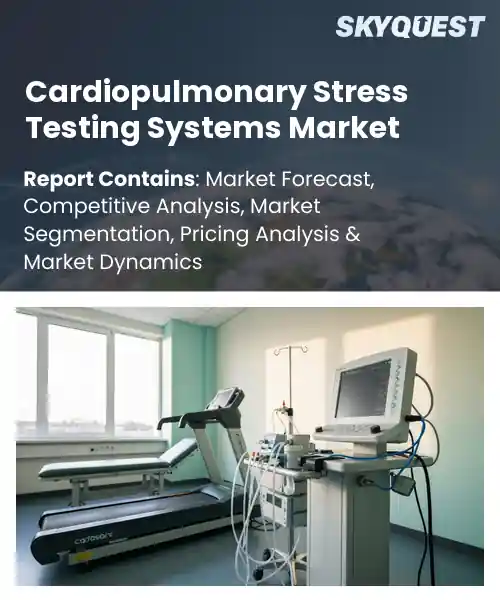
Cardiopulmonary Stress Testing Systems Market
Report ID: SQMIG35A4051
Report ID: SQMIG35A4051
[email protected]
USA +1 351-333-4748
Report ID:
SQMIG35A4051 |
Region:
Global |
Published Date: July, 2026
Pages:
157
|Tables:
173
|Figures:
79


Global Cardiopulmonary Stress Testing Systems Market size was valued at USD 987.4 Million in 2024 and is poised to grow from USD 1048.62 Million in 2025 to USD 1696.74 Million by 2033, growing at a CAGR of 6.2% during the forecast period (2026-2033).
The integration of health platforms using artificial intelligence to convert signals from stress tests into useful information creates global cardiopulmonary stress testing systems market growth source. If hospitals use cloud-based analytics with their testing systems, clinicians can quickly detect early ventricular dysfunction and make timely adjustments to medication, resulting in fewer patients having to return to the hospital. As was illustrated in a study done at an academic center in the U.S. in 2023, with the implementation of these capabilities, there is also an increasing demand for both subscription-based software and interoperable hardware. As manufacturers develop more modular products that are capable of being integrated with in-home treadmill units, they are able to move into new markets in emerging economies where portable devices allow community clinics to conduct guideline-supported evaluations with little cost associated. This has opened new markets for both revenue generation and patient access.
How is AI Improving Accuracy In The Cardiopulmonary Stress Testing Systems Market?
The incorporation of machine learning algorithms into ECG, respiratory and hemodynamic signal interpretation has greatly enhanced the accuracy and precision of cardiopulmonary stress testing. These models can filter out noise, detect subtle arrhythmias and make reliable predictions about exercise capacity compared to older methods. Real-time analytic feedback can assist clinicians during treadmill or cycle stress tests, which helps to reduce the need for repeat testing and increases patient safety. The data management process is also made more efficient through the use of this technology, allowing for a seamless transfer of data into electronic medical record systems and enabling telemedicine consultations.
As hospitals begin to implement new technologically-based systems within their organizations, the device market has seen an increased demand for devices that offer a combination of strong hardware capabilities with more sophisticated software and position AI as one of the key differentiators among competing technologies.
Market snapshot - (2026-2033)
Global Market Size
USD 987.4 Million
Largest Segment
Cardiopulmonary Exercise Testing (CPET) Systems
Fastest Growth
Metabolic Stress Testing Systems
Growth Rate
6.2% CAGR
To get more insights on this market click here to Request a Free Sample Report
Global cardiopulmonary stress testing systems market is segmented by product type, modality, application, end user, patient group, portability and region. Based on product type, the market is segmented into Cardiopulmonary Exercise Testing (CPET) Systems, Stress ECG Testing Systems, Metabolic Stress Testing Systems and Others. Based on modality, the market is segmented into Treadmill-Based Systems, Cycle Ergometer-Based Systems, Combined Systems and Others. Based on application, the market is segmented into Cardiology, Pulmonology, Sports Medicine and Others. Based on end user, the market is segmented into Hospitals, Diagnostic Centers, Specialty Clinics and Others. Based on patient group, the market is segmented into Adult Patients and Pediatric Patients. Based on portability, the market is segmented into Fixed Systems and Portable Systems. Based on region, the market is segmented into North America, Europe, Asia Pacific, Latin America and Middle East & Africa.
Cardiopulmonary Exercise Testing Systems hold significant market share due to the comprehensive nature of physiological assessment, including measures of both respiratory gas analysis and cardiac metrics, giving physicians access to data for accurate diagnosis and treatment planning. Details of patient aerobic capacity and ventilatory efficiency are essential and provide a unique perspective for cardiac and pulmonary practitioners therefore, healthcare systems prioritize CPET installation projects defining the scope of demand in both the market place and product development.
However, the fastest growing market segment is Metabolic Stress Testing Systems. Innovative sensor technologies enable real-time, breath-by-breath analysis of patients, generating interest from research organizations and sports performance laboratories. This innovation has broadened the potential application for metabolic stress testing into new areas beyond medicine resulting in growing adoption cycles and accelerating market growth through novel application opportunities.
The Treadmill Based Systems are dominant in the marketplace due to their ability to mimic natural walking and running, giving clinicians a familiar physiologically relevant environment in which to evaluate patients for stress. Treadmill Based Systems will generate higher aerobic workloads and offer precise speed increments, which enhances the accuracy of diagnostics related to cardiac and pulmonary illnesses. They are also utilized as a standard tool for testing in most hospitals or diagnostic centers due to their proven reliability and the amount of existing clinical data available, as well as because they can easily be integrated into previously established exercise procedures.
On the other hand, the segment of the Combined Systems has the highest rate of growth because it combines the exercise capabilities of a treadmill and a cycle ergometer, enabling clinicians to select which protocol they want to use depending upon patient needs from one piece of equipment. This combination of equipment reduces the amount of floor space and cost associated with different types of exercise testing equipment, which is desirable to clinics that specialize in wide-ranging testing solutions; therefore, it is speeding up the adoption of Combined Systems and providing new markets for growth.
To get detailed segments analysis, Request a Free Sample Report
The convergence of advanced healthcare systems, research institutions, and an innovative regulatory environment in North America make it the leader in this market. In the US many of its academic medical centres have incorporated stress testing into their cardiovascular programs while creating a robust reimbursement system which allows widespread adoption. The Canadian system has provided universal coverage which gives every patient equal access to advanced diagnostic equipments and creates a consistent flow of demand for these devices in both hospital-based and outpatient settings. Both countries bring in major manufacturers of devices, as well as technological companies, which creates a dense supply chain where devices can be introduced into the market and improved on through continuous iteration at a fast pace. The culture of evidence-based practice, combined with the high degree of awareness by clinicians of the value of cardiovascular and pulmonary assessments, creates an environment where these assessments are used consistently. Together these factors create a conducive environment for creating and maintaining the North American leader position in this market.
The United States Cardiopulmonary Stress Testing Systems Market is made possible by an expansive ecosystem of research institutions, which support both the clinical validation of products and their integration into clinical practice guidelines. In addition, there are extensive reimbursement options available to hospitals, which motivate the acquisition of advanced testing systems for cardiac departments. The ability to use multinationally based manufacturers also allows for the rapid access of cutting-edge technologies, and the presence of highly qualified personnel supports the interpretation of complex test results. The combination of these factors generates strong demand for CPRS equipment in the wide range of settings providing patient care.
The Canadian Cardiopulmonary Stress Testing Systems Market benefits from a universal health care system that supports equitable access to diagnostic services across all provinces. Canadian Health Agencies are focused on cardiology prevention and have created diagnostic stress testing protocols and processes that are now considered standard throughout Canada for assessing cardiac risk. In addition, many Canadian academic centers are creating collaborative networks that enhance knowledge transfer among each other, to regional hospitals and to private industry in order to share best practices. The Canadian market is also being driven by many national and international manufacturers of products that have been specifically designed to provide cost-effective solutions, which will support the continued growth of the CPRS market.
Europe’s rapid expansion is propelled by a strong emphasis on preventive cardiology and harmonized regulatory standards that simplify cross‑border product deployment. Health systems in key countries allocate resources to early detection programs, positioning stress testing as a central component of cardiovascular risk management. Collaborative research initiatives within the European Union foster innovation, while reimbursement models that align with clinical outcomes encourage adoption of advanced platforms. The presence of established device manufacturers and a skilled clinical workforce further accelerates market diffusion. Additionally, integration of digital health solutions and emphasis on patient‑centered care enhance the perceived value of comprehensive cardiopulmonary assessment, collectively driving vigorous growth throughout the region.
Cardiopulmonary Stress Testing Systems Market Germany combines rigorous clinical standards with a robust manufacturing base that produces high‑precision devices. Strong reimbursement incentives and national guidelines emphasize accurate functional assessment, prompting wide adoption in tertiary hospitals and specialized clinics. Collaborative ties between industry and research institutions drive continuous improvement, while the country’s reputation for engineering excellence attracts global partners seeking reliable technology. This environment sustains Germany’s leading role in the European market.
Cardiopulmonary Stress Testing Systems Market United Kingdom experiences accelerated uptake driven by national health service initiatives focused on early detection of cardiac disease. Integrated care pathways prioritize functional testing, and evidence‑based protocols support routine use in both inpatient and community settings. Partnerships between academic cardiac centers and device innovators accelerate technology transfer, while policy emphasis on value‑based care encourages investment in efficient, high‑quality systems. The result is a dynamic market landscape reflecting rapid growth.
Cardiopulmonary Stress Testing Systems Market France is emerging as a growing segment thanks to increasing awareness of lifestyle‑related cardiovascular risk and proactive public health campaigns. National health policies promote incorporation of stress testing within preventive cardiology programs, encouraging adoption in regional hospitals and outpatient facilities. Domestic firms are expanding capabilities alongside international collaborators, offering tailored solutions that address cost considerations while maintaining clinical performance. This supportive ecosystem positions France as an expanding contributor to Europe’s overall market momentum.
Asia Pacific is strengthening its position through strategic investments in healthcare infrastructure and a rising focus on chronic disease management. Government initiatives across the region prioritize modern diagnostic capabilities, encouraging hospitals to integrate sophisticated cardiopulmonary stress testing into routine cardiac care. Rapid urbanization and an expanding middle class drive demand for comprehensive health services, while collaborations with global manufacturers accelerate technology transfer and local production. The convergence of advanced electronic expertise, especially in countries with strong semiconductor industries, supports the development of compact, cost‑effective testing platforms. Coupled with growing clinician expertise and patient awareness of preventive cardiology, these dynamics collectively enhance the region’s relevance in the global market.
Cardiopulmonary Stress Testing Systems Market Japan leverages its reputation for precision medicine and an aging population that heightens the need for detailed functional assessment. Leading academic hospitals integrate stress testing into multidisciplinary cardiac programs, supported by national health insurance that acknowledges its diagnostic value. Domestic manufacturers specialize in high‑resolution imaging and data analytics, while partnerships with international firms introduce cutting‑edge technologies. This blend of clinical rigor, supportive reimbursement, and technological sophistication sustains robust market activity.
Cardiopulmonary Stress Testing Systems Market South Korea benefits from a technology‑driven healthcare environment and strong governmental support for advanced diagnostics. Rapid adoption of digital health solutions enables seamless integration of stress testing data into electronic medical records, enhancing clinical workflow. Domestic equipment producers capitalize on expertise in electronics to deliver innovative, compact systems tailored to hospital needs. Policy incentives that emphasize early detection of cardiovascular disease further encourage widespread utilization, positioning South Korea as a dynamic and growing contributor within the Asia Pacific landscape.
To know more about the market opportunities by region and country, click here to
Buy The Complete Report
Rising Demand for Preventive Cardiology
Advancements in Portable Testing Technology
High Initial Equipment Investment
Limited Skilled Operator Availability
Request Free Customization of this report to help us to meet your business objectives.
The competitive landscape is shaped by aggressive product innovation, strategic partnerships and selective M&A as firms race to integrate advanced metabolic analytics and AI-driven interpretation into stress testing platforms, driving differentiation and market share gains while responding to clinician demand for faster, more accurate cardiopulmonary assessments.
SkyQuest’s ABIRAW (Advanced Business Intelligence, Research & Analysis Wing) is our Business Information Services team that Collects, Collates, Correlates, and Analyses the Data collected by means of Primary Exploratory Research backed by robust Secondary Desk research.
As per SkyQuest analysis the global cardiopulmonary stress testing systems market is projected to expand at a 6.2 % CAGR through 2033, fueled primarily by rising demand for preventive cardiology that pushes hospitals and clinics to adopt comprehensive exercise assessments. A second strong driver is the rapid advancement of portable testing technology, which lets clinicians bring accurate stress tests to community centers and even patients’ homes. The market remains led by North America, where mature reimbursement structures and strong research networks support growth, and the Cardiopulmonary Exercise Testing segment continues to dominate due to its full physiologic insight. However, high initial equipment investment still restrains adoption, especially for budget‑constrained facilities.
| Report Metric | Details |
|---|---|
| Market size value in 2024 | USD 987.4 Million |
| Market size value in 2033 | USD 1696.74 Million |
| Growth Rate | 6.2% |
| Base year | 2024 |
| Forecast period | (2026-2033) |
| Forecast Unit (Value) | USD Million |
| Segments covered |
|
| Regions covered | North America (US, Canada), Europe (Germany, France, United Kingdom, Italy, Spain, Rest of Europe), Asia Pacific (China, India, Japan, Rest of Asia-Pacific), Latin America (Brazil, Rest of Latin America), Middle East & Africa (South Africa, GCC Countries, Rest of MEA) |
| Companies covered |
|
| Customization scope | Free report customization with purchase. Customization includes:-
|
To get a free trial access to our platform which is a one stop solution for all your data requirements for quicker decision making. This platform allows you to compare markets, competitors who are prominent in the market, and mega trends that are influencing the dynamics in the market. Also, get access to detailed SkyQuest exclusive matrix.
Table Of Content
Executive Summary
Market overview
Parent Market Analysis
Market overview
Market size
KEY MARKET INSIGHTS
COVID IMPACT
MARKET DYNAMICS & OUTLOOK
Market Size by Region
KEY COMPANY PROFILES
Methodology
For the Cardiopulmonary Stress Testing Systems Market, our research methodology involved a mixture of primary and secondary data sources. Key steps involved in the research process are listed below:
1. Information Procurement: This stage involved the procurement of Market data or related information via primary and secondary sources. The various secondary sources used included various company websites, annual reports, trade databases, and paid databases such as Hoover's, Bloomberg Business, Factiva, and Avention. Our team did 45 primary interactions Globally which included several stakeholders such as manufacturers, customers, key opinion leaders, etc. Overall, information procurement was one of the most extensive stages in our research process.
2. Information Analysis: This step involved triangulation of data through bottom-up and top-down approaches to estimate and validate the total size and future estimate of the Cardiopulmonary Stress Testing Systems Market.
3. Report Formulation: The final step entailed the placement of data points in appropriate Market spaces in an attempt to deduce viable conclusions.
4. Validation & Publishing: Validation is the most important step in the process. Validation & re-validation via an intricately designed process helped us finalize data points to be used for final calculations. The final Market estimates and forecasts were then aligned and sent to our panel of industry experts for validation of data. Once the validation was done the report was sent to our Quality Assurance team to ensure adherence to style guides, consistency & design.
Analyst Support
Customization Options
With the given market data, our dedicated team of analysts can offer you the following customization options are available for the Cardiopulmonary Stress Testing Systems Market:
Product Analysis: Product matrix, which offers a detailed comparison of the product portfolio of companies.
Regional Analysis: Further analysis of the Cardiopulmonary Stress Testing Systems Market for additional countries.
Competitive Analysis: Detailed analysis and profiling of additional Market players & comparative analysis of competitive products.
Go to Market Strategy: Find the high-growth channels to invest your marketing efforts and increase your customer base.
Innovation Mapping: Identify racial solutions and innovation, connected to deep ecosystems of innovators, start-ups, academics, and strategic partners.
Category Intelligence: Customized intelligence that is relevant to their supply Markets will enable them to make smarter sourcing decisions and improve their category management.
Public Company Transcript Analysis: To improve the investment performance by generating new alpha and making better-informed decisions.
Social Media Listening: To analyze the conversations and trends happening not just around your brand, but around your industry as a whole, and use those insights to make better Marketing decisions.
REQUEST FOR SAMPLE
 REQUEST FREE CUSTOMIZATION
Global Cardiopulmonary Stress Testing Systems Market size was valued at USD 987.4 Million in 2024 and is poised to grow from USD 1048.62 Million in 2025 to USD 1696.74 Million by 2033, growing at a CAGR of 6.2% during the forecast period (2026-2033).
The competitive landscape is shaped by aggressive product innovation, strategic partnerships and selective M&A as firms race to integrate advanced metabolic analytics and AI-driven interpretation into stress testing platforms, driving differentiation and market share gains while responding to clinician demand for faster, more accurate cardiopulmonary assessments. 'GE HealthCare Technologies Inc.', 'Koninklijke Philips N.V.', 'Schiller AG', 'COSMED S.r.l.', 'MGC Diagnostics Corporation', 'Vyaire Medical, Inc.', 'CareFusion Corporation', 'Nihon Kohden Corporation', 'Fukuda Denshi Co., Ltd.', 'Cardinal Health, Inc.', 'Welch Allyn, Inc.', 'OSI Systems, Inc.', 'Geratherm Respiratory GmbH', 'Cortex Biophysik GmbH', 'MedGraphics Corporation', 'ECG Excellence LLC', 'Norav Medical Ltd.', 'Lode Holding B.V.', 'Bionet Co., Ltd.', 'Edan Instruments, Inc.'
Healthcare providers are increasingly prioritizing early detection of cardiovascular impairments, and cardiopulmonary stress testing offers a comprehensive assessment of exercise capacity and gas exchange abnormalities. This clinical relevance encourages hospitals and specialty clinics to integrate advanced testing systems into routine diagnostic pathways, thereby expanding the installed base of equipment. As physicians seek objective data to guide treatment decisions, the perceived value of these systems grows, stimulating demand across both mature and emerging markets and supporting long‑term healthcare sustainability initiatives globally.
Ai-Driven Diagnostic Integration: The adoption of artificial‑intelligence algorithms within CPET platforms is reshaping clinical workflows. By automatically interpreting gas exchange data, heart‑rate variability, and ventilatory efficiency, AI reduces interpretation time and enhances diagnostic confidence. Healthcare providers are increasingly leveraging these insights to personalize treatment plans for heart failure, pulmonary disease, and elite athletes. Integration with electronic health records enables seamless data sharing, supporting multidisciplinary decision‑making and fostering a more proactive, data‑driven approach to patient management through continuous monitoring and predictive analytics across populations.
Why does North America Dominate the Global Cardiopulmonary Stress Testing Systems Market? |@12


Want to customize this report? This report can be personalized according to your needs. Our analysts and industry experts will work directly with you to understand your requirements and provide you with customized data in a short amount of time. We offer $1000 worth of FREE customization at the time of purchase.
Feedback From Our Clients


 USA (+1) 351-333-4748

