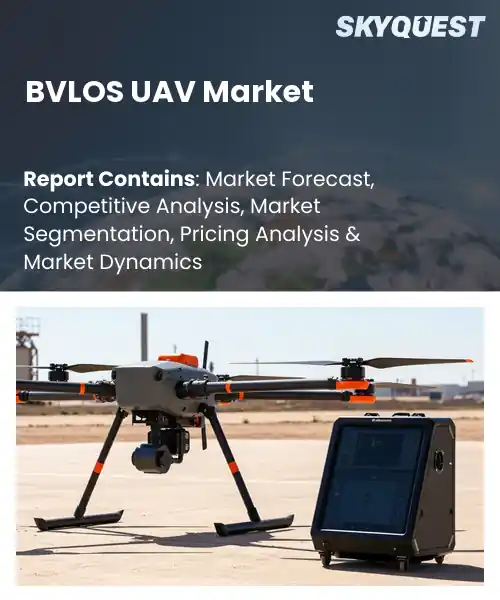
BVLOS UAV Market
Report ID: SQMIG20A2789
Report ID: SQMIG20A2789
[email protected]
USA +1 351-333-4748
Report ID:
SQMIG20A2789 |
Region:
Global |
Published Date: July, 2026
Pages:
157
|Tables:
123
|Figures:
77


Global BVLOS UAV Market size was valued at USD 15.36 Billion in 2024 and is poised to grow from USD 16.97 Billion in 2025 to USD 37.73 Billion by 2033, growing at a CAGR of 10.5% during the forecast period (2026-2033).
The BVLOS UAV market comprises unmanned aircraft systems that operate without a pilot maintaining sight, a capability that expands operational range and enables data collection. Its importance stems from the ability to conduct inspections, deliveries, and surveying across vast or hazardous terrains, reducing labor costs and safety risks. Historically, regulatory restrictions confined drones to line‑of‑sight flight, limiting commercial adoption; however, gradual policy liberalization in the United States, Europe, and Asia since 2018 has unlocked new use cases. For example, Amazon’s Prime Air trials and oil‑field pipeline monitoring projects illustrate how regulatory evolution has propelled market growth.
Regulatory certainty now stands as the pivotal catalyst driving the BVLOS UAV market toward accelerated adoption, because clear rules reduce risk for investors and enable airlines and logistics firms to integrate drones into operations. This certainty triggers capital inflows, prompting manufacturers to scale production of longer‑endurance platforms and sophisticated detect‑and‑avoid sensors, which in turn expands service offerings such as high‑value parcel delivery in suburban neighborhoods and autonomous agricultural scouting across thousands of acres. Companies like Zipline in Rwanda and DJI’s partnership with Brazil’s ANATEL demonstrate how policy clarity translates into operational scale, unlocking revenue streams worth billions and prompting innovation.
How are AI and IoT Advancing BVLOS UAV Operations And Regulatory Acceptance?
Artificial intelligence and the Internet of Things are reshaping beyond visual line of sight UAV operations. AI provides real time perception, path planning and risk assessment while IoT links drones to ground stations, traffic management platforms and sensor networks. Together they enable autonomous navigation, dynamic obstacle avoidance and continuous health monitoring. Regulators see these capabilities as safety enablers and are updating rules to allow more flexible missions. The market now sees pilots using AI driven flight controllers and operators relying on IoT telemetry for compliance reporting. This synergy creates higher efficiency, lower operational cost and broader acceptance across logistics, inspection and emergency response.
Zipline July 2023, demonstrated a fully autonomous BVLOS delivery network that combines AI route optimization with IoT telemetry to monitor flight health and airspace status. The system proves that intelligent data exchange can satisfy regulator safety criteria and unlock new commercial routes.
Market snapshot - (2026-2033)
Global Market Size
USD 15.36 Billion
Largest Segment
Fixed-Wing UAVs
Fastest Growth
Hybrid VTOL UAVs
Growth Rate
10.5% CAGR
To get more insights on this market click here to Request a Free Sample Report
Global bvlos uav market is segmented by platform architecture type, operational range class, propulsion platform type, end-use industry vertical and region. Based on platform architecture type, the market is segmented into Fixed-Wing UAVs, Rotary-Wing & Multirotor UAVs and Hybrid VTOL UAVs. Based on operational range class, the market is segmented into Short-Range Systems (Under 25 km), Medium-Range Systems (25 km to 150 km) and Long-Range Systems (Above 150 km). Based on propulsion platform type, the market is segmented into Battery-Electric Powertrains, Hybrid-Electric Powertrains, Fuel-Powered & Internal Combustion Engines and Hydrogen Fuel-Cell Systems. Based on end-use industry vertical, the market is segmented into Defense & Military Forces, Energy, Utilities & Linear Infrastructure, Logistics, Cargo & Medical Delivery, Agriculture, Forestry & Environmental Surveying and Civil Government & Public Safety. Based on region, the market is segmented into North America, Europe, Asia Pacific, Latin America and Middle East & Africa.
Fixed winged UAVs are the most popular because of their aerodynamic efficiency, which allows them to sustain flight over large distances while carrying substantial payloads, which is the core requirement of beyond visual line of sight operation. There is less need to refuel or recharge, because they can go longer on a tank of fuel or a battery charge, simplifying mission planning and reducing operating costs. This inherent capability matches the market focus on large scale surveillance, infrastructure inspection and long-distance delivery, reinforcing their dominance in BVLOS deployments.
Simultaneously, multirotor UAVs show the most vigorous growth dynamics in the market of BVLOS UAVs. Their vertical lift capability allows for precise positioning and hover, unlocking new use cases such as detailed asset inspection and time-critical delivery in confined environments. Improvements in battery density and autonomous navigation are expanding their range of viability, and their applicability is growing quickly, spurring market growth.
Hybrid‑VTOL UAVs stand out because they merge the endurance of fixed‑wing flight with the vertical take‑off and landing flexibility of rotorcraft, eliminating the need for runways while extending operational range. This dual capability satisfies diverse industry demands, from energy line inspections to emergency response, by offering rapid deployment and sustained coverage in a single platform. Their versatility directly addresses logistical constraints that have previously limited BVLOS adoption.
Conversely, fuel‑powered internal combustion engine UAVs are the fastest growing component within the BVLOS market. Greater regulatory encouragement for higher altitude operations and advances in emissions controls have renewed interest in gasoline and diesel propulsion, which provides unparalleled energy density for ultra-long missions. This renewed focus is unlocking new high‑value routes, especially in remote utility inspection and defense scouting, accelerating overall market growth.
To get detailed segments analysis, Request a Free Sample Report
North America leverages a mature regulatory environment that encourages innovation while maintaining safety standards. Robust investment ecosystems and a concentration of leading aerospace firms create a fertile ground for advanced UAV development. Collaborative frameworks between industry and government agencies accelerate the approval process for beyond‑visual‑line‑of‑sight operations. The region also benefits from extensive infrastructure networks that support large‑scale testing and deployment across diverse sectors such as logistics, agriculture, and energy. Strategic emphasis on research partnerships and talent pipelines sustains a competitive edge, positioning North America as a benchmark for operational excellence and technological leadership in the global BVLOS UAV marketplace.
BVLOS UAV Market in the United States is driven by a deep integration of autonomous systems into commercial logistics and precision agriculture. Strong collaboration between federal aviation authorities and industry pioneers facilitates streamlined certification pathways. The presence of major technology hubs fuels continuous innovation, while a broad spectrum of end‑users adopts BVLOS capabilities to enhance operational efficiency and safety. Investment in advanced sensor suites and data analytics further solidifies the United States’ role as a global leader.
BVLOS UAV Market in Canada benefits from a supportive policy framework that emphasizes sustainable development and remote area connectivity. Collaborative research initiatives between academic institutions and aerospace firms nurture cutting‑edge solutions tailored to forestry, mineral exploration, and emergency response. The expansive terrain and diverse climatic zones provide realistic testing environments, encouraging robust system validation. Government incentives promote adoption across energy and infrastructure sectors, reinforcing Canada’s position as an emerging hub for BVLOS innovation.
Europe’s BVLOS UAV market is propelled by harmonized regulatory standards that facilitate cross‑border operations and encourage industry collaboration. Strong public‑private partnerships foster the development of integrated air traffic management solutions tailored to densely populated airspaces. Emphasis on environmental sustainability drives adoption in sectors such as renewable energy, precision farming, and urban logistics. Investment in research clusters across key economies nurtures cutting‑edge technology, while a focus on safety and public acceptance accelerates market penetration. The confluence of these factors positions Europe as a dynamic arena for BVLOS growth.
BVLOS UAV Market in Germany is anchored by a robust industrial base and a strategic focus on precision manufacturing and logistics. Collaborative frameworks between regulatory bodies and technology providers streamline certification processes, encouraging rapid deployment. Extensive research networks drive innovation in sensor integration and autonomous navigation, supporting applications in automotive supply chains and energy infrastructure. Commitment to safety and standardization ensures confidence among stakeholders, reinforcing Germany’s leadership within the European BVLOS ecosystem.
BVLOS UAV Market in the United Kingdom is experiencing accelerated adoption due to proactive regulatory reforms and strong governmental support for emerging technologies. A vibrant startup culture paired with established aerospace expertise fuels rapid innovation in delivery services and infrastructure inspection. Collaborative pilots across urban and rural environments showcase the versatility of BVLOS operations, while investment in digital airspace management enhances safety and efficiency. The United Kingdom’s agile approach positions it as the fastest growing market in the region.
BVLOS UAV Market in France is emerging through targeted initiatives that link aerospace research with agricultural modernization and coastal monitoring. National programs encourage integration of UAVs into traditional sectors, promoting operational efficiency and data‑driven decision making. Partnerships between defense agencies and civilian operators expand the scope of BVLOS applications, while regulatory adaptations ensure a balanced pathway for commercial deployment. France’s emphasis on sustainable practices and technological convergence supports its rising prominence in the European BVLOS landscape.
Asia Pacific is enhancing its BVLOS UAV standing by leveraging rapid technological adoption and supportive governmental policies across a diverse set of economies. Collaborative initiatives focus on integrating UAVs into logistics, disaster response, and infrastructure monitoring, capitalizing on the region’s expansive geography. Investment in advanced navigation systems and real‑time data analytics fuels operational reliability, while regional standardization efforts streamline cross‑border airspace management. The synergy of innovation, regulatory openness, and strategic industry alliances accelerates the region’s transition from emerging to influential player in the global BVLOS arena.
BVLOS UAV Market in Japan benefits from a strong emphasis on precision engineering and automation across manufacturing and disaster mitigation sectors. Government‑backed frameworks prioritize safety while encouraging experimental trials in complex urban environments. Integration of high‑resolution imaging and AI‑driven analytics enhances situational awareness, supporting applications in infrastructure inspection and agricultural monitoring. Japan’s commitment to collaborative research and technology transfer bolsters its reputation as a leader in sophisticated BVLOS solutions.
BVLOS UAV Market in South Korea is propelled by a vibrant technology ecosystem that emphasizes connectivity and smart city initiatives. Strategic government incentives facilitate the deployment of UAVs for logistics, public safety, and environmental monitoring. Advanced communication networks enable real‑time command and control, improving operational confidence. Partnerships between leading electronics firms and aerospace startups accelerate innovation in autonomous navigation, positioning South Korea as a key contributor to the regional BVLOS advancement.
To know more about the market opportunities by region and country, click here to
Buy The Complete Report
Regulatory Support is Expanding
Advances in Sensor Technology are Enabling
Public Perception is Skeptical
Infrastructure Limitations are Hindering Deployment
Request Free Customization of this report to help us to meet your business objectives.
The BVLOS UAV market is shaped by intense competition as vendors race to secure regulatory approvals and differentiate through technology. Septentrio has expanded its GNSS solutions for BVLOS navigation, while manufacturers are launching BVLOS‑optimized platforms that boost endurance and payload capacity. Players are also integrating AI‑driven sensing and on‑board computing to meet commercial demand and lock in long‑term contracts.
SkyQuest’s ABIRAW (Advanced Business Intelligence, Research & Analysis Wing) is our Business Information Services team that Collects, Collates, Correlates, and Analyses the Data collected by means of Primary Exploratory Research backed by robust Secondary Desk research.
As per SkyQuest analysis, the market is being propelled primarily by expanding regulatory support that clarifies certification, air‑space rules and safety protocols, while a second strong driver is the rapid advancement of sensor and AI technologies that boost autonomous navigation and obstacle avoidance. Public perception remains a notable restraint, with privacy and safety worries encouraging community push‑back and slowing rollout. North America dominates the global BVLOS UAV landscape due to its mature regulatory framework, deep investment base and concentration of aerospace innovators. Within the segment hierarchy, fixed‑wing UAVs hold the largest share because their endurance and payload capacity align perfectly with the long‑range, beyond‑visual‑line‑of‑sight missions driving the industry.
| Report Metric | Details |
|---|---|
| Market size value in 2024 | USD 15.36 Billion |
| Market size value in 2033 | USD 37.73 Billion |
| Growth Rate | 10.5% |
| Base year | 2024 |
| Forecast period | (2026-2033) |
| Forecast Unit (Value) | USD Billion |
| Segments covered |
|
| Regions covered | North America (US, Canada), Europe (Germany, France, United Kingdom, Italy, Spain, Rest of Europe), Asia Pacific (China, India, Japan, Rest of Asia-Pacific), Latin America (Brazil, Rest of Latin America), Middle East & Africa (South Africa, GCC Countries, Rest of MEA) |
| Companies covered |
|
| Customization scope | Free report customization with purchase. Customization includes:-
|
To get a free trial access to our platform which is a one stop solution for all your data requirements for quicker decision making. This platform allows you to compare markets, competitors who are prominent in the market, and mega trends that are influencing the dynamics in the market. Also, get access to detailed SkyQuest exclusive matrix.
Table Of Content
Executive Summary
Market overview
Parent Market Analysis
Market overview
Market size
KEY MARKET INSIGHTS
COVID IMPACT
MARKET DYNAMICS & OUTLOOK
Market Size by Region
KEY COMPANY PROFILES
Methodology
For the BVLOS UAV Market, our research methodology involved a mixture of primary and secondary data sources. Key steps involved in the research process are listed below:
1. Information Procurement: This stage involved the procurement of Market data or related information via primary and secondary sources. The various secondary sources used included various company websites, annual reports, trade databases, and paid databases such as Hoover's, Bloomberg Business, Factiva, and Avention. Our team did 45 primary interactions Globally which included several stakeholders such as manufacturers, customers, key opinion leaders, etc. Overall, information procurement was one of the most extensive stages in our research process.
2. Information Analysis: This step involved triangulation of data through bottom-up and top-down approaches to estimate and validate the total size and future estimate of the BVLOS UAV Market.
3. Report Formulation: The final step entailed the placement of data points in appropriate Market spaces in an attempt to deduce viable conclusions.
4. Validation & Publishing: Validation is the most important step in the process. Validation & re-validation via an intricately designed process helped us finalize data points to be used for final calculations. The final Market estimates and forecasts were then aligned and sent to our panel of industry experts for validation of data. Once the validation was done the report was sent to our Quality Assurance team to ensure adherence to style guides, consistency & design.
Analyst Support
Customization Options
With the given market data, our dedicated team of analysts can offer you the following customization options are available for the BVLOS UAV Market:
Product Analysis: Product matrix, which offers a detailed comparison of the product portfolio of companies.
Regional Analysis: Further analysis of the BVLOS UAV Market for additional countries.
Competitive Analysis: Detailed analysis and profiling of additional Market players & comparative analysis of competitive products.
Go to Market Strategy: Find the high-growth channels to invest your marketing efforts and increase your customer base.
Innovation Mapping: Identify racial solutions and innovation, connected to deep ecosystems of innovators, start-ups, academics, and strategic partners.
Category Intelligence: Customized intelligence that is relevant to their supply Markets will enable them to make smarter sourcing decisions and improve their category management.
Public Company Transcript Analysis: To improve the investment performance by generating new alpha and making better-informed decisions.
Social Media Listening: To analyze the conversations and trends happening not just around your brand, but around your industry as a whole, and use those insights to make better Marketing decisions.
REQUEST FOR SAMPLE
 REQUEST FREE CUSTOMIZATION
Global Bvlos Uav Market size was valued at USD 15.36 Billion in 2024 and is poised to grow from USD 16.97 Billion in 2025 to USD 37.73 Billion by 2033, growing at a CAGR of 10.5% during the forecast period (2026-2033).
The BVLOS UAV market is shaped by intense competition as vendors race to secure regulatory approvals and differentiate through technology. Septentrio has expanded its GNSS solutions for BVLOS navigation, while manufacturers are launching BVLOS‑optimized platforms that boost endurance and payload capacity. Players are also integrating AI‑driven sensing and on‑board computing to meet commercial demand and lock in long‑term contracts. 'Northrop Grumman Corporation', 'General Atomics', 'Lockheed Martin Corporation', 'The Boeing Company', 'Airbus SE', 'Thales Group', 'Saab AB', 'Elbit Systems', 'Israel Aerospace Industries', 'Textron', 'AeroVironment', 'Teledyne Technologies', 'DJI', 'Parrot SA', 'EHang Holdings', 'Joby Aviation', 'Archer Aviation', 'Wing Aviation', 'Zipline International', 'Matternet'
Regulatory frameworks in many regions are being updated to explicitly accommodate BVLOS operations, providing clearer guidelines for certification, airspace management, and safety protocols. This legal clarity reduces uncertainty for manufacturers and service providers, encouraging investment in technology development and operational planning. By establishing standardized procedures, authorities facilitate broader acceptance among commercial users, enabling operators to launch services with confidence. The progressive alignment of regulations with emerging capabilities thus acts as a catalyst that accelerates market adoption and expands the scope of potential applications.
Advanced Sensors Enable Continuous Flight: The integration of next‑generation vision, lidar, and radar suites is allowing UAVs to operate safely beyond visual line of sight in complex airspaces. These sensors provide real‑time obstacle detection and precise navigation, reducing reliance on ground‑based controllers and expanding operational envelopes for inspection, delivery, and agricultural missions. As manufacturers embed AI‑driven sensor fusion, confidence in autonomous decision‑making grows, unlocking new commercial use cases that were previously limited by safety concerns.
Why does North America Dominate the Global BVLOS UAV Market? |@12


Want to customize this report? This report can be personalized according to your needs. Our analysts and industry experts will work directly with you to understand your requirements and provide you with customized data in a short amount of time. We offer $1000 worth of FREE customization at the time of purchase.
Feedback From Our Clients


 USA (+1) 351-333-4748

