Anti-Drone Market
Report ID: SQMIG20A2190
Report ID: SQMIG20A2190
[email protected]
USA +1 351-333-4748
Report ID:
SQMIG20A2190 |
Region:
Global |
Published Date: July, 2025
Pages:
198
|Tables:
140
|Figures:
71


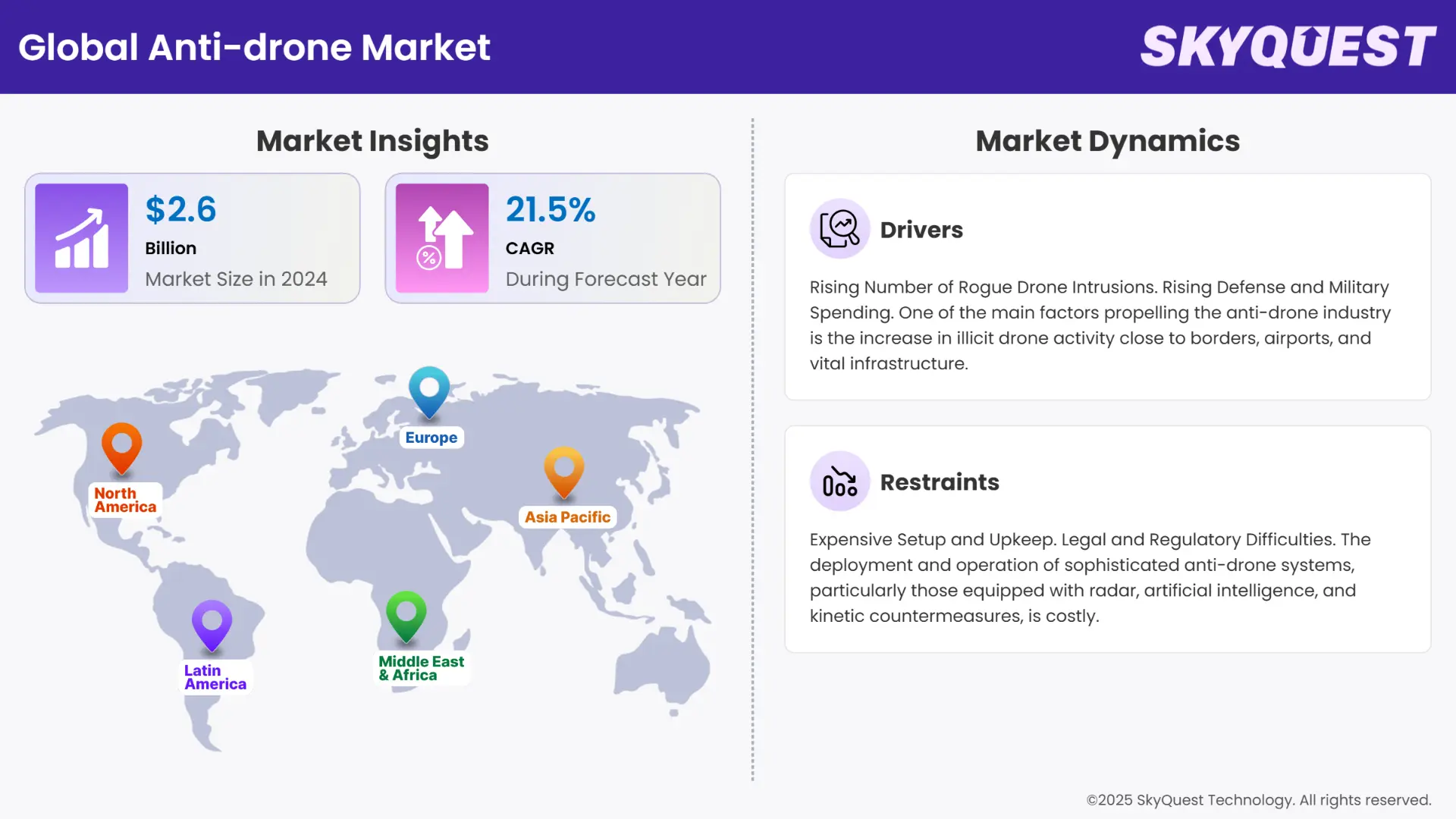
Global Anti-Drone Market size was valued at USD 2.6 Billion in 2024 and is poised to grow from USD 3.16 Billion in 2025 to USD 15 Billion by 2033, growing at a CAGR of 21.5% during the forecast period (2026–2033).
The extensive use of drones has raised security concerns, particularly in sensitive areas like airports, military installations, and public gathering spots. Governments and organizations are investing heavily in anti-drone technologies to mitigate these risks, which is expected to support the global anti-drone market growth in the years to come.
Moreover, governments around the world are also encouraging the development of defenses and are establishing models to regulate drone flights. Examples would be regulations requiring anti-drone systems to be implemented at airports, which has created a strong demand for a solutions provider market. Furthermore, global efforts to harmonize counter-drone systems should fuel market growth, ensuring interoperability for systems deployed globally. In addition, businesses are investing heavily into R&D to develop new anti-drone systems like DEW and jamming systems, but also advanced detection and neutralization systems like high energy lasers and AI systems.
How is AI Revolutionizing Counter-Drone Defense Systems?
Artificial intelligence (AI) is crucial for developing industries that address illegal UAV operations. AI can have a significant defense industry impact, as it allows real-time surveillance of malicious UAV activity. In addition, AI algorithms can analyze large quantities of data acquired from sensors and cameras essential to increasing accuracy and response time and identifying the drone from aerial objects. AI optimizes the controllability of these systems by decreasing false alarms and reacting to unseen threats. AI also automates drone operations.
To get more insights on this market click here to Request a Free Sample Report
The global anti-drone market is segmented into type, range, technology, mitigation, end use, and region. By type, the market is classified into ground-based, uav-based, and handheld. Depending on range, it is bifurcated into less than 5km and more than 5km. According to technology, the market is divided into anti-drone radar, RF scan, and thermal images. As per mitigation, it is segregated into destructive systems and non-destructive systems. On the basis of end use, the market is fragmented into military & defense, government, and commercial sectors. Regionally, it is analyzed across North America, Europe, Asia-Pacific, Latin America, and the Middle East & Africa.
How are Events and Borders Secured with Ground-Based Technology?
As per the 2024 global anti-drone market analysis, the ground-based segment held the largest market share. This growth can be attributed to the ability of ground-based anti-drones to respond swiftly to drone threats, particularly in sensitive areas such as military installations and critical infrastructure. Due to their versatility, these systems are a preferred choice for a variety of applications, including event security and border protection.
The UAV-based category is anticipated to have the highest anti-drone market share during the forecast period. The expanding application of unmanned aerial vehicles in surveillance and counter-drone operations. As technology develops, UAVs' capacity to recognize and eliminate threats independently is growing, making them increasingly appealing to both the military and commercial sectors.
How Do Destructive Technologies Offer Immediate UAV Neutralization?
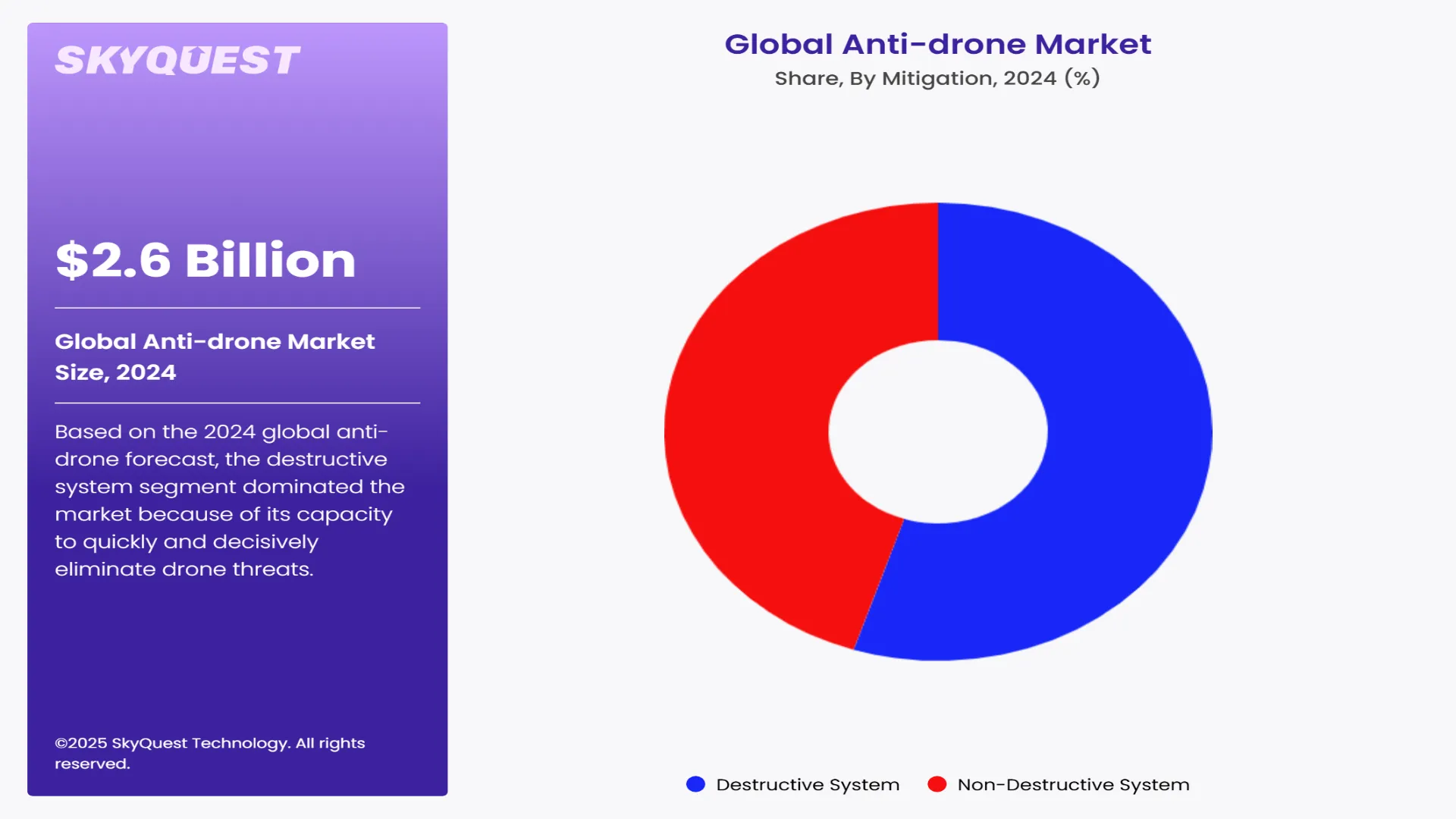
Based on the 2024 global anti-drone forecast, the destructive system segment dominated the market because of its capacity to quickly and decisively eliminate drone threats. Destructive measures are often preferred in high-stakes scenarios where prompt action is needed to prevent potential harm or breaches. This trend is expected to further support segmental growth in the coming years.
The non-destructive system segment is expected to grow at the fastest rate between 2025 and 2032. Customers' growing desire for solutions that can eliminate threats without causing collateral damage or breaking any laws is driving segmental growth. The importance of non-destructive methods in maintaining security and effectively managing drone-related risks is growing, which presents more lucrative opportunities for the market's growth in the years to come.
To get detailed segments analysis, Request a Free Sample Report
How is North America Leading the Development of Anti-Drone Technologies?
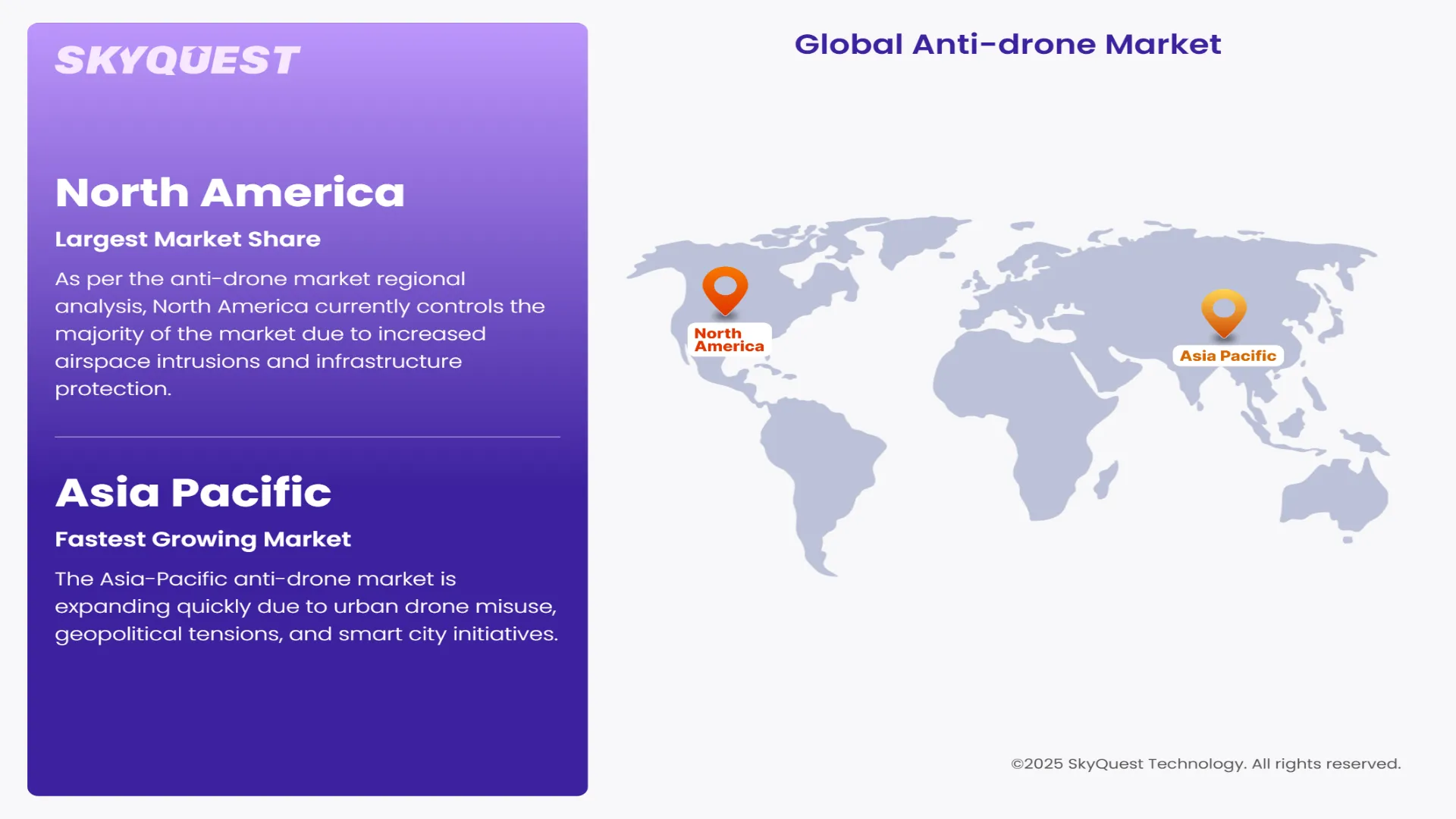
As per the anti-drone market regional analysis, North America currently controls the majority of the market due to increased airspace intrusions and infrastructure protection. More than 2,000 airport disruptions in the US were attributed to drones in 2024. In 2025, the Department of Homeland Security allocated more money for counter-UAS systems. RF and AI-based detection systems have been used by companies such as Dedrone to protect important public events, and their application in critical infrastructure and sports venues is expanding.
U.S. Anti-Drone Market
Homeland security and defense demands caused the U.S. anti-drone industry to expand by 18% in 2024. In 2025, the Pentagon allocated USD 1.3 billion to expand its counter-UAS program. Procurement was accelerated by incidents such as the Fort Sill drone swarm attack scenario. AI-enabled interception tools for critical infrastructure and the military are being developed by companies like Anduril and Black Sage.
Canada Anti-Drone Market
The Canadian anti-drone sector is growing as a result of the danger of surveillance near borders and airports. After numerous drone sightings, Transport Canada assessed CUAS devices at Toronto Pearson Airport in 2024. More funds will be allocated to event security and law enforcement in 2025. Optical tracking and radar-jamming equipment are being integrated into Canadian border surveillance operations through local partnerships with NATO and U.S. defense industries.
How are Geopolitical Tensions Fueling Anti-Drone Demand in Asia-Pacific?
The Asia-Pacific anti-drone market is expanding quickly due to urban drone misuse, geopolitical tensions, and smart city initiatives. Major cities like Seoul and Singapore set up drone detection zones for public safety in 2024. The integration of AI-based threat identification and response systems will be the main area of investment in 2025. Increased military spending and collaborations with Western defense technology companies are driving the industry.
South Korea Anti-Drone Market
Concerns about North Korean espionage prompted South Korea to bolster its anti-drone defenses in 2024. Along with the DMZ, the Defense Acquisition Program Administration (DAPA) set up microwave and jammer equipment. Seoul intends to spend USD 300 million on cutting-edge CUAS for both military and commercial applications by 2025. AI-enabled technologies for early threat detection and neutralization are being developed domestically by companies such as Hanwha Systems.
Japan Anti-Drone Market
In 2024, Japan's anti-drone industry grew in response to the dangers posed by drones near airports and nuclear power plants. Rafael and Dedrone systems for critical infrastructure were acquired by the Japanese Self-Defense Forces. More than USD 500 million will be allotted in 2025, with an emphasis on UAV net weapons, RF jammers, and AI surveillance. In preparation for upcoming global events, the government is also working with private companies to safeguard public areas and well-known locations.
Why is Regulation and Public Event Security Boosting Europe’s Anti-Drone Market?
An increase in drone activity near airports and military installations is driving the anti-drone market in Europe. Following near-miss incidents, the airports in Heathrow and Frankfurt enhanced their detection systems in 2024. Under Horizon Europe, the EU set aside Euro 200 million for counter-UAS innovation in 2025. Interest in mobile, AI-enhanced detection and neutralization systems has grown, with border security and public event protection continuing to be major factors.
UK Anti-Drone Market
Following several drone incursions that disrupted flights at Gatwick and Heathrow, the UK stepped up its anti-drone operations in 2024. For airport security, the government made investments in AUDS and SkyWall systems. By 2025, real-time detection through radar, radio frequency, and artificial intelligence analytics is being used in more military and police applications. Spending on counter-drones is predicted to rise to over Euro 150 million due to demands for crowd monitoring and home security.
France Anti-Drone Market
Ahead of significant public gatherings, such as the 2024 Summer Olympics in Paris, France is bolstering its anti-drone capabilities. At strategic sites, the government installed CerbAir and DroneShield technologies. With €100 million set aside for perimeter security and urban monitoring, defense modernization initiatives will continue in 2025. The French military is combining soft-kill and hard-kill tactics to destroy UAVs on the battlefield and in civilian skies.
Germany Anti-Drone Market
Growing defense and airport security expenditures are driving Germany's anti-drone market. Berlin Brandenburg Airport experimented with AI-based detection technologies in 2024 to lessen disruptions caused by drones. The Bundeswehr is extending its counter-UAS operations along the eastern edge of NATO in 2025. Advanced radar and electromagnetic devices are being developed by Rheinmetall and Hensoldt to complement Germany's multi-layered airspace defense strategy.
To know more about the market opportunities by region and country, click here to
Buy The Complete Report
Anti-Drone Market Drivers
Rising Number of Rogue Drone Intrusions
Rising Defense and Military Spending
Anti-Drone Market Restraints
Expensive Setup and Upkeep
Legal and Regulatory Difficulties
Request Free Customization of this report to help us to meet your business objectives.
In the fiercely competitive anti-drone market, businesses prioritize government contracts, technology development, and strategic alliances. For instance, Dedrone worked with NATO forces to extend its AI-based detection network. DroneShield concentrates on ruggedized systems for border protection, while Leonardo and Rafael Advanced Defense Systems keep improving their kinetic interceptors. To offer complete situational awareness, major players are also integrating their systems with C2 platforms.
Top Player’s Company Profile
Recent Developments in Anti-Drone Market
SkyQuest’s ABIRAW (Advanced Business Intelligence, Research & Analysis Wing) is our Business Information Services team that Collects, Collates, Correlates, and Analyses the Data collected by means of Primary Exploratory Research backed by robust Secondary Desk research.
As per SkyQuest analysis, development of the anti-drone market is accelerating with investments for critical infrastructure protection and national security rising, along with the drone threat. Billions are being invested into AI and soft-kill solution, in particular, which have transformed the ability to identify and disable unauthorized UAVs. The market is mainly being driven by military, border security and event surveillance nowadays, despite the high price tags and constantly evolving regulations. Deployments to the real-world have showcased the urgency for scalable, automated counter-UAV systems. The anti-drone industry is expected to increase dramatically as drone threats evolve with the continued investment in strong R&D projects, as well as cross-border defense partnerships, and the influx of start-up technology and innovation, particularly within the AI-based and modular sectors.
| Report Metric | Details |
|---|---|
| Market size value in 2024 | USD 2.6 Billion |
| Market size value in 2033 | USD 15 Billion |
| Growth Rate | 21.5% |
| Base year | 2024 |
| Forecast period | 2026–2033 |
| Forecast Unit (Value) | USD Billion |
| Segments covered |
|
| Regions covered | North America (US, Canada), Europe (Germany, France, United Kingdom, Italy, Spain, Rest of Europe), Asia Pacific (China, India, Japan, Rest of Asia-Pacific), Latin America (Brazil, Rest of Latin America), Middle East & Africa (South Africa, GCC Countries, Rest of MEA) |
| Companies covered |
|
| Customization scope | Free report customization with purchase. Customization includes:-
|
To get a free trial access to our platform which is a one stop solution for all your data requirements for quicker decision making. This platform allows you to compare markets, competitors who are prominent in the market, and mega trends that are influencing the dynamics in the market. Also, get access to detailed SkyQuest exclusive matrix.
Table Of Content
Executive Summary
Market overview
Parent Market Analysis
Market overview
Market size
KEY MARKET INSIGHTS
COVID IMPACT
MARKET DYNAMICS & OUTLOOK
Market Size by Region
KEY COMPANY PROFILES
Methodology
For the Anti-Drone Market, our research methodology involved a mixture of primary and secondary data sources. Key steps involved in the research process are listed below:
1. Information Procurement: This stage involved the procurement of Market data or related information via primary and secondary sources. The various secondary sources used included various company websites, annual reports, trade databases, and paid databases such as Hoover's, Bloomberg Business, Factiva, and Avention. Our team did 45 primary interactions Globally which included several stakeholders such as manufacturers, customers, key opinion leaders, etc. Overall, information procurement was one of the most extensive stages in our research process.
2. Information Analysis: This step involved triangulation of data through bottom-up and top-down approaches to estimate and validate the total size and future estimate of the Anti-Drone Market.
3. Report Formulation: The final step entailed the placement of data points in appropriate Market spaces in an attempt to deduce viable conclusions.
4. Validation & Publishing: Validation is the most important step in the process. Validation & re-validation via an intricately designed process helped us finalize data points to be used for final calculations. The final Market estimates and forecasts were then aligned and sent to our panel of industry experts for validation of data. Once the validation was done the report was sent to our Quality Assurance team to ensure adherence to style guides, consistency & design.
Analyst Support
Customization Options
With the given market data, our dedicated team of analysts can offer you the following customization options are available for the Anti-Drone Market:
Product Analysis: Product matrix, which offers a detailed comparison of the product portfolio of companies.
Regional Analysis: Further analysis of the Anti-Drone Market for additional countries.
Competitive Analysis: Detailed analysis and profiling of additional Market players & comparative analysis of competitive products.
Go to Market Strategy: Find the high-growth channels to invest your marketing efforts and increase your customer base.
Innovation Mapping: Identify racial solutions and innovation, connected to deep ecosystems of innovators, start-ups, academics, and strategic partners.
Category Intelligence: Customized intelligence that is relevant to their supply Markets will enable them to make smarter sourcing decisions and improve their category management.
Public Company Transcript Analysis: To improve the investment performance by generating new alpha and making better-informed decisions.
Social Media Listening: To analyze the conversations and trends happening not just around your brand, but around your industry as a whole, and use those insights to make better Marketing decisions.
REQUEST FOR SAMPLE
 REQUEST FREE CUSTOMIZATION
Global Anti-Drone Market size was valued at USD 2.6 Billion in 2024 and is poised to grow from USD 3.16 Billion in 2025 to USD 15 Billion by 2033, growing at a CAGR of 21.5% during the forecast period (2026–2033).
In the fiercely competitive anti-drone market, businesses prioritize government contracts, technology development, and strategic alliances. For instance, Dedrone worked with NATO forces to extend its AI-based detection network. DroneShield concentrates on ruggedized systems for border protection, while Leonardo and Rafael Advanced Defense Systems keep improving their kinetic interceptors. To offer complete situational awareness, major players are also integrating their systems with C2 platforms. 'The Thales Group', 'Advanced Radar Technologies S.A.', 'Airbus SE', 'Blighter Surveillance Systems', 'Dedrone', 'DeTect, Inc.', 'Droneshield LLC', 'Enterprise Control Systems', 'Israel Aerospace Industries Ltd. (IAI)', 'Liteye Systems, Inc.', 'Lockheed Martin Corporation', 'Orelia', 'Prime Consulting and technologies'
One of the main factors propelling the anti-drone industry is the increase in illicit drone activity close to borders, airports, and vital infrastructure. Global awareness has been raised by high-profile events like the 2018 closure of Gatwick Airport. In order to identify, track, and destroy UAVs before they have a chance to harm people or interfere with operations, governments and businesses have been utilizing anti-drone technologies more and more in 2024 and 2025.
Incorporating Artificial Intelligence and Machine Learning: AI is revolutionizing anti-drone systems through advanced threat classification, automated threat responses while reducing false targets on friend or foe beyond the visual line of sight. There have been many anecdotal AI implementations from 2024 to 2025 to deploy the drone of an autonomous platform to determine whether it is a bird or a threatening drone, and next-generation systems with more AI capabilities are enhancing speed and accuracy of threat determination.
How is North America Leading the Development of Anti-Drone Technologies?


Want to customize this report? This report can be personalized according to your needs. Our analysts and industry experts will work directly with you to understand your requirements and provide you with customized data in a short amount of time. We offer $1000 worth of FREE customization at the time of purchase.
Feedback From Our Clients


 USA (+1) 351-333-4748

