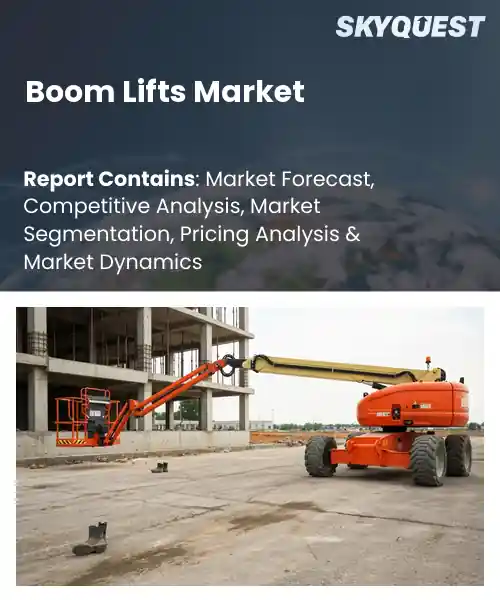
Boom Lifts Market
Report ID: SQMIG20G2148
Report ID: SQMIG20G2148
[email protected]
USA +1 351-333-4748
Report ID:
SQMIG20G2148 |
Region:
Global |
Published Date: June, 2026
Pages:
157
|Tables:
141
|Figures:
78


Global Boom Lifts Market size was valued at USD 5.3 Billion in 2024 and is poised to grow from USD 5.55 Billion in 2025 to USD 8.08 Billion by 2033, growing at a CAGR of 4.79% during the forecast period (2026-2033).
The primary driver of the global boom lifts market is expanding infrastructure and maintenance demand across urbanizing economies, which elevates need for safe elevated access equipment. Aerial work platforms like boom lifts also reduce fall hazards associated with traditional ladders or towers, when used properly. As the construction, utility, oil and gas, and facility management industries have evolved, so too have the types and styles of boom lifts available to these customers. Engineers and designers have worked to create products that are suitable for both rough terrain in the erection of wind turbines and compact electric boom lifts that are designed for use inside warehouses as part of a retrofit project, thereby illustrating the continued evolution of technology and regulatory concerns for the boom lift market.
A key trend driving the global boom lifts sector growth is regulatory emphasis on workplace safety and emissions reduction, which forces fleets to adopt advanced, low-emission sensor-equipped boom lifts, expanding market value. With increasing attention being paid to safety regulations, rental companies will continue the trend of updating existing equipment by replacing older equipment with articulated electric booms, which will lower overall cost due to reduced fuel usage and less maintenance required on these types of equipment. The increasing demand for these telematics and BAAS systems is a result of contractors in urban façade renovation, telecommunications tower servicing and solar deployment favouring compact electric units that can be used indoors or where there are noise restrictions and modular connected solutions will have high aftermarket revenue opportunities.
How is IoT Improving Safety and Maintenance in the Boom Lifts Market?
By utilizing real-time sensors and telematics, IoT is improving safety and maintenance in the boom lift market by connecting equipment, operators, and service personnel. By having this data available, businesses will be able to reduce risk and prevent unexpected downtime or failure. Increased usage of connected systems is being seen across the industry with both OEMs and rental companies adopting these technologies to maximize equipment uptime and improve serviceability. In use cases sensors flag developing wear, enable remote troubleshooting and control access so trained personnel operate equipment. These capabilities make job sites safer and maintenance more proactive, helping contractors and rental companies keep projects on schedule.
In March 2026, JLG previewed new boom lift models that integrate the ClearSky Smart Fleet IoT platform to enable two way connectivity, remote diagnostics and over the air updates which reduce downtime and support more efficient fleet maintenance and growth.
Market snapshot - (2026-2033)
Global Market Size
USD 5.3 Billion
Largest Segment
Hydraulic Boom Lifts
Fastest Growth
Electric Boom Lifts
Growth Rate
4.79% CAGR
To get more insights on this market click here to Request a Free Sample Report
Global boom lifts market is segmented by product type, end user industry, application, ownership type, load capacity and region. Based on product type, the market is segmented into electric boom lifts and hydraulic boom lifts. Based on end user industry, the market is segmented into construction, maintenance services and telecommunications. Based on application, the market is segmented into indoor applications and outdoor applications. Based on ownership type, the market is segmented into rental and purchase. Based on load capacity, the market is segmented into below 300 lbs, 300-800 lbs and above 800 lbs. Based on region, the market is segmented into North America, Europe, Asia Pacific, Latin America and Middle East & Africa.
Based on the global boom lifts market growth, electric boom lifts segment dominates because quieter operation, zero on site emissions, and lower ongoing operating costs make them preferable for modern job sites. Advances in battery technology and charging infrastructure reduce downtime and extend duty cycles, enabling operators to choose electrically driven units for both indoor and sensitive outdoor projects. Workplace air quality regulations are becoming stricter, and more customers would prefer cleaner equipment when purchasing or renting them; together, these factors help to drive demand for new or rented products and thus create stable market leadership.
However, hydraulic boom lifts are witnessing the strongest growth momentum as contractors seek higher reach and tougher load handling for outdoor construction projects. Improvements in hydraulic controls and hybridized power systems boost reliability and fuel efficiency, widening use across demanding job sites and encouraging rental fleets to expand hydraulic offerings to meet escalating project needs.
Rental segment dominates because project based workloads and short term staffing patterns push contractors to access boom lifts without capital commitment. By providing a range of fleets and maintenance options that minimize lifecycle costs and streamline logistics, rental suppliers help customers to quickly respond to abrupt increases in demand. Flexible contracts with integrated telematics for optimal fleet operation also help to mitigate the risk of renting by providing customers with more reliable methods for renting than other types of business transactions. These developments have created a greater market preference for renting by reducing the overall cost and risk liabilities to end-users, and encouraging capital to be invested into rental operations.
However, purchase is the most rapidly expanding area among buyers focused on long term asset control and tailored equipment specifications. Through financing options, long-term warranties, and modular design flexibility manufacturers are able to promote the purchase of their products to larger contractors and specialty users. This, in turn, builds long term relationships between the manufacturer and end-user, provides a means for aftermarket service revenue growth, and creates the potential for unique products.
To get detailed segments analysis, Request a Free Sample Report
As per global boom lifts market share, North America commands the industry due to a well established mix of advanced infrastructure investment, mature rental ecosystems, widespread adoption of safety and productivity enhancing technologies, and strong OEM presence with localized manufacturing and service networks. With continual resource-sharing on a multi-party basis, deep connectivity between construction, operation & maintenance, utility, and industrial sectors remains a stable and healthy source of demand for aerial work platforms. Supporting the total cost of ownership advantages of AWPs is robust aftermarket support, established training programs for the operators of AWPs, and a favourable regulatory environment for equipment certification. The large size of rental fleets and the continued adoption of advanced project management systems allow rapid deployment to numerous work locations; an emphasis on operational efficiency and workplace safety continues the preference for larger reach and specialty boom lift types of equipment.
Boom lifts market in United States continues to reflect a large and diversified demand base driven by major infrastructure projects, a developed rental sector, and a strong focus on workplace safety and productivity. While rental companies and contractors prefer to use models that specialize in more complex jobs and have a greater reach, manufacturers have developed extensive service networks and parts availability for their equipment. Operator training, machine uptime, and an integrated way to manage fleet are vital components of the ongoing maturity of the market and the commitment to use the latest technologies.
Boom lifts market in Canada benefits from extensive maintenance and utilities activity, a strong rental culture, and emphasis on equipment reliability suited to diverse climates. Suppliers adapt their product offering to the regional needs of the market and work together with local dealers and rental companies, as well as their customers, so that they can have a stronger aftermarket presence and carry out effective training programs. As a result of effective collaboration between these parties, there is also an increase in interest in advanced telematics technology that may also influence purchasers' decision to purchase equipment used to work at height.
Based on global boom lifts regional forecast, Asia Pacific expansion is fueled by accelerating infrastructure development, industrial modernization, and increasing urbanization which drive demand for aerial access across construction, energy, and maintenance sectors. The Growing rental market and local manufacturer providing different models are supporting the growth of the overall sector, while the improved dealer network and service ability have decreased the barriers to purchasing and using the equipment. Compact, electric and low emission versions will support the urban project needs and environmental requirements. Increasing the level of investment in operator training, telematics and localized aftersales services will improve the reliability of the equipment and build fleet managers' confidence in their equipment, which will allow the region to quickly adopt advanced boom lift technology and specialized configurations for high-density urban environments. Long-term fleet investments and the creation of a comprehensive rental and maintenance solution across the metropolitan and industrial corridors can be facilitated by public-private partnerships focused on safety standards and localized certification.
Boom lifts market in Japan shows strong preference for compact, electric machines suited to tight urban job sites and industrial applications. Manufacturers and dealerships provide high-quality equipment that can be customized according to customer needs and offer comprehensive aftersales support. More fleets are now integrating telematics or predictive maintenance tools within their fleets; this will enable fleets to achieve high levels of uptime as well as schedule their urban construction or maintenance operations efficiently.
Boom lifts market in South Korea reflects a technology driven approach with strong interest in electric and telematics enabled machines for urban and industrial applications. Manufacturers and OEMs compete through customization and responsive aftersales service. On the other hand, companies involved in industrial operations expect tougher units capable of doing maintenance and power work. To ensure proper fleet management and purchase decisions, rental firms are placing greater emphasis on operator safety and training, allowing them to achieve a more professional attitude toward fleet management.
As per global boom lifts regional outlook, Europe is strengthening its role through a combination of rigorous safety regulations, growing adoption of low emission and electric equipment, and strong OEM engineering heritage that emphasizes reliability and customization. A strong rental market, along with good dealer networks, helps make rental equipment widely available for many types of construction and industrial projects. By collaborating across borders, manufacturers are creating common standards, training methods and telematics connectivity to improve fleet performance and increase the use of specialised boom lift types. More demand for maintenance of energy sectors, urban redevelopments, and industrial updates will continue to create demand for compact urban units as well as heavyweight platforms, while long-term resilience of the marketplace will be established by investing in operator competence and maintenance infrastructure.
Boom lifts market in Germany reflects demand from heavy industry, manufacturing, and infrastructure sectors that prioritize robust engineering. Domestic original equipment manufacturers (OEMs) and foreign suppliers compete by providing specialized platforms with precision and offering comprehensive service support for their products. Collaboration between manufacturers, dealers, and training partners helps improve operator training and the aftersales network, which creates reliable equipment for use in numerous complex industrial applications.
Boom lifts market in United Kingdom is shaped by urban regeneration, construction, and energy sector maintenance that demand versatile, compact platforms. The focus on low-emission or electric types of machines is ideally suited for use in urban settings, whereas rentals of heavier duty engines are more applicable to utility maintenance offshore or performing repairs related to utility maintenance. Safety and training standards and obligations will support broader, enhanced, and more dependable professional equipment fleets across a wide range of areas.
Boom lifts market in France reflects strong activity in urban renovation, construction, and public works that favor compact electric and hybrid platforms. Several rental companies are also beginning to expand their rental fleets to support various contractors and maintenance programs. Likewise, Original Equipment Manufacturers (OEMs) are working to add local service to support the distribution of their products. With increasing demand for quiet, low emission machines in densely populated urban areas, telematics is being utilized more often than before by fleets to manage their maintenance and service.
To know more about the market opportunities by region and country, click here to
Buy The Complete Report
Expansion Of Construction Activities
Technological Advancements In Equipment
High Initial Capital Investment
Workforce Skill And Training Shortages
Request Free Customization of this report to help us to meet your business objectives.
Competitive intensity in the global boom lifts market outlook is driven by electrification, rental fleet procurement and distribution partnerships that change service footprints. Examples include rental programs adopting Genie fuel electric hybrids, manufacturers launching battery electric booms such as Haulotte and Manitou, and distributor tie ups like Bronto Skylift’s arrangement with TRI Lift to gain rapid access to niche end markets.
Top Player’s Company Profile
Recent Developments
SkyQuest’s ABIRAW (Advanced Business Intelligence, Research & Analysis Wing) is our Business Information Services team that Collects, Collates, Correlates, and Analyses the Data collected by means of Primary Exploratory Research backed by robust Secondary Desk research.
As per SkyQuest analysis, the global boom lifts industry is being driven primarily by expanding infrastructure and maintenance demand across urbanizing economies, the key driver that increases need for safe elevated access equipment. The restraint is the high initial capital investment required to acquire advanced boom lifts, which slows purchases and favors rentals. North America remains the dominating region thanks to mature rental ecosystems and strong OEM presence, while Electric Boom Lifts are the dominating segment due to quieter, zero-emission operation and lower operating costs. A second driver is tightening regulatory emphasis on workplace safety and emissions reduction encouraging fleet modernization and electrification.
| Report Metric | Details |
|---|---|
| Market size value in 2024 | USD 5.3 Billion |
| Market size value in 2033 | USD 8.08 Billion |
| Growth Rate | 4.79% |
| Base year | 2024 |
| Forecast period | (2026-2033) |
| Forecast Unit (Value) | USD Billion |
| Segments covered |
|
| Regions covered | North America (US, Canada), Europe (Germany, France, United Kingdom, Italy, Spain, Rest of Europe), Asia Pacific (China, India, Japan, Rest of Asia-Pacific), Latin America (Brazil, Rest of Latin America), Middle East & Africa (South Africa, GCC Countries, Rest of MEA) |
| Companies covered |
|
| Customization scope | Free report customization with purchase. Customization includes:-
|
To get a free trial access to our platform which is a one stop solution for all your data requirements for quicker decision making. This platform allows you to compare markets, competitors who are prominent in the market, and mega trends that are influencing the dynamics in the market. Also, get access to detailed SkyQuest exclusive matrix.
Table Of Content
Executive Summary
Market overview
Parent Market Analysis
Market overview
Market size
KEY MARKET INSIGHTS
COVID IMPACT
MARKET DYNAMICS & OUTLOOK
Market Size by Region
KEY COMPANY PROFILES
Methodology
For the Boom Lifts Market, our research methodology involved a mixture of primary and secondary data sources. Key steps involved in the research process are listed below:
1. Information Procurement: This stage involved the procurement of Market data or related information via primary and secondary sources. The various secondary sources used included various company websites, annual reports, trade databases, and paid databases such as Hoover's, Bloomberg Business, Factiva, and Avention. Our team did 45 primary interactions Globally which included several stakeholders such as manufacturers, customers, key opinion leaders, etc. Overall, information procurement was one of the most extensive stages in our research process.
2. Information Analysis: This step involved triangulation of data through bottom-up and top-down approaches to estimate and validate the total size and future estimate of the Boom Lifts Market.
3. Report Formulation: The final step entailed the placement of data points in appropriate Market spaces in an attempt to deduce viable conclusions.
4. Validation & Publishing: Validation is the most important step in the process. Validation & re-validation via an intricately designed process helped us finalize data points to be used for final calculations. The final Market estimates and forecasts were then aligned and sent to our panel of industry experts for validation of data. Once the validation was done the report was sent to our Quality Assurance team to ensure adherence to style guides, consistency & design.
Analyst Support
Customization Options
With the given market data, our dedicated team of analysts can offer you the following customization options are available for the Boom Lifts Market:
Product Analysis: Product matrix, which offers a detailed comparison of the product portfolio of companies.
Regional Analysis: Further analysis of the Boom Lifts Market for additional countries.
Competitive Analysis: Detailed analysis and profiling of additional Market players & comparative analysis of competitive products.
Go to Market Strategy: Find the high-growth channels to invest your marketing efforts and increase your customer base.
Innovation Mapping: Identify racial solutions and innovation, connected to deep ecosystems of innovators, start-ups, academics, and strategic partners.
Category Intelligence: Customized intelligence that is relevant to their supply Markets will enable them to make smarter sourcing decisions and improve their category management.
Public Company Transcript Analysis: To improve the investment performance by generating new alpha and making better-informed decisions.
Social Media Listening: To analyze the conversations and trends happening not just around your brand, but around your industry as a whole, and use those insights to make better Marketing decisions.
REQUEST FOR SAMPLE
 REQUEST FREE CUSTOMIZATION
Global Boom Lifts Market size was valued at USD 5.3 Billion in 2024 and is poised to grow from USD 5.55 Billion in 2025 to USD 8.08 Billion by 2033, growing at a CAGR of 4.79% during the forecast period (2026-2033).
Competitive intensity in the global boom lifts market is driven by electrification, rental fleet procurement and distribution partnerships that change service footprints. Examples include rental programs adopting Genie fuel electric hybrids, manufacturers launching battery electric booms such as Haulotte and Manitou, and distributor tie ups like Bronto Skylift’s arrangement with TRI Lift to gain rapid access to niche end markets. 'JLG Industries', 'Genie Industries', 'Skyjack', 'Haulotte Group', 'Manitou Group', 'Snorkel', 'Terex Corporation', 'Aichi Corporation', 'Niftylift', 'Ruthmann', 'MEC Aerial Work Platforms', 'Xtreme Manufacturing', 'Biljax', 'Sky Climber', 'Palfinger AG', 'Denka', 'Liftman', 'Aerial Work Platform (AWP) Systems', 'Tadano', 'Kato Works'
The expansion of construction activities across urban and industrial regions has increased requirement for efficient access solutions at height, directly supporting demand for boom lifts. Contractors prefer versatile machines that speed installation, maintenance, and finishing operations while improving operator safety and reducing reliance on scaffolding. This factor encourages investment in new and specialized lifting equipment, spurs product customization to suit varied jobsite conditions, and motivates rental fleet growth, all of which collectively drive market adoption and supplier innovation across diverse end-use sectors.
Autonomous And Telematics: Growing demand for remote monitoring, predictive maintenance, and semi-autonomous positioning is reshaping boom lift offerings. Manufacturers and fleet operators prioritize machine-to-cloud connectivity and intelligent controls to improve uptime, optimize utilization, and reduce on-site coordination. Telematics integration supports condition-based servicing, streamlined job planning, and enhanced site safety through geofencing and operator alerts. Suppliers embedding interoperable software platforms and collaborating with digital service providers can offer differentiated lifecycle services, lower total ownership friction, and stronger value propositions to rental companies and contractors.
Why does North America Dominate the Global Boom Lifts Market? |@12


Want to customize this report? This report can be personalized according to your needs. Our analysts and industry experts will work directly with you to understand your requirements and provide you with customized data in a short amount of time. We offer $1000 worth of FREE customization at the time of purchase.
Feedback From Our Clients


 USA (+1) 351-333-4748

