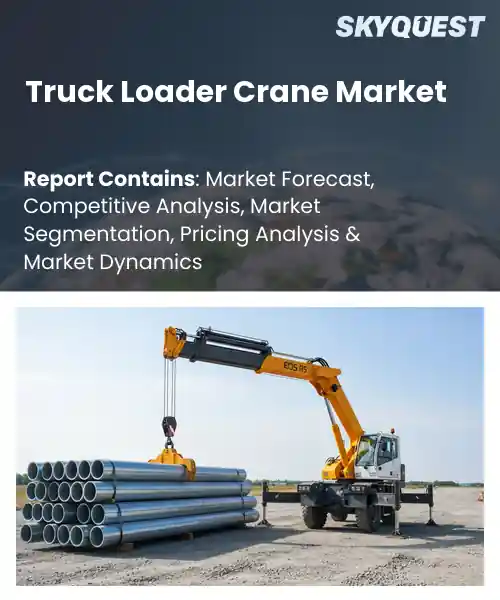
Truck Loader Crane Market
Report ID: SQMIG20G2152
Report ID: SQMIG20G2152
[email protected]
USA +1 351-333-4748
Report ID:
SQMIG20G2152 |
Region:
Global |
Published Date: June, 2026
Pages:
157
|Tables:
94
|Figures:
76


Global Truck Loader Crane Market size was valued at USD 1.45 Billion in 2024 and is poised to grow from USD 1.5 Billion in 2025 to USD 1.99 Billion by 2033, growing at a CAGR of 3.6% during the forecast period (2026-2033).
The truck loader crane market covers hydraulically driven lifting units mounted on trucks that enable rapid loading, unloading and placement of materials in construction, utilities and logistics. It matters because mobile cranes reduce dependence on separate lifting fleets, compress project schedules and lower labor costs, driving adoption. Over decades the industry shifted from simple winches to advanced telescopic and knuckle-boom cranes featuring remote controls and stabilizers. For example, European urban operators favor compact knuckle booms for tight quaysides while Australian mining sites use heavy telescopic units for bulk handling. The primary driver is infrastructure expansion coupled with demand for efficiency.Building on infrastructure-led demand, fleet modernization serves as a critical factor driving truck loader crane growth because companies seek higher uptime, payload efficiency and regulatory compliance. Upgrading older vehicles to cranes with telematics and automated safety systems reduces downtime via predictive maintenance, which lowers operating costs and justifies expenditure; European waste management firm reported 18 percent fewer service interruptions after retrofitting telematics-enabled knuckle booms. Additionally tighter emissions norms incentivize electrified or hybrid crane solutions, creating opportunities for manufacturers to introduce lighter materials and modular designs that increase fuel economy and simplify maintenance, thereby further expanding addressable markets in urban applications.
How is AI enhancing predictive maintenance in the truck loader crane market?
AI is transforming predictive maintenance for truck loader cranes by combining onboard sensors telematics and fleet context to detect early signs of wear. Key aspects include vibration and load sensing oil and temperature monitoring edge processing and cloud based analytics that learn normal behaviour and flag anomalies. The current state shows OEMs and service providers shifting from reactive repairs to condition based servicing which improves uptime and simplifies spare parts planning. In practice AI finds subtle patterns before failure enables remote diagnostics and schedules targeted interventions making operations safer and more efficient for rental fleets municipal operators and construction contractors.Hiab February 2026, the company announced a U.S. dealer expansion with MGX Equipment Services and emphasized growth in ProCare remote monitoring, showing how embedded telematics and AI based health scoring enable earlier fault detection and faster service, supporting higher uptime and stronger service revenues.
Market snapshot - (2026-2033)
Global Market Size
USD 1.45 Billion
Largest Segment
Heavy Duty
Fastest Growth
Medium Duty
Growth Rate
3.6% CAGR
To get more insights on this market click here to Request a Free Sample Report
Global truck loader crane market is segmented by capacity type, sales channel, end-use sector and region. Based on capacity type, the market is segmented into Small Duty, Medium Duty, Big Duty and Heavy Duty. Based on sales channel, the market is segmented into New Sales and Aftermarket. Based on end-use sector, the market is segmented into Construction, Logistics, Mining, Oil and Gas, Energy, Forestry and Rental. Based on region, the market is segmented into North America, Europe, Asia Pacific, Latin America and Middle East & Africa.
Heavy Duty segment dominates because its machines meet the most demanding lifting and reach requirements across heavy construction, mining and energy handling tasks in the Truck Loader Crane Market. Their reinforced structures and high-capacity hydraulics reduce equipment changeovers and prevent lift underperformance, which cuts operational friction. Proven durability and compatibility with large chassis encourage fleet standardization, improving uptime and driving procurement preference toward heavy duty units.
However, Medium Duty segment is the most rapidly expanding because its balance of payload capability and maneuverability fits growing urban and mixed-site operations. Easier integration on mid chassis platforms and lower acquisition and operating thresholds accelerate uptake by smaller fleets and rental providers, opening new application areas and creating persistent demand that broadens market access for manufacturers and dealers.
Aftermarket segment leads because post sale services and parts availability materially extend equipment uptime and useful life across truck loader crane fleets. Robust maintenance programs, local parts inventories and field refurbishment capabilities reduce unplanned downtime and repair cycles, which motivates operators to prioritize service agreements. Enhanced diagnostics and parts commonality further entrench aftermarket as the primary channel for revenue, reliability and customer retention in the Truck Loader Crane Market.
Meanwhile, New Sales segment is emerging as the key high growth area because fleets are renewing equipment to access higher automation, improved safety packages and embedded telematics. Manufacturer financing and modular design options reduce buyer friction, prompting more frequent renewals and stimulating upstream production. This trend expands dealer activity and supports investment in next generation models, catalyzing future market expansion.
To get detailed segments analysis, Request a Free Sample Report
Asia Pacific dominates the global truck loader crane market due to a convergence of strong industrial demand, concentrated manufacturing capability, and dense logistics networks. Large volume activity in ports, construction, and resource handling creates sustained need for versatile lifting solutions, while regional manufacturers provide tailored product lines and cost efficient supply chains. Governments in key markets prioritize infrastructure and trade facilitation, reinforcing demand. A skilled service and maintenance ecosystem, coupled with familiarity with compact and high performance crane configurations, supports long term adoption. Cross border supplier relationships and localized production reduce lead times and enable rapid customization for diverse operational environments, reinforcing the region as the primary source of both demand and innovation for truck loader crane solutions. Strong aftermarket networks and availability of trained operators further cement market leadership. Local finance and leasing options often facilitate fleet renewal and expansion.
Truck Loader Crane Market in Japan is characterized by demand for compact high precision cranes suited to dense urban construction and logistics operations. Domestic manufacturers focus on engineering refinement, durability, and integration with medium duty vehicles. Maintenance networks and operator training support service cycles, while buyers prioritize reliability and cost of ownership. Customization for restricted sites and stringent safety expectations shapes product offerings and local aftersales support models across participants.
Truck Loader Crane Market in South Korea features strong emphasis on heavy duty capability for port and shipyard operations. Manufacturers prioritize robust engineering, high torque configurations and ease of maintenance. Integration with local vehicle platforms and ready aftermarket support enables rapid deployment. Fleet managers emphasize operator training and compliance with safety regimes, while customization for specialized loading profiles and close collaboration between suppliers and end users drives tailored product adoption.
Rapid expansion in Europe is driven by a confluence of regulatory emphasis on safety and operational efficiency, a maturing rental economy, and steady demand across construction, utilities, and material handling sectors. Buyers increasingly favor versatile tractors mounted cranes that reduce on site labor and improve turnaround, while suppliers respond with modular designs, advanced control systems, and lighter materials tailored to regional operational constraints. Strong service networks and financing options support fleet renewal, and market participants prioritize compliance with stringent safety regimes and environmental considerations. Cross border logistics and integrated supply chains encourage standardized offerings, while end users value uptime and predictable maintenance, reinforcing growth through repeat procurement and evolving product differentiation. Established European manufacturers and specialist suppliers collaborate with rental companies and contractors to pilot new features, driving faster adoption of telematics and safety enhancements. Service orientation and localized spare part ecosystems reduce downtime and support premium positioning for brands.
Truck Loader Crane Market in Germany is anchored by a robust industrial base and a tradition of engineering excellence that favors durable, high performance solutions. Domestic OEMs supply a broad range of models suited to heavy duty applications, while extensive service networks and component suppliers support uptime. Buyers emphasize safety, modularity, and long term maintainability, and close cooperation among manufacturers, rental providers and contractors promotes standardized configurations and aftermarket ecosystems.
Truck Loader Crane Market in United Kingdom is driven by a vibrant rental sector and demand for flexible fleet solutions for urban and utility work. Suppliers emphasize compact maneuverable cranes with advanced controls and telematics integration to meet operational needs. Leasing options enable fleet renewal, and partnerships between manufacturers, hire companies and contractors accelerate adoption of innovative features and maintenance support that prioritize uptime and operator safety.
Truck Loader Crane Market in France is emerging through a mix of urban renovation projects, evolving contractor preferences and growing rental penetration. Suppliers emphasize compact adaptable cranes tailored for constrained sites and versatile handling tasks. Local manufacturers and distributors are expanding service footprints and availability to support adoption. Sustainability considerations and operator ergonomics influence procurement, while collaborations among installers, hire companies and OEMs foster tailored solutions and aftersales relationships.
North America is strengthening its role through concentrated investment in fleet modernization, robust dealer and service networks, and closer integration between vehicle manufacturers and crane suppliers. Market participants place significant emphasis on safety certifications, operator training and telematics enabled fleet management that increase operational efficiency. Rental and leasing channels broaden access to diverse crane configurations, while demand from infrastructure maintenance and resource handling supports varied product requirements. Local aftermarket capabilities and spare parts distribution reduce downtime, and collaboration among integrators, fleet managers and financing providers accelerates procurement cycles and adoption of advanced features tailored to regional operating conditions. Suppliers adapt offerings for diverse climatic and terrain conditions, providing ruggedized components and corrosion resistant finishes for demanding environments. Manufacturer and dealer partnerships focus on rapid parts delivery and localized technician certification programs to maintain fleet readiness and support premium service contracts.
Truck Loader Crane Market in United States is driven by diverse end use sectors including construction and utility maintenance that demand varied lifting solutions. Manufacturers and rental companies offer ranges and emphasize telematics and safety systems for fleet visibility. Strong dealer networks and financing options facilitate acquisition, while aftermarket support and technician training extend equipment lifecycle. Collaboration between OEMs and fleet operators enables customization for operational profiles and service agreements.
Truck Loader Crane Market in Canada emphasizes rugged reliable cranes suited to remote and challenging operating environments, including resource work. Suppliers stress corrosion resistant materials and simplified servicing for field maintenance. Dealer networks and technician programs extend effective support across dispersed regions, while telematics adoption enhances fleet oversight. Rental offerings aid procurement flexibility, and collaboration between manufacturers and end users yields equipment adapted to seasonal conditions and demanding duty cycles.
To know more about the market opportunities by region and country, click here to
Buy The Complete Report
Growing Infrastructure Development Projects
Truck loader cranes benefit from expanding infrastructure projects as these activities create sustained demand for heavy lifting and versatile material handling at construction sites and logistics hubs. Contractors prefer mobile lifting solutions that reduce reliance on separate lifting equipment and streamline on site operations, encouraging fleet upgrades and procurement. The adaptability of truck mounted cranes to varied site conditions and quick deployment supports contractors' needs for productivity and scheduling flexibility, which in turn motivates manufacturers and rental companies to supply more units and promote technological enhancements that align with project requirements.
Rising Demand For Logistics Efficiency
Enhanced logistics efficiency requirements are prompting fleet operators and logistics providers to adopt truck loader cranes because they streamline cargo handling and minimize secondary handling at distribution nodes. Integrating lifting capability directly on transport vehicles allows organizations to simplify transfer workflows, reduce dependence on separate loading equipment, and improve turnaround reliability. These operational benefits encourage procurement and rental of truck mounted cranes as strategic investments to support flexible routing and varied cargo types, and they stimulate collaboration to deliver tailored solutions for evolving industry needs.
High Initial Acquisition Costs
Significant upfront acquisition costs for truck loader cranes can deter smaller contractors and fleet operators from purchasing new equipment, slowing replacement cycles and limiting market expansion. The capital intensity required for these assets often leads organizations to prioritize alternative, lower cost solutions or extend the service life of existing machinery, which reduces immediate demand for new models. Additionally, high procurement costs can shift market dynamics toward rental and shared usage models, creating barriers for manufacturers seeking sustained unit sales and influencing investment in production capacity.
Skilled Operator Shortage
A constrained availability of trained and certified operators for truck loader cranes restricts market growth by increasing operational risks and limiting adoption rates among prospective buyers. Organizations facing labor shortages may hesitate to integrate specialized equipment that requires skilled personnel, resulting in deferred purchases or preference for simpler handling methods. Moreover, inadequate operator expertise can elevate safety concerns and maintenance challenges, prompting stricter procurement standards and insurance considerations that complicate transactions. This labor constraint also incentivizes investment in operator training and service support rather than immediate equipment acquisition.
Request Free Customization of this report to help us to meet your business objectives.
Competitive intensity in the global truck loader crane market is rising as legacy manufacturers pursue consolidation and fleet services while digital entrants push platformisation and automation. Strategic moves include attempted mergers and regional acquisitions among OEMs, Palfinger’s partnership work to develop remote controlled cranes, and digital marketplace expansion by MYCRANE alongside automation innovators such as UltraWis reshaping operator interfaces.
Top Player’s Company Profile
Recent Developments
SkyQuest’s ABIRAW (Advanced Business Intelligence, Research & Analysis Wing) is our Business Information Services team that Collects, Collates, Correlates, and Analyses the Data collected by means of Primary Exploratory Research backed by robust Secondary Desk research. As per SkyQuest analysis, the global truck loader crane market is poised for steady growth driven primarily by infrastructure expansion, with a second major driver being fleet modernization that promotes telematics and electrified solutions. Growth is tempered by high initial acquisition costs that push smaller operators toward rental and delay replacement cycles. Asia Pacific dominates regional demand thanks to dense construction, port activity and localized manufacturing, while the Heavy Duty capacity segment remains the market leader due to its durability and suitability for mining, energy and large construction tasks. Manufacturers focusing on modular designs, connected services and aftermarket support are best positioned to capture evolving fleet and rental opportunities.
| Report Metric | Details |
|---|---|
| Market size value in 2024 | USD 1.45 Billion |
| Market size value in 2033 | USD 1.99 Billion |
| Growth Rate | 3.6% |
| Base year | 2024 |
| Forecast period | (2026-2033) |
| Forecast Unit (Value) | USD Billion |
| Segments covered |
|
| Regions covered | North America (US, Canada), Europe (Germany, France, United Kingdom, Italy, Spain, Rest of Europe), Asia Pacific (China, India, Japan, Rest of Asia-Pacific), Latin America (Brazil, Rest of Latin America), Middle East & Africa (South Africa, GCC Countries, Rest of MEA) |
| Companies covered |
|
| Customization scope | Free report customization with purchase. Customization includes:-
|
To get a free trial access to our platform which is a one stop solution for all your data requirements for quicker decision making. This platform allows you to compare markets, competitors who are prominent in the market, and mega trends that are influencing the dynamics in the market. Also, get access to detailed SkyQuest exclusive matrix.
Table Of Content
Executive Summary
Market overview
Parent Market Analysis
Market overview
Market size
KEY MARKET INSIGHTS
COVID IMPACT
MARKET DYNAMICS & OUTLOOK
Market Size by Region
KEY COMPANY PROFILES
Methodology
For the Truck Loader Crane Market, our research methodology involved a mixture of primary and secondary data sources. Key steps involved in the research process are listed below:
1. Information Procurement: This stage involved the procurement of Market data or related information via primary and secondary sources. The various secondary sources used included various company websites, annual reports, trade databases, and paid databases such as Hoover's, Bloomberg Business, Factiva, and Avention. Our team did 45 primary interactions Globally which included several stakeholders such as manufacturers, customers, key opinion leaders, etc. Overall, information procurement was one of the most extensive stages in our research process.
2. Information Analysis: This step involved triangulation of data through bottom-up and top-down approaches to estimate and validate the total size and future estimate of the Truck Loader Crane Market.
3. Report Formulation: The final step entailed the placement of data points in appropriate Market spaces in an attempt to deduce viable conclusions.
4. Validation & Publishing: Validation is the most important step in the process. Validation & re-validation via an intricately designed process helped us finalize data points to be used for final calculations. The final Market estimates and forecasts were then aligned and sent to our panel of industry experts for validation of data. Once the validation was done the report was sent to our Quality Assurance team to ensure adherence to style guides, consistency & design.
Analyst Support
Customization Options
With the given market data, our dedicated team of analysts can offer you the following customization options are available for the Truck Loader Crane Market:
Product Analysis: Product matrix, which offers a detailed comparison of the product portfolio of companies.
Regional Analysis: Further analysis of the Truck Loader Crane Market for additional countries.
Competitive Analysis: Detailed analysis and profiling of additional Market players & comparative analysis of competitive products.
Go to Market Strategy: Find the high-growth channels to invest your marketing efforts and increase your customer base.
Innovation Mapping: Identify racial solutions and innovation, connected to deep ecosystems of innovators, start-ups, academics, and strategic partners.
Category Intelligence: Customized intelligence that is relevant to their supply Markets will enable them to make smarter sourcing decisions and improve their category management.
Public Company Transcript Analysis: To improve the investment performance by generating new alpha and making better-informed decisions.
Social Media Listening: To analyze the conversations and trends happening not just around your brand, but around your industry as a whole, and use those insights to make better Marketing decisions.
REQUEST FOR SAMPLE
 REQUEST FREE CUSTOMIZATION


Want to customize this report? This report can be personalized according to your needs. Our analysts and industry experts will work directly with you to understand your requirements and provide you with customized data in a short amount of time. We offer $1000 worth of FREE customization at the time of purchase.
Feedback From Our Clients


 USA (+1) 351-333-4748

