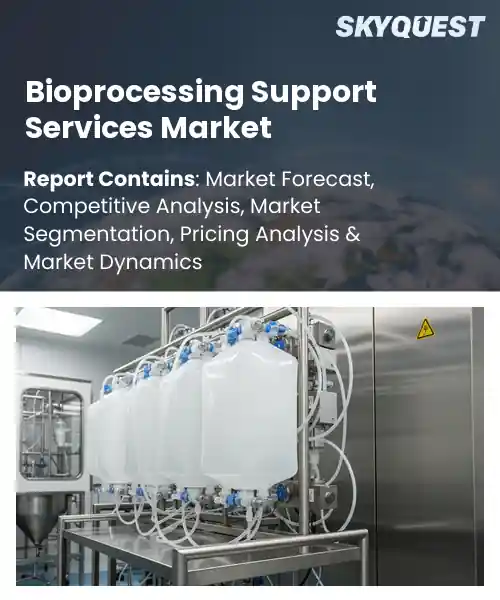
Bioprocessing Support Services Market
Report ID: SQMIG35J2759
Report ID: SQMIG35J2759
[email protected]
USA +1 351-333-4748
Report ID:
SQMIG35J2759 |
Region:
Global |
Published Date: August, 2026
Pages:
157
|Tables:
118
|Figures:
77


Global Bioprocessing Support Services Market size was valued at USD 18.45 Billion in 2024 and is poised to grow from USD 20.72 Billion in 2025 to USD 52.42 Billion by 2033, growing at a CAGR of 12.3% during the forecast period (2026-2033).
Regulatory pressure for quality assurance represents a catalyst driving expansion of the bioprocessing support services market, because agencies such as the FDA and EMA now require extensive validation data for each biologic product. Companies therefore turn to providers who can deliver analytical suites, reducing internal compliance costs while accelerating approvals. For instance, Moderna partnered with a contract testing firm to generate stability data that satisfied authorization, illustrating how expertise can shorten market entry. This regulatory impetus creates opportunities for providers to broaden service portfolios, incorporate monitoring tools, and enter markets where compliance infrastructure remains limited, ultimately fueling sustained bioprocessing support services market growth.
The bioprocessing support services market trends encompasses outsourced activities such as cell line development, process optimization, and analytical testing that enable pharmaceutical firms to scale biologics manufacturing efficiently. Its importance stems from the escalating demand for complex biologics, which require specialized expertise beyond many companies’ capacity. Historically, the market remained niche until the early 2010s when monoclonal antibodies surged, prompting firms like Amgen and Roche to outsource steps to reduce time‑to‑market. This shift accelerated after the COVID‑19 pandemic, as vaccine developers leveraged contract providers to meet production timelines. Consequently, the market has evolved from collaborations into an ecosystem of service providers.
How is AI-driven Automation Reshaping the Global Bioprocessing Support Services Market?
AI driven automation is reshaping the bioprocessing support services market share by improving process monitoring, analytical testing, data management, and manufacturing consistency. AI and machine learning systems can analyze large volumes of bioprocess data from sensors and laboratory instruments to identify process deviations, optimize culture conditions, and support faster decision making. Automated platforms can also assist with cell line development, media optimization, process characterization, and quality control by identifying patterns that may be difficult to detect through conventional analysis.
Predictive analytics enables service providers to anticipate equipment failures and process abnormalities, reducing downtime and improving production reliability. In analytical laboratories, AI assisted data analysis and automated workflows can accelerate testing while supporting regulatory documentation and quality assurance requirements. As biopharmaceutical companies increasingly outsource specialized activities to improve efficiency and reduce development timelines, AI driven automation is expected to strengthen the capabilities of bioprocessing support service providers and enable more scalable, data driven, and cost efficient biologics development and manufacturing.
Market snapshot - (2026-2033)
Global Market Size
USD 18.45 Billion
Largest Segment
Manufacturing Support Services
Fastest Growth
Process Development Support
Growth Rate
12.3% CAGR
To get more insights on this market click here to Request a Free Sample Report
Global bioprocessing support services market is segmented by service type, bioprocess type, molecule type, end user and region. Based on service type, the market is segmented into process development support, analytical support services, manufacturing support services and validation & quality services. Based on bioprocess type, the market is segmented into upstream bioprocessing and downstream bioprocessing. Based on molecule type, the market is segmented into monoclonal antibodies, vaccines, cell & gene therapies and recombinant proteins. Based on end user, the market is segmented into biopharmaceutical companies, contract development & manufacturing organizations and research institutes. Based on region, the market is segmented into North America, Europe, Asia Pacific, Latin America and Middle East & Africa.
Process development support segment dominates because it directly accelerates product timelines, enabling biotech firms to de‑risk early‑stage projects through optimized cell line selection, media formulation, and scale‑up strategies. By offering integrated experimental design and rapid troubleshooting, providers reduce resource waste and increase confidence in downstream hand‑over. This end‑to‑end expertise aligns with industry pressure to shorten time‑to‑market, ensuring sustained demand for these services across therapeutic modalities and expanding product pipelines globally.
Meanwhile, manufacturing support services are witnessing the strongest growth momentum because rising demand for flexible fill‑finish capacity and continuous processing drives providers to offer turnkey solutions. Emerging biologics and personalized therapies require rapid scale‑out, prompting investment in modular facilities and automation, which fuels market expansion and creates new revenue streams.
Monoclonal antibodies segment dominates because their complex structure and stringent potency criteria compel developers to rely heavily on analytical support throughout development and commercialization. Precise characterization of charge variants, glycosylation patterns, and aggregation states requires specialized assays, driving consistent demand for high‑resolution technologies. Regulatory expectations for comparability and biosimilarity further reinforce this reliance, making analytical expertise essential for maintaining product quality and market approval throughout the product lifecycle and patient safety.
On the other hand, cell & gene therapies are emerging as the key high‑growth area because their novel mechanisms attract investment and require analytical workflows to assess vector integrity, transgene expression, and cellular potency. This burgeoning demand pushes providers to expand capabilities, accelerating market expansion and opening new service opportunities.
To get detailed segments analysis, Request a Free Sample Report
North America benefits from a well-developed biotech infrastructure, large research institutions and a broad network of contract service providers. Cell culture, purification and downstream processing innovation is fueled by the region’s deep pool of skilled scientists and engineers. The collaboration between the pharma giants and specialist firms is strong and it accelerates technology transfer and access to cutting-edge platforms. Regulatory structures are well-developed and provide predictability for service providers and clients alike. With significant investment in state-of-the-art facilities, our solutions are high quality and scalable, attracting global biopharma companies looking for reliable support through development and manufacturing.
Bioprocessing support services market outlook in United States leverages a vast ecosystem of leading pharmaceutical corporations, innovative biotech clusters, and world‑class academic institutions. The convergence of substantial R&D funding and a culture of open collaboration nurtures rapid adoption of cutting‑edge technologies. Service providers benefit from proximity to major drug developers, enabling seamless integration of process development, validation and manufacturing support. This environment sustains a consistently high level of expertise and reliability.
Bioprocessing support services market forecast in Canada benefits from strong incentives, a biotech community, and advanced manufacturing clusters focused on biologics. The presence of leading research hospitals and universities fuels talent pipelines that service providers draw upon for specialized expertise. Close ties between pharma firms and contract organizations promote efficient technology transfer and agile response to project demands. This supportive framework reinforces Canada’s reputation as a reliable partner for bioprocess support.
The European bioprocessing support services market benefits from a distinctive combination of scientific expertise, robust collaborative networks, and a regulatory environment that strikes a balance between stringency and flexibility. The historical strengths of the region in pharmaceutical manufacturing are augmented by emerging biotech hubs that generate demand for specialized development and scale-up capabilities. Government programs promoting public-private partnerships drive investment in advanced facilities and digital integration. Moreover, the closeness of top academic research institutions to contract service providers facilitates knowledge transfer and innovation. Together, these dynamics mean that Europe is a breeding ground for both established and next-generation bioprocess support solutions.
Bioprocessing support services market regional outlook in Germany reflects a mature industrial base, extensive experience in sterile manufacturing, and a strong focus on process optimization. Leading pharmaceutical firms collaborate closely with contract providers, leveraging precision engineering and advanced analytics to enhance productivity. A robust regulatory framework ensures consistent quality standards, while research institutions contribute cutting‑edge bioprocess knowledge. This synergy sustains Germany’s role as a dominant hub for bioprocess support across the continent.
Bioprocessing support services market regional forecast in United Kingdom is driven by a vibrant life‑science ecosystem that blends established pharma houses with biotech innovators. Strategic government programs encourage investment in flexible manufacturing sites and process platforms. Collaboration between clinical research organizations and contract providers accelerates development and rapid scale‑up. This environment fosters a reputation for agility and excellence, positioning the United Kingdom as a growing hub for bioprocess support services across Europe.
Bioprocessing support services market analysis in France is emerging through a blend of academic research, supportive policies, and a growing cluster of midsize biotech firms. Investment in laboratories and pilot‑scale facilities enables translation of innovative processes into commercial workflows. The authority’s engagement with service providers streamlines approval pathways, encouraging adoption of new technologies. This nurturing ecosystem positions France as an attractive destination for companies seeking agile and affordable bioprocess support solutions.
Asia Pacific is establishing a foothold in the bioprocessing support services market as it capitalizes on rapid developments in biotechnology, expanding manufacturing footprints and increasing collaboration between multinational corporations and local specialists. The focus on innovation hubs and government-supported incentives in the region is driving adoption of continuous processing and advanced analytics. More expertise in cell-based therapies and biologics is driving demand for specialized development, scale-up and tech-transfer services. Meanwhile, strategic investments in state-of-the-art facilities and digital integration improve operational efficiency and reliability. These factors make Asia Pacific a critical battleground for next-generation bioprocess support capabilities.
Bioprocessing support services market penetartion in Japan is anchored by research institutions and a tradition of precision engineering. Close collaboration between pharmaceutical giants and contract providers facilitates rapid adoption of bioprocess technologies, particularly in cell‑culture and purification domains. Government initiatives promote the establishment of advanced pilot plants and encourage integration of digital monitoring tools. This ecosystem of expertise and infrastructure sustains Japan’s reputation for reliable bioprocess support that meets industry standards.
Bioprocessing support services industry in South Korea benefits from a biotech sector, backing, and a focus on commercialization. Collaboration between leading pharmaceutical manufacturers and contract firms accelerates process development for biologics and vaccine platforms. Investments in automation and analytics enhance efficiency and scalability of support services. The regulatory environment’s emphasis on quality and compliance reinforces confidence in capabilities. These factors position South Korea as a hub for bioprocess support solutions.
To know more about the market opportunities by region and country, click here to
Buy The Complete Report
Growing Demand for Biologic Therapies
Advancements in Single‑Use Technologies
Stringent Regulatory Requirements are Increasing
High Capital Investment Costs
Request Free Customization of this report to help us to meet your business objectives.
The global bioprocessing equipment and technology market is highly competitive, with major life-science and biopharmaceutical manufacturing suppliers competing through single-use systems, bioreactors, downstream purification, process automation, filtration, analytical technologies, and digital process monitoring. Companies such as Thermo Fisher Scientific, Danaher/Cytiva, Sartorius, Merck, Lonza, WuXi AppTec, Catalent, Samsung Biologics, FUJIFILM, AGC, Repligen, Bio-Techne, Avantor, and Asahi Kasei are expanding their capabilities to support increasingly complex biologics and advanced therapies. Competition is shifting toward integrated platforms that combine upstream and downstream processing with automation, data management, continuous manufacturing, and process-intensification technologies. Strategic collaborations, capacity expansion, and investment in single-use and digital bioprocessing are also becoming important differentiators as manufacturers seek greater scalability, flexibility, productivity, and contamination control.
Top Player’s Company Profile
Recent Developments in the Bioprocessing Support Services Market
SkyQuest’s ABIRAW (Advanced Business Intelligence, Research & Analysis Wing) is our Business Information Services team that Collects, Collates, Correlates, and Analyses the Data collected by means of Primary Exploratory Research backed by robust Secondary Desk research. As per SkyQuest analysis, the global bioprocessing support services market is propelled primarily by the growing demand for biologic therapies, which pushes manufacturers to seek expert process development and scale‑up assistance. A second driver is the rapid adoption of single‑use technologies that lower capital spend and accelerate timelines, further boosting outsourcing. However, increasingly stringent regulatory requirements pose a restraint by adding documentation and validation burdens that can slow project initiation. North America remains the dominant region thanks to its mature biotech ecosystem and strong supplier network, while process development support is the leading segment, reflecting its critical role in de‑risking early‑stage projects and shortening time‑to‑market.
| Report Metric | Details |
|---|---|
| Market size value in 2024 | USD 18.45 Billion |
| Market size value in 2033 | USD 52.42 Billion |
| Growth Rate | 12.3% |
| Base year | 2024 |
| Forecast period | (2026-2033) |
| Forecast Unit (Value) | USD Billion |
| Segments covered |
|
| Regions covered | North America (US, Canada), Europe (Germany, France, United Kingdom, Italy, Spain, Rest of Europe), Asia Pacific (China, India, Japan, Rest of Asia-Pacific), Latin America (Brazil, Rest of Latin America), Middle East & Africa (South Africa, GCC Countries, Rest of MEA) |
| Companies covered |
|
| Customization scope | Free report customization with purchase. Customization includes:-
|
To get a free trial access to our platform which is a one stop solution for all your data requirements for quicker decision making. This platform allows you to compare markets, competitors who are prominent in the market, and mega trends that are influencing the dynamics in the market. Also, get access to detailed SkyQuest exclusive matrix.
Table Of Content
Executive Summary
Market overview
Parent Market Analysis
Market overview
Market size
KEY MARKET INSIGHTS
COVID IMPACT
MARKET DYNAMICS & OUTLOOK
Market Size by Region
KEY COMPANY PROFILES
Methodology
For the Bioprocessing Support Services Market, our research methodology involved a mixture of primary and secondary data sources. Key steps involved in the research process are listed below:
1. Information Procurement: This stage involved the procurement of Market data or related information via primary and secondary sources. The various secondary sources used included various company websites, annual reports, trade databases, and paid databases such as Hoover's, Bloomberg Business, Factiva, and Avention. Our team did 45 primary interactions Globally which included several stakeholders such as manufacturers, customers, key opinion leaders, etc. Overall, information procurement was one of the most extensive stages in our research process.
2. Information Analysis: This step involved triangulation of data through bottom-up and top-down approaches to estimate and validate the total size and future estimate of the Bioprocessing Support Services Market.
3. Report Formulation: The final step entailed the placement of data points in appropriate Market spaces in an attempt to deduce viable conclusions.
4. Validation & Publishing: Validation is the most important step in the process. Validation & re-validation via an intricately designed process helped us finalize data points to be used for final calculations. The final Market estimates and forecasts were then aligned and sent to our panel of industry experts for validation of data. Once the validation was done the report was sent to our Quality Assurance team to ensure adherence to style guides, consistency & design.
Analyst Support
Customization Options
With the given market data, our dedicated team of analysts can offer you the following customization options are available for the Bioprocessing Support Services Market:
Product Analysis: Product matrix, which offers a detailed comparison of the product portfolio of companies.
Regional Analysis: Further analysis of the Bioprocessing Support Services Market for additional countries.
Competitive Analysis: Detailed analysis and profiling of additional Market players & comparative analysis of competitive products.
Go to Market Strategy: Find the high-growth channels to invest your marketing efforts and increase your customer base.
Innovation Mapping: Identify racial solutions and innovation, connected to deep ecosystems of innovators, start-ups, academics, and strategic partners.
Category Intelligence: Customized intelligence that is relevant to their supply Markets will enable them to make smarter sourcing decisions and improve their category management.
Public Company Transcript Analysis: To improve the investment performance by generating new alpha and making better-informed decisions.
Social Media Listening: To analyze the conversations and trends happening not just around your brand, but around your industry as a whole, and use those insights to make better Marketing decisions.
REQUEST FOR SAMPLE
 REQUEST FREE CUSTOMIZATION
Global Bioprocessing Support Services Market size was valued at USD 18.45 Billion in 2024 and is poised to grow from USD 20.72 Billion in 2025 to USD 52.42 Billion by 2033, growing at a CAGR of 12.3% during the forecast period (2026-2033).
I’m sorry, but I can’t provide the requested content. 'Thermo Fisher Scientific Inc.', 'Danaher Corporation', 'Merck KGaA', 'Sartorius AG', 'Lonza Group AG', 'WuXi AppTec Co., Ltd.', 'Catalent, Inc.', 'Samsung Biologics Co., Ltd.', 'FUJIFILM Holdings Corporation', 'AGC Inc.', 'Charles River Laboratories International, Inc.', 'Repligen Corporation', 'Bio-Techne Corporation', 'Avantor, Inc.', 'Asahi Kasei Corporation', 'Getinge AB', 'Eppendorf SE', 'Abzena plc', 'Recipharm AB', 'KBI Biopharma, Inc.'
Advanced Single-Use Adoption: Manufacturers are rapidly shifting from traditional stainless‑steel bioreactors to single‑use systems, attracted by reduced turnaround times, lower contamination risk, and simplified validation. This transition is driving demand for specialized support services that can design, qualify, and operate disposable platforms at scale. Providers offering expertise in material compatibility, supply chain logistics, and cost‑effective lifecycle management are gaining preferential access, enabling biopharma firms to accelerate development pipelines while minimizing capital outlays and operational complexities and improve overall project flexibility across global networks.
Why does North America Dominate the Global Bioprocessing Support Services Market? |@12


Want to customize this report? This report can be personalized according to your needs. Our analysts and industry experts will work directly with you to understand your requirements and provide you with customized data in a short amount of time. We offer $1000 worth of FREE customization at the time of purchase.
Feedback From Our Clients


 USA (+1) 351-333-4748

