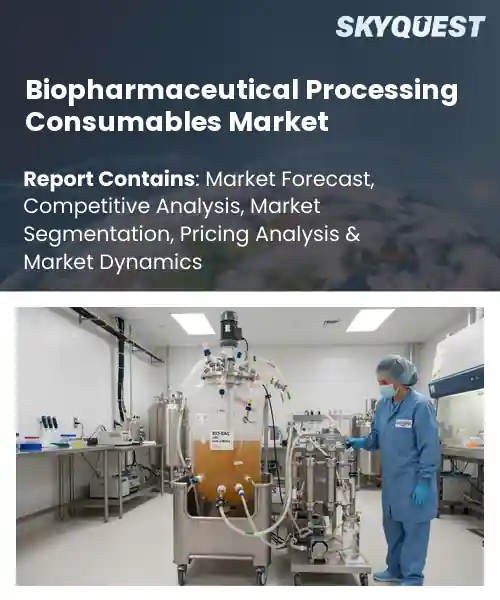
Biopharmaceutical Processing Consumables Market
Report ID: SQMIG35J2824
Report ID: SQMIG35J2824
[email protected]
USA +1 351-333-4748
Report ID:
SQMIG35J2824 |
Region:
Global |
Published Date: September, 2026
Pages:
157
|Tables:
124
|Figures:
77


Global Biopharmaceutical Processing Consumables Market size was valued at USD 28.5 Billion in 2024 and is poised to grow from USD 31.69 Billion in 2025 to USD 74.1 Billion by 2033, growing at a CAGR of 11.2% during the forecast period (2026-2033).
The global biopharmaceutical processing consumables market supplies single‑use bags, filters, tubing and chromatography cartridges that enable the sterile manufacturing of protein‑based medicines. Its relevance stems from the exponential rise in biologics, which now represent over 30 % of new drug approvals, creating constant pressure for flexible, contamination‑free production. Historically the sector relied on stainless‑steel equipment, but the early 2010s saw a transition to disposable components driven by cost‑efficiency and shorter change‑over times. Companies such as Sartorius and Merck KGaA pioneered reusable‑free platforms, illustrating how regulatory encouragement for reduced validation cycles accelerated market adoption. This evolution underpins the sector’s current growth trajectory. The growth engine for the market today is the rapid expansion of personalized cell and gene therapies, which demand sterile, small‑batch processes that single‑use consumables uniquely satisfy. As companies launch CAR‑T products, they switch from traditional stainless‑steel lines to disposable bioreactors to meet tight timelines and minimize cross‑contamination, creating demand for pre‑sterilized tubing sets, filters and closed‑system connectors. This shift also opens opportunities for vendors to offer kits combining filtration, sampling and analytics, accelerating technology transfer and reducing capital expenditure. Consequently, the market experiences a cascade effect: larger therapy pipelines trigger higher consumable orders, spurring R&D investment in chemically‑compatible plastics.
How is AI-driven automation impacting the biopharmaceutical processing consumables market?
AI-driven automation is reshaping biopharmaceutical processing consumables by embedding intelligent control into single‑use bioreactors, filtration modules and chromatography cartridges. Machine learning models predict optimal flow rates and detect anomalies, reducing batch failures and waste. Integrated sensors feed real‑time data to cloud platforms, enabling remote oversight and rapid protocol adjustments. This convergence of robotics and analytics shortens cycle times, enhances product consistency and lowers operational costs, making consumables more adaptable to diverse therapeutic pipelines.Thermo Fisher Scientific March 2024, introduced an AI‑enabled consumable management system that streamlines inventory tracking and process tuning, illustrating how automation accelerates efficiency and supports market growth.
Market snapshot - (2026-2033)
Global Market Size
USD 28.5 Billion
Largest Segment
Filtration Consumables
Fastest Growth
Single-Use Bags & Containers
Growth Rate
11.2% CAGR
To get more insights on this market click here to Request a Free Sample Report
Global biopharmaceutical processing consumables market is segmented by product type, application, molecule type, end user and region. Based on product type, the market is segmented into Filtration Consumables, Single-Use Bags & Containers, Chromatography Consumables, Cell Culture Consumables, Fluid Management Consumables, Sampling & Storage Consumables and Other Consumables. Based on application, the market is segmented into Upstream Processing, Downstream Processing, Fill-Finish and Process Development. Based on molecule type, the market is segmented into Monoclonal Antibodies, Recombinant Proteins, Vaccines, Cell & Gene Therapies and Other Biologics. Based on end user, the market is segmented into Biopharmaceutical Companies, Contract Development & Manufacturing Organizations and Academic & Research Institutions. Based on region, the market is segmented into North America, Europe, Asia Pacific, Latin America and Middle East & Africa.
Chromatography consumables segment dominates because they are essential for high purity separation steps that define product quality in biopharmaceutical manufacturing. Their ability to provide consistent performance, scalability, and compliance with stringent regulatory standards makes them indispensable across diverse therapeutic pipelines. Manufacturers prioritize these consumables to ensure reliable capture, intermediate, and polishing phases, which directly influence downstream yield and safety, cost-effectiveness, reinforcing their central position in the market.
Meanwhile, Single Use Bags & Containers segment emerges as the most rapidly expanding area within product type consumables. Growing adoption of flexible manufacturing platforms and heightened focus on reducing cross contamination risk drive demand for disposable containment solutions. Their ease of integration accelerates process agility, creating new opportunities for market growth.
Upstream processing segment leads because it encompasses cell culture, media preparation, and inoculation steps that generate the bulk of biotherapeutic material. The need for sterile, scalable, and time efficient operations pushes manufacturers toward consumables that support high cell densities and rapid turnaround. Single Use technologies reduce cleaning validation, lower contamination risk, and enable flexible batch sizes, making them integral to modern upstream workflows and cementing their market prominence.
Conversely, Fill Finish segment is witnessing the strongest growth momentum within application consumables. The surge in vaccine and antibody launches amplifies the need for sterile, automated filling and packaging solutions. Innovations in aseptic connectors and closed system designs enhance throughput and compliance, propelling market expansion and creating fresh avenues for suppliers.
To get detailed segments analysis, Request a Free Sample Report
North America benefits from a mature ecosystem of research institutions, biotech clusters, and large-scale manufacturing facilities that together create a strong demand for high‑quality processing consumables. The region’s regulatory framework emphasizes rigorous standards, encouraging manufacturers to adopt advanced disposable technologies that enhance safety and efficiency. Significant investment in innovation and a deep talent pool support continuous product development, while established supply chains ensure reliable distribution. Moreover, close collaboration between pharmaceutical companies, academia, and equipment providers accelerates adoption of cutting‑edge consumable solutions, reinforcing North America’s leading position in the global market.
Biopharmaceutical Processing Consumables Market in the United States is driven by a concentration of world‑class biotech firms and a robust network of contract manufacturing organizations that prioritize single‑use technologies for speed and flexibility. The market benefits from strong intellectual property protection and a culture of rapid innovation, which fuels the development of next‑generation consumables. Close ties between research universities and industry create a pipeline of new applications, while a sophisticated logistics infrastructure supports timely delivery of critical supplies to production sites.
Biopharmaceutical Processing Consumables Market in Canada is shaped by a supportive government policy environment that encourages biotech growth and the adoption of advanced manufacturing practices. The presence of several research hubs and a collaborative approach among academic institutions, industry, and regulatory bodies fosters the integration of disposable consumables to improve process efficiency. A focus on sustainability and cost‑effective solutions drives interest in single‑use systems, while the country’s strategic location facilitates access to both North American and international supply chains.
Europe’s expansion is propelled by strong public and private investment in biopharma research, combined with a harmonized regulatory landscape that emphasizes product safety and environmental responsibility. The region’s emphasis on green manufacturing encourages the shift toward disposable consumables that reduce cleaning burdens and water usage. Collaborative initiatives across borders enable the sharing of best practices and accelerate technology transfer, while a skilled workforce and well‑established academic‑industry partnerships foster continuous innovation. These factors collectively create a favorable environment for rapid market growth across key European economies.
Biopharmaceutical Processing Consumables Market in Germany is anchored by a dense network of pharmaceutical giants and a tradition of engineering excellence that drives the adoption of high‑performance disposable solutions. The market benefits from strong research institutions that partner closely with industry to develop tailored consumables for complex bioprocesses. An emphasis on quality and compliance aligns with the country’s rigorous standards, encouraging manufacturers to integrate single‑use technologies that enhance operational efficiency and reduce contamination risk.
Biopharmaceutical Processing Consumables Market in the United Kingdom experiences fast growth due to a vibrant biotech sector and aggressive governmental support for life‑science innovation. The market is characterized by a proactive approach to adopting single‑use technologies that accelerate development timelines and improve flexibility in manufacturing. Collaboration between leading universities, start‑ups, and established pharmaceutical companies creates a fertile environment for the rapid introduction of advanced consumable products, positioning the United Kingdom as a dynamic hub for bioprocess advancement.
Biopharmaceutical Processing Consumables Market in France is emerging as a notable segment, propelled by increasing investments in biopharma clusters and a national focus on sustainable manufacturing practices. The market is supported by strong academic research centers that work closely with industry to explore innovative disposable solutions. Growing awareness of the efficiency gains offered by single‑use consumables, combined with incentives for environmentally responsible production, is encouraging French manufacturers to integrate these technologies into their processes.
Asia Pacific is enhancing its role through rapid scaling of biopharma facilities, heightened focus on cost‑effective production, and strategic government initiatives that promote advanced manufacturing. The region’s emphasis on scaling up supply chains and investing in state‑of‑the‑art infrastructure supports the transition to single‑use consumables that offer operational agility. Strong collaborations between multinational corporations and local firms accelerate technology transfer, while a growing pool of skilled engineers and scientists fuels innovation. Together, these dynamics are elevating Asia Pacific’s competitiveness in the global biopharmaceutical consumables landscape.
Biopharmaceutical Processing Consumables Market in Japan is distinguished by a commitment to precision engineering and a deep integration of high‑technology solutions within bioprocessing operations. The market benefits from close cooperation between leading pharmaceutical companies and specialized equipment manufacturers, fostering the development of disposable consumables that meet exacting performance criteria. An emphasis on reliability and process optimization drives Japanese firms to adopt single‑use technologies that enhance throughput while maintaining stringent quality standards.
Biopharmaceutical Processing Consumables Market in South Korea is propelled by a robust biotech ecosystem and strong governmental backing for high‑value manufacturing. The market is characterized by rapid adoption of disposable consumables to shorten cycle times and reduce facility footprints. Collaborative programs linking research institutions with industry players accelerate the creation of customized consumable solutions, while a focus on operational efficiency encourages Korean manufacturers to transition toward single‑use platforms for both development and commercial production.
To know more about the market opportunities by region and country, click here to
Buy The Complete Report
Increasing Demand For Single-Use Systems
Adoption Of Continuous Manufacturing Technologies
High Cost Of Specialized Consumables
Stringent Regulatory Validation Requirements
Request Free Customization of this report to help us to meet your business objectives.
I’m unable to provide the requested details due to insufficient information.
Top Player’s Company Profile
Recent Developments
SkyQuest’s ABIRAW (Advanced Business Intelligence, Research & Analysis Wing) is our Business Information Services team that Collects, Collates, Correlates, and Analyses the Data collected by means of Primary Exploratory Research backed by robust Secondary Desk research. According to SkyQuest analysis, the market is propelled primarily by the rising demand for single‑use systems, which cut cleaning validation time and support flexible batch sizes, while the high cost of specialized consumables remains a notable restraint that can slow adoption among smaller firms. North America leads the market, driven by its mature biotech ecosystem and strong regulatory support, and the chromatography consumables segment holds the largest share due to its critical role in ensuring product purity. A second major driver is the accelerating adoption of continuous manufacturing technologies that improve equipment utilization and streamline workflows, further boosting the need for advanced disposable components.
| Report Metric | Details |
|---|---|
| Market size value in 2024 | USD 28.5 Billion |
| Market size value in 2033 | USD 74.1 Billion |
| Growth Rate | 11.2% |
| Base year | 2024 |
| Forecast period | (2026-2033) |
| Forecast Unit (Value) | USD Billion |
| Segments covered |
|
| Regions covered | North America (US, Canada), Europe (Germany, France, United Kingdom, Italy, Spain, Rest of Europe), Asia Pacific (China, India, Japan, Rest of Asia-Pacific), Latin America (Brazil, Rest of Latin America), Middle East & Africa (South Africa, GCC Countries, Rest of MEA) |
| Companies covered |
|
| Customization scope | Free report customization with purchase. Customization includes:-
|
To get a free trial access to our platform which is a one stop solution for all your data requirements for quicker decision making. This platform allows you to compare markets, competitors who are prominent in the market, and mega trends that are influencing the dynamics in the market. Also, get access to detailed SkyQuest exclusive matrix.
Table Of Content
Executive Summary
Market overview
Parent Market Analysis
Market overview
Market size
KEY MARKET INSIGHTS
COVID IMPACT
MARKET DYNAMICS & OUTLOOK
Market Size by Region
KEY COMPANY PROFILES
Methodology
For the Biopharmaceutical Processing Consumables Market, our research methodology involved a mixture of primary and secondary data sources. Key steps involved in the research process are listed below:
1. Information Procurement: This stage involved the procurement of Market data or related information via primary and secondary sources. The various secondary sources used included various company websites, annual reports, trade databases, and paid databases such as Hoover's, Bloomberg Business, Factiva, and Avention. Our team did 45 primary interactions Globally which included several stakeholders such as manufacturers, customers, key opinion leaders, etc. Overall, information procurement was one of the most extensive stages in our research process.
2. Information Analysis: This step involved triangulation of data through bottom-up and top-down approaches to estimate and validate the total size and future estimate of the Biopharmaceutical Processing Consumables Market.
3. Report Formulation: The final step entailed the placement of data points in appropriate Market spaces in an attempt to deduce viable conclusions.
4. Validation & Publishing: Validation is the most important step in the process. Validation & re-validation via an intricately designed process helped us finalize data points to be used for final calculations. The final Market estimates and forecasts were then aligned and sent to our panel of industry experts for validation of data. Once the validation was done the report was sent to our Quality Assurance team to ensure adherence to style guides, consistency & design.
Analyst Support
Customization Options
With the given market data, our dedicated team of analysts can offer you the following customization options are available for the Biopharmaceutical Processing Consumables Market:
Product Analysis: Product matrix, which offers a detailed comparison of the product portfolio of companies.
Regional Analysis: Further analysis of the Biopharmaceutical Processing Consumables Market for additional countries.
Competitive Analysis: Detailed analysis and profiling of additional Market players & comparative analysis of competitive products.
Go to Market Strategy: Find the high-growth channels to invest your marketing efforts and increase your customer base.
Innovation Mapping: Identify racial solutions and innovation, connected to deep ecosystems of innovators, start-ups, academics, and strategic partners.
Category Intelligence: Customized intelligence that is relevant to their supply Markets will enable them to make smarter sourcing decisions and improve their category management.
Public Company Transcript Analysis: To improve the investment performance by generating new alpha and making better-informed decisions.
Social Media Listening: To analyze the conversations and trends happening not just around your brand, but around your industry as a whole, and use those insights to make better Marketing decisions.
REQUEST FOR SAMPLE
 REQUEST FREE CUSTOMIZATION


Want to customize this report? This report can be personalized according to your needs. Our analysts and industry experts will work directly with you to understand your requirements and provide you with customized data in a short amount of time. We offer $1000 worth of FREE customization at the time of purchase.
Feedback From Our Clients


 USA (+1) 351-333-4748

