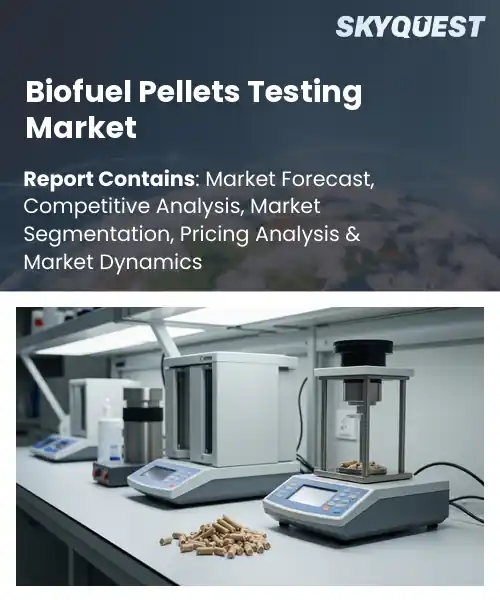
Biofuel Pellets Testing Market
Report ID: SQMIG10G2079
Report ID: SQMIG10G2079
[email protected]
USA +1 351-333-4748
Report ID:
SQMIG10G2079 |
Region:
Global |
Published Date: July, 2026
Pages:
157
|Tables:
118
|Figures:
77


Global Biofuel Pellets Testing Market size was valued at USD 174.3 Million in 2024 and is poised to grow from USD 184.06 Million in 2025 to USD 284.62 Million by 2033, growing at a CAGR of 5.6% during the forecast period (2026-2033).
Stringent emission standards for industrial heating compel facilities to use certified bio‑pellets and demand testing to prove compliance. When regulators lower allowable CO2 levels, plant operators must verify that their fuel mix meets the threshold, which drives purchases of test‑verified pellets from suppliers holding accredited certificates. This requirement fuels a feedback loop: rising verification demand pushes laboratories to expand capacity, adopt spectroscopy, and provide audits. For instance, a German steel mill cut its carbon intensity by 15 % after switching to certified pellets, while a Texas utility now contracts a lab for quarterly emissions verification, underscoring the market’s growing significant relevance.
How is AI improving efficiency in the biofuel pellets testing market?
AI is streamlining the biofuel pellets testing market by embedding machine‑learning models into laboratory workflows. Automated image analysis now evaluates pellet density, moisture and ash content with consistent precision, reducing human error and freeing technicians for higher‑value tasks. Predictive algorithms flag out‑of‑spec batches before full testing, accelerating decision‑making and lowering turnaround times. Real‑time data dashboards integrate results from multiple labs, giving producers a unified view of quality trends and enabling rapid adjustments to feedstock or processing parameters. These advances are reshaping the testing landscape, making it more responsive and cost‑effective while supporting the sector’s expanding demand for reliable pellet fuels.Stellar MR, February 2026, launched an AI‑powered testing platform that automates quality assessment, cutting manual review time and boosting certification speed, thereby enhancing overall market efficiency.
Market snapshot - (2026-2033)
Global Market Size
USD 174.3 Million
Largest Segment
Moisture Analysis
Fastest Growth
Mechanical Durability Testing
Growth Rate
5.6% CAGR
To get more insights on this market click here to Request a Free Sample Report
Global biofuel pellets testing market is segmented by test type, pellet type, testing method, end user and region. Based on test type, the market is segmented into Moisture Analysis, Ash Content Analysis, Calorific Value Testing and Mechanical Durability Testing. Based on pellet type, the market is segmented into Wood Pellets, Agricultural Pellets and Industrial Biomass Pellets. Based on testing method, the market is segmented into Laboratory Testing and On-site Testing. Based on end user, the market is segmented into Pellet Manufacturers, Power Plants, Testing Laboratories and Research Institutes. Based on region, the market is segmented into North America, Europe, Asia Pacific, Latin America and Middle East & Africa.
Moisture analysis segment dominates because reliable moisture content directly determines pellet combustion efficiency, storage stability, and transport safety. Manufacturers prioritize precise moisture measurement to meet strict quality certifications, and end‑users rely on these results for optimal furnace performance. This focus fuels consistent demand for moisture testing services, encouraging laboratories to invest in advanced hygrometric technologies and process expertise, reinforcing its leading role in the biofuel pellets testing market.
However, calorific value testing segment emerges as the fastest growing because renewable energy policies demand precise energy output verification, spurring interest in advanced calorimetry. New automated bomb calorimeters cut analysis time, attracting power generators focused on efficiency. This heightened focus on performance metrics fuels rapid uptake, making the segment a potent driver of market expansion.
Wood pellets segment leads because they constitute the most established feedstock, offering consistent density, low ash, and predictable combustion characteristics that satisfy the majority of residential and industrial boilers. Their broad availability and familiarity drive manufacturers to standardize testing protocols, ensuring compliance with long‑standing specifications. Consequently, testing services centered on wood pellets attract sustained demand, reinforcing their position at the forefront of the market.
Meanwhile, industrial biomass pellets segment experiences the strongest growth as manufacturers adopt waste‑derived feedstocks to meet circular‑economy goals and tighter carbon‑neutral standards. Improved preprocessing raises energy density, encouraging power plants to co‑fire these pellets. The resulting rise in compositional and durability testing needs makes this segment a rapidly expanding opportunity within the market.
To get detailed segments analysis, Request a Free Sample Report
Europe’s dominance stems from a mature regulatory environment that mandates rigorous fuel quality standards, driving extensive testing activity. A dense network of specialized laboratories, bolstered by strong collaboration between research institutes and industry, provides cutting‑edge analytical capabilities. The region benefits from well‑established logistics infrastructure that supports efficient distribution of test services across borders. Moreover, a deep commitment to decarbonisation fuels continuous investment in renewable fuel technologies, creating sustained demand for reliable testing to certify compliance. High awareness of environmental performance among consumers and policymakers further reinforces the need for transparent verification, positioning Europe as the benchmark for biofuel pellet testing excellence.
Biofuel Pellets Testing Market in Germany is supported by a robust industrial base and a proactive stance on renewable energy policies. Leading technical universities and research centers contribute advanced methodologies, while a cluster of accredited test facilities ensures rapid turnaround for manufacturers. Close alignment with EU quality directives drives consistency, and strong collaboration between oil refiners and renewable fuel producers promotes integrated testing solutions that meet stringent emissions criteria.
Biofuel Pellets Testing Market in the United Kingdom reflects the country’s strategic emphasis on clean energy transition and rigorous certification processes. A network of highly qualified testing laboratories works closely with regulatory bodies to uphold compliance with domestic and European standards. The presence of pioneering renewable fuel projects fuels demand for sophisticated analytical services, while industry associations facilitate knowledge sharing that elevates testing practices across the sector.
Biofuel Pellets Testing Market in France benefits from strong governmental incentives that encourage renewable fuel adoption and rigorous quality assurance. Accredited testing facilities leverage expertise from leading academic institutions to deliver precise assessments of pellet composition and performance. Close cooperation between energy ministries and industry stakeholders ensures that testing protocols remain aligned with national sustainability goals, reinforcing France’s role as a key driver of market confidence and product reliability.
The expansion in North America is propelled by heightened emphasis on energy independence and climate‑focused policies that incentivize renewable fuel integration. A dynamic blend of innovation hubs and mature petroleum infrastructure creates a fertile environment for biofuel pellet development, necessitating comprehensive testing to verify blend integrity and emissions performance. Strong collaboration between governmental agencies, industry coalitions, and academic research centers fosters the evolution of standardized testing frameworks. Consumer demand for greener transportation fuels further amplifies the need for transparent verification, while the presence of multiple certified laboratories ensures rapid and reliable service delivery across the continent, cementing North America’s accelerating market momentum.
Biofuel Pellets Testing Market in the United States thrives on a diverse ecosystem of federal and state regulations that encourage renewable fuel usage. A vast network of accredited laboratories provides extensive analytical capabilities, supporting both large‑scale producers and emerging innovators. Partnerships between research universities and industry accelerate method development, while active trade associations promote harmonized testing standards that facilitate market entry and product acceptance nationwide.
Biofuel Pellets Testing Market in Canada is shaped by a strong policy framework that prioritizes low‑carbon fuel solutions and rigorous quality assurance. Provincial initiatives complement national guidelines, creating a demand for precise testing to certify compliance. A handful of specialized testing centres collaborate closely with renewable energy firms, delivering tailored analyses that address the unique characteristics of Canadian feedstocks and supporting the country’s commitment to sustainable fuel adoption.
Asia Pacific is strengthening its position through rapid industrialisation, expanding renewable energy mandates, and a surge in investment for sustainable fuel technologies. Nations in the region are establishing comprehensive testing guidelines that align with global standards, fostering trust among international partners. Advanced research facilities and emerging private laboratories are enhancing analytical precision, while government‑backed pilot projects generate practical demand for thorough testing. Growing awareness of air quality and climate impacts drives both public and private sectors to adopt biofuel pellets, creating a feedback loop that accelerates capacity building and knowledge exchange throughout the Asia Pacific landscape.
Biofuel Pellets Testing Market in Japan benefits from a strong culture of quality control and a proactive renewable energy agenda. Leading research institutes collaborate with commercial testing laboratories to refine analytical techniques that meet stringent domestic standards. Government incentives for low‑emission fuels encourage manufacturers to seek certification, while industry consortia promote shared best practices that elevate testing reliability across the market.
Biofuel Pellets Testing Market in South Korea is reinforced by an ambitious clean energy roadmap that emphasizes alternative fuels for transport and industry. A cluster of certified testing providers works closely with technology firms to ensure that pellet products conform to rigorous performance and emissions criteria. Continuous dialogue between regulatory agencies and industry stakeholders drives the evolution of testing protocols, positioning South Korea as a progressive contributor to the regional biofuel pellet ecosystem.
To know more about the market opportunities by region and country, click here to
Buy The Complete Report
Increasing Renewable Energy Policies
Enhanced Pellet Quality Standards
High Testing Cost Structures
Limited Laboratory Infrastructure Access
Request Free Customization of this report to help us to meet your business objectives.
Intense competition in the global biofuel pellets testing market is driven by stringent emission regulations and the need for consistent fuel quality. Leaders such as POET LLC and Cargill are expanding testing capabilities through acquisitions of specialist labs, while partnerships like FutureMetrics with power generators and Vertus Energy’s AI‑based testing platform illustrate how tech innovation and strategic alliances are shaping market dynamics.
Top Player’s Company Profile
Recent Developments
SkyQuest’s ABIRAW (Advanced Business Intelligence, Research & Analysis Wing) is our Business Information Services team that Collects, Collates, Correlates, and Analyses the Data collected by means of Primary Exploratory Research backed by robust Secondary Desk research. As per SkyQuest analysis, the global biofuel pellets testing market is being propelled primarily by increasing renewable energy policies that push producers to certify their pellets, while enhanced pellet quality standards further spur demand for precise testing services. Moisture analysis remains the dominant segment because moisture content directly impacts combustion efficiency and safety, and Europe leads the market thanks to its rigorous regulatory framework and dense network of accredited labs. However, high testing cost structures act as a restraint, especially for smaller producers who find comprehensive analyses financially burdensome. Together these forces shape a market that is expanding steadily but faces cost‑related barriers.
| Report Metric | Details |
|---|---|
| Market size value in 2024 | USD 174.3 Million |
| Market size value in 2033 | USD 284.62 Million |
| Growth Rate | 5.6% |
| Base year | 2024 |
| Forecast period | (2026-2033) |
| Forecast Unit (Value) | USD Million |
| Segments covered |
|
| Regions covered | North America (US, Canada), Europe (Germany, France, United Kingdom, Italy, Spain, Rest of Europe), Asia Pacific (China, India, Japan, Rest of Asia-Pacific), Latin America (Brazil, Rest of Latin America), Middle East & Africa (South Africa, GCC Countries, Rest of MEA) |
| Companies covered |
|
| Customization scope | Free report customization with purchase. Customization includes:-
|
To get a free trial access to our platform which is a one stop solution for all your data requirements for quicker decision making. This platform allows you to compare markets, competitors who are prominent in the market, and mega trends that are influencing the dynamics in the market. Also, get access to detailed SkyQuest exclusive matrix.
Table Of Content
Executive Summary
Market overview
Parent Market Analysis
Market overview
Market size
KEY MARKET INSIGHTS
COVID IMPACT
MARKET DYNAMICS & OUTLOOK
Market Size by Region
KEY COMPANY PROFILES
Methodology
For the Biofuel Pellets Testing Market, our research methodology involved a mixture of primary and secondary data sources. Key steps involved in the research process are listed below:
1. Information Procurement: This stage involved the procurement of Market data or related information via primary and secondary sources. The various secondary sources used included various company websites, annual reports, trade databases, and paid databases such as Hoover's, Bloomberg Business, Factiva, and Avention. Our team did 45 primary interactions Globally which included several stakeholders such as manufacturers, customers, key opinion leaders, etc. Overall, information procurement was one of the most extensive stages in our research process.
2. Information Analysis: This step involved triangulation of data through bottom-up and top-down approaches to estimate and validate the total size and future estimate of the Biofuel Pellets Testing Market.
3. Report Formulation: The final step entailed the placement of data points in appropriate Market spaces in an attempt to deduce viable conclusions.
4. Validation & Publishing: Validation is the most important step in the process. Validation & re-validation via an intricately designed process helped us finalize data points to be used for final calculations. The final Market estimates and forecasts were then aligned and sent to our panel of industry experts for validation of data. Once the validation was done the report was sent to our Quality Assurance team to ensure adherence to style guides, consistency & design.
Analyst Support
Customization Options
With the given market data, our dedicated team of analysts can offer you the following customization options are available for the Biofuel Pellets Testing Market:
Product Analysis: Product matrix, which offers a detailed comparison of the product portfolio of companies.
Regional Analysis: Further analysis of the Biofuel Pellets Testing Market for additional countries.
Competitive Analysis: Detailed analysis and profiling of additional Market players & comparative analysis of competitive products.
Go to Market Strategy: Find the high-growth channels to invest your marketing efforts and increase your customer base.
Innovation Mapping: Identify racial solutions and innovation, connected to deep ecosystems of innovators, start-ups, academics, and strategic partners.
Category Intelligence: Customized intelligence that is relevant to their supply Markets will enable them to make smarter sourcing decisions and improve their category management.
Public Company Transcript Analysis: To improve the investment performance by generating new alpha and making better-informed decisions.
Social Media Listening: To analyze the conversations and trends happening not just around your brand, but around your industry as a whole, and use those insights to make better Marketing decisions.
REQUEST FOR SAMPLE
 REQUEST FREE CUSTOMIZATION


Want to customize this report? This report can be personalized according to your needs. Our analysts and industry experts will work directly with you to understand your requirements and provide you with customized data in a short amount of time. We offer $1000 worth of FREE customization at the time of purchase.
Feedback From Our Clients


 USA (+1) 351-333-4748

