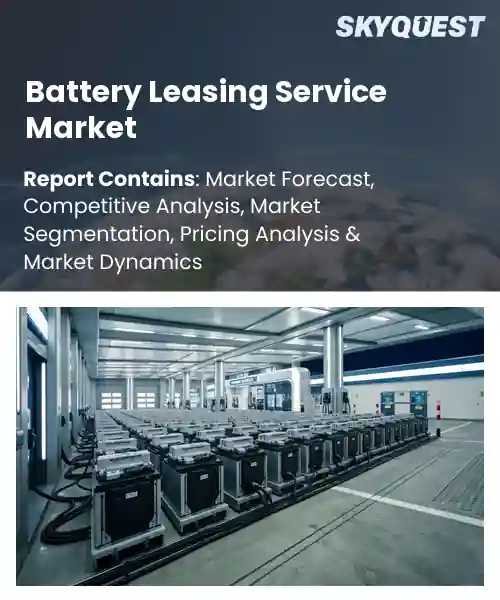
Battery Leasing Service Market
Report ID: SQMIG25C2234
Report ID: SQMIG25C2234
[email protected]
USA +1 351-333-4748
Report ID:
SQMIG25C2234 |
Region:
Global |
Published Date: May, 2026
Pages:
157
|Tables:
143
|Figures:
73


Global Battery Leasing Service Market size was valued at USD 8.52 Billion in 2024 and is poised to grow from USD 10.12 Billion in 2025 to USD 38.85 Billion by 2033, growing at a CAGR of 18.82% during the forecast period (2026-2033).
Vehicles and businesses using electric power have the ability to rent battery capacity through battery leasing service instead of having to purchase batteries outright. The main reasons for this service are reducing the up-front costs associated with battery systems and providing a way for people who use electric vehicles to minimize the risk associated with the degradation of their batteries. This type of service opens up new opportunities in the industry because it decouples the value of an electric vehicle from the condition of the battery within it, allowing many more people to participate in the electric vehicle market and creating standardized methods for replacing and recycling batteries. The battery leasing service has progressed over the past decade from pilot programs initiated by start-up companies to large-scale fleets operated by some of the major automotive manufacturers in China and Europe.
The use of battery swapping networks and manufacturer-sponsored lease program has led to a much greater degree of predictability concerning a customer's future residual value on their electric vehicle, which has greatly increased the overall confidence of these customers when they make their buying decision. Many factors are contributing to the rapid growth of battery leasing services around the world. One of the most important elements is the establishment of interoperable infrastructure and regulatory frameworks to help reduce friction associated with operation and to facilitate additional investment in battery leasing.
With the ability to operate at scale and to provide all of the various components necessary for a successful battery swapping station (battery form factors, safety standards, etc.) operators will benefit from improved utilization rates and reduced unit costs resulting in lower leasing prices and improved margins. Real-world use cases include NIO’s battery swap network accelerating EV uptime in Chinese cities and Gogoro’s scooter ecosystem that monetized batteries as services. Meanwhile fleet managers and ride-hailing companies adopt leasing because predictable replacement schedules cut downtime and simplify asset accounting.
How is IoT Enabling Operational Efficiency In The Battery Leasing Service Market?
The integration of the Internet of Things (IoT) into the battery leasing service industry enhances the operational efficiencies of the industry by creating a continuous telemetry connection to the battery, reporting the following metrics: state of charge, state of health, and geographic location. With this data, operators use predictive maintenance techniques to reduce unplanned downtime, re-route batteries and replenish swap stations based on actual demand. The application of IoT technology to usage-based billing and automated asset tracking enables battery lease companies to optimize lifecycle management and energy scheduling for their products. These IoT driven solutions also assist operators in scaling their network while maintaining high reliability because they provide a cost-effective alternative to purchasing an electric vehicle by leasing or swapping batteries.
An example of the expanding battery swap infrastructure supporting IoT would be NIO's February 2026 report detailing a battery swap recognition; which represents a significant battery swap milestone by demonstrating how large the actual use of swaps is based on the amount of data available from connected swap locations. Battery swap utilization data from IoT enabled telemetry, in conjunction with coordination of the data through the cloud, enables operators to forecast the future availability of batteries within the swap system, improve throughput through battery swap stations, and automate the billing process for battery swaps; all of which promote faster network growth and improved operational efficiency.
Market snapshot - (2026-2033)
Global Market Size
USD 8.52 Billion
Largest Segment
Lithium-Ion
Fastest Growth
Solid-State
Growth Rate
18.82% CAGR
To get more insights on this market click here to Request a Free Sample Report
Global battery leasing service market is segmented by battery type, vehicle type, service model, end-user and region. Based on battery type, the market is segmented into Lithium-Ion, Solid-State and LFP. Based on vehicle type, the market is segmented into Electric Passenger Vehicles, Electric Motorcycles/Scooters and Electric Commercial Vehicles. Based on service model, the market is segmented into Monthly Subscription, Pay-Per-Kilometer and Battery Swap Network. Based on end-user, the market is segmented into Individual EV Owners and Fleet Operators. Based on region, the market is segmented into North America, Europe, Asia Pacific, Latin America and Middle East & Africa.
As per battery leasing service market analysis, fleet operators hold the largest share of the revenue as a result of the scale and regularity of their fleet operations that create predictable, high use cycles, making the economics of leasing attractive and creates operational efficiencies. The integration of centralized maintenance and telematics optimizes battery lifecycle management, thereby minimizing downtime and reducing total costs to deliver services. The long-term commitment by leasing companies to procure and refurbish batteries through consolidated purchasing power allows leasing companies to amortize battery procurement and refurbishment costs across long-term contracts, which gives fleet-focused revenue streams and operational leverage to their business model.
As per battery leasing service market forecast, the Individual EV Owner segment has become the fastest growing area of the market due to increasing demand from consumers combined with attractive financing options for leased batteries. The growth of consumer demand is further supported by app-based subscriptions along with partnerships between OEMs and battery service providers who deliver increased access to consumers. The continued growth in consumer demand will further grow the overall market as well as stimulate the development of new service and retail models.
As per battery leasing service market outlook, the LFP category is the current leader among battery chemistries due to its industry-leading performance stability and long usable cycle life, which results in lower overall lifecycle costs for the leasing companies and the final customer. What also makes LFP preferable from an operational standpoint are its superior thermal resistance and simplified safety protocol, which reduces warranty claims and insurance exposure allowing the leasing companies to offer a more predictable residual value and lease term. As a result of these performance advantages, leasing companies tend to enter into long-term lease agreements on the basis of dependability, longevity (typically 8 years or more), and low-maintenance complexity, making the LFP category the optimal asset class in terms of profitability and effective risk management for leasing portfolios.
In contrast, the solid-state category is the fastest segment of the battery leasing service market due to advances in cell design that promise to deliver higher energy density and faster charging rates; thus providing an opportunity to expand usage in vehicles and justify premium leasing models. The significant interest in pilot deployment by investors and original equipment manufacturers (OEMs) and the anticipated benefits of improved safety and range will drive new applications and provide providers with an opportunity to develop compatible services and capture early adopter demand.
To get detailed segments analysis, Request a Free Sample Report
With the interconnectedness of depth in supply chain across Asia Pacific, along with scale of manufacturing capacity, the region has developed into the dominant global source for battery leasing service due to its high levels of demand from both mobility and consumer electronics. In addition, since the region is highly urbanized, it creates an ideal environment for many shared mobility scenarios. The dense clustering of battery cell production reduces the logistical complexities incurred by lease companies and manufacturers; whereas innovative commercial partnerships between automobile manufacturers and leasing companies are developing at a rapid pace. The strong interest from private equity in advanced technologies supports the development of a wide variety of different business models, including subscription services to battery swapping networks; nor do they charge customers/take commissions, as part of the arrangements. In addition, transport policy foundations and supportive public infrastructure further eliminate barriers for battery leasing services. The capacity of skillful labor and the abundance of established service bases will enable reliable after-sales service, thus creating a basis for long-term trust in leasing arrangements and leading to scale, improved customer loyalty and longevity in leasing relationships.
Battery Leasing Service Market is supported by the continued evolution of battery manufacturing ecosystems, the ongoing collaboration between OEMs in the Automotive Industry and battery suppliers, and the relatively mature state of supply chain integration in the industry. Urban fleet owners’ broad adoption of EVs and the proactive piloting of private sector initiatives provide a platform for leasing models to evolve and develop further. Providers of leasing services will offer more reliability and performance than previously anticipated due to the shared experience of both technology leaders in cell chemistry and battery management systems.
The growth of the Battery Leasing Service Market in South Korea has been supported by the strong heritage of consumer electronics manufacturers, by the supply of specialised batteries to meet the demands of urban mobility patterns, and through recent investments in battery-related infrastructure. Technology companies have worked with urban mobility operators to innovate subscription-based leases, including swap-based leasing solutions. By using a combination of small compact cells, with high energy density, along with a rigorous set of quality specifications, consumers will be more likely to trust their leased batteries, and use them for longer periods of time. Regional providers will leverage the talent pool of highly skilled engineers, as well as their own agile and cost-effective distribution networks, to create and service a wide array of flexible leasing opportunities in metropolitan transport providers.
As per battery leasing service market regional analysis, market growth is accelerating in Europe as a result of national governments harmonizing regulations, manufacturing plants retooling to support electric vehicle production efforts ,and significant engagement from automobile manufacturers. Cross-border interoperability initiatives and investments in electric vehicle charging infrastructure help to eliminate commercial barriers and support customers who seek flexible ownership options. The result is that the demand for these types of consumer flexible ownership models continues to grow rapidly with many customers opting for innovative leasing solutions (created through collaboration between mobility providers, utilities, and independent service providers) tailored specifically to the commercial and private segments of their business. Established financing markets combined with increased second life battery initiatives also provide an example of some of the ways that companies can manage assets cost effectively and provide a basis for companies to scale their leasing offerings and develop additional service offerings across different national and regional markets. Pilot programs operating locally and supportive city governments are offering test beds for new commercial models; while energy providers work in synergy to develop partnerships that will allow battery leasing plans to operate in alignment with other grid services and programs that support the circular economy ultimately increasing long-term viability for battery leasing across Europe and investor confidence in the industry.
In Germany, the battery leasing service market has strong support from domestic automotive production clusters and proactive relationships between like-minded OEM and mobility operators. There is demand for such products and services supported by commercial fleet operators and an overall financial ecosystem for funding innovative leasing options. In addition to manufacturers, independent battery leasing providers can benefit from using maintenance networks and urban infrastructure to offer innovative solutions. Pilot projects with energy providers and the integration of battery playing a role providing grid services further increase battery use across all segments, creating a potentially compelling alternative to outright battery ownership through leasing.
In the UK, the battery leasing service market is beginning to form as a result of progressive experimentation and technology initiatives from mobility-based start-ups, the consumer demand for flexible ownership options, and pilot projects in cities. Collaboration within the industry with energy providers and financial partners is key to developing various payment and insurance models. Collaborative emphasis on service design that integrates the user experience is driving greater adoption both by private drivers and urban fleets. As a result of pilot testing/beta programmes, many local providers will implement methods to increase their ability to scale onboarding, implement robust warranty programmes, and provide transparent lifecycle reporting to enhance consumer trust.
The Battery Leasing Service market exhibits significant adoption trends in public transport and commercial vehicles. There are also highly collaborative relationships between automotive manufacturers and providers of battery leasing services in addition to being able to take coordinated infrastructure planning into consideration. The provision of integrated approaches that connect battery leasing offerings with energy providers and municipal purchasers helps create a streamlined rollout for an organization’s battery leasing program. The adoption of warranty protocols, standardized technical specifications and aftersales support solutions increases a potential customer's confidence in leasing batteries from a particular provider. Given the strong emphasis on lifecycle management and circular economy pathways, the market leaders in this space have the greatest ability to maximize asset value and service reliability to their customers.
As per battery leasing service market regional outlook, through a diverse set of new business models, quality investment by private capital, and collaboration from automotive manufacturers and energy companies, North America is developing a stronger base for battery leasing services. Companies are focused on developing leasing and charging infrastructure together with grid services to maximise asset value and flexibility in operations. Early adopters include large commercial fleets and mobility platforms that have helped to establish the validity of leasing offerings, while more built-in warranties and safety will provide customers with confidence in their leasing arrangements. Stronger partnerships across sectors, along with expanding aftermarket capabilities, and improved service logistics, will allow battery-leasing providers to scale up regionally and offer custom leasing arrangements to various commercial and consumer segments. Across multiple jurisdictions, participation in regulatory engagement and the development of testbed projects will support pilot programs, while the capital markets will provide long-term funding options for providers looking to expand operations. Focusing on data-driven lifecycle management will build long-term cost savings and environmental benefits associated with leasing and provide second life use initiatives for batteries.
The Battery Leasing Service Industry in the USA is driven by demand for commercial fleets, active involvement from leading auto manufacturers, and advanced logistic capabilities for fleet operations. By collaborating with charging and energy providers, service providers are able to create an integrated offering that includes leasing along with providing grid services and electrification programs. Access to a wide variety of financing options for fleet operators and the existence of extensive aftermarket networks facilitate larger deployment. Service providers focus on creating confidence in fleet operators through the provision of high safety standards; the establishment of a comprehensive warranty structure; and the use of data to implement maintenance processes.
The Canadian Battery Leasing Service Industry is benefiting from pilot projects conducted with utility companies, the importance placed on grid integration, and interest from fleet operators in the services offered by service providers. Service providers are focusing on creating solutions for varied geographic locations and cold-weather conditions, with their warranty and maintenance programs adapted accordingly. Cooperation with energy suppliers and end-of-life recycling strategies are also common practices used to develop strong end-of-life strategies. The major focus of market activity is on deployment; reliable service delivery methods within the service provider’s network; and the creation of strategic partnerships that can assist in addressing operational challenges in the transportation sector’s urban and rural market segments.
To know more about the market opportunities by region and country, click here to
Buy The Complete Report
Rising Electric Vehicle Adoption
Shift Towards Battery Standardization
High Upfront Infrastructure Costs
Regulatory Uncertainty And Fragmentation
Request Free Customization of this report to help us to meet your business objectives.
Competitive landscape with OEM-led battery asset separation competing with BaaS networks for coverage, interoperability and battery asset financing. Partnerships and joint ventures are being pursued between firms for battery asset control (NIO's Battery Asset Company with CATL), and then there are asset financing and leasing deals through Proterra’s financing Bus Battery leases. As for Startups scaling through partnerships and modular technologies.
SkyQuest’s ABIRAW (Advanced Business Intelligence, Research & Analysis Wing) is our Business Information Services team that Collects, Collates, Correlates, and Analyses the Data collected by means of Primary Exploratory Research backed by robust Secondary Desk research.
As per SkyQuest analysis, the global battery leasing service market is propelled by a key driver, rising electric vehicle adoption which lowers upfront ownership barriers, and a second driver, IoT-enabled operational efficiency that enables predictive maintenance, demand forecasting and usage-based billing. A significant restraint is the high upfront infrastructure costs for swap stations, storage and specialized logistics that slow network rollout. The dominating region is Asia Pacific due to manufacturing scale, dense urban mobility and supportive partnerships. The dominating segment is Fleet Operators because predictable utilization and long-term contracts make leasing financially attractive. Integrated ecosystems and circular second-life strategies will further support scalable, sustainable leasing models.
| Report Metric | Details |
|---|---|
| Market size value in 2024 | USD 8.52 Billion |
| Market size value in 2033 | USD 38.85 Billion |
| Growth Rate | 18.82% |
| Base year | 2024 |
| Forecast period | (2026-2033) |
| Forecast Unit (Value) | USD Billion |
| Segments covered |
|
| Regions covered | North America (US, Canada), Europe (Germany, France, United Kingdom, Italy, Spain, Rest of Europe), Asia Pacific (China, India, Japan, Rest of Asia-Pacific), Latin America (Brazil, Rest of Latin America), Middle East & Africa (South Africa, GCC Countries, Rest of MEA) |
| Companies covered |
|
| Customization scope | Free report customization with purchase. Customization includes:-
|
To get a free trial access to our platform which is a one stop solution for all your data requirements for quicker decision making. This platform allows you to compare markets, competitors who are prominent in the market, and mega trends that are influencing the dynamics in the market. Also, get access to detailed SkyQuest exclusive matrix.
Table Of Content
Executive Summary
Market overview
Parent Market Analysis
Market overview
Market size
KEY MARKET INSIGHTS
COVID IMPACT
MARKET DYNAMICS & OUTLOOK
Market Size by Region
KEY COMPANY PROFILES
Methodology
For the Battery Leasing Service Market, our research methodology involved a mixture of primary and secondary data sources. Key steps involved in the research process are listed below:
1. Information Procurement: This stage involved the procurement of Market data or related information via primary and secondary sources. The various secondary sources used included various company websites, annual reports, trade databases, and paid databases such as Hoover's, Bloomberg Business, Factiva, and Avention. Our team did 45 primary interactions Globally which included several stakeholders such as manufacturers, customers, key opinion leaders, etc. Overall, information procurement was one of the most extensive stages in our research process.
2. Information Analysis: This step involved triangulation of data through bottom-up and top-down approaches to estimate and validate the total size and future estimate of the Battery Leasing Service Market.
3. Report Formulation: The final step entailed the placement of data points in appropriate Market spaces in an attempt to deduce viable conclusions.
4. Validation & Publishing: Validation is the most important step in the process. Validation & re-validation via an intricately designed process helped us finalize data points to be used for final calculations. The final Market estimates and forecasts were then aligned and sent to our panel of industry experts for validation of data. Once the validation was done the report was sent to our Quality Assurance team to ensure adherence to style guides, consistency & design.
Analyst Support
Customization Options
With the given market data, our dedicated team of analysts can offer you the following customization options are available for the Battery Leasing Service Market:
Product Analysis: Product matrix, which offers a detailed comparison of the product portfolio of companies.
Regional Analysis: Further analysis of the Battery Leasing Service Market for additional countries.
Competitive Analysis: Detailed analysis and profiling of additional Market players & comparative analysis of competitive products.
Go to Market Strategy: Find the high-growth channels to invest your marketing efforts and increase your customer base.
Innovation Mapping: Identify racial solutions and innovation, connected to deep ecosystems of innovators, start-ups, academics, and strategic partners.
Category Intelligence: Customized intelligence that is relevant to their supply Markets will enable them to make smarter sourcing decisions and improve their category management.
Public Company Transcript Analysis: To improve the investment performance by generating new alpha and making better-informed decisions.
Social Media Listening: To analyze the conversations and trends happening not just around your brand, but around your industry as a whole, and use those insights to make better Marketing decisions.
REQUEST FOR SAMPLE
 REQUEST FREE CUSTOMIZATION
Global Battery Leasing Service Market size was valued at USD 8.52 Billion in 2024 and is poised to grow from USD 10.12 Billion in 2025 to USD 38.85 Billion by 2033, growing at a CAGR of 18.82% during the forecast period (2026-2033).
The competitive landscape is driven by OEM led battery asset separation competing with independent BaaS networks on coverage, interoperability and asset financing. Firms pursue joint ventures and partnerships to control battery assets, for example NIO’s BaaS and its battery asset company with CATL. Others deploy asset financing and leasing deals such as Proterra’s bus battery leasing credit facility, while startups scale via partnerships and modular tech. 'NIO Inc. (Battery as a Service)', 'Gogoro Inc.', 'CATL (EVOGO Battery Swap)', 'BAIC Group', 'Renault SA', 'SAIC Motor', 'BYD Company', 'Aulton New Energy', 'Geely Automobile', 'Better Place (historical)', 'Dian (Battery Swap)', 'Sunbike', 'Amara Raja Batteries', 'LG Energy Solution', 'Panasonic Holdings'
Integrated Service Ecosystems: Market players are forming broader ecosystems that bundle leasing with maintenance, insurance, software diagnostics, charging access and vehicle services to simplify ownership. These partnerships among manufacturers, fleet operators and energy providers enable seamless customer experiences, reduce perceived risk and create recurring revenue streams. Emphasis on standardized interfaces and interoperable operations supports expansion across segments and geographies, fostering integrated contractual models and shared platforms that accelerate uptake while capturing value across the battery lifecycle through coordinated service offerings.
Why does Asia Pacific Dominate the Global Battery Leasing Service Market? |@12


Want to customize this report? This report can be personalized according to your needs. Our analysts and industry experts will work directly with you to understand your requirements and provide you with customized data in a short amount of time. We offer $1000 worth of FREE customization at the time of purchase.
Feedback From Our Clients


 USA (+1) 351-333-4748

