

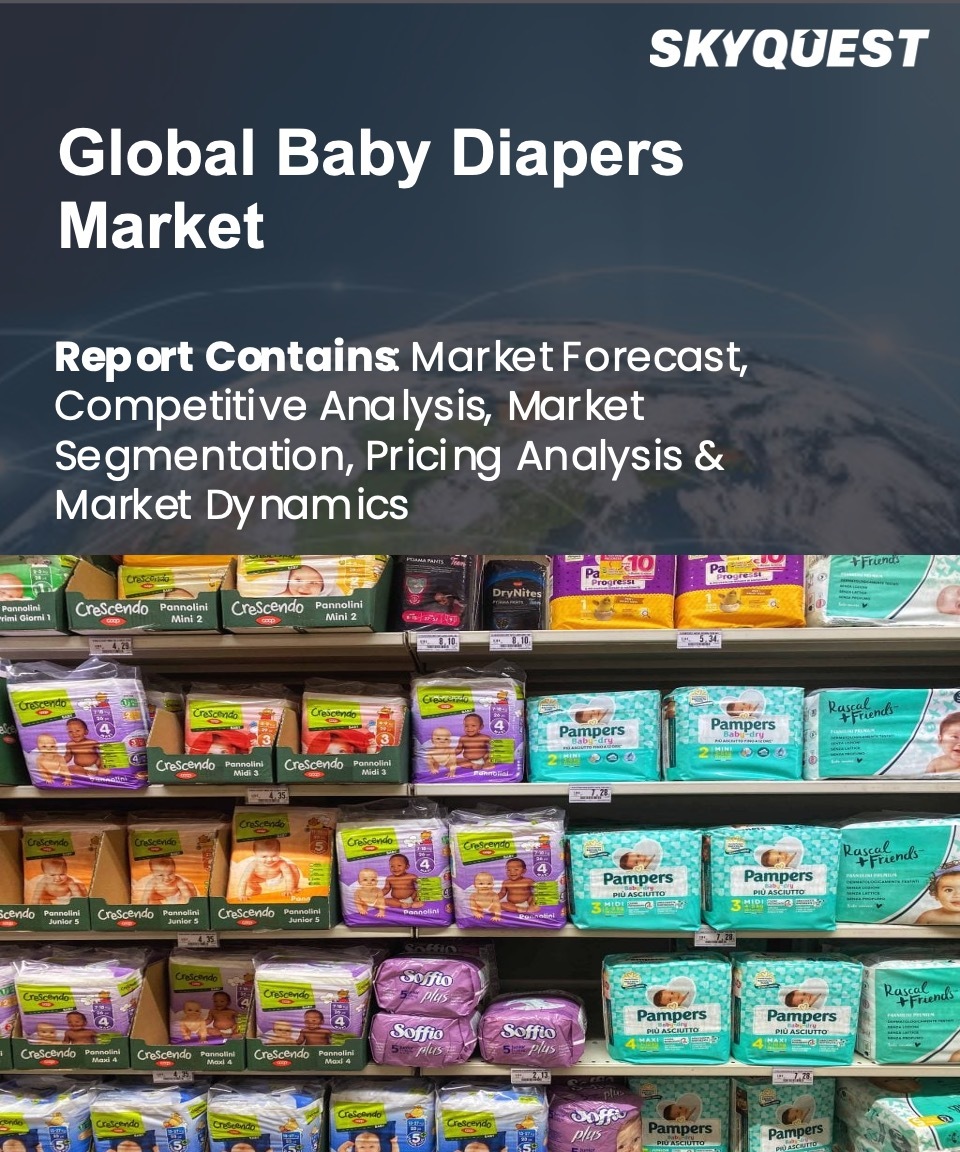
Baby Diapers Market
Report ID: SQMIG30K2079
Skyquest Technology's expert advisors have carried out comprehensive research and identified these companies as industry leaders in the Baby Diapers Market. This Analysis is based on comprehensive primary and secondary research on the corporate strategies, financial and operational performance, product portfolio, market share and brand analysis of all the leading Baby Diapers industry players.


As the hygiene and health of an infant deviate from the present norms, the global baby diapers market encounters continual growth. Various factors that include the changing family structure, a trend of increased number of working mothers, and greater access to materials have resulted in tremendous demand for reliable and convenient disposable diapers. Companies are also pushing to deliver on innovations in absorbency, leak protection, and skin-friendliness. Biodegradable and environmentally safe products are also gaining in preference. This page will attempt to study the strategies adopted by the leading players, possible avenues for future growth, and the dynamics of the market in developed as well as in developing regions.
According to SkyQuest Technology “Baby Diapers Market By Type (Disposable and Reusable) By Material (Conventional and Organic), By Category (Pant and Taped), By Size, By Age Group, By Product, By Price Range, By Distribution Channel, By Region - Industry Forecast 2026-2033,” the reusable segment is growing rapidly, particularly with environmentally-conscious consumers that highly regard cost. Things like washables and cloth-based, are gaining popularity due to increased awareness of the hazards posed by plastic pollution, the rise of sustainable options, and the very delicate skin of babies.
|
Company |
Est. Year |
Headquarters |
Revenue |
Key Services |
|
Procter & Gamble (P&G) |
1837 |
Cincinnati, Ohio, USA |
USD 84.28 Billion (2025) |
Global consumer goods provider; baby diapers (Pampers, Luvs), personal care, home care; strong innovation and digital supply chain integration. |
|
Kimberly-Clark Corporation |
1872 |
Irving, Texas, USA |
USD 9.9 Billion in Diaper Segment (2025) |
Manufactures baby diapers (Huggies, Pull-Ups), adult care, feminine care, and tissue products; strong global distribution and brand presence. |
|
Unicharm Corporation |
1961 |
Tokyo, Japan |
Estimated USD 7.1 Billion retail revenue share (2025) |
Leading Asian hygiene company; baby diapers (MamyPoko), adult care, feminine care, and pet care products with global operations. |
|
Kao Corporation |
1887 |
Tokyo, Japan |
Approximately USD 2.67 Billion (2025) |
Multinational personal care and hygiene provider; produces baby diapers (Merries), adult care and beauty & household products globally. |
|
Ontex Group NV |
1979 |
Aalst, Belgium |
USD 1.03 Billion (2025) |
Develops and supplies baby care (diapers, pants), feminine care, and adult incontinence products worldwide. |
|
Essity AB – Libero, DryNites |
2017 (spin-off from SCA) |
Stockholm, Sweden |
NA |
Global hygiene leader; baby diapers (Libero), adult care (TENA), tissue products, and professional hygiene solutions. |
|
Hengan International Group |
1985 |
Jinjiang, Fujian, China |
NA |
Leading Chinese provider of baby diapers, sanitary napkins, adult diapers, and other personal hygiene products. |
|
First Quality Enterprises |
1989 |
Great Neck, New York, USA |
NA |
Manufacturer of baby diapers, adult incontinence, feminine hygiene, wipes, and paper products under multiple brands. |
|
Domtar Corporation |
1848 |
Montreal, Canada & Fort Mill, South Carolina, USA |
USD 76 Million (2025) |
Major pulp, paper and absorbent hygiene materials manufacturer supplying diaper components and related products globally. |
|
DSG International Ltd. |
1973 |
Hong Kong, China |
NA |
Previously, a top baby diaper and training pants manufacturer (Fitti, BabyLove, PetPet), now integrated under larger groups in key markets. |
Procter and Gamble, under their Pampers brand, commands an enormous market share globally for baby diapers. The firm plans to go for even more innovations under the Pampers brand with different innovations such as ultra-thin absorbent layers, moisture indicators, and breathable materials for comfort and functionality. Huge investments in sustainability are committed by P&G for plant-based and biodegradable product lines, while connecting with parents through digital marketing, mass distribution, and subscriptions in developed markets and emerging ones.
Kimberly-Clark brands Huggies and Pull-Ups, known for their quality, absorbency, and skin protection, contribute significantly to the global baby diaper industry. The company maintains its product segmentation to accommodate various needs, from newborns to toddlers, yet source sustainable materials including plant-based ones. Their strong retail partnership network and well-known marketing strategies strengthen their foothold in North America, Latin America, and other regions to keep them in check with P&G as one of the key competitors.
In Asia-Pacific, Unicharm holds a strong position in the baby diapers industry. In Japan, China, India, and Southeast Asian markets, it leads the way with its brands MamyPoko and Moony. The company focuses on comfort, affordability, and rapid innovation to cater to local tastes. This includes super-soft materials and a tape-style fit for the diaper. Unicharm has further consolidated its global position through a determined push into emerging markets well supported by retail and e-commerce.
Kao diapers claim to be the premium and best product. They are very soft and made with breathable fabric that fits well. The targeted customers are health-conscious parents who value comfort and skin friendliness. Kao's marketing makes noticeable use of recyclable packaging together with plant-derived ingredients that strongly appeal to a sustainability perspective, at least in developed markets like Japan and some Asian nations. Continuous improvements to product performance and planned marketing activities ensure the brand retains its status as an association with quality.
Ontex Group is a key player in Europe and beyond by providing an extensive variety of infant diapers under both private label as well as branded labels. The company places special emphasis on reasonably priced, cutting-edge products such as diapers with advanced absorbent cores like BioSAP to lessen environmental impact without compromising performance. Ontex broad product line responds to customer demand at different levels and pricing points comfortably serving the larger and more price-sensitive markets with aim of expanding towards widening global reach.
Essity's Libero newborn diapers merge ecological responsibility with uncompromised product quality for great impact. Critics are attracted to the environmental-friendly approach of the company towards its use of raw materials to mitigate the ecological impact through recycling and chlorine-free sourcing. Moreover, Essity has established a solid base of strong private label collaboration with large retail chains, which establishes credibility and available access for its products while maintaining market share. This collation of sustainability and performance serves to bolster its farce in Europe as well as many other international markets.
With a significant penetration of the domestic market and a good reputation among budget-class consumers, Hengan International is a pivotal player in the Chinese infant diaper market. The Anerle and other diaper brands serve as very good balances of price and quality, which are widely used across China's humongous population. Heavily fortified by the benefits it derives from local production and distribution, Hengan is well set to get ahead in the quick-paced growth of the Asian market, edging out the international competition in the lesser cities of China.
First Quality Enterprises is an important player in the baby diapers market, producing a wide range of diapers for both private label customers and its own brands. The company is currently increasing its production capacity through additional facilities to meet rising global demand. The value proposition of its product offering that covers baby diapers, training pants, and other hygiene products allows them to leverage strong retail partnerships and competitive pricing strategies that appeal to both value-conscious and performance-conscious consumers to expand their footprint in North America and beyond.
Domtar is a major player in the baby diapers industry, mostly because it provides essential absorbent hygiene products. This contains pulp and nonwovens, both of which are necessary for diaper cores. Not so often presenting itself as a direct manufacturer of consumer-facing diaper brands, Domtar's components are the mass production choice for many diaper manufacturers. These components influence the quality, absorbency, and performance of the finished product. Hence, as colloquially viewed in the supply chain, Domtar strengthens the overall value proposition with respect to innovation and reliability.
DSG International has a name imprinted among major producers and distributors of training trousers and disposable newborn diapers. In Southeast Asia, their brands, Fitti, BabyLove, and PetPet, are well-known. Though certain brands have been absorbed by larger companies such as Unicharm, DSG has historically fostered competition and market diversity within the local markets especially in Thailand, Malaysia, and adjoining nations, thus contributing to increased consumer options and strengthening of local brands.
The growth of the global baby diapers market is a combination of several factors, the increasing number of working women, the understanding of newborns' needs, and the need for simpler and efficient products. Major companies like P&G, Kimberly-Clark, and Unicharm continuously develop new innovative diapers that are highly absorbent, gentle to the skin, and environmentally friendly. At the same time, such regional players as Hengan and Ontex sharpen their focus on emerging and cost-sensitive markets. Digitalized marketing outreach, customized products, and environmentally sensitive measures will likely influence future growth and widespread usage in emerging and developed countries.
REQUEST FOR SAMPLE
 REQUEST FREE CUSTOMIZATION
Global Baby Diapers Market size was valued at USD 86.64 Billion in 2024 and is poised to grow from USD 90.89 Billion in 2025 to USD 133.26 Billion by 2033, growing at a CAGR of 4.9% in the forecast period (2026–2033).
The competitive landscape of the global baby diapers industry in 2024 is characterized by intense rivalry among established global players and rising regional contenders focusing on sustainability, innovation, and affordability. Market leaders such as Procter & Gamble and Kimberly-Clark continue to dominate through strong brand portfolios and wide distribution networks. These companies are investing in eco-friendly diaper innovations, aiming to meet increasing consumer demand for sustainable products. 'First Quality Enterprises', 'Pura', 'DOMS Industries', 'Procter & Gamble (P&G)', 'Kimberly-Clark Corporation', 'Unicharm Corporation', 'Kao Corporation', 'Essity AB', 'Ontex Group NV', 'Drylock Technologies', 'Nobel Hygiene', 'Wowper', 'Soft N Dry Diapers Corp.'
Nowadays, parents are more informed and concerned about the health and hygiene of their infants than they were before. This heightened awareness drives demand for diapers that not only offer superior absorption but also protect delicate baby skin from irritation and rashes. Advances in diaper technology, such as breathable materials and hypoallergenic fabrics, cater to this demand. As a result, caregivers are willing to invest in higher-quality diapers to ensure their babies’ comfort and safety, thereby fueling market growth.
Growing Demand for Sustainable and Biodegradable Diapers: Environmental awareness among consumers is steadily rising, pushing the demand for sustainable products. In response, diaper manufacturers are investing in biodegradable materials and eco-friendly manufacturing processes. Organic cotton, bamboo fibers, and plant-based polymers are increasingly used to reduce environmental impact. This market trend aligns with stricter government regulations on waste and pollution and appeals to environmentally conscious parents who seek to minimize their ecological footprint.
The North America baby diapers market is one of the most mature and well-developed globally. This region benefits from a high level of consumer awareness about baby hygiene and safety, advanced healthcare infrastructure, and widespread availability of premium products. There is a significant preference for disposable diapers due to their convenience, hygiene, and technological innovation such as diapers with superior absorbency and skin-friendly materials. Additionally, the increasing trend toward eco-friendly and biodegradable diapers is gaining momentum, driven by growing environmental concerns. Strong distribution networks across supermarkets, pharmacies, and e-commerce platforms further boost market penetration in this region.
Want to customize this report? This report can be personalized according to your needs. Our analysts and industry experts will work directly with you to understand your requirements and provide you with customized data in a short amount of time. We offer $1000 worth of FREE customization at the time of purchase.
Feedback From Our Clients
Report ID: SQMIG30K2079
[email protected]
USA +1 351-333-4748
 USA (+1) 351-333-4748

