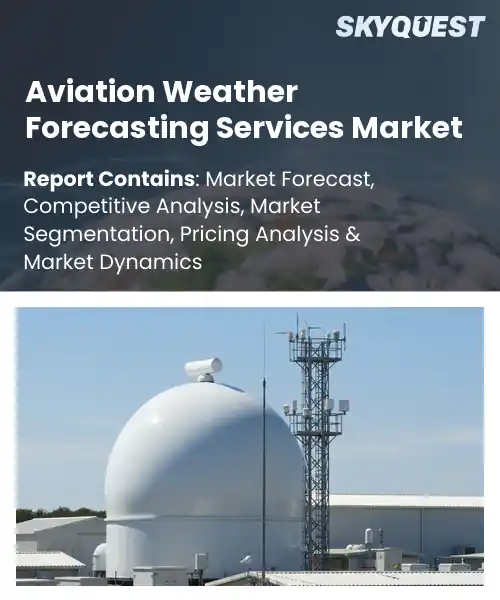
Aviation Weather Forecasting Services Market
Report ID: SQMIG45C2173
Report ID: SQMIG45C2173
[email protected]
USA +1 351-333-4748
Report ID:
SQMIG45C2173 |
Region:
Global |
Published Date: June, 2026
Pages:
157
|Tables:
88
|Figures:
76


Global Aviation Weather Forecasting Services Market size was valued at USD 6.4 Billion in 2024 and is poised to grow from USD 7.14 Billion in 2025 to USD 17.17 Billion by 2033, growing at a CAGR of 11.59% during the forecast period (2026-2033).
Advances in sensor networks and data analytics serve as the primary driver of the aviation weather forecasting services market, reshaping how airlines, airports and regulators manage operational risk. This market delivers tailored meteorological products and decision-support tools that inform route planning, deicing, enroute turbulence avoidance and airport flow management, and it matters because weather-related disruptions cost the industry billions and impact safety. Historically the sector evolved from manual synoptic charts and pilot reports to automated observation systems, satellite-derived products and numerical models; for example, commercial providers integrate ADS-B, radar mosaics and high-resolution models to produce probabilistic forecasts for dispatch centers.Building on that evolution, a pivotal factor propelling global aviation weather forecasting services is the convergence of high-resolution data streams with machine learning models, which increases forecast accuracy and benefits operators. As more sensors and satellites generate dense observations, model assimilation improves, causing probabilistic guidance to become actionable for route optimization and fuel planning, so airlines cut costs and maintain safety. This dynamic produces opportunities for bespoke services such as turbulence-probability alerts for long-haul carriers, runway contamination forecasts that optimize deicing logistics at hubs, and microclimate predictions for unmanned aircraft, illustrating significant direct commercial returns tied to improved predictive fidelity.
How is AI enhancing real-time accuracy in aviation weather forecasting services?
AI is improving real-time accuracy in aviation weather forecasting by combining faster data assimilation with machine learning nowcasting and sensor fusion. Key aspects include ingesting radar satellite surface sensors and aircraft observations into models that detect small scale hazards such as wind shear and turbulence. Today operational services use neural networks to downscale global models and produce probabilistic short term guidance for pilots and air traffic control. Market demand is rising from airlines airports and new air mobility providers that need actionable forecasts to reduce delays and improve safety. Examples include industry efforts to open AI weather stacks and satellite driven AI ensembles that speed updates and sharpen local forecasts.Tomorrow.io February 2026, announced expansion of its DeepSky AI satellite program to deliver higher resolution atmospheric sensing for aviation nowcasting, improving route level alerts and operational decision support for airlines airports and air traffic operators while supporting market growth through faster more localized forecasts.
Market snapshot - (2026-2033)
Global Market Size
USD 6.4 Billion
Largest Segment
Short-Term Forecasts
Fastest Growth
Short-Term Forecasts
Growth Rate
11.59% CAGR
To get more insights on this market click here to Request a Free Sample Report
Global aviation weather forecasting services market is segmented by forecasting types, service delivery, target users and region. Based on forecasting types, the market is segmented into Short-Term Forecasts and Long-Term Forecasts. Based on service delivery, the market is segmented into Online Platforms and On-Site Services. Based on target users, the market is segmented into Commercial Airlines, Private Aviation and Government Agencies. Based on region, the market is segmented into North America, Europe, Asia Pacific, Latin America and Middle East & Africa.
Short-Term Forecasts segment dominates because operators rely on rapid horizon updates to make immediate routing, takeoff and landing decisions that directly affect safety and efficiency. High cadence observations and frequent model refreshes reduce forecast uncertainty for dispatchers and crews, enabling adaptive operational choices that minimize delays and fuel waste. This immediacy drives procurement of services focused on nowcasting and tactical advisories, reinforcing the sub segment's centrality in the market.
However, Long-Term Forecasts are emerging as the fastest growing area as airlines and planners demand seasonal and strategic probabilistic outlooks to shape capacity, maintenance and network planning. Advances in climate models and data assimilation, together with growing acceptance of scenario based frameworks, expand long horizon applications and create recurring service opportunities.
Online Platforms segment leads because centralized cloud enabled portals aggregate multi source weather feeds, analytics and visualization tools into scalable interfaces that fit airline operations and government workflows. Persistent accessibility and integration APIs allow real time dissemination and automated alerting, reducing latency between forecast updates and operational action. Seamless connectivity with flight planning systems and mobile devices drives adoption, making platform oriented delivery the preferred model for efficient, data driven weather decision support.
However, On-Site Services are witnessing the strongest growth as operators prioritize bespoke sensor deployment, localized briefings and embedded meteorologists to address complex airport microclimates and ground operations. Customized installation, hands on training and integration with local operational procedures create stickier contracts and open avenues for value added consulting that broaden vendor revenue streams.
To get detailed segments analysis, Request a Free Sample Report
North America commands the aviation weather forecasting space through a synthesis of extensive operational demand, mature meteorological institutions, and deep integration between public agencies and private providers. The region benefits from a dense network of commercial and general aviation operators that require high fidelity forecasting across diverse climates and terrain. Robust funding streams support advanced research, operational testing, and rapid deployment of satellite and radar enhancements. Strong regulatory emphasis on safety and operational continuity fosters adoption of sophisticated forecasting tools and decision support systems, while a competitive vendor landscape drives continuous innovation in data assimilation, machine learning applications, and customer tailored services that align with airline, airport, and air traffic management priorities.
Aviation Weather Forecasting Services Market in the United States is characterized by close collaboration between federal agencies, industry stakeholders, and academic research centers to deliver operationally focused products. Demand from major airline hubs and cargo operations drives investment in high resolution models and nowcasting capabilities. Private sector firms and integrators work alongside national providers to develop tailored decision support tools for flight planning, dispatch, and air traffic flow management, reinforcing a market oriented toward reliability and scalability.
Aviation Weather Forecasting Services Market in Canada is shaped by the need to cover extensive and diverse geographies, including remote regions that present unique forecasting challenges. Emphasis on enroute and terminal forecasting for long haul and regional services has encouraged specialized product development. Collaboration between national meteorological services and regional operators supports resilient solutions for low visibility, icing, and winter operations. The market reflects a pragmatic focus on tailored services that support safety and continuity across sparse but critical air routes.
Europe is experiencing rapid expansion in aviation weather forecasting driven by a convergence of regulatory harmonization, dense air traffic flows, and cooperative pan regional initiatives that promote data sharing and standardization. Investment priorities center on enhancing cross border interoperability and integrating meteorological output with air traffic management to optimize route efficiency and reduce environmental impacts. National meteorological agencies and specialized private providers are scaling advanced modeling, ensemble approaches, and terminal area nowcasting to meet complex operational needs across multiple hubs. Market momentum is also supported by demand for sophisticated decision support systems that address both safety imperatives and performance targets for airlines and airports operating within a highly interconnected European sky.
Aviation Weather Forecasting Services Market in Germany benefits from a strong national meteorological infrastructure and close ties between research institutions and major hub airports. Focus on precision and reliability supports development of high quality operational models and tailored products for terminal and enroute use. Industry collaborations enable translation of research into practice, while integration with European systems ensures interoperability for cross border operations. The market emphasizes robustness and technical depth to meet stringent operational and regulatory expectations.
Aviation Weather Forecasting Services Market in the United Kingdom is driven by expertise in operational meteorology and a mature ecosystem of commercial providers serving large international hubs. Emphasis on safety, contingency planning, and operational resilience encourages uptake of advanced nowcasting and decision support tools. Strong relationships between national services, airports, and airlines foster bespoke solutions that align meteorological intelligence with operational workflows and strategic performance objectives across the aviation sector.
Aviation Weather Forecasting Services Market in France is experiencing rapid growth fueled by modernization efforts and increasing demand for integrated air traffic flow management solutions. National meteorological capability supports innovative products tailored to terminal operations and environmental performance. Collaboration among regional stakeholders, airport authorities, and private vendors accelerates deployment of new forecasting services that enhance punctuality and operational efficiency. The market trend reflects active investment in scalable, interoperable solutions to support expanding traffic and evolving operational needs.
Asia Pacific is strengthening its aviation weather forecasting role through targeted investments in observational infrastructure, modeling capability, and digital integration that address the region specific challenges of dense air traffic and extreme weather variability. National agencies and commercial entities are adopting high resolution models, radar networks, and satellite assimilation to improve situational awareness for busy hubs and complex airspaces. There is growing emphasis on nowcasting and AI enabled analytics to support rapid decision making. Cross sector partnerships and a focus on resilience to convective storms and tropical systems are translating into more sophisticated product offerings, while technology driven services broaden market reach across carriers, airports, and air navigation service providers.
Aviation Weather Forecasting Services Market in Japan is shaped by advanced observational networks and a strong tradition of applied meteorological research. Operational emphasis on resilience to typhoons, winter storms, and volcanic ash has driven development of specialized forecasting modules and rapid dissemination channels. Integration with airline operations and airport management supports tailored decision support tools, while a culture of technological adoption encourages continuous refinement of predictive models and nowcasting capabilities for complex regional air routes.
Aviation Weather Forecasting Services Market in South Korea reflects rapid adoption of high resolution modeling, dense radar coverage, and strong IT integration to deliver precision forecasting for busy international gateways. Collaboration between government agencies and private sector technology firms enables cloud based service delivery and scalable decision support for airlines and airport operators. Focus on predictive analytics and seamless operational integration enhances safety and efficiency for arrival and departure flows in challenging weather conditions.
To know more about the market opportunities by region and country, click here to
Buy The Complete Report
Increasing Demand For Real-Time Data
Adoption Of Advanced Analytics
High Implementation And Integration Costs
Regulatory And Data Privacy Challenges
Request Free Customization of this report to help us to meet your business objectives.
Competitive activity in the global aviation weather forecasting services market centers on partnerships, airline led venture investment, targeted acquisitions, and rapid product innovation. Examples include SmartSky integrating AvMet predictive weather products into its Skytelligence platform and ANA's CVC funding for BlueWX to commercialize AI turbulence prediction. These moves drive differentiation through exclusive data access, embedded avionics delivery, and validated airline trials.
Top Player’s Company Profile
Recent Developments
SkyQuest’s ABIRAW (Advanced Business Intelligence, Research & Analysis Wing) is our Business Information Services team that Collects, Collates, Correlates, and Analyses the Data collected by means of Primary Exploratory Research backed by robust Secondary Desk research. As per SkyQuest analysis, the global aviation weather forecasting services market is being propelled by advances in sensor networks and data analytics as a key driver, while high implementation and integration costs remain a significant restraint. North America dominates regional demand thanks to mature institutions and dense operations, and the short-term forecasts segment holds the leading share because operators prioritize rapid updates for routing and dispatch. A second driver is widespread adoption of AI and machine learning that improves real-time nowcasting and probabilistic guidance. Market momentum favors cloud platforms and bespoke on-site services as airlines and airports seek actionable meteorological intelligence to reduce delays and enhance safety.
| Report Metric | Details |
|---|---|
| Market size value in 2024 | USD 6.4 Billion |
| Market size value in 2033 | USD 17.17 Billion |
| Growth Rate | 11.59% |
| Base year | 2024 |
| Forecast period | (2026-2033) |
| Forecast Unit (Value) | USD Billion |
| Segments covered |
|
| Regions covered | North America (US, Canada), Europe (Germany, France, United Kingdom, Italy, Spain, Rest of Europe), Asia Pacific (China, India, Japan, Rest of Asia-Pacific), Latin America (Brazil, Rest of Latin America), Middle East & Africa (South Africa, GCC Countries, Rest of MEA) |
| Companies covered |
|
| Customization scope | Free report customization with purchase. Customization includes:-
|
To get a free trial access to our platform which is a one stop solution for all your data requirements for quicker decision making. This platform allows you to compare markets, competitors who are prominent in the market, and mega trends that are influencing the dynamics in the market. Also, get access to detailed SkyQuest exclusive matrix.
Table Of Content
Executive Summary
Market overview
Parent Market Analysis
Market overview
Market size
KEY MARKET INSIGHTS
COVID IMPACT
MARKET DYNAMICS & OUTLOOK
Market Size by Region
KEY COMPANY PROFILES
Methodology
For the Aviation Weather Forecasting Services Market, our research methodology involved a mixture of primary and secondary data sources. Key steps involved in the research process are listed below:
1. Information Procurement: This stage involved the procurement of Market data or related information via primary and secondary sources. The various secondary sources used included various company websites, annual reports, trade databases, and paid databases such as Hoover's, Bloomberg Business, Factiva, and Avention. Our team did 45 primary interactions Globally which included several stakeholders such as manufacturers, customers, key opinion leaders, etc. Overall, information procurement was one of the most extensive stages in our research process.
2. Information Analysis: This step involved triangulation of data through bottom-up and top-down approaches to estimate and validate the total size and future estimate of the Aviation Weather Forecasting Services Market.
3. Report Formulation: The final step entailed the placement of data points in appropriate Market spaces in an attempt to deduce viable conclusions.
4. Validation & Publishing: Validation is the most important step in the process. Validation & re-validation via an intricately designed process helped us finalize data points to be used for final calculations. The final Market estimates and forecasts were then aligned and sent to our panel of industry experts for validation of data. Once the validation was done the report was sent to our Quality Assurance team to ensure adherence to style guides, consistency & design.
Analyst Support
Customization Options
With the given market data, our dedicated team of analysts can offer you the following customization options are available for the Aviation Weather Forecasting Services Market:
Product Analysis: Product matrix, which offers a detailed comparison of the product portfolio of companies.
Regional Analysis: Further analysis of the Aviation Weather Forecasting Services Market for additional countries.
Competitive Analysis: Detailed analysis and profiling of additional Market players & comparative analysis of competitive products.
Go to Market Strategy: Find the high-growth channels to invest your marketing efforts and increase your customer base.
Innovation Mapping: Identify racial solutions and innovation, connected to deep ecosystems of innovators, start-ups, academics, and strategic partners.
Category Intelligence: Customized intelligence that is relevant to their supply Markets will enable them to make smarter sourcing decisions and improve their category management.
Public Company Transcript Analysis: To improve the investment performance by generating new alpha and making better-informed decisions.
Social Media Listening: To analyze the conversations and trends happening not just around your brand, but around your industry as a whole, and use those insights to make better Marketing decisions.
REQUEST FOR SAMPLE
 REQUEST FREE CUSTOMIZATION


Want to customize this report? This report can be personalized according to your needs. Our analysts and industry experts will work directly with you to understand your requirements and provide you with customized data in a short amount of time. We offer $1000 worth of FREE customization at the time of purchase.
Feedback From Our Clients


 USA (+1) 351-333-4748

