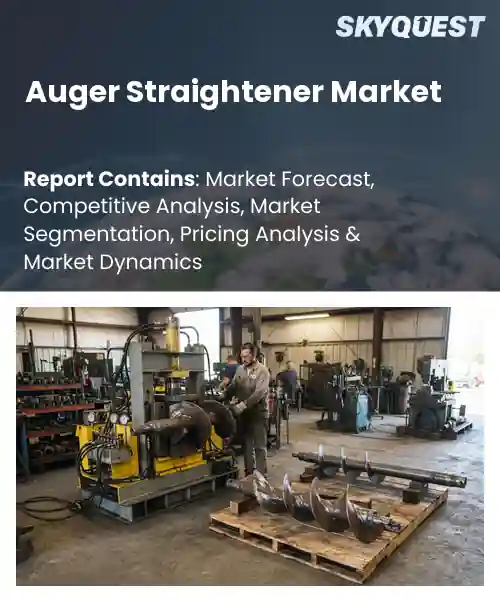
Auger Straightener Market
Report ID: SQMIG20I3737
Report ID: SQMIG20I3737
[email protected]
USA +1 351-333-4748
Report ID:
SQMIG20I3737 |
Region:
Global |
Published Date: August, 2026
Pages:
157
|Tables:
91
|Figures:
76


Global Auger Straightener Market size was valued at USD 264.0 Million in 2024 and is poised to grow from USD 276.94 Million in 2025 to USD 406.06 Million by 2033, growing at a CAGR of 4.9% during the forecast period (2026-2033).
The auger straightener market includes manufacturers of devices that align and condition drilling rods used in construction, mining, and oil‑field operations. Its significance lies in reducing torque irregularities, preventing premature tool wear, and improving borehole stability, which influences project cost and schedule compliance. Historically the market was niche until the 2010s when water‑jet and hydraulic straightening technologies emerged, offering faster processing and reduced labor intensity. For example, a supplier reported a 35 % boost after deploying straightening cells on projects. This evolution shows how efficiency gains have turned the sector from a peripheral service into a strategic component of drilling workflows. Rising demand for deep‑well drilling in renewable‑energy infrastructure acts as a catalyst propelling market expansion because boreholes require straightened augers to maintain alignment and avoid costly deviation. Wind‑farm foundations and geothermal plants increasingly rely on auger‑driven augering to achieve required depth, prompting contractors to invest in advanced straightening equipment that delivers tolerance. The resulting improvement in hole straightness translates into fewer pipe‑jacking incidents and lower non‑productivity costs, which in turn justifies higher upfront capital outlays. Moreover, digital monitoring systems that integrate torque sensors with analytics create revenue streams for OEMs, as end users seek predictive maintenance solutions that enhance efficiency.
How is AI-driven automation influencing the Auger straightener market?
AI driven automation is reshaping the auger straightener market by embedding intelligent sensors and machine learning algorithms into equipment. Real time data collection enables operators to monitor torque, speed and material flow, while predictive analytics forecast wear and schedule maintenance before failures occur. These capabilities reduce downtime, extend tool life and improve product consistency across construction and mining projects. Integration with cloud platforms allows remote adjustments and seamless coordination with other site machinery, creating a more responsive and efficient workflow. As manufacturers adopt smarter control systems, customers experience lower operating costs and higher productivity, driving broader acceptance of advanced straightening solutions.Barbco, July 2025, showcased a new auger boring machine that incorporates AI based precision control, illustrating how similar automation can boost efficiency and support growth in the auger straightener market.
Market snapshot - (2026-2033)
Global Market Size
USD 264.0 Million
Largest Segment
Automatic Auger Straighteners
Fastest Growth
Semi-Automatic Auger Straighteners
Growth Rate
4.9% CAGR
To get more insights on this market click here to Request a Free Sample Report
Global auger straightener market is segmented by product type, material compatibility, end use industry and region. Based on product type, the market is segmented into Manual Auger Straighteners, Semi-Automatic Auger Straighteners and Automatic Auger Straighteners. Based on material compatibility, the market is segmented into Steel Augers, Stainless Steel Augers and Alloy & Specialty Metal Augers. Based on end use industry, the market is segmented into Agriculture, Food Processing, Industrial Equipment Manufacturing and Mining & Bulk Material Handling. Based on region, the market is segmented into North America, Europe, Asia Pacific, Latin America and Middle East & Africa.
Manual Auger Straighteners segment dominates because operators value direct control and simplicity, which align with lowmaintenance requirements in many processing lines. The tactile feedback allows technicians to adjust alignment in real time, reducing cycle time and minimizing downstream wear. Its rugged mechanical design tolerates harsh environments, making it the preferred choice for legacy equipment retrofits and costsensitive facilities. Consequently, demand remains stable and it anchors the core market.
Meanwhile, Automatic Auger Straighteners segment emerges as the most rapidly expanding area, propelled by increasing adoption of Industry 4.0 standards and the need for highthroughput processing. Integrated sensors and closedloop controls enable predictive maintenance, attracting operators seeking efficiency gains. This technological shift fuels new investment and broadens future market opportunities.
Stainless Steel Augers segment dominates because its corrosionresistant properties meet the stringent hygiene standards of food processing and pharmaceutical environments. The material’s ability to maintain structural integrity under repeated stress reduces downtime and replacement costs, encouraging widespread adoption across highvalue production lines. Engineers also appreciate the consistent surface finish that facilitates precise straightening, reinforcing its status as the goto choice for premium applications and sustaining market leadership.
Conversely, Alloy & Specialty Metal Augers segment is seeing the strongest growth as advanced alloys tolerate extreme temperature and abrasive conditions. New mining and bulk material handling projects demand these highperformance materials, boosting need for straightening solutions. Their adaptability opens markets, accelerating market expansion and creating lucrative opportunities for innovators.
To get detailed segments analysis, Request a Free Sample Report
North America retains a leading position thanks to a mature manufacturing base, advanced engineering expertise, and strong demand from construction and infrastructure sectors. The region benefits from well‑established supply chains that ensure rapid delivery and high reliability of equipment. Robust investment in research and development drives continual improvement in product efficiency and durability. Close collaboration between equipment manufacturers and end‑users accelerates adoption of innovative designs. A supportive regulatory environment encourages the integration of auger straighteners in projects that require precise material handling, further cementing the market’s depth. The presence of major industrial hubs and a culture of early technology adoption also contribute to a sustained competitive edge.
Auger Straightener Market in the United States is shaped by extensive mining and large‑scale construction activities that demand high‑precision material handling solutions. Engineers prioritize equipment that offers reliability under heavy duty cycles, prompting manufacturers to focus on robust designs. Collaboration between industry associations and equipment suppliers accelerates the diffusion of best practices, while a strong emphasis on safety standards ensures that products meet stringent operational requirements across diverse applications.
Auger Straightener Market in Canada benefits from a diversified resource extraction sector and a growing emphasis on sustainable infrastructure development. Operators value equipment that delivers consistent performance in cold climate conditions, encouraging manufacturers to incorporate advanced material coatings and thermal management features. Close ties between provincial research institutes and equipment providers foster innovation, while government incentives for modernizing material handling processes support broader market acceptance across mining, forestry, and construction domains.
Europe’s market momentum stems from a combination of stringent environmental regulations, escalating demand for efficient material handling, and a strong engineering tradition that drives product innovation. Manufacturers are compelled to develop auger straighteners that align with energy‑saving standards and reduced emissions, prompting a wave of greener designs. The region’s dense network of construction and renewable energy projects creates continuous demand for reliable equipment. Collaborative research initiatives across leading industrial nations enhance technological sophistication, while a focus on modular and easily maintainable solutions meets the expectations of cost‑conscious operators. In addition, the presence of influential standards bodies ensures that new products quickly achieve market acceptance, reinforcing Europe’s position as a hub for advanced material handling technologies.
Auger Straightener Market in Germany is characterized by a highly engineered approach that emphasizes precision, durability, and compliance with rigorous industrial standards. Leading manufacturers invest heavily in automation and digitalization, enabling seamless integration of auger straighteners into smart production lines. Close cooperation with automotive and heavy machinery sectors fuels technology transfer, while a strong export orientation broadens market reach beyond domestic borders, reinforcing Germany’s status as a central hub for sophisticated material handling equipment.
Auger Straightener Market in the United Kingdom is driven by a rapidly expanding construction sector and a growing emphasis on modular infrastructure projects. Operators seek equipment that offers quick installation and adaptability, prompting suppliers to prioritize compact and interchangeable designs. The UK’s strong focus on research collaborations with universities accelerates the development of lightweight yet robust solutions. Additionally, a proactive regulatory framework encourages the adoption of energy‑efficient technologies, positioning the market for swift and sustained growth.
Auger Straightener Market in France is emerging alongside a focus on renewable energy infrastructure and agricultural processing facilities. Companies value equipment that can be easily integrated into existing systems while delivering consistent performance under varied operating conditions. French manufacturers leverage expertise in lightweight alloys and precision engineering to create solutions tailored for both urban and rural applications. Government support for innovation clusters stimulates collaboration, helping accelerate market maturation and broaden adoption across diverse sectors.
Asia Pacific is steadily advancing its role as a pivotal contributor to the auger straightener industry through a blend of rapid industrialization, expanding infrastructure investments, and a rising appetite for high‑efficiency material handling equipment. Nations such as Japan and South Korea emphasize precision engineering and compact design, aligning with space‑constrained project environments. Growing emphasis on automation and digital control systems drives local manufacturers to embed smart sensors and predictive maintenance capabilities into their products. Collaborative initiatives between technology firms and equipment producers accelerate the rollout of next‑generation solutions, while supportive trade policies facilitate cross‑border component sourcing. This convergence of technological ambition, market demand, and policy encouragement positions Asia Pacific as an increasingly influential arena for auger straightener innovation and adoption.
Auger Straightener Market in Japan is defined by a strong culture of precision manufacturing and a focus on compact, high‑performance equipment suitable for densely populated urban projects. Engineers prioritize reliability and ease of integration with existing automation lines, prompting manufacturers to adopt advanced ceramic and alloy materials. Close partnerships with robotics firms enable the development of synchronized handling solutions that enhance productivity. Government initiatives supporting smart factories further reinforce demand for sophisticated auger straightening technologies, positioning Japan as a leader in efficient material handling.
Auger Straightener Market in South Korea benefits from a dynamic manufacturing ecosystem that blends advanced metallurgy with cutting‑edge digital controls. Companies focus on delivering lightweight yet robust solutions that can be quickly deployed in fast‑paced construction and recycling operations. Integration of IoT connectivity allows real‑time monitoring and adaptive performance tuning, meeting the expectations of tech‑savvy operators. Collaborative research programs between universities and industry accelerate material innovations, while export‑oriented strategies expand the market reach of Korean‑engineered auger straightening systems across the region.
To know more about the market opportunities by region and country, click here to
Buy The Complete Report
Increasing Construction Activity
Advancements In Material Technology
High Initial Capital Expenditure
Stringent Environmental Regulations
Request Free Customization of this report to help us to meet your business objectives.
The competitive landscape is shaped by major tool manufacturers such as Metabo, Makita, and Bosch, which are accelerating market share through strategic acquisitions of niche specialty tool firms and joint ventures with component suppliers to broaden their auger straightener portfolios. Recent partnerships focus on integrating advanced brushless motor technology and IoT connectivity, enabling predictive maintenance features that differentiate product lines and drive customer adoption.
Top Player’s Company Profile
Recent Developments
SkyQuest’s ABIRAW (Advanced Business Intelligence, Research & Analysis Wing) is our Business Information Services team that Collects, Collates, Correlates, and Analyses the Data collected by means of Primary Exploratory Research backed by robust Secondary Desk research. As per SkyQuest analysis the global auger straightener market is projected to grow at a 4.9 % CAGR through 2033, driven primarily by rising construction activity that pushes demand for precise drilling tools and secondarily by breakthroughs in material technology that deliver lighter, wear‑resistant equipment. The manual auger straightener segment remains the market anchor because its simplicity and low‑maintenance appeal suit many legacy lines, while the North American region leads in volume thanks to its mature manufacturing base and strong infrastructure spending. However, high initial capital expenditure continues to restrain adoption, especially among smaller operators, tempering the pace of expansion despite the clear upside.
| Report Metric | Details |
|---|---|
| Market size value in 2024 | USD 264.0 Million |
| Market size value in 2033 | USD 406.06 Million |
| Growth Rate | 4.9% |
| Base year | 2024 |
| Forecast period | (2026-2033) |
| Forecast Unit (Value) | USD Million |
| Segments covered |
|
| Regions covered | North America (US, Canada), Europe (Germany, France, United Kingdom, Italy, Spain, Rest of Europe), Asia Pacific (China, India, Japan, Rest of Asia-Pacific), Latin America (Brazil, Rest of Latin America), Middle East & Africa (South Africa, GCC Countries, Rest of MEA) |
| Companies covered |
|
| Customization scope | Free report customization with purchase. Customization includes:-
|
To get a free trial access to our platform which is a one stop solution for all your data requirements for quicker decision making. This platform allows you to compare markets, competitors who are prominent in the market, and mega trends that are influencing the dynamics in the market. Also, get access to detailed SkyQuest exclusive matrix.
Table Of Content
Executive Summary
Market overview
Parent Market Analysis
Market overview
Market size
KEY MARKET INSIGHTS
COVID IMPACT
MARKET DYNAMICS & OUTLOOK
Market Size by Region
KEY COMPANY PROFILES
Methodology
For the Auger Straightener Market, our research methodology involved a mixture of primary and secondary data sources. Key steps involved in the research process are listed below:
1. Information Procurement: This stage involved the procurement of Market data or related information via primary and secondary sources. The various secondary sources used included various company websites, annual reports, trade databases, and paid databases such as Hoover's, Bloomberg Business, Factiva, and Avention. Our team did 45 primary interactions Globally which included several stakeholders such as manufacturers, customers, key opinion leaders, etc. Overall, information procurement was one of the most extensive stages in our research process.
2. Information Analysis: This step involved triangulation of data through bottom-up and top-down approaches to estimate and validate the total size and future estimate of the Auger Straightener Market.
3. Report Formulation: The final step entailed the placement of data points in appropriate Market spaces in an attempt to deduce viable conclusions.
4. Validation & Publishing: Validation is the most important step in the process. Validation & re-validation via an intricately designed process helped us finalize data points to be used for final calculations. The final Market estimates and forecasts were then aligned and sent to our panel of industry experts for validation of data. Once the validation was done the report was sent to our Quality Assurance team to ensure adherence to style guides, consistency & design.
Analyst Support
Customization Options
With the given market data, our dedicated team of analysts can offer you the following customization options are available for the Auger Straightener Market:
Product Analysis: Product matrix, which offers a detailed comparison of the product portfolio of companies.
Regional Analysis: Further analysis of the Auger Straightener Market for additional countries.
Competitive Analysis: Detailed analysis and profiling of additional Market players & comparative analysis of competitive products.
Go to Market Strategy: Find the high-growth channels to invest your marketing efforts and increase your customer base.
Innovation Mapping: Identify racial solutions and innovation, connected to deep ecosystems of innovators, start-ups, academics, and strategic partners.
Category Intelligence: Customized intelligence that is relevant to their supply Markets will enable them to make smarter sourcing decisions and improve their category management.
Public Company Transcript Analysis: To improve the investment performance by generating new alpha and making better-informed decisions.
Social Media Listening: To analyze the conversations and trends happening not just around your brand, but around your industry as a whole, and use those insights to make better Marketing decisions.
REQUEST FOR SAMPLE
 REQUEST FREE CUSTOMIZATION


Want to customize this report? This report can be personalized according to your needs. Our analysts and industry experts will work directly with you to understand your requirements and provide you with customized data in a short amount of time. We offer $1000 worth of FREE customization at the time of purchase.
Feedback From Our Clients


 USA (+1) 351-333-4748

