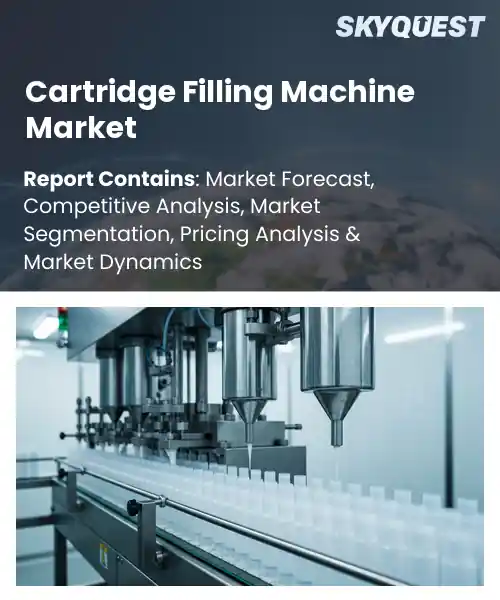
Cartridge Filling Machine Market
Report ID: SQMIG20I2698
Report ID: SQMIG20I2698
[email protected]
USA +1 351-333-4748
Report ID:
SQMIG20I2698 |
Region:
Global |
Published Date: February, 2026
Pages:
157
|Tables:
151
|Figures:
78


Global Cartridge Filling Machine Market size was valued at USD 1.01 Billion in 2024 and is poised to grow from USD 1.06 Billion in 2025 to USD 1.5 Billion by 2033, growing at a CAGR of 4.5% during the forecast period (2026-2033).
The primary driver of the cartridge filling machine market is the accelerating need for precise, high‑throughput dispensing across pharmaceuticals, cosmetics and adhesives. This market supplies automated machinery that fills cartridges with liquids, gels, pastes and viscous formulations, and it matters because accurate dosing reduces product waste, ensures regulatory compliance, and enables production scaling. Over time, the industry moved from manual and semi‑automatic piston fillers in small workshops to fully automated rotary and servo‑driven lines by contract manufacturers and brand owners. For example, pharmaceutical companies adopted aseptic cartridge filling after stricter GMPs while adhesive producers deployed high‑viscosity metering to improve consistency.Building on the need for precision, the primary growth factor is technological innovation that delivers measurable operational benefits. When manufacturers integrate servo drives, PLC controls and vision inspection, filling accuracy improves and downtime falls, which reduces material loss and lowers cost per unit, prompting further investment in automation. Real‑world use cases include a cosmetics contract packer whose piston fillers with servo control doubled throughput while cutting rejects, and a pharmaceutical aseptic line that lowered contamination risk through enclosed rotary systems. Consequently, opportunities emergefor modular retrofits, IoT‑enabled predictive maintenance and tailored machines for regional producers rapidly seeking quality at scale.
Recent market developments underscore significant shifts in cartridge filling machine market sector dynamics. West Pharmaceutical Services in January 2026 launched the Synchrony prefillable syringe system, offering multiple configuration options and a verified system-level approach that streamlines syringe selection and supply continuity for biologics and vaccines while positioning the company as a single-source provider of integrated syringe system solutions for development and commercial supply.
Growing demand for automated and reliable filling solutions in the pharmaceuticals, cosmetics, food & beverage, and chemical industries is driving rapid global cartridge filling machine market growth. These machines are widely used to package semi-liquid and viscous products such as pharmaceuticals, cosmetics, foods, liquids, and chemicals into cartridges, syringes, tubes, and cartridges with high accuracy, and very little spoilage of the filled product.
The pharmaceutical industry continues to be one of the largest end-users globally due to increasingly strict regulatory compliance requirements regarding sterile and contamination-free manufacturing processes and strong growth in the production volume of oral care, injectable, and topical drugs. In addition, the rapid growth within the global cosmetics and personal care industry, driven primarily by the demand for creams, gels, and ointments, has led to an increase in demand for versatile, hygienic filling equipment.
Technologies such as fully automated filling systems, servo-motor controlled filling systems, touch screen interfaces, and real-time monitoring systems have all contributed to increasing production rates, reducing human error and facilitating the seamless integration of filling machines with upstream and downstream packaging lines. Continuing interest in industry 4.0 or smart manufacturing has stimulated investment in machines that can provide IoT connectivity and predictive maintenance.
Geographically, Asia-Pacific has emerged as an important cartridge filling machine market as a result of established manufacturing infrastructure, growth of pharmaceutical manufacturing and cosmetic manufacturing centres of excellence, and increased emphasis on export competitiveness.
How is Automation Improving Efficiency in the Cartridge Filling Machine Market?Automation is changing the way cartridge filling machines operate using robotic systems that can dose products accurately and provide accurate visual inspection methods of product quality control. Key features of the automated filling operation will include automated material handling, servo-controlled dosing delivery systems with inline inspection, which will reduce the amount of human touching the product and variability of product quality. The industry is also moving toward modular, scalable lines that allow for quick changeovers, reduced waste of raw materials, and improved hygiene when producing sensitive products. Manufacturers are turning to automation as a means to increase repeatability for cosmetics, adhesives and medical cartridges and are desiring to be able to produce small batches with improved throughput. These trends are shifting replacing manual labor with automated processes, encouraging retrofitting existing machines, and enabling smarter maintenance strategies to improve uptime.
Market snapshot - 2026-2033
Global Market Size
USD 1.01 Billion
Largest Segment
Fully Automatic
Fastest Growth
Fully Automatic
Growth Rate
4.5% CAGR
To get more insights on this market click here to Request a Free Sample Report
Global cartridge filling machine market is segmented into automation level, filling technology, cartridge type, capacity filling, end-use industry and region. Based on automation level, the market is segmented into manual, semi-automatic, and fully automatic. Based on filling technology, the market is segmented into volumetric, gravimetric, piston, auger, peristaltic, and others. Based on cartridge type, the market is segmented into plastic cartridges, glass cartridges,, and metal cartridges. Based on capacity filling, the market is segmented into low-capacity cartridge filling machines, medium-capacity cartridge filling machines, and high-capacity cartridge filling machines. Based on end-use industry, the market is segmented into pharmaceuticals, cosmetics & personal care, food & beverages, chemicals & adhesives, industrial lubricants, healthcare & medical devices, and others. Based on the region, the market is segmented into North America, Europe, Asia Pacific, Latin America and Middle East & Africa.
The cartridge filling machine market is primarily dominated by the fully automatic segment, owing to its capability of producing high volumes quickly, with great precision and very little human intervention. Fully automatic systems have been widely utilized in the pharmaceutical, cosmetic, and food processing industries due to their high degree of consistency and ability to meet high standards of hygiene and regulation. Fully automatic machines also improve the operational efficiency of their users and reduce the cost of labour and potential for human error, while providing seamless integration between upstream and downstream packaging lines. In addition, fully automatic machines are equipped with advanced features, such as PLCs, touch screens, and real-time monitoring, all of which contribute to their continued dominance in large-scale manufacturing operations.
As per the cartridge filling machine market outlook, semi-automatic segment is the fastest-growing segment in the market. This rapid growth can be attributed to the efforts of small and mid-sized manufacturers looking for a cost-effective way to automate their manufacturing processes. Manufacturers are currently using semi-automatic machines to boost productivity and automate their processes without the greater capital cost of more fully automated machines. In addition, semi-automatic machines are generally flexible, easy to operate, and scalable, making them attractive to new and growing businesses, as well as contract manufacturers that are gradually upgrading from manual operation to fully automatic systems.
As per global cartridge filling machine market forecast, the piston filling segment currently dominates the market because of its versatility and high accuracy in handling viscous and semi-viscous products such as creams, gels, adhesives, and ointments. Consequently, the piston filler is a common choice in both the pharmaceutical and cosmetic industries because it provides consistent dosing, less product waste, and an ability to accommodate a wide range of viscosities. The robust design of piston fillers also contributes to their prominent position in the marketplace, especially with respect to production consistency in continuous production environments.
As per global cartridge filling machine market analysis, the peristaltic filling segment is experiencing the highest growth. This trend can be attributed to the increasing demand for filling processes that are sterile, free from contamination and gentle on the filled product, particularly within the pharmaceutical, biotechnology and high-end specialty chemical markets. The peristaltic filling process reduces the amount of time that filled products meet machine parts, thereby addressing the cross-contamination issue and keeping the machine clean. As the regulatory environment becomes more stringent and the demand for precision-based sterile packaging increases, the adoption of peristaltic filling systems continues to grow.
To get detailed segments analysis, Request a Free Sample Report
The Asia Pacific is recognized as the leading region for cartridge filling machines due to the established bases of manufacturing, electronics production, and pharmaceutical production. There is also an extensive network of suppliers for quick customization and scalability. Some of the advantages that the Asia Pacific has over its competitors are advanced automation experience, leading industrial companies have established advanced mechatronics systems, and there is a strong culture of continuous improvement, which supports the efficient integration of filling solutions into complicated manufacturing operations.
As per global cartridge filling machine market regional outlook, the Japan industry operates as one of the markets in the Asia Pacific and is characterized by a high degree of advanced precision engineering, a long-established culture of industrial automation and well-correlated relationships between equipment manufacturers and high-value end-users. The primary markets in Japan, which drive the demand for cartridge filling machines, are the medical device industries, specialty chemical industries, and packaging industries that manufacture electronics. Japanese cartridge filling manufacturers place great emphasis on producing high-quality, modular solutions and providing superior service to end users. Additionally, there is many well-established domestic suppliers in Japan that provide rapid technical support and tailored solutions to assist end-users in maintainingthe continuity of critical manufacturing processes.
As per global cartridge filling machine industry analysis, South Korea industry consists of large electronics manufacturing clusters, as well as a growing medical device industry operating and utilizing cartridge filling machines in their product lines, which require compact, high-precision filling machines. The South Korean manufacturers of cartridge filling machines utilize advanced controls and robotics to provide integrated systems that enable high-speed product changeovers.
There is rapid growth in both North America, driven by robust demand from the pharmaceutical, personal care, and specialty chemical industries, which need dependable and compliant filling solutions. The momentum in these sectors is aided by a strong existing base of contract manufacturing, increased emphasis on automation and data connectivity to assure quality control, and the desire for adaptable systems that enable quick product change.
The cartridge filling machine market in the United States is robust, fueled by the demand for validated, data-enabled filling solutions among pharmaceutical, biotech, and specialty consumer products manufacturers. Regulatory compliance and traceability requirements drive the development of integrated systems with environmental controls. Manufacturers and contract manufacturers in the United States prefer using modular systems for quick changeovers. Extensive local service networks and engineers provide fast installation, qualification, and performance support across all types of production environments.
As per global cartridge filling machine market forecast, Canada is affected by contract manufacturing and specialty markets looking for flexibility, hygienic design, and strong supplier support. There is high demand for user-friendly machines that are easy to clean, quick to change over, and reliable for validation of documentation. Domestic and regional suppliers emphasize turnkey solutions and aftermarket support, while working with local research organizations to meet the unique needs of niche formulations and small batch production and market entry.
The combination of Europe's legacy of precision engineering, strong laws and policies for handling hazards at work, and strong interest in sustainable/efficient processes supports a growing need for new technology used to fill out products. European manufacturers who produce filling systems pay close attention to their machining quality, design to support a hygienic manufacturing environment, and processes that make validation easier to meet the most demanding requirements of pharmaceutical/cosmetic industries. Through collaborative partnerships between machine suppliers, research institutions, and their customers, manufacturers can produce modular energy-saving systems capable of filling outvarious types of products. Manufacturers of filling systems can also retrofit or upgrade older filling machines to extend their useful operating life, because they are able to work with local service providers who can maintain those machines to the highest standards required under regulation.
The cartridge filling equipment market in Germany leverages proficiency in engineering and automation technologies to specifically address the demanding requirements of pharmaceutical and specialty chemical manufacturers. Manufacturers emphasize providing a hygienic machine design, a durable machine build, and full qualification services to minimize integration problems into a regulated manufacturing environment.
The UK cartridge filling machine market is characterized by a growing pharmaceutical industry and an increasing number of specialty consumer products companies who require validated, flexible filling systems. Equipment Suppliers generally emphasize modularity to facilitate rapid changeover of products and minimize complexity with validation. Equipment suppliers emphasize providing collaborative business models through engineering consulting and providing a well-established local parts and service capability to facilitate timelyinstallation and ongoing maintenance throughout the lifecycle of the equipment.
In France, the cartridge filling machine market is driven primarily by the cosmetic sector and the pharmaceutical sector, both requiring hygienic filling processes and extreme accuracy. Manufacturers are focusing on filling machines that provide gentle handling of product in addition to being easy to clean and qualify for the filling machine. Local manufacturers of equipment provide customized designs for ergonomic operation and seamless integration with their packaging equipment.
To know more about the market opportunities by region and country, click here to
Buy The Complete Report
Rising Demand for Portable Devices
As the use of cartridges in personal care, medical and industrial applications continue to grow; manufacturers are focusing on machines that provide consistent fill volume and contamination control. As a result, suppliers are developing specific cartridge filling equipment that can accommodate a range of formulations and container formats, while maintaining product integrity. With customers looking for an effective, scalable solution for new product launches and unique package design, filling technology becomes an integral component of production strategy making substantial contributions to market activity through upgrades of existing equipment, retrofits and procurement decisions that emphasize performance and compliance with regulations.
Increase in Adoption of Automation
The global cartridge filling machine market trend towards automating the production of pharmaceuticals and consumer goods is encouraging manufacturers to adopt cartridge filling machines that improve throughput while minimizing variability. Automated solutions provide consistent doses, allow for frequent changeovers, and enable the capture of traceability data. As a result, automating the cartridge filling process aligns well with the quality assurance initiatives and operational efficiency objectives of organizations. By streamlining processes and decreasing manual intervention, automation helps organizations address workforce shortages while ensuring production continuity. Therefore, suppliers that offer enhanced automation capabilities will see greater success in the marketplace as manufacturers favour systems that improve productivity, reduce defect rates, and enable scalable operation of multiple product lines.
Stringent Regulatory Compliance
Regulatory compliance for sterile filling, product safety, and packaging traceability can create complicated regulatory environments requiring extensive validation, documentation, and compliance with established manufacturing protocols which will inevitably delay equipment deployment. Companies must allocate resources to qualify forfilling machines, modify processes, and continue compliance which delays production increases and creates disincentives to rapidly implement new technology. This regulatory burden will increase the length of project timelines and operational overhead; therefore, resulting in cautious purchasing decisions/restrictive investment practices that will inhibit expansion into new markets even though there is market demand for advanced filling technologies.
High Start-Up Costs
Modern cartridge filling machinery, which includes automation, clean room interfaces, and validation assistance, has an extravagant initial cost barrier for small or medium-sized producers. This high initial cost discourages companies from introducing new filling technologies and causes most companies to invest only in existing production processes or defer the replacement of equipment, which limits the market penetration of advanced filling technology. Financial considerations will influence purchasing cycles, favoring leasing/incremental upgrades over comprehensive investments creating a slowdown in the diffusion of new filling technologies across the marketplace with current customers even though there will be long-term benefits from their operational use.
Request Free Customization of this report to help us to meet your business objectives.
The global cartridge filling machine industry is highly competitive and consists of several types of competition strategies, including using different technologies to create better solutions, forming strategic partnerships to access regulated smoking cannabis and pharmaceutical industries, and making selective acquisitions for adding downstream packaging or services capabilities through partnerships that have been recently established.
Modular Automation Adoption: Several manufacturers are beginning to implement modular & configurable cartridge filling systems that allow for fast and flexible configuration of multiple formats as well as small batch production. Some of the elements associated with this type of system design is the use of products that are interoperable, plug and play modules, and are based on simple mechanical configuration to reduce the complexity of operations and speed of time to product launch. Many manufacturers have identifiedscalable architecture and equipment design as a means of extending the life of equipment and accommodating continuously evolving formulation and packaging requirements.
Integrating Sustainable Materials: Machine manufacturers have begun to develop and implement technologies which will support the production of recyclable, biodegradable, & low-solvent cartridge materials due to the increased demand for environmentally friendly packaging. Engineering is now placing greater emphasis on contamination control, gentle handling, and adjustable fill profiles while maintaining product integrity and promoting circular material usage. In addition to material suppliers collaborating with machine manufacturers to develop advanced materials for seals, dosing systems, and cleaning protocols to minimize waste, reduce available waste, and implement re-use strategies, the overall focus on sustainability will help to position valuable brands, support the objectives of extended producer responsibility, and create an environment conducive for ongoing capital investment in circular manufacturing capabilities.
SkyQuest’s ABIRAW (Advanced Business Intelligence, Research & Analysis Wing) is our Business Information Services team that Collects, Collates, Correlates, and Analyses the Data collected by means of Primary Exploratory Research backed by robust Secondary Desk research.
As per SkyQuest analysis, the global cartridge filling machine market is seeing consistent growth, mainly fueled by the increased need for cartridge filling in pharmaceutical, cosmetic, and specialty chemicals industries that require highly accurate, hygienic, and automated filling solutions. Another key global cartridge filling machine market trend in driving growth is the increased use of advanced automation, smart controls, and integrated packaging systems which provide greater efficiency and reduce waste. The high initialinvestment and maintenance costs of cartridge filling equipment also serve to constrain the market, especially for smaller manufacturers. In terms of regional growth, Asia-Pacific is currently the fastest developing region due to the importance of growing manufacturing activities; however, North America and Europe remain major contributors to product volume driven largely by their existing infrastructure and extensive regulations regarding quality. The market holds a significant cartridge filling machine market share within the broader packaging machinery industry, supported by strong demand from pharmaceutical, cosmetics, and specialty chemical manufacturing sectors.
| Report Metric | Details |
|---|---|
| Market size value in 2024 | USD 1.01 Billion |
| Market size value in 2033 | USD 1.5 Billion |
| Growth Rate | 4.5% |
| Base year | 2024 |
| Forecast period | 2026-2033 |
| Forecast Unit (Value) | USD Billion |
| Segments covered |
|
| Regions covered | North America (US, Canada), Europe (Germany, France, United Kingdom, Italy, Spain, Rest of Europe), Asia Pacific (China, India, Japan, Rest of Asia-Pacific), Latin America (Brazil, Rest of Latin America), Middle East & Africa (South Africa, GCC Countries, Rest of MEA) |
| Companies covered |
|
| Customization scope | Free report customization with purchase. Customization includes:-
|
To get a free trial access to our platform which is a one stop solution for all your data requirements for quicker decision making. This platform allows you to compare markets, competitors who are prominent in the market, and mega trends that are influencing the dynamics in the market. Also, get access to detailed SkyQuest exclusive matrix.
Table Of Content
Executive Summary
Market overview
Parent Market Analysis
Market overview
Market size
KEY MARKET INSIGHTS
COVID IMPACT
MARKET DYNAMICS & OUTLOOK
Market Size by Region
KEY COMPANY PROFILES
Methodology
For the Cartridge Filling Machine Market, our research methodology involved a mixture of primary and secondary data sources. Key steps involved in the research process are listed below:
1. Information Procurement: This stage involved the procurement of Market data or related information via primary and secondary sources. The various secondary sources used included various company websites, annual reports, trade databases, and paid databases such as Hoover's, Bloomberg Business, Factiva, and Avention. Our team did 45 primary interactions Globally which included several stakeholders such as manufacturers, customers, key opinion leaders, etc. Overall, information procurement was one of the most extensive stages in our research process.
2. Information Analysis: This step involved triangulation of data through bottom-up and top-down approaches to estimate and validate the total size and future estimate of the Cartridge Filling Machine Market.
3. Report Formulation: The final step entailed the placement of data points in appropriate Market spaces in an attempt to deduce viable conclusions.
4. Validation & Publishing: Validation is the most important step in the process. Validation & re-validation via an intricately designed process helped us finalize data points to be used for final calculations. The final Market estimates and forecasts were then aligned and sent to our panel of industry experts for validation of data. Once the validation was done the report was sent to our Quality Assurance team to ensure adherence to style guides, consistency & design.
Analyst Support
Customization Options
With the given market data, our dedicated team of analysts can offer you the following customization options are available for the Cartridge Filling Machine Market:
Product Analysis: Product matrix, which offers a detailed comparison of the product portfolio of companies.
Regional Analysis: Further analysis of the Cartridge Filling Machine Market for additional countries.
Competitive Analysis: Detailed analysis and profiling of additional Market players & comparative analysis of competitive products.
Go to Market Strategy: Find the high-growth channels to invest your marketing efforts and increase your customer base.
Innovation Mapping: Identify racial solutions and innovation, connected to deep ecosystems of innovators, start-ups, academics, and strategic partners.
Category Intelligence: Customized intelligence that is relevant to their supply Markets will enable them to make smarter sourcing decisions and improve their category management.
Public Company Transcript Analysis: To improve the investment performance by generating new alpha and making better-informed decisions.
Social Media Listening: To analyze the conversations and trends happening not just around your brand, but around your industry as a whole, and use those insights to make better Marketing decisions.
REQUEST FOR SAMPLE
 REQUEST FREE CUSTOMIZATION
Global Cartridge Filling Machine Market size was valued at USD 1.01 Billion in 2024 and is poised to grow from USD 1.06 Billion in 2025 to USD 1.5 Billion by 2033, growing at a CAGR of 4.5% during the forecast period (2026-2033).
Competition in the global cartridge filling machine market centers on technology differentiation, strategic partnerships, and targeted consolidation. Rivalry is driven by vendors deploying machine vision and AI to cut fill variability, by alliances to access regulated cannabis and pharma channels, and by selective acquisitions to add downstream packaging or service capabilities, as seen in recent product launches and partner integrations by market entrants. 'Syntegon Technology GmbH', 'Krones AG', 'Optima Packaging Group GmbH', 'GEA Group AG', 'IMA S.p.A.', 'Coesia S.p.A.', 'Bausch+Ströbel Maschinenfabrik', 'Romaco Group', 'Cozzoli Machine Company', 'Filamatic', 'Dara Pharmaceutical Packaging', 'ProSys Servo Filling Systems, Inc.', 'Naf-Naf Filling Systems', 'Liquid Technologies, Inc.', 'Marchesini Group S.p.A.', 'Nannini Renato S.r.l.', 'Changzhou MIC Machinery Co., Ltd.', 'Vanguard Pharmaceutical Machinery (Dover)', 'Spee-Dee Packaging Industry, Inc.', 'TurboFil Packaging Machines'
Considering the expanding use of cartridges in personal care, medical, and industrial applications, manufacturers are prioritizing machines that deliver consistent fill volumes and contamination control. This demand encourages vendors to develop specialized cartridge filling equipment that can handle diverse formulations and container formats while maintaining product integrity. As customers seek reliable, scalable solutions for new product launches and differentiated packaging, investment in filling technology becomes central to production strategies, driving market activity through equipment upgrades, retrofits, and procurement decisions focused on performance and regulatory compatibility.
Asia Pacific Dominates the Global Cartridge Filling Machine Market


Want to customize this report? This report can be personalized according to your needs. Our analysts and industry experts will work directly with you to understand your requirements and provide you with customized data in a short amount of time. We offer $1000 worth of FREE customization at the time of purchase.
Feedback From Our Clients


 USA (+1) 351-333-4748

