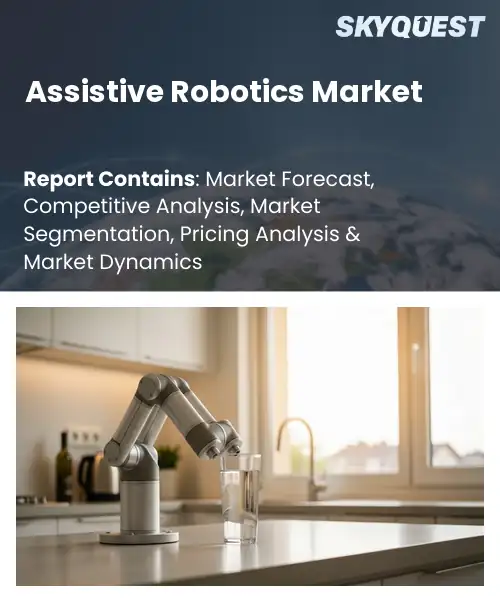
Assistive Robotics Market

Report ID: SQMIG35A4036

[email protected]
USA +1 351-333-4748

Assistive Robotics Market Size, Share, and Growth Analysis

Assistive Robotics Market

Assistive Robotics Market By Robot Type (Mobility Assistance Robots, Rehabilitation Robots, Social Assistance Robots, Others), By Application, By End User, By Mobility, By Operation Mode, By Sales Channel, By Region - Industry Forecast 2026-2033


Report ID: SQMIG35A4036 | Region: Global | Published Date: July, 2026
Pages: 157 |Tables: 172 |Figures: 79

Format - word format excel data power point presentation

Assistive Robotics Market Insights

Global Assistive Robotics Market size was valued at USD 3.42 Billion in 2024 and is poised to grow from USD 4.06 Billion in 2025 to USD 16.0 Billion by 2033, growing at a CAGR of 18.7% during the forecast period (2026-2033).

The global assistive robotics market includes systems that help individuals with physical, cognitive, or sensory limitations, from exosuits to hospital robotic arms. Its importance arises from an aging population and increasing chronic disability, which together create steady, significant demand for technologies that can perform daily tasks independently. The sector appeared in the early 2000s as research prototypes, advanced with AI‑driven perception in the 2010s, and gained momentum after COVID‑19 highlighted remote caregiving needs. Japan’s “HAL” exoskeleton, a laboratory model in 2005, became a commercial aid for elderly users by 2018, showing how demographic shifts and policy global support have driven overall market growth. Building on the demographic impulse outlined earlier, the primary growth catalyst now is the fusion of sophisticated sensors with cloud‑based AI, which turns basic assistive tools into adaptive companions that learn user habits. Because robots can monitor vitals and adjust mobility support in real time, hospitalization expenses decline, prompting insurers to reimburse these services. SoftBank Robotics, for instance, places Pepper units in assisted‑living homes where bots analyze movement patterns and issue alerts that prevent falls, demonstrating cost benefits for providers. As a result, investors allocate capital to startups focused on modular hardware and open‑source learning algorithms, broadening market scope and encouraging cross‑industry partnerships.

How is AI-driven automation shaping the assistive robotics market?

AI-driven automation is redefining the assistive robotics market by embedding intelligent perception, adaptive control, and predictive assistance into devices that support daily living and rehabilitation. Modern assistive robots now combine sensor fusion with machine‑learning models to recognize user intent, adjust motion in real time, and personalize support based on individual needs. This shift moves products from simple repetitive tools toward collaborative companions that can learn from interaction, reduce caregiver burden, and enhance safety. The market is responding with a surge of research collaborations, integration of cloud‑based AI services, and a focus on user‑centric design that makes technology feel intuitive and trustworthy.International Federation of Robotics, Jan 2026, unveiled a new AI‑enabled assistive arm that streamlines home care tasks, illustrating how automation accelerates product adoption and improves efficiency in the sector.

Market snapshot - (2026-2033)

Global Market Size

USD 3.42 Billion

Largest Segment

Mobility Assistance Robots

Fastest Growth

Social Assistance Robots

Growth Rate

18.7% CAGR

Assistive Robotics Market ($ Bn)
Country Share for North America Region (%)

To get more insights on this market click here to Request a Free Sample Report

Assistive Robotics Market Segments Analysis

Global assistive robotics market is segmented by robot type, application, end user, mobility, operation mode, sales channel and region. Based on robot type, the market is segmented into Mobility Assistance Robots, Rehabilitation Robots, Social Assistance Robots and Others. Based on application, the market is segmented into Elderly Care, Disability Assistance, Rehabilitation Therapy and Others. Based on end user, the market is segmented into Hospitals, Rehabilitation Centers, Homecare and Others. Based on mobility, the market is segmented into Stationary Robots and Mobile Robots. Based on operation mode, the market is segmented into Autonomous Robots and Semi-Autonomous Robots. Based on sales channel, the market is segmented into Direct Sales, Distributors and Others. Based on region, the market is segmented into North America, Europe, Asia Pacific, Latin America and Middle East & Africa.

What role do mobility assistance robots play in transforming the assistive robotics market?

Mobility Assistance Robots segment dominates because they directly address the core need for movement support among aging and disabled populations, making them indispensable in daily living environments. Their ability to navigate complex indoor spaces, provide safe ambulation, and integrate with smart home ecosystems creates strong demand across care settings. This functional relevance, combined with continuous sensor and AI improvements, reinforces their central position in the Assistive Robotics Market.

However, Social Assistance Robots are witnessing the strongest growth momentum as they expand beyond companionship to include mental health monitoring and interactive therapy. Advances in natural language processing and affective computing enable richer human robot interaction, attracting investments from care providers seeking holistic wellbeing solutions. This capability is accelerating market expansion and opens new revenue streams.

what role does elderly care play in shaping the assistive robotics market?

Elderly Care segment dominates because it represents the largest and most immediate demand pool for assistive technologies, driven by demographic shifts toward older populations requiring support for daily activities. Providers prioritize solutions that enhance independence, reduce caregiver burden, and improve safety, prompting sustained investment in robot platforms tailored for this group. Consequently, product roadmaps and partnership strategies largely revolve around meeting elderly-specific functional and regulatory requirements.

Meanwhile, Rehabilitation Therapy is emerging as the key high growth area as clinicians adopt robotics for precise repeatable exercises that accelerate patient recovery. Integration with data analytics enables tailored therapy protocols, attracting funding from health systems eager to improve outcomes while managing costs. This adoption expands market reach beyond traditional care settings, creating new channels for robot deployment and stimulating innovation pipelines.

Assistive Robotics Market By Robot Type

To get detailed segments analysis, Request a Free Sample Report

Assistive Robotics Market Regional Insights

Why does North America Dominate the Global Assistive Robotics Market?

North America maintains a leadership position through a convergence of advanced research infrastructure, strong ecosystem of technology innovators, and extensive healthcare networks that readily adopt cutting‑edge solutions. Robust collaboration between academic institutions and industry accelerates product development, while generous funding mechanisms support long‑term innovation pipelines. Integration of assistive robotics into home care and clinical settings is facilitated by a mature regulatory framework that balances safety with agility. The market benefits from a culture that embraces digital transformation, a skilled workforce, and a consumer base that is receptive to technology that enhances independence and quality of life.

United States Assistive Robotics Market

Assistive Robotics Market in United States benefits from a deep talent pool, leading research universities, and a vibrant venture capital landscape that fuels startup growth. Partnerships between hospitals and technology firms accelerate real‑world testing, while policy incentives encourage adoption in both acute and long‑term care environments. Consumer acceptance is high, driven by a societal emphasis on independent living and aging in place, which propels continuous refinement of robotic solutions.

Canada Assistive Robotics Market

Assistive Robotics Market in Canada is shaped by strong governmental support for health innovation and collaborative public‑private initiatives that bridge research and deployment. Emphasis on universal healthcare access creates a receptive environment for technologies that improve service efficiency and patient outcomes. Regional clusters of expertise foster knowledge exchange, and a focus on inclusive design ensures solutions meet diverse user needs across urban and remote communities.

Assistive Robotics Market By Geography
  • Largest
  • Fastest

To know more about the market opportunities by region and country, click here to
Buy The Complete Report

Assistive Robotics Market Dynamics

Drivers

Aging Population Driving Demand

  • The global increase in elderly individuals creates a growing need for assistance in daily activities, prompting healthcare providers and families to seek robotic solutions that enhance independence and safety. As mobility challenges and chronic conditions become more prevalent, assistive robots are perceived as essential tools to reduce caregiver burden and improve quality of life, thereby stimulating sustained interest, investment, and product development across the industry. This demographic shift also encourages policymakers to prioritize funding for innovative assistive technologies, further accelerating market expansion.

Advancements In Sensor Technology

  • Recent breakthroughs in sensor accuracy, miniaturization, and real‑time data processing enable robots to interact more naturally with users, adapting to subtle movements and environmental changes. These capabilities increase confidence among end‑users and clinicians, fostering broader acceptance and integration of assistive robots into home and clinical settings. The enhanced perception and responsiveness also open new application possibilities, prompting manufacturers to invest in sophisticated platforms that meet evolving user expectations. Consequently, developers are accelerating research cycles to incorporate artificial intelligence, further enriching interaction quality and expanding market appeal.

Restraints

High Costs Limiting Adoption

  • The sophisticated hardware, advanced sensors, and extensive software integration required for assistive robots result in premium price points that many individuals and institutions find prohibitive. Cost concerns deter potential buyers, especially in regions with limited healthcare budgets, and impede widespread deployment in homes and care facilities. Consequently, organizations often delay procurement decisions, opting for conventional aids until economies of scale drive prices down, thereby slowing overall market momentum. This financial barrier also restricts research funding for new designs, limiting innovation pipelines and further constraining market growth.

Regulatory Compliance Complexity

  • Assistive robotics must adhere to stringent safety standards, medical device classifications, and data privacy regulations across multiple jurisdictions, creating a complex compliance landscape. Navigating these requirements demands extensive testing, certification processes, and continual updates, which prolong time‑to‑market and increase development costs. Manufacturers therefore face uncertainty regarding regulatory approval timelines, causing hesitation in product launches and limiting the speed at which innovative solutions reach end‑users. Additionally, divergent regional policies often require duplicate documentation, further straining resources and discouraging smaller firms from entering the market, which narrows competitive dynamics.

Request Free Customization of this report to help us to meet your business objectives.

Assistive Robotics Market Competitive Landscape

The competitive landscape is shaped by aggressive M&A activity, strategic partnerships, and rapid tech innovation, with companies leveraging advanced AI, sensor integration, and modular designs to differentiate their assistive solutions; recent collaborations between robotics firms and healthcare providers accelerate market entry, while high‑profile acquisitions consolidate capabilities and expand global reach.

  • All3: Established in 2022, their main objective is to automate construction site tasks and improve worker safety. Recent development: secured $25 million seed funding, bringing total disclosed capital to at least $55 million, enabling expansion of its robotic brick‑laying platform.
  • Smart Robotics: Established in 2021, their main objective is to provide turnkey robotic automation services for manufacturers. Recent development: raised €10 million in a Series A round, funding the rollout of its AI‑driven robotic cells across European production facilities.

Top Player’s Company Profile

  • Ekso Bionics Holdings, Inc.
  • ReWalk Robotics Ltd.
  • Cyberdyne Inc.
  • Honda Motor Co., Ltd.
  • Toyota Motor Corporation
  • SoftBank Robotics Group Corp.
  • Kinova Inc.
  • Kinova Robotics
  • Focal Meditech B.V.
  • Bionik Laboratories Corp.
  • Fourier Intelligence Co., Ltd.
  • Hocoma AG
  • RoboCT Technology Development Co., Ltd.
  • Miko AI
  • Aeolus Robotics Corporation
  • PAL Robotics S.L.
  • F&P Robotics AG
  • UBTECH Robotics Corp. Ltd.
  • Diligent Robotics Inc.
  • Hello Robot Inc.

Recent Developments

  • SoftBank Robotics Group launches Pepper Pro Assist in July 2025, an upgraded service robot with integrated AI for elder care, featuring multimodal interaction and autonomous navigation in home environments. It supports remote health monitoring and communicates with care providers, enabling personalized assistance and reducing caregiver workload. The platform also integrates voice‑activated medication reminders and fall‑detection alerts.
  • Honda Motor Co. unveiled the WALK‑Assist X exoskeleton in May 2025 for post‑stroke rehabilitation, combining lightweight carbon‑fiber frame with AI‑driven gait analysis, allowing users to regain mobility at home. The system syncs with a cloud platform, offering therapists real‑time progress data and adaptive training programs. It also features customizable support straps and intuitive voice commands for independent operation.
  • Ekso Bionics Holdings secured a strategic partnership with Kinova Inc. in March 2025 to integrate Kinova’s modular robotic arm into Ekso’s upper‑limb exosuit, delivering enhanced dexterity for users with spinal cord injuries. The combined solution enables precise object manipulation and seamless transition between assistance modes in daily activities. Clinical trials report increased independence and reduced fatigue among participants.

Assistive Robotics Key Market Trends

Assistive Robotics Market SkyQuest Analysis

SkyQuest’s ABIRAW (Advanced Business Intelligence, Research & Analysis Wing) is our Business Information Services team that Collects, Collates, Correlates, and Analyses the Data collected by means of Primary Exploratory Research backed by robust Secondary Desk research. As per SkyQuest analysis, the global assistive robotics market is being propelled primarily by the aging population, which creates urgent demand for devices that enhance independence and safety, while advances in sensor technology serve as a second strong catalyst by enabling more intuitive and responsive robots. Mobility Assistance Robots remain the dominating segment because they directly address movement challenges, and North America is the leading region thanks to its robust research ecosystem and early adoption in healthcare. However, high costs continue to restrain broader uptake, especially in budget‑constrained settings, tempering the market’s otherwise rapid expansion. This dynamic is encouraging investors to fund AI‑driven personalization and cloud‑based platforms that further broaden applications across home and clinical environments.

Report Metric Details
Market size value in 2024 USD 3.42 Billion
Market size value in 2033 USD 16.0 Billion
Growth Rate 18.7%
Base year 2024
Forecast period (2026-2033)
Forecast Unit (Value) USD Billion
Segments covered
  • Robot Type
    • Mobility Assistance Robots
    • Rehabilitation Robots
    • Social Assistance Robots
    • Others
  • Application
    • Elderly Care
    • Disability Assistance
    • Rehabilitation Therapy
    • Others
  • End User
    • Hospitals
    • Rehabilitation Centers
    • Homecare
    • Others
  • Mobility
    • Stationary Robots
    • Mobile Robots
  • Operation Mode
    • Autonomous Robots
    • Semi-Autonomous Robots
  • Sales Channel
    • Direct Sales
    • Distributors
    • Others
Regions covered North America (US, Canada), Europe (Germany, France, United Kingdom, Italy, Spain, Rest of Europe), Asia Pacific (China, India, Japan, Rest of Asia-Pacific), Latin America (Brazil, Rest of Latin America), Middle East & Africa (South Africa, GCC Countries, Rest of MEA)
Companies covered
  • Ekso Bionics Holdings, Inc.
  • ReWalk Robotics Ltd.
  • Cyberdyne Inc.
  • Honda Motor Co., Ltd.
  • Toyota Motor Corporation
  • SoftBank Robotics Group Corp.
  • Kinova Inc.
  • Kinova Robotics
  • Focal Meditech B.V.
  • Bionik Laboratories Corp.
  • Fourier Intelligence Co., Ltd.
  • Hocoma AG
  • RoboCT Technology Development Co., Ltd.
  • Miko AI
  • Aeolus Robotics Corporation
  • PAL Robotics S.L.
  • F&P Robotics AG
  • UBTECH Robotics Corp. Ltd.
  • Diligent Robotics Inc.
  • Hello Robot Inc.
Customization scope

Free report customization with purchase. Customization includes:-

  • Segments by type, application, etc
  • Company profile
  • Market dynamics & outlook
  • Region

To get a free trial access to our platform which is a one stop solution for all your data requirements for quicker decision making. This platform allows you to compare markets, competitors who are prominent in the market, and mega trends that are influencing the dynamics in the market. Also, get access to detailed SkyQuest exclusive matrix.

Table Of Content

Executive Summary

Market overview

  • Exhibit: Executive Summary – Chart on Market Overview
  • Exhibit: Executive Summary – Data Table on Market Overview
  • Exhibit: Executive Summary – Chart on Assistive Robotics Market Characteristics
  • Exhibit: Executive Summary – Chart on Market by Geography
  • Exhibit: Executive Summary – Chart on Market Segmentation
  • Exhibit: Executive Summary – Chart on Incremental Growth
  • Exhibit: Executive Summary – Data Table on Incremental Growth
  • Exhibit: Executive Summary – Chart on Vendor Market Positioning

Parent Market Analysis

Market overview

Market size

  • Market Dynamics
    • Exhibit: Impact analysis of DROC, 2021
      • Drivers
      • Opportunities
      • Restraints
      • Challenges
  • SWOT Analysis

KEY MARKET INSIGHTS

  • Technology Analysis
    • (Exhibit: Data Table: Name of technology and details)
  • Pricing Analysis
    • (Exhibit: Data Table: Name of technology and pricing details)
  • Supply Chain Analysis
    • (Exhibit: Detailed Supply Chain Presentation)
  • Value Chain Analysis
    • (Exhibit: Detailed Value Chain Presentation)
  • Ecosystem Of the Market
    • Exhibit: Parent Market Ecosystem Market Analysis
    • Exhibit: Market Characteristics of Parent Market
  • IP Analysis
    • (Exhibit: Data Table: Name of product/technology, patents filed, inventor/company name, acquiring firm)
  • Trade Analysis
    • (Exhibit: Data Table: Import and Export data details)
  • Startup Analysis
    • (Exhibit: Data Table: Emerging startups details)
  • Raw Material Analysis
    • (Exhibit: Data Table: Mapping of key raw materials)
  • Innovation Matrix
    • (Exhibit: Positioning Matrix: Mapping of new and existing technologies)
  • Pipeline product Analysis
    • (Exhibit: Data Table: Name of companies and pipeline products, regional mapping)
  • Macroeconomic Indicators

COVID IMPACT

  • Introduction
  • Impact On Economy—scenario Assessment
    • Exhibit: Data on GDP - Year-over-year growth 2016-2022 (%)
  • Revised Market Size
    • Exhibit: Data Table on Assistive Robotics Market size and forecast 2021-2027 ($ million)
  • Impact Of COVID On Key Segments
    • Exhibit: Data Table on Segment Market size and forecast 2021-2027 ($ million)
  • COVID Strategies By Company
    • Exhibit: Analysis on key strategies adopted by companies

MARKET DYNAMICS & OUTLOOK

  • Market Dynamics
    • Exhibit: Impact analysis of DROC, 2021
      • Drivers
      • Opportunities
      • Restraints
      • Challenges
  • Regulatory Landscape
    • Exhibit: Data Table on regulation from different region
  • SWOT Analysis
  • Porters Analysis
    • Competitive rivalry
      • Exhibit: Competitive rivalry Impact of key factors, 2021
    • Threat of substitute products
      • Exhibit: Threat of Substitute Products Impact of key factors, 2021
    • Bargaining power of buyers
      • Exhibit: buyers bargaining power Impact of key factors, 2021
    • Threat of new entrants
      • Exhibit: Threat of new entrants Impact of key factors, 2021
    • Bargaining power of suppliers
      • Exhibit: Threat of suppliers bargaining power Impact of key factors, 2021
  • Skyquest special insights on future disruptions
    • Political Impact
    • Economic impact
    • Social Impact
    • Technical Impact
    • Environmental Impact
    • Legal Impact

Market Size by Region

  • Chart on Market share by geography 2021-2027 (%)
  • Data Table on Market share by geography 2021-2027(%)
  • North America
    • Chart on Market share by country 2021-2027 (%)
    • Data Table on Market share by country 2021-2027(%)
    • USA
      • Exhibit: Chart on Market share 2021-2027 (%)
      • Exhibit: Market size and forecast 2021-2027 ($ million)
    • Canada
      • Exhibit: Chart on Market share 2021-2027 (%)
      • Exhibit: Market size and forecast 2021-2027 ($ million)
  • Europe
    • Chart on Market share by country 2021-2027 (%)
    • Data Table on Market share by country 2021-2027(%)
    • Germany
      • Exhibit: Chart on Market share 2021-2027 (%)
      • Exhibit: Market size and forecast 2021-2027 ($ million)
    • Spain
      • Exhibit: Chart on Market share 2021-2027 (%)
      • Exhibit: Market size and forecast 2021-2027 ($ million)
    • France
      • Exhibit: Chart on Market share 2021-2027 (%)
      • Exhibit: Market size and forecast 2021-2027 ($ million)
    • UK
      • Exhibit: Chart on Market share 2021-2027 (%)
      • Exhibit: Market size and forecast 2021-2027 ($ million)
    • Rest of Europe
      • Exhibit: Chart on Market share 2021-2027 (%)
      • Exhibit: Market size and forecast 2021-2027 ($ million)
  • Asia Pacific
    • Chart on Market share by country 2021-2027 (%)
    • Data Table on Market share by country 2021-2027(%)
    • China
      • Exhibit: Chart on Market share 2021-2027 (%)
      • Exhibit: Market size and forecast 2021-2027 ($ million)
    • India
      • Exhibit: Chart on Market share 2021-2027 (%)
      • Exhibit: Market size and forecast 2021-2027 ($ million)
    • Japan
      • Exhibit: Chart on Market share 2021-2027 (%)
      • Exhibit: Market size and forecast 2021-2027 ($ million)
    • South Korea
      • Exhibit: Chart on Market share 2021-2027 (%)
      • Exhibit: Market size and forecast 2021-2027 ($ million)
    • Rest of Asia Pacific
      • Exhibit: Chart on Market share 2021-2027 (%)
      • Exhibit: Market size and forecast 2021-2027 ($ million)
  • Latin America
    • Chart on Market share by country 2021-2027 (%)
    • Data Table on Market share by country 2021-2027(%)
    • Brazil
      • Exhibit: Chart on Market share 2021-2027 (%)
      • Exhibit: Market size and forecast 2021-2027 ($ million)
    • Rest of South America
      • Exhibit: Chart on Market share 2021-2027 (%)
      • Exhibit: Market size and forecast 2021-2027 ($ million)
  • Middle East & Africa (MEA)
    • Chart on Market share by country 2021-2027 (%)
    • Data Table on Market share by country 2021-2027(%)
    • GCC Countries
      • Exhibit: Chart on Market share 2021-2027 (%)
      • Exhibit: Market size and forecast 2021-2027 ($ million)
    • South Africa
      • Exhibit: Chart on Market share 2021-2027 (%)
      • Exhibit: Market size and forecast 2021-2027 ($ million)
    • Rest of MEA
      • Exhibit: Chart on Market share 2021-2027 (%)
      • Exhibit: Market size and forecast 2021-2027 ($ million)

KEY COMPANY PROFILES

  • Competitive Landscape
    • Total number of companies covered
      • Exhibit: companies covered in the report, 2021
    • Top companies market positioning
      • Exhibit: company positioning matrix, 2021
    • Top companies market Share
      • Exhibit: Pie chart analysis on company market share, 2021(%)

Methodology

For the Assistive Robotics Market, our research methodology involved a mixture of primary and secondary data sources. Key steps involved in the research process are listed below:

1. Information Procurement: This stage involved the procurement of Market data or related information via primary and secondary sources. The various secondary sources used included various company websites, annual reports, trade databases, and paid databases such as Hoover's, Bloomberg Business, Factiva, and Avention. Our team did 45 primary interactions Globally which included several stakeholders such as manufacturers, customers, key opinion leaders, etc. Overall, information procurement was one of the most extensive stages in our research process.

2. Information Analysis: This step involved triangulation of data through bottom-up and top-down approaches to estimate and validate the total size and future estimate of the Assistive Robotics Market.

3. Report Formulation: The final step entailed the placement of data points in appropriate Market spaces in an attempt to deduce viable conclusions.

4. Validation & Publishing: Validation is the most important step in the process. Validation & re-validation via an intricately designed process helped us finalize data points to be used for final calculations. The final Market estimates and forecasts were then aligned and sent to our panel of industry experts for validation of data. Once the validation was done the report was sent to our Quality Assurance team to ensure adherence to style guides, consistency & design.

Analyst Support

Customization Options

With the given market data, our dedicated team of analysts can offer you the following customization options are available for the Assistive Robotics Market:

Product Analysis: Product matrix, which offers a detailed comparison of the product portfolio of companies.

Regional Analysis: Further analysis of the Assistive Robotics Market for additional countries.

Competitive Analysis: Detailed analysis and profiling of additional Market players & comparative analysis of competitive products.

Go to Market Strategy: Find the high-growth channels to invest your marketing efforts and increase your customer base.

Innovation Mapping: Identify racial solutions and innovation, connected to deep ecosystems of innovators, start-ups, academics, and strategic partners.

Category Intelligence: Customized intelligence that is relevant to their supply Markets will enable them to make smarter sourcing decisions and improve their category management.

Public Company Transcript Analysis: To improve the investment performance by generating new alpha and making better-informed decisions.

Social Media Listening: To analyze the conversations and trends happening not just around your brand, but around your industry as a whole, and use those insights to make better Marketing decisions.

$5,300

REQUEST FOR SAMPLE

Please verify that you're not a robot to proceed!
Want to customize this report? REQUEST FREE CUSTOMIZATION

FAQs

Global Assistive Robotics Market size was valued at USD 3.42 Billion in 2024 and is poised to grow from USD 4.06 Billion in 2025 to USD 16.0 Billion by 2033, growing at a CAGR of 18.7% during the forecast period (2026-2033).

The competitive landscape is shaped by aggressive M&A activity, strategic partnerships, and rapid tech innovation, with companies leveraging advanced AI, sensor integration, and modular designs to differentiate their assistive solutions; recent collaborations between robotics firms and healthcare providers accelerate market entry, while high‑profile acquisitions consolidate capabilities and expand global reach. 'Ekso Bionics Holdings, Inc.', 'ReWalk Robotics Ltd.', 'Cyberdyne Inc.', 'Honda Motor Co., Ltd.', 'Toyota Motor Corporation', 'SoftBank Robotics Group Corp.', 'Kinova Inc.', 'Kinova Robotics', 'Focal Meditech B.V.', 'Bionik Laboratories Corp.', 'Fourier Intelligence Co., Ltd.', 'Hocoma AG', 'RoboCT Technology Development Co., Ltd.', 'Miko AI', 'Aeolus Robotics Corporation', 'PAL Robotics S.L.', 'F&P Robotics AG', 'UBTECH Robotics Corp. Ltd.', 'Diligent Robotics Inc.', 'Hello Robot Inc.'

The global increase in elderly individuals creates a growing need for assistance in daily activities, prompting healthcare providers and families to seek robotic solutions that enhance independence and safety. As mobility challenges and chronic conditions become more prevalent, assistive robots are perceived as essential tools to reduce caregiver burden and improve quality of life, thereby stimulating sustained interest, investment, and product development across the industry. This demographic shift also encourages policymakers to prioritize funding for innovative assistive technologies, further accelerating market expansion.

Ai-Driven Personalization Expands Care Scope: The integration of advanced artificial intelligence enables assistive robots to learn individual user habits, adapt movement patterns, and predict assistance needs in real time, delivering highly personalized support that enhances independence and reduces caregiver burden. As algorithms become more context‑aware, devices can seamlessly transition between tasks such as medication reminders, mobility assistance, and environmental control, fostering a more intuitive human‑machine relationship that drives broader acceptance across home and institutional settings while also opening fresh revenue streams for providers across global markets.

Why does North America Dominate the Global Assistive Robotics Market? |@12
AGC3x.webp
Aisin3x.webp
ASKA P Co. LTD3x.webp
BD3x.webp
BILL & MELIDA3x.webp
BOSCH3x.webp
CHUNGHWA TELECOM3x.webp
DAIKIN3x.webp
DEPARTMENT OF SCIENCE & TECHNOLOGY3x.webp
ETRI3x.webp
Fiti Testing3x.webp
GERRESHEIMER3x.webp
HENKEL3x.webp
HITACHI3x.webp
HOLISTIC MEDICAL CENTRE3x.webp
Institute for information industry3x.webp
JAXA3x.webp
JTI3x.webp
Khidi3x.webp
METHOD.3x.webp
Missul E&S3x.webp
MITSUBISHI3x.webp
MIZUHO3x.webp
NEC3x.webp
Nippon steel3x.webp
NOVARTIS3x.webp
Nttdata3x.webp
OSSTEM3x.webp
PALL3x.webp
Panasonic3x.webp
RECKITT3x.webp
Rohm3x.webp
RR KABEL3x.webp
SAMSUNG ELECTRONICS3x.webp
SEKISUI3x.webp
Sensata3x.webp
SENSEAIR3x.webp
Soft Bank Group3x.webp
SYSMEX3x.webp
TERUMO3x.webp
TOYOTA3x.webp
UNDP3x.webp
Unilever3x.webp
YAMAHA3x.webp
Yokogawa3x.webp

Want to customize this report? This report can be personalized according to your needs. Our analysts and industry experts will work directly with you to understand your requirements and provide you with customized data in a short amount of time. We offer $1000 worth of FREE customization at the time of purchase.

Feedback From Our Clients


