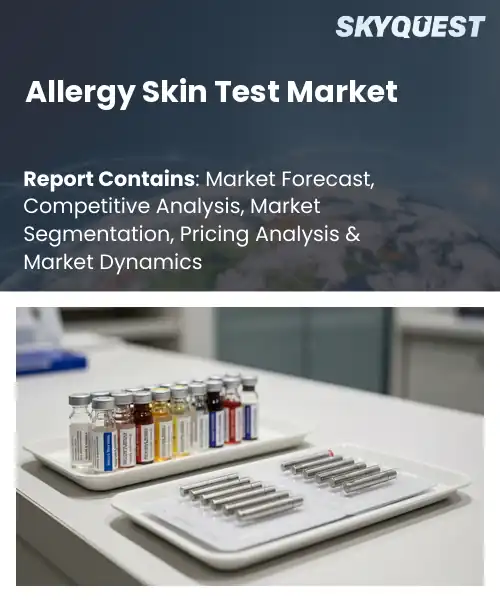
Allergy Skin Test Market
Report ID: SQMIG35D2566
Report ID: SQMIG35D2566
[email protected]
USA +1 351-333-4748
Report ID:
SQMIG35D2566 |
Region:
Global |
Published Date: July, 2026
Pages:
157
|Tables:
121
|Figures:
77


Global Allergy Skin Test Market size was valued at USD 672.3 Million in 2024 and is poised to grow from USD 727.43 Million in 2025 to USD 1366.5 Million by 2033, growing at a CAGR of 8.2% during the forecast period (2026-2033).
The global allergy skin‑test market encompasses diagnostic kits, reagents, and devices used to detect IgE‑mediated hypersensitivity through prick or intradermal testing. Its importance stems from rising prevalence of allergic diseases, which now affect roughly one‑third of the world’s population and drive demand for diagnostics. Historically, the market was dominated by manual lancet kits; however, the introduction of standardized extracts in the 1990s and automated reading systems in the 2010s expanded accessibility and reduced operator error. This evolution has been accelerated by insurance reimbursements for allergy testing and heightened awareness among primary physicians, positioning the sector as a component of preventive health. The dominant growth catalyst for the allergy skin‑test market is the integration of point‑of‑care platforms into primary‑care and urgent‑care settings, which shortens diagnostic timelines and improves patient throughput. By embedding digital readers that automatically quantify wheal size, clinicians can deliver immediate results, prompting same‑day allergen‑avoidance counseling and targeted immunotherapy initiation. This capability attracts health systems seeking to reduce specialist referrals and lower overall treatment costs, thereby expanding market uptake. Moreover, emerging reimbursement codes in Europe and Asia incentivize routine testing, while partnerships between manufacturers and telehealth providers generate remote‑monitoring solutions that broaden access in underserved regions and improve population health.
How is AI improving accuracy and efficiency in the allergy skin test market?
AI enhances allergy skin testing by digitizing the visual assessment of wheal and flare reactions. Machine‑learning models trained on thousands of images can instantly measure reaction size, compare it against baseline patterns, and flag atypical results, reducing subjectivity and human error. Integrated electronic health records allow the algorithm to cross‑reference patient history, allergy profiles, and medication use, streamlining interpretation and shortening reporting time. Real‑time analytics enable clinicians to adjust testing protocols on the spot, improving patient throughput while maintaining diagnostic confidence. By automating routine steps, AI frees technicians to focus on patient interaction and complex case analysis, fostering a more efficient and accurate testing environment.A recent AI‑driven skin test reader was introduced in March 2024, accelerating result turnaround and supporting broader adoption of precise allergy diagnostics across clinics.
Market snapshot - (2026-2033)
Global Market Size
USD 672.3 Million
Largest Segment
Intradermal Test
Fastest Growth
Patch Test
Growth Rate
8.2% CAGR
To get more insights on this market click here to Request a Free Sample Report
Global allergy skin test market is segmented by test type, allergen type, age group, end user and region. Based on test type, the market is segmented into Skin Prick Test (SPT), Intradermal Test and Patch Test. Based on allergen type, the market is segmented into Inhalant Allergens, Food Allergens, Drug Allergens, Insect Venom Allergens, Contact Allergens and Others. Based on age group, the market is segmented into Pediatric, Adult and Geriatric. Based on end user, the market is segmented into Hospitals, Specialty Allergy & Dermatology Clinics, Diagnostic Laboratories and Academic & Research Institutes. Based on region, the market is segmented into North America, Europe, Asia Pacific, Latin America and Middle East & Africa.
Skin Prick Test segment dominates because it offers a quick, minimally invasive approach that clinicians trust for diagnosing a wide range of allergic conditions. Its ease of administration, immediate visual readout, and compatibility with standard clinical workflows make it the preferred choice in most care settings. These attributes reinforce provider confidence, drive consistent utilization, and sustain its central position in the allergy skin test market while supporting comprehensive patient assessment and facilitating timely treatment decisions.
Meanwhile, Patch Test segment emerges as the most rapidly expanding area within the allergy skin test market. Growing consumer demand for precise contact allergen identification, coupled with advances in standardized allergen panels, fuels its uptake. This momentum broadens diagnostic capabilities, spurs innovation in test materials, and creates new revenue streams for providers.
Inhalant Allergens segment dominates because it addresses the most prevalent triggers of allergic rhinitis, asthma, and conjunctivitis, conditions that drive routine clinical assessments. The broad spectrum of airborne particles, coupled with well established testing protocols, ensures that clinicians rely heavily on these tests for initial diagnosis and monitoring. This pervasive relevance translates into steady demand across diverse care environments, anchoring the segment at the core of market activity and sustaining long term provider engagement.
On the other hand, Food Allergens segment is witnessing the strongest growth momentum in the allergy skin test market. Rising incidences of food related hypersensitivity, heightened awareness among caregivers, and expanded pediatric screening programs propel its adoption. This surge stimulates development of specialized extracts, enhances test accuracy, and opens avenues for integrated care pathways, amplifying market expansion.
To get detailed segments analysis, Request a Free Sample Report
North America maintains a commanding lead in the Allergy Skin Test market through a combination of mature healthcare systems, widespread clinical adoption, and strong reimbursement mechanisms that encourage routine testing. The region benefits from an extensive network of allergy specialists and dermatology clinics that integrate skin testing into standard diagnostic pathways. Continuous investment by leading biotech and diagnostic firms fuels innovation in test reagents and automation, reinforcing product availability. Collaborative research institutions generate robust clinical evidence that supports test efficacy, further driving clinician confidence. Additionally, well‑established insurance frameworks reduce out‑of‑pocket costs for patients, expanding access. The presence of major academic medical centers also accelerates the translation of emerging biomarkers into practical skin test applications, reinforcing the region’s leadership.
Allergy Skin Test Market in the United States is propelled by a network of specialized allergy clinics and physician familiarity with skin testing protocols. Robust insurance coverage and integrated electronic health records streamline patient referral and test ordering, while leading diagnostic manufacturers maintain a strong local supply chain. Ongoing collaboration between academic research centers and industry accelerates the introduction of refined testing reagents, reinforcing clinical confidence and sustaining market depth.
Allergy Skin Test Market in Canada benefits from a funded healthcare framework that emphasizes preventive diagnostics and facilitates test reimbursement. A community of allergists and dermatologists adopts standardized skin testing methods, fostering consistency across provinces. Domestic manufacturers collaborate with research institutions to tailor reagents for the Canadian patient population, while regulatory pathways ensure market entry for innovative products. These factors collectively nurture a stable demand environment and encourage service improvement.
The European Allergy Skin Test market accelerates through harmonized regulatory standards that simplify product approval across member states, enabling manufacturers to scale distribution efficiently. Strong public health initiatives prioritize early identification of allergic conditions, embedding skin testing into routine primary care pathways. Collaborative networks among leading academic hospitals and biotech firms foster continuous innovation in allergen extracts and testing devices, while reimbursement frameworks in many countries support clinical adoption. Growing patient awareness of personalized treatment options further fuels demand for precise diagnostic tools. Additionally, cross‑border trade agreements and a mature logistics infrastructure reduce time‑to‑market, reinforcing Europe’s position as a hub for advanced allergy diagnostics. European health agencies also invest heavily in longitudinal cohort studies that elucidate regional allergen patterns, providing actionable data for test refinement. This research emphasis, combined with a culture of clinical guideline development, ensures that skin testing practices evolve alongside emerging scientific insights, sustaining market momentum.
Allergy Skin Test Market in Germany is anchored by a comprehensive national health insurance system that reimburses skin testing as a standard preventive service. A dense network of allergology centers and university hospitals drives high clinical adoption, while domestic manufacturers collaborate closely with research institutes to refine allergen extracts for the German population. Regulatory alignment within the EU further streamlines product introduction, fostering a stable and sophisticated robust market environment.
Allergy Skin Test Market in the United Kingdom experiences rapid growth driven by health campaigns that promote early allergy detection and by private healthcare providers investing in diagnostic suites. The NHS integrates skin testing into primary care referral pathways, while private clinics offer services. Strong partnerships between biotech startups and laboratories accelerate the rollout of novel allergen panels, reinforcing the United Kingdom’s position as an evolving market for allergy diagnostics.
Allergy Skin Test Market in France is emerging as healthcare providers place greater emphasis on allergy management within a coverage system. National clinical guidelines increasingly recommend skin testing as a first‑line diagnostic tool, encouraging widespread adoption across hospitals and private practices. Domestic biotech firms collaborate with research universities to develop allergen extracts, while regulatory pathways facilitate market entry. These developments stimulate demand and set the foundation for sustained market expansion.
Asia Pacific fortifies its role in the Allergy Skin Test market by leveraging rapid economic development and expanding middle‑class populations that prioritize preventive health care. National health ministries increasingly incorporate allergic disease screening into routine pediatric and adult check‑ups, creating broader clinical acceptance of skin testing. Investments in digital health platforms enable tele‑dermatology consultations and streamlined test ordering, accelerating patient access. Regional biotech clusters, particularly in Japan and South Korea, drive innovation in high‑purity allergen extracts and portable testing devices, while supportive regulatory frameworks expedite product launch. Collaborative research initiatives across the region generate comprehensive allergen profiles tailored to local environmental exposures, enhancing diagnostic relevance. Together, these factors elevate Asia Pacific’s market sophistication and position it as a burgeoning hub for advanced allergy diagnostics.
Allergy Skin Test Market in Japan is integrated within universal health coverage, ensuring broad patient access and routine utilization. Research institutions collaborate with domestic manufacturers to produce allergen extracts that reflect the Japanese environmental profile. Reimbursement schemes and regulatory pathways facilitate market entry for testing technologies. This ecosystem promotes improvement in diagnostic accuracy and sustains Japan’s leadership in the regional allergy testing landscape effectively through ongoing continuous clinical education initiatives.
Allergy Skin Test Market in South Korea benefits from a healthcare system that encourages early allergy detection through public hospitals and clinics. Governmental support for biomedical research fuels the development of high‑purity allergen extracts tailored to Korean environmental allergens. Streamlined approval processes and insurance coverage reduce barriers to adoption, while health platforms enhance outreach and scheduling efficiency. These factors reinforce South Korea’s growing prominence in the regional allergy diagnostics sector.
To know more about the market opportunities by region and country, click here to
Buy The Complete Report
Increasing Prevalence of Allergic Conditions
Advancements In Skin Test Technologies
High Cost Of Test Kits
Regulatory Hurdles In Emerging Markets
Request Free Customization of this report to help us to meet your business objectives.
The allergy skin test market is defined by fierce competition between legacy diagnostic manufacturers and fast‑moving health‑tech entrants. Companies are pursuing M&A of niche assay technologies, forging partnerships with AI investors, and deploying digital testing platforms to capture market share. Recent examples include Self.co’s €2.56 million funded European expansion and Capsa AI’s $18 million Series A that accelerates AI‑driven test interpretation.
Top Player’s Company Profile
Recent Developments
SkyQuest’s ABIRAW (Advanced Business Intelligence, Research & Analysis Wing) is our Business Information Services team that Collects, Collates, Correlates, and Analyses the Data collected by means of Primary Exploratory Research backed by robust Secondary Desk research. As per SkyQuest analysis the global allergy skin test market is propelled mainly by the rising prevalence of allergic conditions, which fuels clinicians’ demand for reliable diagnostics, while advances in skin‑test technologies such as recombinant allergens and digital readers provide a second catalyst by improving accuracy and workflow efficiency. The market is constrained by the high cost of test kits, limiting adoption in cost‑sensitive settings. North America remains the dominant region thanks to mature reimbursement systems and a dense network of specialty clinics, and the skin prick test continues to dominate the segment landscape because of its speed, minimal invasiveness and widespread clinical acceptance. These dynamics together shape the market’s growth trajectory.
| Report Metric | Details |
|---|---|
| Market size value in 2024 | USD 672.3 Million |
| Market size value in 2033 | USD 1366.5 Million |
| Growth Rate | 8.2% |
| Base year | 2024 |
| Forecast period | (2026-2033) |
| Forecast Unit (Value) | USD Million |
| Segments covered |
|
| Regions covered | North America (US, Canada), Europe (Germany, France, United Kingdom, Italy, Spain, Rest of Europe), Asia Pacific (China, India, Japan, Rest of Asia-Pacific), Latin America (Brazil, Rest of Latin America), Middle East & Africa (South Africa, GCC Countries, Rest of MEA) |
| Companies covered |
|
| Customization scope | Free report customization with purchase. Customization includes:-
|
To get a free trial access to our platform which is a one stop solution for all your data requirements for quicker decision making. This platform allows you to compare markets, competitors who are prominent in the market, and mega trends that are influencing the dynamics in the market. Also, get access to detailed SkyQuest exclusive matrix.
Table Of Content
Executive Summary
Market overview
Parent Market Analysis
Market overview
Market size
KEY MARKET INSIGHTS
COVID IMPACT
MARKET DYNAMICS & OUTLOOK
Market Size by Region
KEY COMPANY PROFILES
Methodology
For the Allergy Skin Test Market, our research methodology involved a mixture of primary and secondary data sources. Key steps involved in the research process are listed below:
1. Information Procurement: This stage involved the procurement of Market data or related information via primary and secondary sources. The various secondary sources used included various company websites, annual reports, trade databases, and paid databases such as Hoover's, Bloomberg Business, Factiva, and Avention. Our team did 45 primary interactions Globally which included several stakeholders such as manufacturers, customers, key opinion leaders, etc. Overall, information procurement was one of the most extensive stages in our research process.
2. Information Analysis: This step involved triangulation of data through bottom-up and top-down approaches to estimate and validate the total size and future estimate of the Allergy Skin Test Market.
3. Report Formulation: The final step entailed the placement of data points in appropriate Market spaces in an attempt to deduce viable conclusions.
4. Validation & Publishing: Validation is the most important step in the process. Validation & re-validation via an intricately designed process helped us finalize data points to be used for final calculations. The final Market estimates and forecasts were then aligned and sent to our panel of industry experts for validation of data. Once the validation was done the report was sent to our Quality Assurance team to ensure adherence to style guides, consistency & design.
Analyst Support
Customization Options
With the given market data, our dedicated team of analysts can offer you the following customization options are available for the Allergy Skin Test Market:
Product Analysis: Product matrix, which offers a detailed comparison of the product portfolio of companies.
Regional Analysis: Further analysis of the Allergy Skin Test Market for additional countries.
Competitive Analysis: Detailed analysis and profiling of additional Market players & comparative analysis of competitive products.
Go to Market Strategy: Find the high-growth channels to invest your marketing efforts and increase your customer base.
Innovation Mapping: Identify racial solutions and innovation, connected to deep ecosystems of innovators, start-ups, academics, and strategic partners.
Category Intelligence: Customized intelligence that is relevant to their supply Markets will enable them to make smarter sourcing decisions and improve their category management.
Public Company Transcript Analysis: To improve the investment performance by generating new alpha and making better-informed decisions.
Social Media Listening: To analyze the conversations and trends happening not just around your brand, but around your industry as a whole, and use those insights to make better Marketing decisions.
REQUEST FOR SAMPLE
 REQUEST FREE CUSTOMIZATION


Want to customize this report? This report can be personalized according to your needs. Our analysts and industry experts will work directly with you to understand your requirements and provide you with customized data in a short amount of time. We offer $1000 worth of FREE customization at the time of purchase.
Feedback From Our Clients


 USA (+1) 351-333-4748

