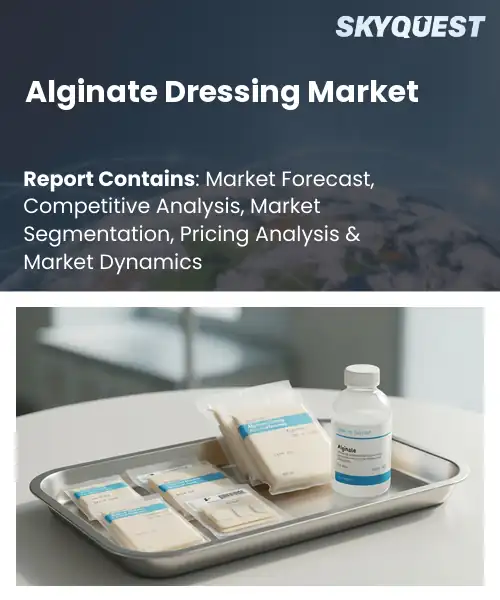
Alginate Dressing Market
Report ID: SQMIG35A3684
Report ID: SQMIG35A3684
[email protected]
USA +1 351-333-4748
Report ID:
SQMIG35A3684 |
Region:
Global |
Published Date: June, 2026
Pages:
157
|Tables:
154
|Figures:
78


Global Alginate Dressing Market size was valued at USD 954.0 Million in 2024 and is poised to grow from USD 994.07 Million in 2025 to USD 1381.52 Million by 2033, growing at a CAGR of 4.2% during the forecast period (2026-2033).
The primary driver of the alginate dressing market is the rising global burden of chronic wounds coupled with innovations that improve clinical outcomes. Alginate dressings derived from seaweed absorb volumes of exudate and maintain a moist wound environment, which makes them critical in managing diabetic foot ulcers and venous leg ulcers, treating pressure injuries and covering donor sites. The market matters because effective wound management reduces infection risk, shortens hospital stays and lowers long-term costs for health systems. The sector has evolved from simple calcium alginates to multifunctional products incorporating antimicrobials, composites and dressings suited to outpatient and home-care settings.
A key factor propelling the global alginate dressing market is the rising prevalence of diabetes and related chronic wounds, which creates clinical demand and incentive. As diabetic foot ulcers and venous leg ulcers become more common, clinicians favor alginate dressings because their high absorbency and gel-forming properties reduce maceration and allow fewer dressing changes, which lowers nursing time and infection rates. That clinical advantage causes manufacturers to scale production and invest in antimicrobial-infused composite dressings, producing outcomes that persuade hospitals and outpatient clinics as well as home-care providers to adopt these products, opening expansion opportunities in emerging healthcare markets globally.
How is AI enhancing quality control in the alginate dressing market?
AI is improving quality control in the alginate dressing market by automating visual inspection and adding process intelligence to manufacturing and packaging lines. Automated camera systems and machine learning models identify fiber variability, foreign particles, incomplete gelation, and seal defects more consistently than manual checks. Vendors are pairing vision AI with predictive analytics to spot drift in production and trigger corrective actions before lots are released. This matters because alginate dressings are natural fiber products that need consistent absorbency and sterility and because leading wound care brands operate at scale. Practical examples include inline density checks, package seal verification, and automated documentation that speeds release and reduces waste.
Integra LifeSciences March 2026, highlights how packaging failures can disrupt supply and patient care and shows why adopting AI driven QA for seal and sterility checks can reduce recall risk and support more reliable production and regulatory compliance.
Market snapshot - (2026-2033)
Global Market Size
USD 954.0 Million
Largest Segment
Calcium Alginate Dressings
Fastest Growth
Silver Alginate Dressings
Growth Rate
4.2% CAGR
To get more insights on this market click here to Request a Free Sample Report
Global alginate dressing market is segmented by product type, form, application, end user, distribution channel and region. Based on product type, the market is segmented into Calcium Alginate Dressings, Silver Alginate Dressings, Honey Alginate Dressings and Others. Based on form, the market is segmented into Sheets, Ropes, Pads, Gels and Others. Based on application, the market is segmented into Chronic Wounds, Acute Wounds, Surgical Wounds, Burns, Ulcers and Others. Based on end user, the market is segmented into Hospitals, Clinics, Ambulatory Surgical Centers, Home Healthcare and Others. Based on distribution channel, the market is segmented into Direct Sales, Pharmacies, Online Sales, Medical Distributors and Others. Based on region, the market is segmented into North America, Europe, Asia Pacific, Latin America and Middle East & Africa.
Silver alginate dressings segment dominates because its inherent antimicrobial properties directly address infection risk in complex wounds, prompting preference among clinicians managing contaminated or chronic wounds. Superior biofilm control and perceived reduction in dressing change frequency drive hospital formulary inclusion and procurement focus. Industry partnerships, clinical evidence generation and clear performance differentiation versus non antimicrobial options further reinforce purchasing decisions, creating a virtuous cycle of adoption that sustains its leadership within alginate dressing offerings.
However, calcium alginate dressings are the most rapidly expanding area due to broad clinical familiarity and strong performance managing high exudate wounds, making them a cost effective staple across care settings. Ongoing formulation improvements and supplier focus on ease of use and compatibility with negative pressure therapy accelerate adoption, unlocking new procurement pathways and practitioner confidence that fuel market growth.
Medical distributors segment leads because established distribution networks and deep relationships with institutional buyers ensure reliable supply to acute care settings and specialty clinics. Their logistics capabilities, inventory management and regulatory compliance support bulk procurement and clinical trial supply, encouraging hospitals and large purchasers to rely on them. Value added services like training, product bundling and technical support further entrench their role, shaping purchasing patterns and maintaining their dominant position in alginate dressing distribution.
Meanwhile, online sales are the most rapidly expanding channel as digital procurement and direct to consumer access simplify purchasing for clinicians and home care users. E commerce platforms enable smaller suppliers to reach new buyers, support bundled offerings and rapid product information dissemination. Integration with telehealth and home health services accelerates demand, creating scalable avenues for innovation and market penetration.
To get detailed segments analysis, Request a Free Sample Report
North America dominates the global alginate dressing market through a confluence of advanced clinical adoption, robust healthcare infrastructure, and deep capabilities in wound care innovation. Concentrations of specialized wound care centers and established reimbursement frameworks support adoption across acute, outpatient, and community settings, while major medical device manufacturers maintain active research pipelines and diverse product portfolios. Clinician familiarity with evidence aligned protocols and emphasis on outcome driven care facilitate consistent integration of alginate solutions. Strong distribution networks and strategic partnerships among providers, payers, and suppliers enable rapid product availability and clinician training, allowing clinical insights to translate efficiently into practice and reinforcing sustained leadership in the market.
Alginate Dressing Market in the United States is characterized by high clinician acceptance, availability across care settings, and ongoing innovation from medical device companies. Mature distribution networks and hospital procurement support consistent adoption. Emphasis on evidence based practice and multidisciplinary wound care teams fosters incorporation of alginate technologies into treatment protocols. Market dynamics reflect close interaction between product development, clinical training programs, and supplier relationships prioritizing outcome driven wound management.
Alginate Dressing Market in Canada benefits from clinician engagement, primary and community care pathways, and collaboration between healthcare providers and suppliers. Provincial procurement and focus on wound care outcomes contribute to utilization across care sites. Investments in clinician education and local distribution channels improve access to varied alginate formats. The market environment emphasizes evidence guided selection, interprofessional care coordination, and supplier support for training and post market clinical feedback loops.
Rapid expansion of the alginate dressing market in Europe is driven by strong clinical adoption across specialized wound care centers, supportive regulatory frameworks, and active innovation among regional manufacturers. Integration of alginate products into standardized care pathways and emphasis on multidisciplinary management of chronic wounds encourage wider use across care settings. Strategic partnerships between hospitals, distributors, and medical technology firms enhance product availability and clinician training. Favorable reimbursement mechanisms in many jurisdictions and investment in localized manufacturing and distribution support broader penetration. Focus on tailored formulations and clinician education programs ensures alignment with national clinical guidelines and local practice patterns, strengthening product credibility and market momentum.
Alginate Dressing Market Germany is led by established wound care infrastructure, strong clinical research activity, and major manufacturers developing advanced formulations. Hospital procurement practices and specialized wound centers facilitate broader clinical use. Emphasis on evidence based treatment algorithms and training for wound care teams supports incorporation of alginate products. Collaborative initiatives between industry and clinical networks foster product refinement and knowledge exchange, reinforcing Germany market leadership within the regional landscape.
Alginate Dressing Market United Kingdom is marked by growth driven by focus on community based wound management, clinician education programs, and adoption in primary care pathways. Collaboration between healthcare trusts, innovative suppliers, and specialist nursing teams accelerates uptake of alginate solutions outside hospital settings. Emphasis on outcome oriented wound care and dissemination of clinical guidance supports broader use of alginate formats across care continuums and further reinforces expanding market momentum.
Alginate Dressing Market France is emerging through integration of alginate products in hospital and community wound services, supported by clinician training and growing engagement from local manufacturers. Specialty distributors are improving supply chain responsiveness and product access. Emphasis on clinical evidence, tailored product ranges for diverse wound types, and coordinated care pathways encourages adoption. Policy interest in improving chronic wound outcomes also underpins the market evolution across regional healthcare settings.
Asia Pacific is strengthening its position in the alginate dressing market through rising clinical adoption, localized product innovation, and enhanced manufacturing capacity. Regional firms are adapting formulations to meet local clinical needs and care delivery models, while partnerships with global manufacturers accelerate technology transfer and supply chain maturation. Expansion of specialized wound care services and increased emphasis on nurse and primary care training supports broader use across acute and community settings. Ongoing clinical research collaborations and growing alignment with international regulatory standards further boost clinician confidence and market credibility, enabling the region to influence product portfolios and clinical practice patterns across diverse healthcare landscapes.
Alginate Dressing Market Japan is characterized by strong clinical research engagement, advanced medical manufacturing capabilities, and collaboration with hospitals. Emphasis on high quality standards and tailored product development supports clinician trust and adoption in acute and specialized wound care settings. Training programs for nurses and wound care specialists promote use of alginate technologies. Coordinated supply chains and distributor partnerships ensure access to diverse product formats for clinicians and care teams.
Alginate Dressing Market South Korea is advancing through investment in medical technology, hospital adoption, and collaboration between manufacturers and global partners. Clinical training and specialized wound clinics promote utilization of alginate products across inpatient and outpatient settings. Local innovation focuses on convenient formats and clinician friendly features to meet practice demands. Distribution networks and emphasis on evidence based selection improve access and support growth across diverse care environments and regions.
To know more about the market opportunities by region and country, click here to
Buy The Complete Report
Rising Chronic Wound Incidence
Advantages Of Alginate Dressings
Reimbursement And Cost Constraints
Limited Clinical Awareness And Training
Request Free Customization of this report to help us to meet your business objectives.
Competitive landscape is concentrated and dynamic, driven by incumbent consolidation through targeted acquisitions and licensing, and by material innovation from venture backed developers that pressure price and formulation differentiation. Recent M and A activity such as Mérieux Equity Partners taking majority interest in Curea Medical illustrates consolidation by private investors. Concurrently startups progressing next generation hydrogels and antimicrobial alginate variants are prompting partnerships for distribution and clinical validation.
Top Player’s Company Profile
Recent Developments
SkyQuest’s ABIRAW (Advanced Business Intelligence, Research & Analysis Wing) is our Business Information Services team that Collects, Collates, Correlates, and Analyses the Data collected by means of Primary Exploratory Research backed by robust Secondary Desk research. As per SkyQuest analysis, the global alginate dressing market is propelled by a key driver, namely the rising chronic wound incidence driven by diabetes, aging and comorbidities that increases demand for high absorbency dressings, while a second driver is ongoing product innovation including antimicrobial and multifunctional alginate variants that improve outcomes and broaden care settings. A restraint is unfavorable reimbursement and cost constraints that slow adoption in budget-sensitive regions. North America remains the dominating region due to advanced clinical adoption and strong distribution, and silver alginate dressings are the dominating segment owing to infection control benefits and hospital formulary preference. Overall market momentum balances clinical need against payer pressures.
| Report Metric | Details |
|---|---|
| Market size value in 2024 | USD 954.0 Million |
| Market size value in 2033 | USD 1381.52 Million |
| Growth Rate | 4.2% |
| Base year | 2024 |
| Forecast period | (2026-2033) |
| Forecast Unit (Value) | USD Million |
| Segments covered |
|
| Regions covered | North America (US, Canada), Europe (Germany, France, United Kingdom, Italy, Spain, Rest of Europe), Asia Pacific (China, India, Japan, Rest of Asia-Pacific), Latin America (Brazil, Rest of Latin America), Middle East & Africa (South Africa, GCC Countries, Rest of MEA) |
| Companies covered |
|
| Customization scope | Free report customization with purchase. Customization includes:-
|
To get a free trial access to our platform which is a one stop solution for all your data requirements for quicker decision making. This platform allows you to compare markets, competitors who are prominent in the market, and mega trends that are influencing the dynamics in the market. Also, get access to detailed SkyQuest exclusive matrix.
Table Of Content
Executive Summary
Market overview
Parent Market Analysis
Market overview
Market size
KEY MARKET INSIGHTS
COVID IMPACT
MARKET DYNAMICS & OUTLOOK
Market Size by Region
KEY COMPANY PROFILES
Methodology
For the Alginate Dressing Market, our research methodology involved a mixture of primary and secondary data sources. Key steps involved in the research process are listed below:
1. Information Procurement: This stage involved the procurement of Market data or related information via primary and secondary sources. The various secondary sources used included various company websites, annual reports, trade databases, and paid databases such as Hoover's, Bloomberg Business, Factiva, and Avention. Our team did 45 primary interactions Globally which included several stakeholders such as manufacturers, customers, key opinion leaders, etc. Overall, information procurement was one of the most extensive stages in our research process.
2. Information Analysis: This step involved triangulation of data through bottom-up and top-down approaches to estimate and validate the total size and future estimate of the Alginate Dressing Market.
3. Report Formulation: The final step entailed the placement of data points in appropriate Market spaces in an attempt to deduce viable conclusions.
4. Validation & Publishing: Validation is the most important step in the process. Validation & re-validation via an intricately designed process helped us finalize data points to be used for final calculations. The final Market estimates and forecasts were then aligned and sent to our panel of industry experts for validation of data. Once the validation was done the report was sent to our Quality Assurance team to ensure adherence to style guides, consistency & design.
Analyst Support
Customization Options
With the given market data, our dedicated team of analysts can offer you the following customization options are available for the Alginate Dressing Market:
Product Analysis: Product matrix, which offers a detailed comparison of the product portfolio of companies.
Regional Analysis: Further analysis of the Alginate Dressing Market for additional countries.
Competitive Analysis: Detailed analysis and profiling of additional Market players & comparative analysis of competitive products.
Go to Market Strategy: Find the high-growth channels to invest your marketing efforts and increase your customer base.
Innovation Mapping: Identify racial solutions and innovation, connected to deep ecosystems of innovators, start-ups, academics, and strategic partners.
Category Intelligence: Customized intelligence that is relevant to their supply Markets will enable them to make smarter sourcing decisions and improve their category management.
Public Company Transcript Analysis: To improve the investment performance by generating new alpha and making better-informed decisions.
Social Media Listening: To analyze the conversations and trends happening not just around your brand, but around your industry as a whole, and use those insights to make better Marketing decisions.
REQUEST FOR SAMPLE
 REQUEST FREE CUSTOMIZATION
Global Alginate Dressing Market size was valued at USD 954.0 Million in 2024 and is poised to grow from USD 994.07 Million in 2025 to USD 1381.52 Million by 2033, growing at a CAGR of 4.2% during the forecast period (2026-2033).
Competitive landscape is concentrated and dynamic, driven by incumbent consolidation through targeted acquisitions and licensing, and by material innovation from venture backed developers that pressure price and formulation differentiation. Recent M and A activity such as Mérieux Equity Partners taking majority interest in Curea Medical illustrates consolidation by private investors. Concurrently startups progressing next generation hydrogels and antimicrobial alginate variants are prompting partnerships for distribution and clinical validation. 'Convatec Group plc', 'Coloplast A/S', 'Smith & Nephew plc', 'Mölnlycke Health Care AB', '3M Company', 'Medline Industries, LP', 'Hollister Incorporated', 'Integra LifeSciences Holdings Corporation', 'Paul Hartmann AG', 'Essity AB', 'B. Braun SE', 'Cardinal Health, Inc.', 'DermaRite Industries, LLC', 'Winner Medical Co., Ltd.', 'Advancis Medical', 'Kikgel Sp. z o.o.', 'Lohmann & Rauscher GmbH & Co. KG', 'Ferris Mfg. Corp.', 'Acelity L.P. Inc.', 'McKesson Corporation'
The increasing prevalence of chronic wounds driven by ageing populations, comorbidities, and lifestyle factors creates sustained demand for advanced wound care options that effectively manage exudate and reduce infection risk. Alginate dressings are perceived as appropriate for moderate to heavily exuding wounds, fostering clinical preference and procurement by healthcare providers seeking reliable, easy-to-use products. This clinical suitability stimulates adoption across inpatient and outpatient settings, encouraging manufacturers to invest in production and distribution, thereby expanding market availability and supporting overall market growth.
Sustainable Bio-Based Materials: Growing environmental concern and procurement preferences are driving manufacturers to develop alginate dressings from renewable and biodegradable feedstocks. Emphasis on reduced lifecycle environmental impact, recyclable packaging, and lower waste aligns with hospital sustainability goals and corporate social responsibility initiatives. Suppliers pursue partnerships with biomaterial innovators to reformulate products and differentiate brands by promoting eco-friendly credentials. This trend encourages investment in sustainable supply chains and communicates value to payers and patients seeking greener healthcare solutions and institutional buyers.
Why does North America Dominate the Global Alginate Dressing Market? |@12


Want to customize this report? This report can be personalized according to your needs. Our analysts and industry experts will work directly with you to understand your requirements and provide you with customized data in a short amount of time. We offer $1000 worth of FREE customization at the time of purchase.
Feedback From Our Clients


 USA (+1) 351-333-4748

