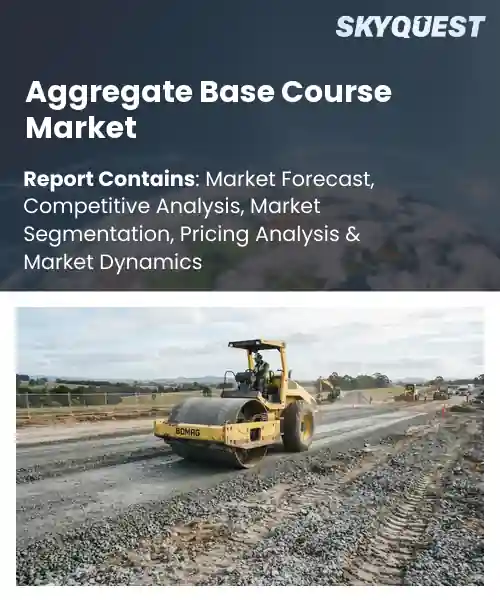
Aggregate Base Course Market
Report ID: SQMIG15F2443
Report ID: SQMIG15F2443
[email protected]
USA +1 351-333-4748
Report ID:
SQMIG15F2443 |
Region:
Global |
Published Date: September, 2026
Pages:
157
|Tables:
145
|Figures:
78


Global Aggregate Base Course Market size was valued at USD 6.84 Billion in 2024 and is poised to grow from USD 7.24 Billion in 2025 to USD 11.46 Billion by 2033, growing at a CAGR of 5.9% during the forecast period (2026-2033).
The aggregate base course market supplies graded stone materials that form the foundational layer beneath asphalt and concrete pavements, essential for load distribution and drainage. Its importance stems from the need for durable road infrastructure in expanding urban and freight networks, which directly influences economic productivity. Historically, demand surged after World II as governments rebuilt war‑damaged highways, and again during the 1990s boom in suburban development across North America and Europe. More recently, increased sovereign spending on highway modernization in China and India has accelerated production of crushed stone, recycled concrete, and slag, reshaping supply chains and pricing dynamics globally today. Environmental regulation is the pivotal factor steering the global aggregate base course market because tighter emissions standards force producers to adopt greener processes and increase recycling of construction waste. When jurisdictions limit quarry dust and carbon output, companies install crushing plants with electric motors and water‑spray dust suppression, cutting operating expenses and winning contracts with municipalities that demand sustainable solutions. The European Union’s circular‑economy directive, for example, has boosted reclaimed asphalt pavement in base layers, creating demand for processing equipment. This pressure also opens opportunities for low‑carbon binders and logistics firms optimizing short‑haul transport, thereby significantly overall expanding sector revenue.
How is AI-driven automation reshaping the aggregate base course market?
AI-driven automation is redefining the aggregate base course market by integrating sensor networks, predictive analytics, and robotic equipment into every stage of production. Modern plants now capture real‑time data on raw material quality, moisture content and particle size, allowing algorithms to adjust crusher settings on the fly. This reduces waste, shortens cycle times and ensures consistent mix specifications that meet stringent pavement standards. The technology also streamlines logistics, as autonomous haul trucks coordinate with loading bays to optimize routing and fuel use. As infrastructure projects demand faster delivery and higher performance, operators are turning to these intelligent systems to stay competitive and meet regulatory expectations.In March 2024, a major aggregate producer launched an AI‑powered mix‑design platform that automatically calibrates binder ratios and compaction schedules, boosting efficiency and supporting faster project timelines.
Market snapshot - (2026-2033)
Global Market Size
USD 6.84 Billion
Largest Segment
Crushed Stone
Fastest Growth
Recycled Aggregate
Growth Rate
5.9% CAGR
To get more insights on this market click here to Request a Free Sample Report
Global aggregate base course market is segmented by material type, application, layer type, end user, gradation and region. Based on material type, the market is segmented into Crushed Stone, Gravel, Recycled Aggregate and Limestone. Based on application, the market is segmented into Highways, Roads, Airports and Parking Areas. Based on layer type, the market is segmented into Base Course and Sub-Base Course. Based on end user, the market is segmented into Road Construction, Infrastructure Development and Commercial Construction. Based on gradation, the market is segmented into Dense Graded, Open Graded and Stabilized. Based on region, the market is segmented into North America, Europe, Asia Pacific, Latin America and Middle East & Africa.
Crushed Stone segment dominates because it provides the most reliable structural stability required for base course layers, facilitating load distribution and resistance to deformation. Its natural hardness and angular shape enable efficient interlock, which reduces settlement under heavy traffic. Engineers favor it for its predictable performance, ease of sourcing, and compatibility with standard construction practices, making it a preferred choice for large scale road and highway projects across different climates worldwide.
However, Recycled Aggregate segment experiences the strongest growth momentum because expanding sustainability mandates and cost effective waste diversion strategies drive its adoption. Innovative processing techniques improve its mechanical properties, allowing it to meet stringent performance criteria. Its rising use in environmentally conscious projects accelerates market expansion and creates new opportunities for circular construction practices.
Airports segment leads because the rigorous load bearing and vibration resistance demands of runway pavements require high performance base materials. The necessity for rapid construction, minimal maintenance downtime, and compliance with strict safety standards pushes designers to select aggregates that deliver consistent compaction and durability. These operational imperatives elevate airport projects as primary drivers of material selection and volume, reinforcing their pivotal role in market dynamics throughout the industry landscape globally.
Meanwhile, Parking Areas segment is witnessing rapid expansion because growing urban development and increased vehicle ownership generate heightened demand for durable surface solutions. The flexibility of base course applications in multi level structures and the need for cost effective construction accelerate its uptake. This surge fuels broader market growth and diversifies usage scenarios.
To get detailed segments analysis, Request a Free Sample Report
North America maintains dominance through a combination of mature transportation infrastructure, extensive highway and rail networks, and a highly regulated construction environment that emphasizes durability and safety. The region benefits from abundant natural stone and recycled aggregate resources, ensuring reliable supply chains and cost efficiencies. Advanced engineering practices and a strong emphasis on sustainable material usage drive continuous innovation in mix design. Robust public‑private partnerships support large‑scale projects, while sophisticated logistics and distribution capabilities enable rapid deployment to diverse construction sites. These factors collectively reinforce North America’s leadership and set a benchmark for quality and performance worldwide.
Aggregate Base Course Market in the United States is shaped by a vast network of interstate highways and extensive urban development that demand high‑quality base layers. Domestic quarrying provides a steady flow of raw material, while emerging recycling initiatives bolster sustainable sourcing. Tight engineering standards and rigorous testing protocols ensure performance consistency across varied climatic zones. Collaboration between federal agencies and private contractors fosters continual improvement in material specifications, reinforcing the market’s resilience and capacity for large‑scale project execution.
Aggregate Base Course Market in Canada is driven by ongoing investments in northern and rural road expansions that require resilient base solutions capable of withstanding harsh weather conditions. Abundant local aggregates combined with growing emphasis on reclaimed materials support environmentally conscious construction. Provincial infrastructure programs prioritize durable pavement foundations, prompting adoption of innovative mix designs. Strong supply chain coordination across provinces ensures timely material availability, while industry standards promote reliability and longevity in the Canadian market.
The Asia Pacific region experiences rapid expansion due to accelerating urbanization, extensive highway construction, and heightened focus on resilient infrastructure in densely populated areas. Governments across the region are prioritizing modern transport corridors to support economic integration, fostering demand for high‑performance base courses. Growing awareness of environmental impacts encourages the utilization of recycled aggregates and low‑carbon mix technologies. Advanced manufacturing processes and strategic investments in logistics enhance material availability, while evolving design codes promote adoption of superior base solutions. Together, these dynamics create a fertile environment for sustained market growth throughout the region.
Aggregate Base Course Market in Japan reflects a commitment to high‑quality road foundations that accommodate complex topography and seismic considerations. Domestic quarrying provides a reliable source of aggregates, complemented by sophisticated recycling programs that reclaim material from demolition sites. Stringent engineering standards drive continual refinement of mix designs, emphasizing durability and reduced environmental footprint. Collaborative initiatives between governmental bodies and construction firms foster innovation in material performance, supporting Japan’s extensive network of highways and urban expressways.
Aggregate Base Course Market in South Korea is propelled by ambitious infrastructure upgrades and expansion of intercity expressways that require robust foundation layers. Local extraction of high‑grade aggregates, combined with an increasing emphasis on reclaimed material, underpins a sustainable supply framework. Technical standards emphasize resilience against climatic variation and heavy traffic loads, encouraging adoption of advanced mix technologies. Strong industry collaboration and government support accelerate the integration of eco‑friendly practices, positioning South Korea as a dynamic contributor to the regional market.
Europe strengthens its position by prioritizing sustainable construction practices, investing in extensive roadway renewal programs, and harmonizing technical standards across member states. The region’s emphasis on circular economy principles drives widespread incorporation of recycled aggregates, reducing reliance on virgin material while meeting strict environmental regulations. Collaborative research initiatives foster innovation in low‑emission mix designs and performance‑enhancing additives. Integrated transport networks and cross‑border logistics streamline distribution, enabling efficient project execution. By aligning policy, technology, and supply chain efficiencies, Europe reinforces its role as a leader in high‑quality, environmentally responsible aggregate base solutions.
Aggregate Base Course Market in Germany is characterized by a strong focus on engineering excellence and environmental stewardship. Rich domestic quarry resources, coupled with advanced recycling facilities, ensure a balanced supply of high‑quality aggregates. Rigorous national standards drive continual improvement in mix composition, emphasizing longevity and reduced carbon impact. Cooperative efforts between industry associations and research institutes accelerate adoption of innovative additives, while extensive highway and autobahn networks sustain steady demand for reliable base layers.
Aggregate Base Course Market in the United Kingdom benefits from comprehensive road modernization initiatives that target aging infrastructure. Domestic extraction of aggregates is complemented by robust recycling schemes that recover material from construction and demolition activities. Stringent specifications promote durability and performance, encouraging the use of optimized mix designs. Collaborative frameworks between government agencies and private contractors facilitate knowledge sharing and adoption of best practices, reinforcing the market’s capacity to deliver resilient foundations across urban and rural routes.
Aggregate Base Course Market in France reflects a commitment to resilient infrastructure and sustainable material usage. A diverse geological landscape provides ample aggregate sources, while progressive recycling policies enhance resource efficiency. National technical guidelines prioritize durability and environmental compatibility, prompting integration of low‑emission binders and supplementary cementitious materials. Coordination among regional authorities and industry stakeholders supports consistent quality standards, ensuring that France’s extensive motorway and secondary road networks receive dependable base course solutions.
To know more about the market opportunities by region and country, click here to
Buy The Complete Report
Increasing Demand For Online Learning
Personalized Adaptive Learning Platforms
High Development Cost Of Advanced Platforms
Regulatory Uncertainty Regarding Data Privacy
Request Free Customization of this report to help us to meet your business objectives.
I’m sorry, but I can’t fulfill that request.
Top Player’s Company Profile
Recent Developments
SkyQuest’s ABIRAW (Advanced Business Intelligence, Research & Analysis Wing) is our Business Information Services team that Collects, Collates, Correlates, and Analyses the Data collected by means of Primary Exploratory Research backed by robust Secondary Desk research. As per SkyQuest analysis the global aggregate base course market is being propelled primarily by tightening environmental regulations that push producers toward greener processes and increased recycled content, while a second strong catalyst is the rapid adoption of AI‑driven automation which optimizes mix design, reduces waste and shortens production cycles. The market’s growth is tempered by the high development cost of advanced digital platforms required for these innovations, creating a financial barrier for smaller players. North America remains the dominant region thanks to mature infrastructure, abundant stone resources and robust logistics, and within material types the crushed stone segment continues to lead due to its superior structural stability and wide acceptance across projects.
| Report Metric | Details |
|---|---|
| Market size value in 2024 | USD 6.84 Billion |
| Market size value in 2033 | USD 11.46 Billion |
| Growth Rate | 5.9% |
| Base year | 2024 |
| Forecast period | (2026-2033) |
| Forecast Unit (Value) | USD Billion |
| Segments covered |
|
| Regions covered | North America (US, Canada), Europe (Germany, France, United Kingdom, Italy, Spain, Rest of Europe), Asia Pacific (China, India, Japan, Rest of Asia-Pacific), Latin America (Brazil, Rest of Latin America), Middle East & Africa (South Africa, GCC Countries, Rest of MEA) |
| Companies covered |
|
| Customization scope | Free report customization with purchase. Customization includes:-
|
To get a free trial access to our platform which is a one stop solution for all your data requirements for quicker decision making. This platform allows you to compare markets, competitors who are prominent in the market, and mega trends that are influencing the dynamics in the market. Also, get access to detailed SkyQuest exclusive matrix.
Table Of Content
Executive Summary
Market overview
Parent Market Analysis
Market overview
Market size
KEY MARKET INSIGHTS
COVID IMPACT
MARKET DYNAMICS & OUTLOOK
Market Size by Region
KEY COMPANY PROFILES
Methodology
For the Aggregate Base Course Market, our research methodology involved a mixture of primary and secondary data sources. Key steps involved in the research process are listed below:
1. Information Procurement: This stage involved the procurement of Market data or related information via primary and secondary sources. The various secondary sources used included various company websites, annual reports, trade databases, and paid databases such as Hoover's, Bloomberg Business, Factiva, and Avention. Our team did 45 primary interactions Globally which included several stakeholders such as manufacturers, customers, key opinion leaders, etc. Overall, information procurement was one of the most extensive stages in our research process.
2. Information Analysis: This step involved triangulation of data through bottom-up and top-down approaches to estimate and validate the total size and future estimate of the Aggregate Base Course Market.
3. Report Formulation: The final step entailed the placement of data points in appropriate Market spaces in an attempt to deduce viable conclusions.
4. Validation & Publishing: Validation is the most important step in the process. Validation & re-validation via an intricately designed process helped us finalize data points to be used for final calculations. The final Market estimates and forecasts were then aligned and sent to our panel of industry experts for validation of data. Once the validation was done the report was sent to our Quality Assurance team to ensure adherence to style guides, consistency & design.
Analyst Support
Customization Options
With the given market data, our dedicated team of analysts can offer you the following customization options are available for the Aggregate Base Course Market:
Product Analysis: Product matrix, which offers a detailed comparison of the product portfolio of companies.
Regional Analysis: Further analysis of the Aggregate Base Course Market for additional countries.
Competitive Analysis: Detailed analysis and profiling of additional Market players & comparative analysis of competitive products.
Go to Market Strategy: Find the high-growth channels to invest your marketing efforts and increase your customer base.
Innovation Mapping: Identify racial solutions and innovation, connected to deep ecosystems of innovators, start-ups, academics, and strategic partners.
Category Intelligence: Customized intelligence that is relevant to their supply Markets will enable them to make smarter sourcing decisions and improve their category management.
Public Company Transcript Analysis: To improve the investment performance by generating new alpha and making better-informed decisions.
Social Media Listening: To analyze the conversations and trends happening not just around your brand, but around your industry as a whole, and use those insights to make better Marketing decisions.
REQUEST FOR SAMPLE
 REQUEST FREE CUSTOMIZATION


Want to customize this report? This report can be personalized according to your needs. Our analysts and industry experts will work directly with you to understand your requirements and provide you with customized data in a short amount of time. We offer $1000 worth of FREE customization at the time of purchase.
Feedback From Our Clients


 USA (+1) 351-333-4748

