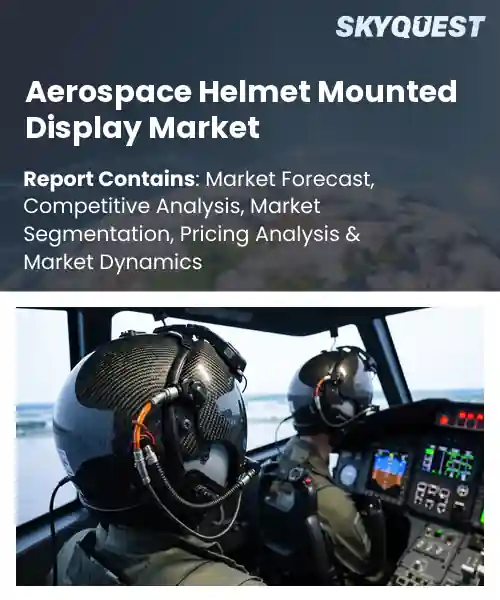
Aerospace Helmet Mounted Display Market
Report ID: SQMIG45J2608
Report ID: SQMIG45J2608
[email protected]
USA +1 351-333-4748
Report ID:
SQMIG45J2608 |
Region:
Global |
Published Date: July, 2026
Pages:
157
|Tables:
176
|Figures:
79


Global Aerospace Helmet Mounted Display Market size was valued at USD 2.95 Billion in 2024 and is poised to grow from USD 3.22 Billion in 2025 to USD 6.46 Billion by 2033, growing at a CAGR of 9.1% during the forecast period (2026-2033).
The aerospace helmet‑mounted display (HMD) market supplies sophisticated visual systems that project flight data directly onto a pilot’s line of sight, enhancing situational awareness and reducing head‑down time. Its significance stems from the increasing complexity of combat and commercial aircraft, where rapid decision making can determine mission success or safety. Originating in the 1970s with early night‑vision helmets for the U.S. Air Force, the technology has evolved through integration of augmented‑reality overlays, eye‑tracking sensors, and lightweight composite housings. Recent programs such as the F‑35’s Distributed Aperture System illustrate how HMDs now deliver 360‑degree imagery, confirming an upward trajectory in adoption.
The key trend driving the global aerospace helmet mounted display sector is the rising need for integrated connectivity that merges sensors, weapons control, and external data into a visual pane. As unmanned combat aircraft and cockpits adopt designs, pilots receive targeting cues, terrain information, and health alerts without diverting attention, boosting combat effectiveness and safety. This pressure drives manufacturers to produce micro‑LED displays and image processing that meet weight and latency limits. Cases such as U.S. Navy’s F/A‑18E/F HMD integration for carrier landings and commercial rollout of augmented‑reality helmets for airline training illustrate expanding significant revenue opportunities and a clear path toward civilian adoption.
How is AI Enhancing Real-Time Data Processing in the Aerospace Helmet Mounted Display Market?
AI is reshaping how helmet mounted displays process flight data by embedding edge computing and machine vision directly into the visor. Sensors capture visual, navigational and threat information, while AI algorithms filter noise, fuse sources and present only the most relevant cues to the pilot. This reduces cognitive load and enables instantaneous decision making. The market is moving from static overlays to dynamic, context aware graphics that adapt as the aircraft maneuvers. Early adopters report smoother mission flow and higher situational awareness, driving demand for smarter display systems.
In April 2026, ZEISS introduced a Gen III helmet mounted display that embeds AI driven image enhancement and real time data fusion, allowing pilots to see clearer threat cues and navigation markers without latency. This breakthrough illustrates how AI powered processing accelerates market adoption and operational efficiency.
Market snapshot - (2026-2033)
Global Market Size
USD 2.95 Billion
Largest Segment
Monocular Helmet Mounted Displays
Fastest Growth
Hybrid Vision Helmet Displays
Growth Rate
9.1% CAGR
To get more insights on this market click here to Request a Free Sample Report
Global aerospace helmet mounted display market is segmented by display technology, platform, technology, display architecture, end user, fit type and region. Based on display technology, the market is segmented into monocular helmet mounted displays, binocular helmet mounted displays, hybrid vision helmet displays and others. Based on platform, the market is segmented into fighter aircraft, military helicopters, transport & special mission aircraft and unmanned aerial systems (UAS). Based on technology, the market is segmented into optical waveguide displays, projection-based displays, holographic displays and others. Based on display architecture, the market is segmented into fixed display systems, head-tracked display systems, augmented reality display systems and others. Based on end user, the market is segmented into air force, naval aviation, army aviation, defense training organizations and others. Based on fit type, the market is segmented into line fit and retrofit. Based on region, the market is segmented into North America, Europe, Asia Pacific, Latin America and Middle East & Africa.
Monocular helmet mounted displays segment dominates because it offers a lightweight low profile solution that integrates seamlessly with legacy avionics, meeting core mission requirements for pilots who need clear forward looking sightlines. Its simplicity reduces integration complexity and maintenance burden, fostering strong adoption across air forces that prioritize reliability over advanced visual augmentation. Consequently, manufacturers focus research and development resources on refining optics, ergonomics, and ruggedization, reinforcing its market leadership.
However, hybrid vision helmet displays are witnessing strong growth momentum as they combine monocular simplicity with binocular depth perception, enabling pilots to overlay tactical data while preserving situational awareness. Emerging combat scenarios and advances in sensor fusion are driving procurement, positioning this technology as a catalyst for future mission capabilities.
Fighter aircraft platform dominates because it represents the primary operational environment where helmet mounted displays deliver critical situational advantage, integrating high performance sensors and weapons systems that rely on rapid target acquisition. Defense budgets allocate substantial resources to modern fighter fleets, prompting sustained demand for advanced visual interfaces that enhance pilot reaction time and mission effectiveness, solidifying its leadership position and supporting continuous pilot training cycles across allied forces worldwide.
Meanwhile, unmanned aerial systems are emerging as the key high growth area because autonomous platforms increasingly rely on helmet mounted displays to provide operators with situational feedback, reducing latency in target identification. Expanding mission profiles, platform costs, and advances in AI driven sensor suites are accelerating adoption, opening market opportunities.
To get detailed segments analysis, Request a Free Sample Report
As per the global aerospace helmet mounted display market share, North America maintains a leadership position in the industry due to a confluence of robust defense spending, advanced research ecosystems, and a mature supply chain that integrates high‑tech optics with avionics expertise. The United States hosts a concentration of premier defense contractors and innovative startups that drive continual product enhancement, while regulatory frameworks encourage rapid certification and deployment. Canada contributes deep aerospace engineering talent and collaborative defense initiatives that complement cross‑border integration. Together these factors create a resilient innovation pipeline, strong customer demand from both military and commercial sectors, and a supportive policy environment that sustains market dominance. The region also benefits from strategic alliances with allied nations, fostering joint development programs that further accelerate technology transfer and operational readiness.
Aerospace helmet mounted display market in the United States thrives on a synergistic blend of defense contracts, research institutions, and a vibrant venture capital environment that fuels continuous innovation. Leading manufacturers collaborate closely with military customers to refine ergonomics, sensor integration, and augmented reality capabilities. The ecosystem benefits from intellectual property protections and a culture of prototyping, enabling swift translation of technologies into fielded solutions that meet high performance standards.
Aerospace helmet mounted display market in Canada is reinforced by a aerospace engineering heritage and close collaboration between defense agencies and local manufacturers. The nation leverages advanced optics research from leading universities and integrates it with government‑backed test facilities that streamline validation processes. A supportive regulatory framework encourages adoption, while a focus on modular design enables flexible upgrades that align with both national security priorities and emerging commercial aviation requirements.
Based on global aerospace helmet mounted display regional forecast, European industry is propelled by a blend of strong governmental investment in next‑generation defense capabilities, a deep pool of engineering talent, and a collaborative industrial landscape that emphasizes standardization and interoperability. Key defense programs across several nations encourage the integration of augmented reality and sensor fusion into pilot helmets, while private aerospace firms advance miniaturized optics and high‑resolution displays. Regulatory bodies within the region promote rigorous safety certification, fostering confidence among end users. Moreover, cross‑border research consortia and joint ventures enable shared risk and accelerate technology transfer, positioning Europe as a hub for innovative, mission‑critical visual systems that serve both military and emerging civilian aviation sectors. Industry forums also facilitate dialogue between manufacturers and regulators, ensuring that emerging standards reflect practical operational needs and accelerate market adoption.
Aerospace helmet mounted display market in Germany benefits from a tradition of precision engineering and a defense procurement framework that prioritizes innovation. Leading OEMs collaborate closely with research institutes to refine holographic projection and eye‑tracking capabilities, while government incentives support scaling of production capacities. Emphasis on modular architecture allows seamless integration with existing aircraft platforms, reinforcing Germany’s position as a central hub for advanced visual solutions across European defense networks.
Aerospace helmet mounted display market in the United Kingdom is characterized by rapid adoption driven by a proactive defense strategy and a vibrant ecosystem of specialized suppliers. Collaborative projects between the armed forces and technology start‑ups accelerate the deployment of lightweight, high‑resolution displays that enhance situational awareness. The regulatory environment emphasizes agility, allowing swift certification pathways, while strong intellectual property protections encourage sustained ongoing investment in cutting‑edge visual augmentation technologies.
Aerospace helmet mounted display market in France is emerging through programs that target modernization of aerial capabilities and cultivation of niche expertise in sensor integration. Partnerships between aerospace giants and innovative SMEs foster development of compact, ergonomic helmets equipped with augmented reality overlays. A supportive certification regime accelerates market entry, while emphasis on interoperability ensures compatibility with NATO standards, positioning France as a growing contributor to the continental visual‑systems landscape.
As per global aerospace helmet mounted display regional outlook, Asia Pacific region is steadily strengthening its foothold in the aerospace helmet mounted display market by leveraging a combination of rapidly advancing electronics manufacturing capabilities, strategic defense modernization agendas, and a growing emphasis on indigenous technology development. Nations such as Japan and South Korea invest heavily in miniaturized sensor arrays and high‑definition display modules, aligning with broader governmental goals to enhance pilot situational awareness and reduce reliance on external suppliers. Collaborative research initiatives with global partners accelerate knowledge transfer, while regional trade agreements facilitate smoother component sourcing. This ecosystem of innovation, coupled with supportive policy frameworks, is positioning Asia Pacific as a vital source of next‑generation visual solutions for both military and commercial aviation platforms. Local universities also play a pivotal role by translating cutting‑edge research into prototype systems that attract further industry collaboration.
Aerospace helmet mounted display market in Japan is driven by a strong defense procurement strategy that prioritizes high‑resolution visual augmentation for next‑generation fighter platforms. Collaboration between major aircraft manufacturers and specialized optics firms yields compact, low‑latency helmets with integrated data links. Government‑backed research programs emphasize sensor fusion and eye‑tracking, while a culture of precision engineering ensures reliable performance under demanding flight conditions, reinforcing Japan’s reputation for cutting‑edge advanced avionics solutions.
Aerospace helmet mounted display market in South Korea benefits from government incentives that accelerate development of lightweight helmets tailored for rotary‑wing and fixed‑wing platforms. Partnerships between leading defense contractors and semiconductor firms enable integration of high‑speed processing chips, enhancing image rendering and situational awareness. A proactive certification authority streamlines approval processes, while a focus on designs positions South Korea as an emerging supplier of sophisticated visual systems for international customers.
To know more about the market opportunities by region and country, click here to
Buy The Complete Report
Enhanced Situational Awareness Capability
Adoption of Augmented Reality Interfaces
High Development Cost Barriers
Regulatory Certification Complexity
Request Free Customization of this report to help us to meet your business objectives.
The global aerospace helmet mounted display market outlook is highly competitive, led by Elbit Systems, BAE Systems, Thales, Collins Aerospace, and L3Harris Technologies. Companies compete through advanced sensor fusion, augmented reality, lightweight optics, and pilot situational awareness technologies. Elbit Systems focuses on integrated helmet cueing solutions for fighter aircraft, while BAE Systems emphasizes next-generation military HMD innovation, and Collins Aerospace expands strategic defense partnerships and avionics integration capabilities.
Top Player’s Company Profile
Recent Developments
SkyQuest’s ABIRAW (Advanced Business Intelligence, Research & Analysis Wing) is our Business Information Services team that Collects, Collates, Correlates, and Analyses the Data collected by means of Primary Exploratory Research backed by robust Secondary Desk research.
As per SkyQuest analysis, the global aerospace helmet mounted display industry is being propelled primarily by enhanced situational awareness that lets pilots see high‑resolution data overlays without looking down, while the rise of augmented‑reality interfaces provides interactive navigation and sensor fusion directly in the line of sight, further boosting demand. North America leads the market thanks to strong defense spending and a mature supply chain, and monocular helmet‑mounted displays dominate the segment mix because of their lightweight, low‑cost integration. However, high development costs present a significant restraint, as complex optics and rigorous certification inflate budgets and limit new entrants, tempering the overall growth pace.
| Report Metric | Details |
|---|---|
| Market size value in 2024 | USD 2.95 Billion |
| Market size value in 2033 | USD 6.46 Billion |
| Growth Rate | 9.1% |
| Base year | 2024 |
| Forecast period | (2026-2033) |
| Forecast Unit (Value) | USD Billion |
| Segments covered |
|
| Regions covered | North America (US, Canada), Europe (Germany, France, United Kingdom, Italy, Spain, Rest of Europe), Asia Pacific (China, India, Japan, Rest of Asia-Pacific), Latin America (Brazil, Rest of Latin America), Middle East & Africa (South Africa, GCC Countries, Rest of MEA) |
| Companies covered |
|
| Customization scope | Free report customization with purchase. Customization includes:-
|
To get a free trial access to our platform which is a one stop solution for all your data requirements for quicker decision making. This platform allows you to compare markets, competitors who are prominent in the market, and mega trends that are influencing the dynamics in the market. Also, get access to detailed SkyQuest exclusive matrix.
Table Of Content
Executive Summary
Market overview
Parent Market Analysis
Market overview
Market size
KEY MARKET INSIGHTS
COVID IMPACT
MARKET DYNAMICS & OUTLOOK
Market Size by Region
KEY COMPANY PROFILES
Methodology
For the Aerospace Helmet Mounted Display Market, our research methodology involved a mixture of primary and secondary data sources. Key steps involved in the research process are listed below:
1. Information Procurement: This stage involved the procurement of Market data or related information via primary and secondary sources. The various secondary sources used included various company websites, annual reports, trade databases, and paid databases such as Hoover's, Bloomberg Business, Factiva, and Avention. Our team did 45 primary interactions Globally which included several stakeholders such as manufacturers, customers, key opinion leaders, etc. Overall, information procurement was one of the most extensive stages in our research process.
2. Information Analysis: This step involved triangulation of data through bottom-up and top-down approaches to estimate and validate the total size and future estimate of the Aerospace Helmet Mounted Display Market.
3. Report Formulation: The final step entailed the placement of data points in appropriate Market spaces in an attempt to deduce viable conclusions.
4. Validation & Publishing: Validation is the most important step in the process. Validation & re-validation via an intricately designed process helped us finalize data points to be used for final calculations. The final Market estimates and forecasts were then aligned and sent to our panel of industry experts for validation of data. Once the validation was done the report was sent to our Quality Assurance team to ensure adherence to style guides, consistency & design.
Analyst Support
Customization Options
With the given market data, our dedicated team of analysts can offer you the following customization options are available for the Aerospace Helmet Mounted Display Market:
Product Analysis: Product matrix, which offers a detailed comparison of the product portfolio of companies.
Regional Analysis: Further analysis of the Aerospace Helmet Mounted Display Market for additional countries.
Competitive Analysis: Detailed analysis and profiling of additional Market players & comparative analysis of competitive products.
Go to Market Strategy: Find the high-growth channels to invest your marketing efforts and increase your customer base.
Innovation Mapping: Identify racial solutions and innovation, connected to deep ecosystems of innovators, start-ups, academics, and strategic partners.
Category Intelligence: Customized intelligence that is relevant to their supply Markets will enable them to make smarter sourcing decisions and improve their category management.
Public Company Transcript Analysis: To improve the investment performance by generating new alpha and making better-informed decisions.
Social Media Listening: To analyze the conversations and trends happening not just around your brand, but around your industry as a whole, and use those insights to make better Marketing decisions.
REQUEST FOR SAMPLE
 REQUEST FREE CUSTOMIZATION
Global Aerospace Helmet Mounted Display Market size was valued at USD 2.95 Billion in 2024 and is poised to grow from USD 3.22 Billion in 2025 to USD 6.46 Billion by 2033, growing at a CAGR of 9.1% during the forecast period (2026-2033).
BAE Systems, Elbit Systems, Rockwell Collins, Thales Group and L‑3 Technologies dominate the aerospace helmet‑mounted display market, competing on advanced optics, lightweight materials and integrated cockpit solutions. The push for next‑generation fighter upgrades drives intense rivalry, prompting firms to secure strategic partnerships, pursue targeted M&A and accelerate technology co‑development to lock in defense contracts and expand into commercial aviation applications. 'Collins Aerospace', 'Elbit Systems Ltd.', 'BAE Systems plc', 'Thales S.A.', 'Leonardo S.p.A.', 'L3Harris Technologies, Inc.', 'Saab AB', 'Honeywell International Inc.', 'ASELSAN A.S.', 'HENSOLDT AG', 'Rheinmetall AG', 'Kaiser Electronics Corporation', 'Gentex Corporation', 'Kopin Corporation', 'Lockheed Martin Corporation', 'Northrop Grumman Corporation', 'Vision Systems International, LLC', 'Esterline Technologies Corporation', 'Rafael Advanced Defense Systems Ltd.', 'Terma A/S'
The integration of high‑resolution imagery and data overlays within helmet displays enables pilots to maintain continuous awareness of threats and navigation cues without diverting gaze, thereby improving decision speed and reducing cognitive load. This capability supports mission effectiveness and safety, encouraging aircraft manufacturers and defense agencies to prioritize HUD development as a core component of cockpit architecture, thus driving market expansion. The visual presentation also facilitates faster threat identification and enhances coordination among crew members, which reinforces confidence in operations and promotes integration of HMD technology across diverse aviation platforms.
Ai-Driven Situational Awareness: Manufacturers are embedding artificial‑intelligence processors directly into helmet displays to analyze sensor feeds in real time, providing pilots with predictive hazard alerts and adaptive flight data overlays. This shift reduces reliance on external computing resources, shortens latency, and enhances decision‑making in contested environments. By learning from previous missions, the AI engine tailors symbology to individual crew preferences, improving ergonomics and mission effectiveness while supporting next‑generation unmanned‑manned teaming concepts and further enabling autonomous sortie planning across diverse operational theatres for forces
Why does North America Dominate the Global Aerospace Helmet Mounted Display Market? |@12


Want to customize this report? This report can be personalized according to your needs. Our analysts and industry experts will work directly with you to understand your requirements and provide you with customized data in a short amount of time. We offer $1000 worth of FREE customization at the time of purchase.
Feedback From Our Clients


 USA (+1) 351-333-4748

