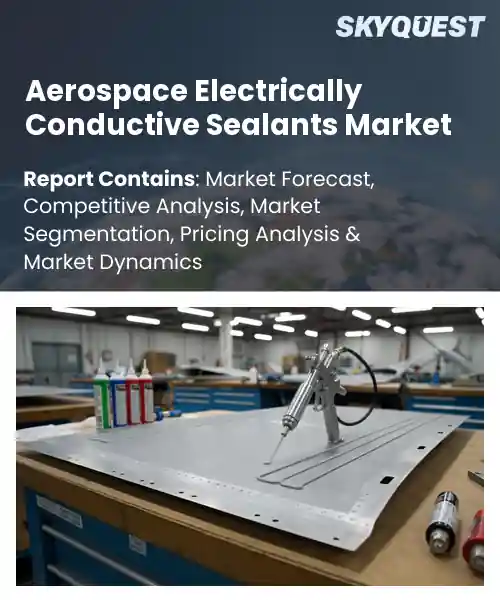
Aerospace Electrically Conductive Sealants Market
Report ID: SQMIG15B2200
Report ID: SQMIG15B2200
[email protected]
USA +1 351-333-4748
Report ID:
SQMIG15B2200 |
Region:
Global |
Published Date: March, 2026
Pages:
157
|Tables:
143
|Figures:
78


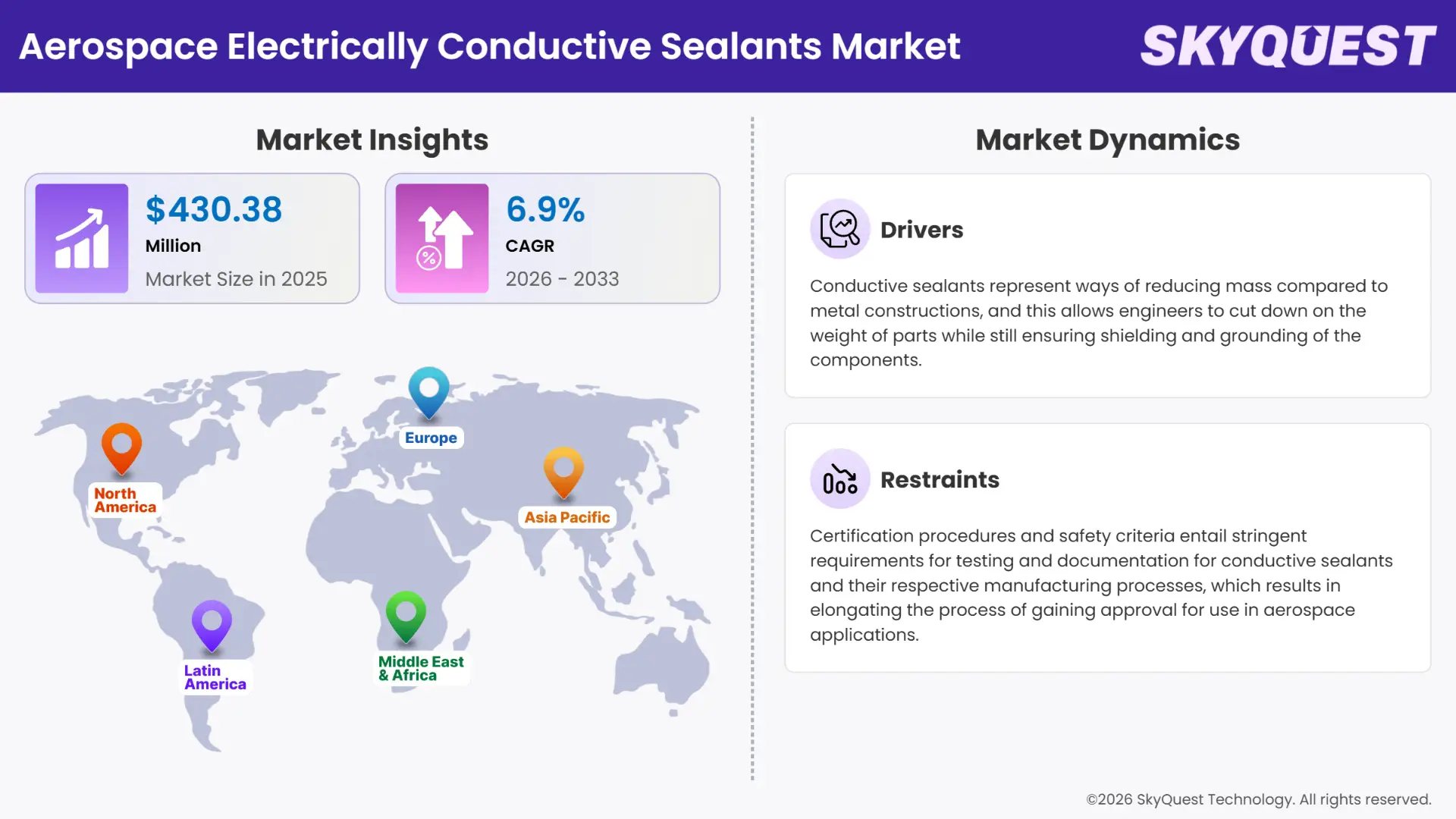
Global Aerospace Electrically Conductive Sealants Market size was valued at USD 402.60 Million in 2024 and is poised to grow from USD 430.38 Million in 2025 to USD 733.96 Million by 2033, growing at a CAGR of 6.9% during the forecast period (2026-2033).
Key Takeaways: Market Trends & Insights
Growing demand for lightweight materials, increasing adoption of advanced avionics systems, rising aircraft production, advancements in conductive material technologies, and emphasis on electromagnetic interference (EMI) shielding are driving sales of aerospace electrically conductive sealants.
Growing requirement for lightweight and functional materials that would work well under conditions of temperature fluctuation and extreme environmental conditions is another factor fueling the development of new polymers and nanoparticles. In addition, increase in aircraft fleets and associated maintenance operations will continue to boost sales in the original equipment manufacturer (OEM) and maintenance repair & overhaul (MRO) sectors. The trend towards electrical systems in aircraft is boosting the use of electrically conductive sealants. Increasing need for high-performance materials in aerospace applications around the world coupled with increasing focus on aircraft safety and reliability is expected to primarily drive aerospace electrically conductive sealants market growth.
On the contrary, high costs of advanced conductive sealants, stringent certification requirements, complexity in formulation and application, and performance limitations under extreme aerospace conditions are predicted to hamper aerospace electrically conductive sealants market penetration going forward.
How is AI Improving Performance Prediction for Aerospace Electrically Conductive Sealants?
Performance prediction improvement will involve accurate estimates of conductivity, adhesion, and durability in varying operational and manufacturing circumstances. AI plays a crucial role in helping make such predictions through integrating laboratory data, manufacturing processes, and computer models in predicting the performance and areas that could fail. There is an increasing demand for multifunctional light materials and certifications.
In February 2026, Henkel showcased conductive materials and AI-generated virtual adhesives at LOPEC. These innovations improve early performance prediction, reduce physical testing, and help accelerate product qualification while improving manufacturing efficiency in aerospace applications.
To get more insights on this market click here to Request a Free Sample Report
Global aerospace electrically conductive sealants market is segmented by product type, application, user type, end-use industry, formulation technology, and region. Based on product type, the market is segmented into sealants and adhesives. Based on application, the market is segmented into airframe, fuel tank, flight line repair, and windshield & canopy. Based on user type, the market is segmented into original equipment manufacturer and maintenance, repair & overhaul. Based on end-use industry, the market is segmented into commercial aviation, military aviation, and general aviation. Based on formulation technology, the market is segmented into solvent-based and water-based. Based on region, the market is segmented into North America, Europe, Asia Pacific, Latin America, and Middle East & Africa.
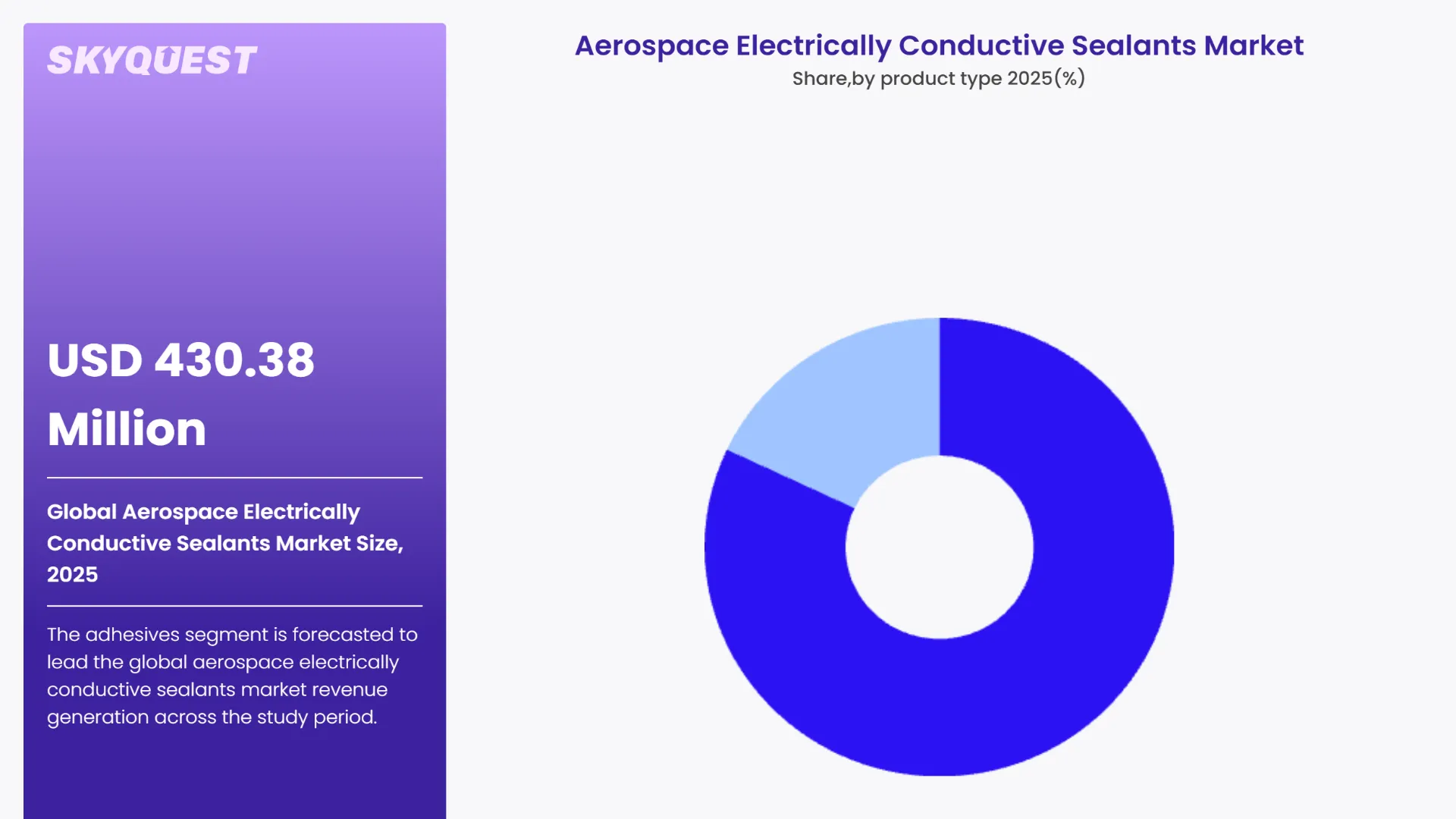
The adhesives segment is forecasted to lead the global aerospace electrically conductive sealants market revenue generation across the study period. Adhesives provide multifunctional bonding combined with electrical conductivity that meets structural and EMI requirements, which cements its dominance. This flexibility in chemical properties means that these materials can be integrated with composites or metals, thus simplifying the assembly process. Advances in materials suppliers when it comes to the development of fillers and cure technology has seen better reliability and longevity of materials, hence increased use in joining processes coupled with electromagnetic management.
However, sealants are emerging as the most rapidly expanding segment as per this aerospace electrically conductive sealants industry analysis. Targeted sealing and EMI gap filling for repair and retrofit work create new opportunities via this segment. Increased demand for repairable conductive seals and greater maintenance requirements on the flight line and windshields contribute to product development. This expansion increases the potential of the aftermarket and stimulates development of low temperature cure materials.
The water-based segment is slated to account for the largest global aerospace electrically conductive sealants market share going forward. Water-based conductive formulations address regulatory and environmental pressures while offering safer handling and simplified cleanup, which helps them hold sway over others. Since their solvent content is relatively low, their emissions are less dangerous, and they can easily be certified by companies that care about sustainability. The advances in chemical technology have also improved their conductive and adhesive capabilities.
Nonetheless, solvent-based formulations are experiencing the highest growth, fueled by superior performance records in harsh temperature and fueling conditions as well as established track records of certifications. The use of these chemicals together with existing materials and their preference among militaries and some civilian aircraft manufacturers ensure rapid adoption and development.
To get detailed segments analysis, Request a Free Sample Report
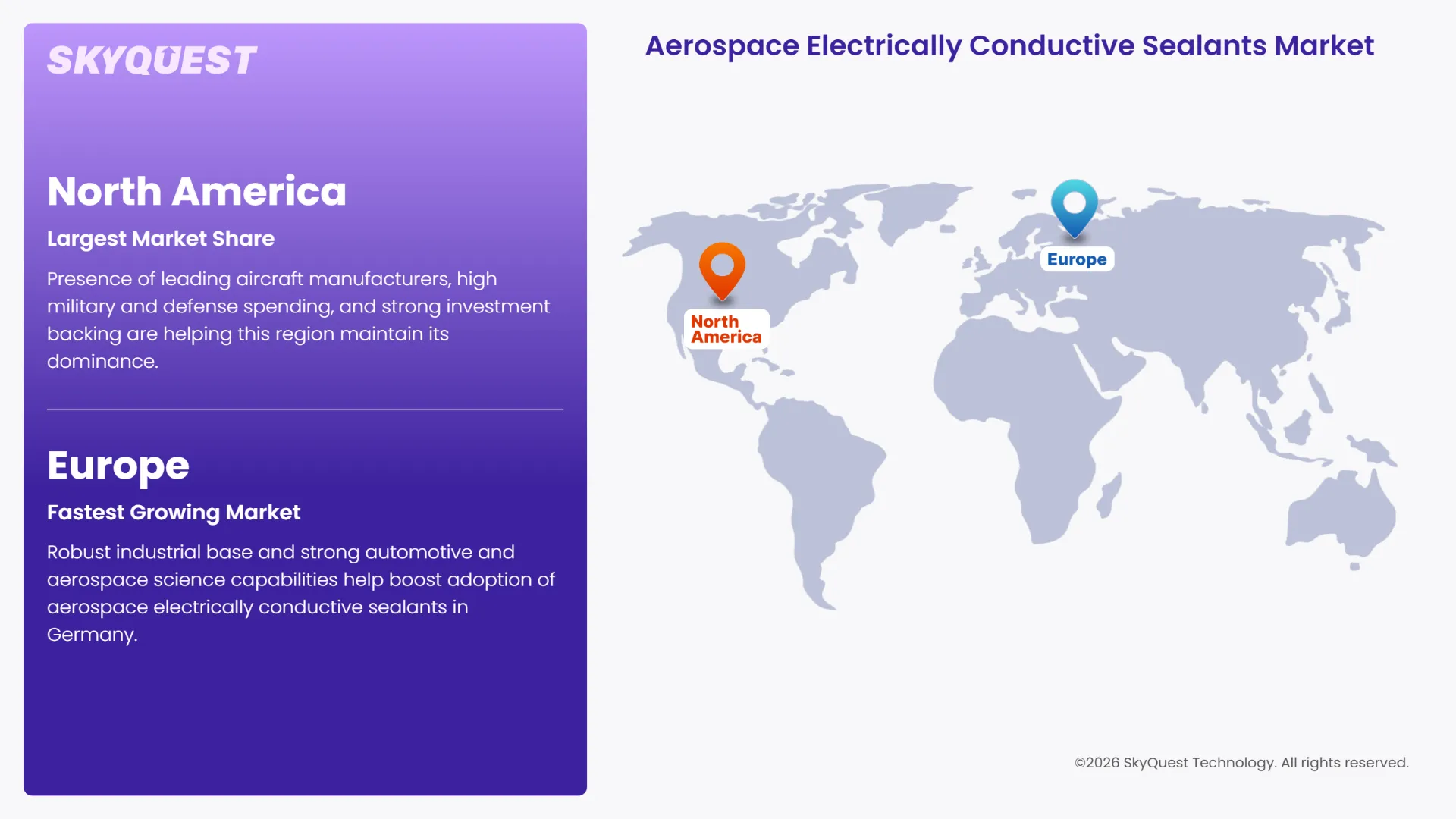
Presence of leading aircraft manufacturers, high military and defense spending, and strong investment backing are helping this region maintain its dominance. Existing maintenance, repair, and overhaul networks provide for aftermarket needs and create demand for retrofit solutions. There is a strong collaboration between industry and academia to facilitate the development of new materials, while existing testing facilities and procurement channels help to accelerate new material onto the marketplace. The regional supply chain supports interoperability with avionics and composite structures and is focused on providing enhanced electromagnetic protection, lightning strike protection, and long-term durability, which ultimately bolster the implementation of advanced electrically conductive sealant systems to maximize their utilization across North America’s aerospace industry.
Presence of top aircraft manufacturers, high defense spending, and research institutions driving specification R&D are shaping market growth in the United States. Robust maintenance programs and high retrofit activities fuel demand in the aftermarket segment, while proximity to end-users leads to the development of optimized formulations. Cooperation in aerospace electrically conductive sealants R&D between supplier companies and testing facilities speeds up the process of qualifying products for use in airframe and avionics systems.
Commercial aerospace supply chain specialization and targeted defense procurement are helping boost sales of aerospace electrically conductive sealants across Canada. Serviceability during the lifecycle of components and composites is a significant consideration. Adaptability requirements for sealing due to lightweight construction and have increased the demand for flexible sealants. Collaboration between universities, accreditation authorities, and regional sealant manufacturers facilitates testing and new product launches.
Advanced aerospace manufacturing, collaborative innovation ecosystems, and harmonized certification frameworks are boosting aerospace electrically conductive sealants adoption in European countries. Regional centers of excellence in materials science support the manufacture of conductive sealants by facilitating collaboration among OEMs, tier suppliers and researchers. In addition, having strong capabilities for providing MRO services and the ability to integrate supply chains across national borders will allow for rapid deployment and customization of conductive sealant formulations to meet the needs of national defense and commercial aviation customers. R&D of conductive sealants with high performance characteristics is of prime importance for aerospace electrically conductive sealants manufacturers in the region. Heavy investments in lightweight composite materials and advanced avionics require effective EM shielding and lightning protection, which makes conductive sealants even more important during both the design and repair phases of aircraft construction.
Robust industrial base and strong automotive and aerospace science capabilities help boost adoption of aerospace electrically conductive sealants in Germany. Focus on electrical technology and regional value chains facilitates development in fillers technology and processing. The interaction of manufacturers and research institutes will speed up qualification. The demand for such products arises from application in advanced generation aircrafts and electronic devices, where electromagnetic integrity is highly important.
Presence of an established maintenance overhaul ecosystem and composite integration expertise shapes procurement of aerospace electrically conductive sealants in the United Kingdom. Academic institutions contribute towards developing innovative formulations for electrically conductive sealants that are well-suited for the modification of modern aircraft. Emphasis on lightness and certification processes promotes supplier agility.
Presence of major OEMs, deep manufacturing capabilities, and integrated design houses shape demand for aerospace electrically conductive sealants in France. Reliability, EMC compatibility, and composites integration continue to drive the market toward custom sealant systems. Strong MRO network further reinforces the position of France in aerospace sealants. Strong ties among system integrators, certification agencies, and local suppliers accelerate the qualification process for aircraft platforms.
Growing aerospace manufacturing capability, focused material science development, and increasing certification and testing capacity shapes aerospace electrically conductive sealants demand in Asia Pacific. Regional suppliers are leveraging their strengths in electronics, nanomaterials, and precision processing to produce formulations that can be integrated into avionics and composite structures—OEMs, tier suppliers and research centres all have joined forces through government/industry partnerships for cluster development. As such, there have been improvements in the availability of MRO services and localised qualification opportunities, reducing barriers to entry, while improving the region’s ability to capture both original equipment and aftermarket opportunities for conductive sealing solutions, via focus on quality, cost competitiveness, and export orientation.
Strong electronics expertise, advanced material science, and precision manufacturing traditions are helping boost sales of aerospace electrically conductive sealants in Japan. Research institutions along with the private sector facilitate faster testing and improvement of these products which can be used in composite structures and aerospace applications. Close working relationships with suppliers of avionics products and strict quality standards guarantee that the products fulfill all the required characteristics regarding their electromagnetics and physical properties.
Rapid industrialization of aerospace manufacturing, strong competencies in electronics and composites, and robust government industry collaboration supports demand in South Korea. Attention to scalability, quality control, and compatibility with regional manufacturing networks helps to drive increased maintenance work on existing installations. Local suppliers stand to gain from the transfer of technology across industries and from forming partnerships with aerospace electrically conductive sealants OEMs.
To know more about the market opportunities by region and country, click here to
Buy The Complete Report
Rising Demand For Lightweight Materials
Increasing Electronic Systems Integration In Aircraft
Stringent Certification And Safety Requirements
High Material And Development Costs
Request Free Customization of this report to help us to meet your business objectives.
Competitive landscape in the global aerospace electrically conductive sealants market is shaped by major tier suppliers, targeted acquisitions and product-level differentiation driven by stricter avionics EMI requirements and aircraft electrification. Suppliers defend contracts via M&A, partnerships and material innovation, exemplified by PPG's PR-2201 B-1 launch, Parker Chomerics' CHO-BOND introductions, Royal Adhesives' acquisition of Bacon and investor partnerships with startups such as FibreCoat.
SkyQuest’s ABIRAW (Advanced Business Intelligence, Research & Analysis Wing) is our Business Information Services team that Collects, Collates, Correlates, and Analyses the Data collected by means of Primary Exploratory Research backed by robust Secondary Desk research.
As per SkyQuest analysis, rise in demand for lightweight and multifunctional materials along with increasing adoption of advanced avionics systems are anticipated to drive the demand for aerospace electrically conductive sealants going forward. However, high costs of advanced formulations, stringent certification requirements, and complexity in application processes are slated to slow down the adoption of aerospace electrically conductive sealants in the future. North America is slated to spearhead the demand for aerospace electrically conductive sealants owing to strong presence of leading aerospace manufacturers, high defense spending, and advanced MRO infrastructure. Advancements in AI-driven performance prediction, development of nanoscale conductive fillers, and integration of lightweight, high-performance sealant technologies are anticipated to be key trends driving the aerospace electrically conductive sealants sector going forward.
| Report Metric | Details |
|---|---|
| Market size value in 2024 | USD 402.60 Million |
| Market size value in 2033 | USD 733.96 Million |
| Growth Rate | 6.9% |
| Base year | 2024 |
| Forecast period | 2026-2033 |
| Forecast Unit (Value) | USD Million |
| Segments covered |
|
| Regions covered | North America (US, Canada), Europe (Germany, France, United Kingdom, Italy, Spain, Rest of Europe), Asia Pacific (China, India, Japan, Rest of Asia-Pacific), Latin America (Brazil, Rest of Latin America), Middle East & Africa (South Africa, GCC Countries, Rest of MEA) |
| Companies covered |
|
| Customization scope | Free report customization with purchase. Customization includes:-
|
To get a free trial access to our platform which is a one stop solution for all your data requirements for quicker decision making. This platform allows you to compare markets, competitors who are prominent in the market, and mega trends that are influencing the dynamics in the market. Also, get access to detailed SkyQuest exclusive matrix.
Table Of Content
Executive Summary
Market overview
Parent Market Analysis
Market overview
Market size
KEY MARKET INSIGHTS
COVID IMPACT
MARKET DYNAMICS & OUTLOOK
Market Size by Region
KEY COMPANY PROFILES
Methodology
For the Aerospace Electrically Conductive Sealants Market, our research methodology involved a mixture of primary and secondary data sources. Key steps involved in the research process are listed below:
1. Information Procurement: This stage involved the procurement of Market data or related information via primary and secondary sources. The various secondary sources used included various company websites, annual reports, trade databases, and paid databases such as Hoover's, Bloomberg Business, Factiva, and Avention. Our team did 45 primary interactions Globally which included several stakeholders such as manufacturers, customers, key opinion leaders, etc. Overall, information procurement was one of the most extensive stages in our research process.
2. Information Analysis: This step involved triangulation of data through bottom-up and top-down approaches to estimate and validate the total size and future estimate of the Aerospace Electrically Conductive Sealants Market.
3. Report Formulation: The final step entailed the placement of data points in appropriate Market spaces in an attempt to deduce viable conclusions.
4. Validation & Publishing: Validation is the most important step in the process. Validation & re-validation via an intricately designed process helped us finalize data points to be used for final calculations. The final Market estimates and forecasts were then aligned and sent to our panel of industry experts for validation of data. Once the validation was done the report was sent to our Quality Assurance team to ensure adherence to style guides, consistency & design.
Analyst Support
Customization Options
With the given market data, our dedicated team of analysts can offer you the following customization options are available for the Aerospace Electrically Conductive Sealants Market:
Product Analysis: Product matrix, which offers a detailed comparison of the product portfolio of companies.
Regional Analysis: Further analysis of the Aerospace Electrically Conductive Sealants Market for additional countries.
Competitive Analysis: Detailed analysis and profiling of additional Market players & comparative analysis of competitive products.
Go to Market Strategy: Find the high-growth channels to invest your marketing efforts and increase your customer base.
Innovation Mapping: Identify racial solutions and innovation, connected to deep ecosystems of innovators, start-ups, academics, and strategic partners.
Category Intelligence: Customized intelligence that is relevant to their supply Markets will enable them to make smarter sourcing decisions and improve their category management.
Public Company Transcript Analysis: To improve the investment performance by generating new alpha and making better-informed decisions.
Social Media Listening: To analyze the conversations and trends happening not just around your brand, but around your industry as a whole, and use those insights to make better Marketing decisions.
REQUEST FOR SAMPLE
 REQUEST FREE CUSTOMIZATION
Global Aerospace Electrically Conductive Sealants Market size was valued at USD 402.6 Million in 2024 and is poised to grow from USD 430.38 Million in 2025 to USD 733.96 Million by 2033, growing at a CAGR of 6.9% during the forecast period (2026-2033).
Competitive landscape in the global aerospace electrically conductive sealants market is shaped by major tier suppliers, targeted acquisitions and product-level differentiation driven by stricter avionics EMI requirements and aircraft electrification. Suppliers defend contracts via M&A, partnerships and material innovation, exemplified by PPG's PR-2201 B-1 launch, Parker Chomerics' CHO-BOND introductions, Royal Adhesives' acquisition of Bacon and investor partnerships with startups such as FibreCoat. '3M', 'Huntsman Corporation', 'H.B. Fuller', 'Henkel', 'Illinois Tool Works Inc.', 'PPG', 'Cytec Solvay Group', 'Hexcel Corporation', 'Bostik (Arkema)', 'Dowdupont', 'Permabond', 'Lord Corporation', 'Master Bond', 'Scigrip Adhesives', 'Sika', 'Delo Industrial Adhesives', 'Hernon Manufacturing', 'Dymax Corporation', 'Uniseal', 'Beacon Adhesives'
Conductive sealants provide mass-saving alternatives to traditional metallic assemblies, enabling designers to reduce component weight while maintaining electromagnetic shielding and grounding continuity. This capability aligns with manufacturers’ emphasis on fuel efficiency and range optimization, prompting greater specification of advanced sealant materials during design cycles. Suppliers that deliver high-performance, reliable conductive elastomers see elevated adoption in structural joints and avionics enclosures because these materials simplify assembly, reduce fastener counts, and integrate electrical functionality without adding significant mass, thereby directly supporting aircraft performance and lifecycle efficiency objectives.
Lightweight Conductive Materials Adoption: Demand for lightweight electrically conductive sealants is rising as manufacturers seek to reduce aircraft mass while preserving electromagnetic shielding and grounding performance. Suppliers are reformulating chemistries and exploring hybrid fillers to balance conductivity, flexibility and adhesion to composite structures. The trend drives collaboration among materials scientists and OEM engineers, validating solutions that integrate with surface treatments and bonding processes. Emphasis on weight reduction supports fuel efficiency goals and maintenance, prompting innovation in low density conductive formulations tailored for airframe architectures.
North America Dominate the Global Aerospace Electrically Conductive Sealants Market.
The adhesives segment is expected to lead the market due to its ability to provide multifunctional bonding along with electrical conductivity, helping meet both structural and EMI management requirements in aerospace applications.
Sealants are projected to be the fastest-growing segment, driven by increasing demand for conductive sealing solutions in repair, retrofit, flight line maintenance, and windshield applications.
AI is helping manufacturers improve predictions related to conductivity, adhesion, durability, and failure risks by integrating laboratory data, manufacturing information, and simulation models. This reduces testing requirements and accelerates product qualification processes.


Want to customize this report? This report can be personalized according to your needs. Our analysts and industry experts will work directly with you to understand your requirements and provide you with customized data in a short amount of time. We offer $1000 worth of FREE customization at the time of purchase.
Feedback From Our Clients


 USA (+1) 351-333-4748

