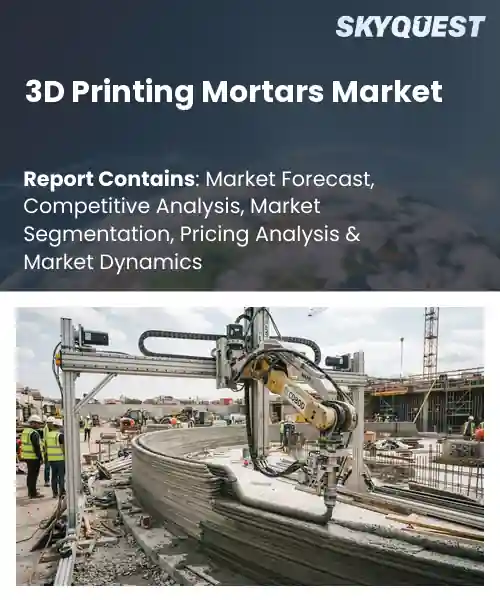
3D Printing Mortars Market
Report ID: SQMIG15F2479
Report ID: SQMIG15F2479
[email protected]
USA +1 351-333-4748
Report ID:
SQMIG15F2479 |
Region:
Global |
Published Date: November, 2026
Pages:
157
|Tables:
145
|Figures:
78


Global 3D Printing Mortars Market size was valued at USD 310.0 Million in 2024 and is poised to grow from USD 362.08 Million in 2025 to USD 1254.15 Million by 2033, growing at a CAGR of 16.8% during the forecast period (2026-2033).
The global 3D‑printing mortars market encompasses additive manufacturing systems that extrude cement‑based pastes to fabricate structural components, façades, and repair elements. It matters because it promises to shorten construction cycles, lower material waste, and enable design freedom unattainable with conventional casting. The market emerged from academic prototypes in the early 2010s, such as the 2014 WinSun concrete printer, and accelerated after major firms like Lafarge and Cemex launched commercial mixers and software platforms. Over the past five years the sector has shifted from pilot projects to deployments in residential housing, disaster‑relief shelters, and heritage restoration, illustrating a trajectory of maturation. The primary growth catalyst is the convergence of rapid urbanization with strict carbon‑reduction policies, pushing developers toward faster, greener construction. As city populations expand, the need to deliver affordable units on tight schedules intensifies, leading contractors to adopt 3D‑printed mortars that lower labor expenses and cut cement use through optimized mixes. Real‑world deployments show this effect: Dubai’s municipality printed a three‑storey office block in 2022, and a U.S. housing agency piloted a 150‑unit printed‑home community for low‑income families. These projects prove scalability, open revenue streams for equipment makers, and attract public funding for sustainable infrastructure, widening the market’s addressable horizon.
How is AI-driven automation reshaping the 3D printing mortars market?
AI‑driven automation is redefining the 3D printing mortars market by embedding intelligent control into every stage of the printing process. Machine‑learning models now predict optimal mix ratios, adjusting water, binder and additive levels in real time to achieve consistent strength and flow. Sensors feed data to algorithms that fine‑tune extrusion speed, layer height and curing time, reducing material waste and shortening build cycles. This seamless feedback loop allows printers to adapt to on‑site conditions such as temperature fluctuations or substrate irregularities, making large‑scale construction projects more reliable. As a result, contractors can deliver complex architectural forms faster while maintaining structural integrity, expanding the appeal of mortar‑based additive manufacturing across residential, commercial and infrastructure sectors.CEMEX announced an AI‑enhanced 3D printing mortar platform in April 2023, demonstrating how predictive mix optimization and autonomous nozzle control boost productivity and material efficiency, accelerating market adoption.
Market snapshot - (2026-2033)
Global Market Size
USD 310.0 Million
Largest Segment
Cement-Based Mortars
Fastest Growth
Geopolymer Mortars
Growth Rate
16.8% CAGR
To get more insights on this market click here to Request a Free Sample Report
Global 3d printing mortars market is segmented by mortar type, material composition, printing technology, application, end user and region. Based on mortar type, the market is segmented into Cement-Based Mortars, Geopolymer Mortars and Lime-Based & Other Specialty Mortars. Based on material composition, the market is segmented into Fiber-Reinforced Mortars and Non-Fiber-Reinforced Mortars. Based on printing technology, the market is segmented into Extrusion-Based Printing and Other 3D Printing Technologies. Based on application, the market is segmented into Residential Construction, Commercial Construction, Infrastructure, Architectural Components and Repair & Rehabilitation. Based on end user, the market is segmented into Construction Companies, 3D Printing Service Providers, Building Material Manufacturers and Research Institutions. Based on region, the market is segmented into North America, Europe, Asia Pacific, Latin America and Middle East & Africa.
Cement based mortars segment dominates because its proven strength and reliability align tightly with the mechanical demands of extrusion processes. The material’s established supply chain and compatibility with conventional additives simplify formulation, enabling consistent layer to layer bonding. Designers favor it for predictable curing behavior, which reduces print failures and supports rapid project timelines. Its familiarity also eases regulatory approval, encouraging widespread adoption across diverse construction projects and facilitates integration with emerging digital workflows.
However, geopolymer mortars segment is the fastest growing because its low carbon formulation meets rising sustainability mandates while offering comparable durability. Innovations in alkaline activation are expanding printable mixes, attracting projects focused on green credentials. This ecological advantage is unlocking new market niches and accelerating broader acceptance of 3d printed construction.
Fiber reinforced mortars segment leads because embedded fibers enhance tensile capacity and crack resistance, which are critical for load bearing printed elements. The fibers distribute stress across printed layers, mitigating anisotropy inherent in additive processes. Manufacturers can tailor fiber type and orientation to specific design criteria, improving overall durability without compromising printability. This performance edge encourages adoption in high rise and complex geometries where structural integrity is paramount for future urban infrastructure projects.
Meanwhile, non fiber reinforced mortars segment is growing rapidly because its simpler formulation cuts material costs and eases mixing, attracting cost conscious builders. Recent admixture innovations improve flow and early strength, making it viable for standard residential printing. This cost advantage and ease of use are widening market adoption of 3d printing.
To get detailed segments analysis, Request a Free Sample Report
North America leads through a convergence of sophisticated construction practices, extensive research ecosystems, and strong collaboration between academia and industry. The region benefits from early integration of additive manufacturing into building processes, supported by progressive codes that encourage innovation. Large infrastructure programs provide fertile ground for pilot projects and scale‑up, while a network of material suppliers and technology firms ensures rapid diffusion of advanced mortar formulations. Skilled labor forces and investment in digital design tools further reinforce the competitive edge, allowing firms to deliver high‑performance, environmentally responsive solutions that set global benchmarks for speed, precision, and durability.
3D Printing Mortars Market in the United States is propelled by a culture of rapid technology adoption and a deep pool of engineering talent. Major construction firms collaborate closely with software developers to embed digital workflows, while universities drive material science breakthroughs that translate into commercial offerings. Demand from large‑scale residential and commercial projects fuels continuous refinement of mix designs, emphasizing sustainability and structural integrity, positioning the market as a catalyst for broader digital transformation in construction.
3D Printing Mortars Market in Canada draws strength from government incentives that prioritize low‑carbon building methods and regional collaboration among research institutes. The emphasis on cold‑climate performance guides the development of specialized mortar blends that maintain workability and strength under challenging conditions. Partnerships between provincial construction associations and technology providers accelerate knowledge transfer, fostering a growing community of practitioners who integrate additive techniques into public and private sector projects.
Europe’s expansion is driven by a harmonious blend of stringent sustainability mandates, innovative design culture, and a cohesive regulatory environment that rewards material efficiency. Robust funding mechanisms for green construction encourage the adoption of additive mortar solutions that reduce waste and carbon emissions. The region’s strong heritage in engineering excellence supports continuous refinement of mix compositions, while collaborative consortia across borders accelerate standardization and knowledge sharing. Consumer demand for high‑performance, aesthetically versatile structures further fuels market momentum, positioning Europe as a leader in integrating 3D printed mortar technologies into both historic renovation and cutting‑edge construction.
3D Printing Mortars Market in Germany benefits from deep expertise in precision engineering and a well‑established network of material suppliers. Research institutions focus on polymer‑modified mortars that enhance durability and tensile performance, aligning with the country’s emphasis on long‑lasting infrastructure. Integration of digital twin technologies enables real‑time monitoring of mix behavior, encouraging wider acceptance among contractors who value reliability and efficiency in complex building projects.
3D Printing Mortars Market in the United Kingdom is characterized by rapid adoption driven by ambitious housing targets and a proactive stance on modular construction. Collaborative initiatives between government bodies and private innovators accelerate pilot deployments, highlighting the speed and cost advantages of printed mortar systems. Emphasis on sustainable building practices steers research toward low‑embodied‑energy mixes, fostering a dynamic environment where new entrants and established firms alike explore novel applications across commercial and residential sectors.
3D Printing Mortars Market in France is emerging through a blend of architectural heritage and forward‑looking policy support for eco‑friendly construction. Academic labs concentrate on bio‑based additives that reduce environmental impact while maintaining structural performance. Early‑stage projects in urban renewal districts showcase the aesthetic flexibility of printed mortars, attracting interest from designers and developers eager to differentiate projects with bespoke surface textures and reduced material waste.
Asia Pacific is advancing its role by leveraging rapid urbanization, government‑backed research programs, and a growing appetite for construction efficiency. The region’s focus on high‑rise and infrastructure development creates a demand for faster, waste‑reduced building methods, prompting extensive trials of printed mortar technologies. Strong ties between technology startups and large construction conglomerates accelerate the translation of laboratory innovations into field applications. Additionally, regional sustainability goals encourage the formulation of low‑carbon mortars, positioning Asia Pacific as a vibrant hub for experimental approaches that blend speed, cost‑effectiveness, and environmental responsibility.
3D Printing Mortars Market in Japan is shaped by a tradition of meticulous craftsmanship and a strategic push toward resilient building solutions. Research centers prioritize seismic‑responsive mortar formulations that maintain integrity under dynamic loads, aligning with the nation’s focus on disaster‑resilient infrastructure. Partnerships between construction firms and robotics companies facilitate seamless integration of printing processes, supporting a gradual yet steady increase in project adoption across residential and public works.
3D Printing Mortars Market in South Korea benefits from strong governmental support for smart city initiatives and a vibrant technology ecosystem. Collaborative programs between universities and industry accelerate the development of high‑performance mortar blends that reduce curing time while enhancing durability. The emphasis on digital construction platforms enables precise material deposition, allowing developers to experiment with complex geometries and faster project timelines, thereby reinforcing the country’s emerging leadership in additive building solutions.
To know more about the market opportunities by region and country, click here to
Buy The Complete Report
Supply Chain is Evolving Rapidly
Construction Industry is Embracing Automation
Material Costs are Rising Significantly
Regulatory Standards are Becoming Stricter
Request Free Customization of this report to help us to meet your business objectives.
The competitive landscape of the global 3D printing mortars market is shaped by intense rivalry among established manufacturers and emerging innovators, driving rapid adoption of advanced extrusion technologies and sustainable material formulations. Recent strategic moves include major acquisitions of specialty additive‑manufacturing firms, joint ventures between construction conglomerates and tech startups to integrate digital design platforms, and aggressive R&D investments that have accelerated the rollout of high‑performance, low‑carbon‑footprint mortar mixes. These actions intensify competition and expand market reach across residential, commercial, and infrastructure projects.
Top Player’s Company Profile
Recent Developments
SkyQuest’s ABIRAW (Advanced Business Intelligence, Research & Analysis Wing) is our Business Information Services team that Collects, Collates, Correlates, and Analyses the Data collected by means of Primary Exploratory Research backed by robust Secondary Desk research. As per SkyQuest analysis, rapid urbanization coupled with stringent carbon‑reduction policies is the primary driver accelerating adoption of 3D‑printed mortars, while rising material costs act as a significant restraint limiting broader uptake. North America emerges as the dominating region thanks to its advanced construction ecosystem, strong research‑industry ties and supportive regulatory environment. Cement‑based mortars remain the dominant segment because of their proven strength, reliable supply chain and ease of regulatory approval. A second driver fueling growth is the construction industry’s shift toward automation, where robotic extrusion and AI‑enabled mix optimisation reduce labor dependence and improve build speed, further expanding market momentum.
| Report Metric | Details |
|---|---|
| Market size value in 2024 | USD 310.0 Million |
| Market size value in 2033 | USD 1254.15 Million |
| Growth Rate | 16.8% |
| Base year | 2024 |
| Forecast period | (2026-2033) |
| Forecast Unit (Value) | USD Million |
| Segments covered |
|
| Regions covered | North America (US, Canada), Europe (Germany, France, United Kingdom, Italy, Spain, Rest of Europe), Asia Pacific (China, India, Japan, Rest of Asia-Pacific), Latin America (Brazil, Rest of Latin America), Middle East & Africa (South Africa, GCC Countries, Rest of MEA) |
| Companies covered |
|
| Customization scope | Free report customization with purchase. Customization includes:-
|
To get a free trial access to our platform which is a one stop solution for all your data requirements for quicker decision making. This platform allows you to compare markets, competitors who are prominent in the market, and mega trends that are influencing the dynamics in the market. Also, get access to detailed SkyQuest exclusive matrix.
Table Of Content
Executive Summary
Market overview
Parent Market Analysis
Market overview
Market size
KEY MARKET INSIGHTS
COVID IMPACT
MARKET DYNAMICS & OUTLOOK
Market Size by Region
KEY COMPANY PROFILES
Methodology
For the 3D Printing Mortars Market, our research methodology involved a mixture of primary and secondary data sources. Key steps involved in the research process are listed below:
1. Information Procurement: This stage involved the procurement of Market data or related information via primary and secondary sources. The various secondary sources used included various company websites, annual reports, trade databases, and paid databases such as Hoover's, Bloomberg Business, Factiva, and Avention. Our team did 45 primary interactions Globally which included several stakeholders such as manufacturers, customers, key opinion leaders, etc. Overall, information procurement was one of the most extensive stages in our research process.
2. Information Analysis: This step involved triangulation of data through bottom-up and top-down approaches to estimate and validate the total size and future estimate of the 3D Printing Mortars Market.
3. Report Formulation: The final step entailed the placement of data points in appropriate Market spaces in an attempt to deduce viable conclusions.
4. Validation & Publishing: Validation is the most important step in the process. Validation & re-validation via an intricately designed process helped us finalize data points to be used for final calculations. The final Market estimates and forecasts were then aligned and sent to our panel of industry experts for validation of data. Once the validation was done the report was sent to our Quality Assurance team to ensure adherence to style guides, consistency & design.
Analyst Support
Customization Options
With the given market data, our dedicated team of analysts can offer you the following customization options are available for the 3D Printing Mortars Market:
Product Analysis: Product matrix, which offers a detailed comparison of the product portfolio of companies.
Regional Analysis: Further analysis of the 3D Printing Mortars Market for additional countries.
Competitive Analysis: Detailed analysis and profiling of additional Market players & comparative analysis of competitive products.
Go to Market Strategy: Find the high-growth channels to invest your marketing efforts and increase your customer base.
Innovation Mapping: Identify racial solutions and innovation, connected to deep ecosystems of innovators, start-ups, academics, and strategic partners.
Category Intelligence: Customized intelligence that is relevant to their supply Markets will enable them to make smarter sourcing decisions and improve their category management.
Public Company Transcript Analysis: To improve the investment performance by generating new alpha and making better-informed decisions.
Social Media Listening: To analyze the conversations and trends happening not just around your brand, but around your industry as a whole, and use those insights to make better Marketing decisions.
REQUEST FOR SAMPLE
 REQUEST FREE CUSTOMIZATION


Want to customize this report? This report can be personalized according to your needs. Our analysts and industry experts will work directly with you to understand your requirements and provide you with customized data in a short amount of time. We offer $1000 worth of FREE customization at the time of purchase.
Feedback From Our Clients


 USA (+1) 351-333-4748

