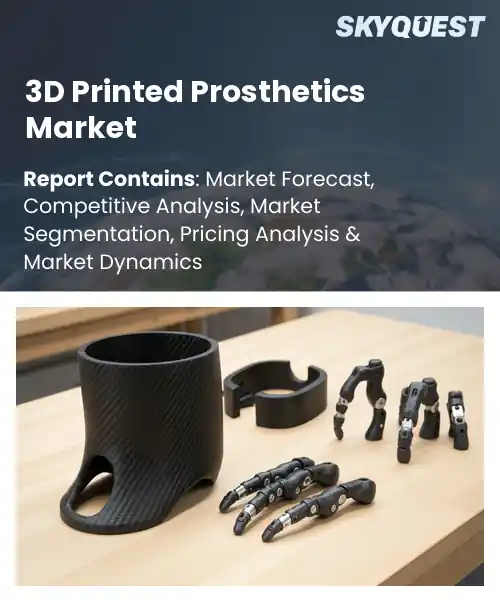
3D Printed Prosthetics Market
Report ID: SQMIG35A3690
Report ID: SQMIG35A3690
[email protected]
USA +1 351-333-4748
Report ID:
SQMIG35A3690 |
Region:
Global |
Published Date: June, 2026
Pages:
157
|Tables:
144
|Figures:
77


Global 3D Printed Prosthetics Market size was valued at USD 0.852 Billion in 2024 and is poised to grow from USD 0.99 Billion in 2025 to USD 3.252 Billion by 2033, growing at a CAGR of 15.82% during the forecast period (2026-2033).
The primary driver of the 3D printed prosthetics market is the convergence of affordable additive manufacturing and digital customization that lowers cost and accelerates design iteration. This market supplies limb replacements and orthotic components that matter because they expand access, personalize fit and restore function for populations. Development has moved from academic prototypes to community built solutions and products as printers improved and materials matured. For example, the volunteer network eNABLE demonstrated rapid, inexpensive hand devices while companies like Open Bionics translated consumer grade scanning and printing into FDA cleared or CE marked offerings, establishing pathways toward scale and adoption.
A key trend driving the 3D printed prosthetic sector is maturation of digital workflows because high resolution scanning, parametric CAD and printing materials shorten fitting cycles and reduce labor costs. As clinical teams can iterate virtual sockets and print replacements, patient throughput rises and payers see lower long term costs, which encourages reimbursement and hospital procurement. This dynamic creates opportunities for scalable customization in pediatrics where frequent resizing is needed and for remote clinics that dispatch print ready files to partners. In practice humanitarian programs and specialized centers now use smartphone scans and desktop printers to deliver timely, affordable prosthetics, illustrating a replicable commercial model.
How Is AI Improving Personalization and Fit in the 3D Printed Prosthetics Market?
The incorporation of AI into 3D-printed prosthetics has enhanced both personalisation and fit by creating design information from clinical scans and user feedback via Example-based 3D printing. The use of machine-learning models combines anatomical contours to form movement patterns for each user’s body and supports the generative design process of creating the different parts which match the location of soft tissue and load points on the human body. Thus, fitting cycles can be completed much faster because fewer manual adjustments are required. In the current market clinicians and small labs use these tools to scale bespoke production while keeping costs lower and outcomes more consistent. Examples include companies using 3D printing for bionic arms and new medical grade materials that enable more lifelike, patient specific parts.
In April 2026, Allow Motion showcased a personalized myoelectric prosthesis that uses AI to learn user intent and adapt control over time, showing how adaptive algorithms and integrated 3D printing make fit and function more intuitive and easier to deliver at scale.
Market snapshot - (2026-2033)
Global Market Size
USD 0.852 Billion
Largest Segment
Upper Limb Prosthetics
Fastest Growth
Lower Limb Prosthetics
Growth Rate
15.82% CAGR
To get more insights on this market click here to Request a Free Sample Report
Global 3d printed prosthetics market is segmented by type, technology, material, end-user, distribution and region. Based on type, the market is segmented into upper limb prosthetics, lower limb prosthetics and others. Based on technology, the market is segmented into FDM (fused deposition modeling), SLS (selective laser sintering) and SLA (stereolithography). Based on material, the market is segmented into thermoplastics (PLA, ABS, nylon) and silicone. Based on end-user, the market is segmented into hospitals, rehabilitation centers and home care. Based on distribution, the market is segmented into direct to clinics and online. Based on region, the market is segmented into North America, Europe, Asia Pacific, Latin America and Middle East & Africa.
Based on the global 3D printed prosthetics market growth, SLS segment dominates because its powder bed fusion process produces strong, isotropic polymer components that meet load bearing and durability demands of functional prosthetic parts. The technology enables complex internal lattices and integrated features that improve strength while controlling weight, reducing component failures and satisfying clinical performance needs. Clinics and manufacturers prefer the material's versatility and reproducibility, which is propelling the adoption of end use devices and accelerating design standardisation throughout the overall complementary structure of the industry.
However, FDM is emerging as the most rapidly expanding option due to low cost, accessibility and fast iteration for custom sockets and cosmetic components. Desktop printers enable clinics and small labs to prototype and deliver personalized fits quickly, while improving filament materials increase durability, unlocking distributed production and broader adoption across care settings.
Upper limb prosthetics segment dominates because demand for functional, dexterous replacements prioritizes customizable multi component designs that 3D printing can deliver. Clinics are switching to additive workflows to meet demand for individualized sockets, modular wrists and detailed cosmetic covers. By speeding up the fitting process, clinics can enhance patient comfort. The demand for hand function, adaptive grips and how the product looks and feels can sustain purchasing and support specialist service offerings that help to maintain their position as leaders in the market.
On the other hand, lower limb prosthetics is the fastest growing area as advances in durable materials and scan to print workflows improve socket fit and load performance for ambulation. Enhanced biomechanics, integrated sensors and rehabilitation demand drive wider clinical acceptance and new product tiers, expanding commercial opportunities and aftercare service ecosystems.
To get detailed segments analysis, Request a Free Sample Report
As per the global 3D printed prosthetics market share, North America dominates due to a convergence of advanced clinical infrastructure, concentrated manufacturing expertise, robust research networks and well established reimbursement and regulatory pathways that facilitate market entry and clinical adoption. Academic medical centers also work closely with specialized prosthetic clinics to bring innovations to the real world. Venture/private investment funds product development/scale, supply chain vetting enables prototyping and producing local customized devices quickly and make iterative improvements easily. Advocacy groups for patients/veteran care are close to their clinicians and intimately familiar with additive manufacturing, contributing to the faster acceptance by patients/clinicians. The market benefits from integration of digital workflows, interdisciplinary teams and favorable intellectual property environments that together sustain leadership in both technological innovation and commercialization. Cross sector partnerships and early clinical outcomes further reinforce a competitive ecosystem that attracts global collaboration and talent.
3D printed prosthetics market in United States reflects concentration of advanced additive manufacturing capacity, clinical research and reimbursement landscape that supports commercialization. Medical centers act as adoption hubs while vibrant startup and investor community accelerates product development and scaling. Through collaboration of engineers, prosthetists and regulators the clinical integration process and iterative design process can be simplified. Emphasis on customisation, use of high performing materials and being integrated with digital health tools offers the market a significant advantage as a global leader in the industry.
3D printed prosthetics market in Canada is shaped by a public health system, regional procurement and collaboration between research hospitals and manufacturers. Telemedicine using remote fittings allows new workflows for both telemedicine providers and telemedicine customers as they look to adopt across their respective geographies. Innovation clusters and global companies entering into partnership with local organizations support building skills and experience, while also generating tangible outcomes around rehabilitation and improving patient experience.
Based on global 3D printed prosthetics regional forecast, rapid expansion in Europe is driven by a combination of strong medical device manufacturing heritage, close collaboration between academic research centers and clinical institutions, and healthcare systems that prioritize patient centered care and technology assessment. Product certification and cross border adoption can be streamlined through regulatory clarity and harmonization across various markets while national reimbursement pathways in some of the world’s leading markets allow for clinical pilot studies and ultimately the integration of innovative products into routine care. There is also a strong investment being made in additive manufacturing clusters that specialize in prosthetic manufacturing, training skilled workforces, and funding public research as the foundation for innovation. The creation of cross disciplinary consortia and partnerships with leading global technology firms will accelerate the speed to market for innovative products and support the localization of complete supply chains.
3D printed prosthetics market in Germany is driven by advanced engineering, a dense network of specialized manufacturers and close collaboration between technical universities and clinical centers. High quality standards and established orthopedic services facilitate clinical adoption. Effective partnering with hospitals supports iterative development of custom-fit solutions which combine small/medium businesses companies that provide custom solutions, agile manufacturing and certified pathways through the relevant certification system for manufacturing prosthetics.
3D printed prosthetics market in United Kingdom features rapid adoption supported by leading research institutions, vibrant startups and innovation programs in public healthcare. Universities, clinics, and technology startups work together to quickly move from prototype to real-world use. Focusing on patient-centered care and integrating digital tools into how we care for patients helps us adopt them faster. Having interconnected services makes it possible to customize and validate prosthetics through skilled people and clinical places that provide services to patients.
3D printed prosthetics market in France is emerging through coordinated efforts among research hospitals, innovation agencies and manufacturing clusters. Design is influenced by the emphasis placed on patient experience the aesthetics & functional outcomes of devices. In addition, rehabilitation centers base their therapy approaches on designing customized solutions. To increase developmental capacity, quality assurance & scalability of appropriate prosthetic offerings, rehabilitation centers collaborate with manufacturers in their respective regions and with patients & partners from around the globe.
As per global 3D printed prosthetics regional outlook, Asia Pacific is strengthening its position through a mix of technological advancement, manufacturing capacity expansion and targeted public policy support that together enhance regional competitiveness. The development of new materials and improved processes is being conducted by many different entities; national research institutions, universities, and private manufacturers are doing this as part of their efforts to develop new technologies. The clinical application & workflow evaluation of these technologies is being done primarily through pilot studies at hospitals and rehabilitation centers. By establishing strategic partnerships between local companies and international tech providers, knowledge transfer & quality assurance can be accelerated. The focus on producing at a lower cost, tailoring products to meet the needs of various patients, and incorporating them into a digital health platform will improve the practicality of these products.
3D printed prosthetics market in Japan benefits from precision manufacturing, robotics integration and collaboration between engineering institutes and clinical centers. Focus on elder care drives demand for comfortable, durable and integrated solutions. Robust materials research and attention to ergonomic design underpin device quality, while regulatory pathways and partnerships support clinical validation. Integration with assistive technologies and rehabilitation programs enables care models that align technical innovation with user centered outcomes effectively.
3D printed prosthetics market in South Korea is propelled by technology driven ecosystem combining advanced electronics, additive manufacturing expertise and hospital networks for clinical evaluation. Startup and corporate investment enable fast prototyping and sophisticated device design, with sensor integration and materials. The national research centers collaborate with clinicians to establish functional efficacy and form fit while also refining manufacturers for scalable production. The design focus, connectivity, and rehab pathways provide support for clinical adoption as well as iterative refinements to products.
To know more about the market opportunities by region and country, click here to
Buy The Complete Report
Customization And Patient Specificity
Material Innovation And Biocompatibility
Regulatory Approval Complexity
Limited Reimbursement And Awareness
Request Free Customization of this report to help us to meet your business objectives.
Competitive dynamics in the global 3D printed prosthetics market outlook are driven by targeted M&A, supplier OEM partnerships, and rapid technology innovation that sharpen time to market and manufacturing scale. Examples include Stratasys acquiring photopolymer capabilities via Origin and Protolabs integrating Hubs for on-demand production, while HP partnerships with prosthetics innovators show how materials and printing alliances become competitive levers.
Top Player’s Company Profile
Recent Developments
SkyQuest’s ABIRAW (Advanced Business Intelligence, Research & Analysis Wing) is our Business Information Services team that Collects, Collates, Correlates, and Analyses the Data collected by means of Primary Exploratory Research backed by robust Secondary Desk research.
As per SkyQuest analysis, the global 3D printed prosthetics industry is being propelled primarily by the convergence of affordable additive manufacturing and digital customization that reduce costs and speed design iteration, while a second important driver is the maturation of end-to-end digital workflows such as high-resolution scanning and parametric CAD that shorten fitting cycles. Despite strong innovation, regulatory approval complexity remains a notable restraint that slows clinical adoption and market entry. North America leads the market thanks to advanced clinical infrastructure and supportive ecosystems, and upper limb prosthetics dominate demand because customization needs for dexterous, multi component designs favor additive manufacturing approaches.
| Report Metric | Details |
|---|---|
| Market size value in 2024 | USD 0.852 Billion |
| Market size value in 2033 | USD 3.252 Billion |
| Growth Rate | 15.82% |
| Base year | 2024 |
| Forecast period | (2026-2033) |
| Forecast Unit (Value) | USD Billion |
| Segments covered |
|
| Regions covered | North America (US, Canada), Europe (Germany, France, United Kingdom, Italy, Spain, Rest of Europe), Asia Pacific (China, India, Japan, Rest of Asia-Pacific), Latin America (Brazil, Rest of Latin America), Middle East & Africa (South Africa, GCC Countries, Rest of MEA) |
| Companies covered |
|
| Customization scope | Free report customization with purchase. Customization includes:-
|
To get a free trial access to our platform which is a one stop solution for all your data requirements for quicker decision making. This platform allows you to compare markets, competitors who are prominent in the market, and mega trends that are influencing the dynamics in the market. Also, get access to detailed SkyQuest exclusive matrix.
Table Of Content
Executive Summary
Market overview
Parent Market Analysis
Market overview
Market size
KEY MARKET INSIGHTS
COVID IMPACT
MARKET DYNAMICS & OUTLOOK
Market Size by Region
KEY COMPANY PROFILES
Methodology
For the 3D Printed Prosthetics Market, our research methodology involved a mixture of primary and secondary data sources. Key steps involved in the research process are listed below:
1. Information Procurement: This stage involved the procurement of Market data or related information via primary and secondary sources. The various secondary sources used included various company websites, annual reports, trade databases, and paid databases such as Hoover's, Bloomberg Business, Factiva, and Avention. Our team did 45 primary interactions Globally which included several stakeholders such as manufacturers, customers, key opinion leaders, etc. Overall, information procurement was one of the most extensive stages in our research process.
2. Information Analysis: This step involved triangulation of data through bottom-up and top-down approaches to estimate and validate the total size and future estimate of the 3D Printed Prosthetics Market.
3. Report Formulation: The final step entailed the placement of data points in appropriate Market spaces in an attempt to deduce viable conclusions.
4. Validation & Publishing: Validation is the most important step in the process. Validation & re-validation via an intricately designed process helped us finalize data points to be used for final calculations. The final Market estimates and forecasts were then aligned and sent to our panel of industry experts for validation of data. Once the validation was done the report was sent to our Quality Assurance team to ensure adherence to style guides, consistency & design.
Analyst Support
Customization Options
With the given market data, our dedicated team of analysts can offer you the following customization options are available for the 3D Printed Prosthetics Market:
Product Analysis: Product matrix, which offers a detailed comparison of the product portfolio of companies.
Regional Analysis: Further analysis of the 3D Printed Prosthetics Market for additional countries.
Competitive Analysis: Detailed analysis and profiling of additional Market players & comparative analysis of competitive products.
Go to Market Strategy: Find the high-growth channels to invest your marketing efforts and increase your customer base.
Innovation Mapping: Identify racial solutions and innovation, connected to deep ecosystems of innovators, start-ups, academics, and strategic partners.
Category Intelligence: Customized intelligence that is relevant to their supply Markets will enable them to make smarter sourcing decisions and improve their category management.
Public Company Transcript Analysis: To improve the investment performance by generating new alpha and making better-informed decisions.
Social Media Listening: To analyze the conversations and trends happening not just around your brand, but around your industry as a whole, and use those insights to make better Marketing decisions.
REQUEST FOR SAMPLE
 REQUEST FREE CUSTOMIZATION
Global 3D Printed Prosthetics Market size was valued at USD 0.852 Billion in 2024 and is poised to grow from USD 0.99 Billion in 2025 to USD 3.252 Billion by 2033, growing at a CAGR of 15.82% during the forecast period (2026-2033).
Competitive dynamics in the global 3D printed prosthetics market are driven by targeted M&A, supplier OEM partnerships, and rapid technology innovation that sharpen time to market and manufacturing scale. Examples include Stratasys acquiring photopolymer capabilities via Origin and Protolabs integrating Hubs for on-demand production, while HP partnerships with prosthetics innovators show how materials and printing alliances become competitive levers. 'Open Bionics', 'Bionico (e-NABLE)', 'Unlimited Tomorrow', 'Ossur hf.', 'Ottobock SE', 'Hanger Inc.', 'Enable Community Foundation', 'Touch Bionics Motion Control (Fillauer)', 'College Park Industries', 'Fillauer LLC', 'Protez Fabrikası', 'Naked Prosthetics', 'Arm Dynamics', 'Create O&P', '3D Systems Corporation', 'Materialise NV', 'Stratasys Ltd.', 'Formlabs', 'Renishaw plc'
3D printing enables highly personalized prosthetic designs tailored to an individual’s residual limb geometry, activity needs, and aesthetic preferences, which improves comfort and functional outcomes and increases user satisfaction. The ability to iterate designs rapidly and prototype bespoke components encourages clinicians and prosthetists to adopt patient-centered solutions, while customization supports better integration with assistive devices and rehabilitation programs, making prosthetics more acceptable and effective for users who previously rejected standardized fittings or experienced discomfort with off the shelf alternatives thereby.
Customization And Patient Centric Design: Rising emphasis on individualized prosthetic solutions is shifting product development toward patient centric design, enabling tailored form, fit and function that improve comfort and daily use. Clinician driven workflows, iterative digital fitting and user collaboration accelerate refinement of components and control strategies. This trend supports integration of aesthetic preferences, activity features and considerations, enhancing adherence and long term outcomes, while fostering partnerships between designers, therapists and users to co create solutions that meet diverse anatomical and lifestyle needs across settings.
Why does North America Dominate the Global 3D Printed Prosthetics Market? |@12


Want to customize this report? This report can be personalized according to your needs. Our analysts and industry experts will work directly with you to understand your requirements and provide you with customized data in a short amount of time. We offer $1000 worth of FREE customization at the time of purchase.
Feedback From Our Clients


 USA (+1) 351-333-4748

