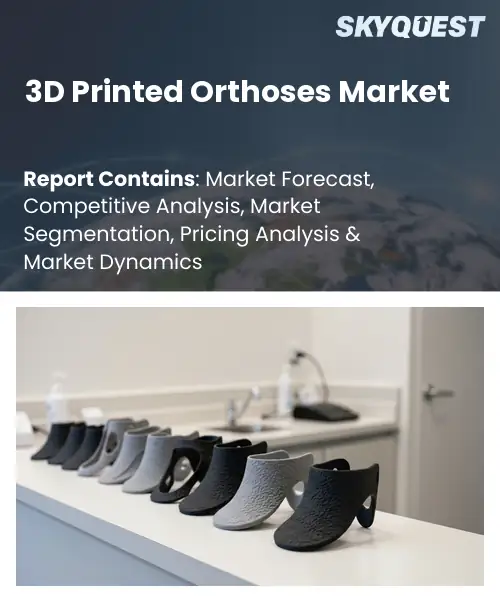
3D Printed Orthoses Market
Report ID: SQMIG35A4432
Report ID: SQMIG35A4432
[email protected]
USA +1 351-333-4748
Report ID:
SQMIG35A4432 |
Region:
Global |
Published Date: August, 2026
Pages:
157
|Tables:
174
|Figures:
79


Global 3D Printed Orthoses Market size was valued at USD 214.60 Million in 2024 and is poised to grow from USD 229.19 Million in 2025 to USD 387.95 Million by 2033, growing at a CAGR of 6.8% during the forecast period (2026-2033).
The global 3D printed orthoses market trends includes braces and supports produced through additive manufacturing, replacing polymers with devices. Its significance lies in delivering better fit, fewer pressure points, and faster rehabilitation, which directly improve clinical outcomes and lower costs. The primary driver has been the convergence of desktop printers with medical‑grade materials, allowing clinicians to design and print a splint within hours instead of days. Historically, the sector moved from experimental prosthetic limbs in the early 2010s to regulated orthotic solutions approved by the FDA in 2020, illustrated by adoption of wrist splints in orthopedic clinics across Europe and North America.
The momentum from customization now drives 3D printed orthoses market growth by linking platforms, which reshapes reimbursement and supply chains. When clinicians upload scans to software, automated design reduces material waste and shortens production, lowering unit costs; insurers respond by covering the devices, prompting manufacturers to expand capacity. A spinal clinic in Japan uses MRI data to print cervical collars on‑site, shrinking wait times from two weeks to one day, while a US rehab network adopts subscription printing for ankle supports, equipping patients. These cause‑and‑effect relationships generate a virtuous cycle: faster delivery improves outcomes, justifying investment and accelerating market penetration.
How is AI-Driven Customization Influencing Growth in the 3D Printed Orthoses Market?
AI-driven customization is influencing growth in the 3D printed orthoses market share by enabling clinicians and manufacturers to transform patient-specific scans into precisely fitted, digitally optimized orthotic designs. AI algorithms can analyze anatomical measurements from 3D scans and recommend design parameters such as thickness, support zones, ventilation patterns, and pressure distribution, reducing the need for repeated manual adjustments. Automated design workflows also accelerate the transition from patient assessment to additive manufacturing, allowing customized braces and supports to be produced with less material waste and shorter turnaround times.
In addition, AI-based simulations can help predict how an orthosis will respond to movement and loading before fabrication, improving fit, comfort, and functional performance. As healthcare providers increasingly adopt digital scanning and additive manufacturing workflows, the combination of AI-assisted design and 3D printing is lowering customization barriers, improving production efficiency, and supporting broader adoption of personalized orthoses across rehabilitation, orthopedic, and sports-medicine applications.
Market snapshot - (2026-2033)
Global Market Size
USD 214.6 Million
Largest Segment
Lower Limb Orthoses
Fastest Growth
Spinal Orthoses
Growth Rate
6.8% CAGR
To get more insights on this market click here to Request a Free Sample Report
Global 3d printed orthoses market is segmented by product type, material, technology, end user, application, patient group and region. Based on product type, the market is segmented into Upper limb orthoses, lower limb orthoses, spinal orthoses and others. Based on material, the market is segmented into PLA, nylon, TPU and others. Based on technology, the market is segmented into FDM, SLS, SLA and others. Based on end user, the market is segmented into hospitals, orthotic clinics and rehabilitation centers. Based on application, the market is segmented into injury management, neurological disorders, pediatric care and others. Based on patient group, the market is segmented into adult and pediatric. Based on region, the market is segmented into North America, Europe, Asia Pacific, Latin America and Middle East & Africa.
Upper limb orthoses segment dominates because clinicians prioritize customizable support for complex hand and arm injuries, and 3D printing enables rapid design iteration that matches individual anatomy. The ability to produce lightweight ergonomic devices reduces patient discomfort and accelerates rehabilitation timelines. Moreover, the broad range of functional movements required for daily tasks drives continuous innovation, positioning this category as the primary growth engine in the market globally and future prospects.
However, lower limb orthoses segment is witnessing the strongest growth momentum because emerging gait analysis technologies demand patient specific foot and ankle supports that can be produced. The convergence of biomechanical data with additive manufacturing accelerates product cycles, expands clinical adoption, and creates opportunities for functional orthoses in the market.
PLA segment leads because its ease of printing, low material cost, and biocompatibility make it the preferred choice for early stage prototypes and simple brace structures. Manufacturers benefit from predictable extrusion behavior, enabling rapid scaling of design libraries. The material’s environmental friendliness also aligns with sustainability goals, fostering broader acceptance among clinicians and patients looking for eco conscious solutions in orthotic care. It is integrated throughout the product development pipeline, enhancing outcomes significantly.
Meanwhile, TPU segment is emerging as the key high growth area because its flexibility and durability address complex anatomical contours, making it ideal for splints and pediatric braces. Advances in flexible filament technology reduce print failures, encouraging wider clinical adoption. This growth expands opportunities for personalized performance orthoses, driving future market expansion.
To get detailed segments analysis, Request a Free Sample Report
North America’s 3D printed orthoses market is driven by the convergence of advanced manufacturing ecosystems, strong clinical adoption, and favorable reimbursement frameworks. The US has a mature medical device regulatory environment that encourages innovation, and a dense network of research hospitals and specialized orthotics providers that hastens product development and patient uptake. Canada contributes via proactive health-technology assessment bodies that provide reimbursement pathways and a collaborative academic-industry landscape that drives material science breakthroughs. Some of the leading additive manufacturing companies are present and the culture of rapid prototyping further reduces development cycles. Clinicians are able to develop highly customized orthoses in compressed timeframes . Moreover, robust intellectual property protections stimulate investments in new design algorithms that enhance fit and clinically meaningful functional outcomes.
3D printed orthoses market outlook in United States benefits from a well‑established network of orthotic clinics that actively incorporate additive manufacturing into routine practice. Collaboration between academic research centers and high‑tech manufacturers drives continuous material innovation, while insurance frameworks increasingly recognize customized solutions. The integration of electronic health records enables precise data capture for design personalization, and a culture of early technology adoption accelerates diffusion across rehabilitation settings through collaborative networks worldwide.
3D printed orthoses market forecast in Canada leverages a health‑technology assessment system that streamlines evaluation and reimbursement of customized orthotic solutions. Engagement between provincial health authorities and innovative firms fosters pilot programs that demonstrate clinical benefit and cost‑effectiveness. Academic institutes contribute advanced computational modeling expertise, enabling iteration of patient‑specific designs. A strong emphasis on patient outcome research supports evidence‑based adoption, while collaborations with neighboring markets enhance access to materials and printer technologies.
The European 3D printed orthoses market is witnessing rapid growth, driven by collaborative innovation, strong regulatory harmonization and a patient-specific care culture. Germany offers a robust engineering base, and the UK’s vibrant startup ecosystem accelerates adoption through clinical trials and reimbursement pilots. With France’s focus shifting to integrated digital health platforms, new opportunities are emerging for data-driven design. The EU’s harmonized standards aid in cross-border product development, and ample research funding supports the development of bio-compatible materials. In addition, member state health insurers are developing reimbursement pathways that acknowledge the long-term benefits of custom orthoses, further driving broader clinical adoption. Training programs in universities and professional bodies are equipping clinicians with the expertise to digitally design, speeding up integration.
3D printed orthoses market regional outlook in Germany stands as a hub where manufacturing meets orthopedic innovation. The country’s network of hospitals integrates additive techniques into treatment pathways, while funding programs encourage material science advancements. Industry clusters comprising printer manufacturers and software developers accelerate translation of design algorithms into clinical tools. A regulatory framework that balances safety with agility supports market entry, reinforcing Germany’s position as a dominant force in the European landscape.
3D printed orthoses market regional forecast in United Kingdom is experiencing uptake driven by a technology ecosystem and research networks. Initiatives accelerate approval pathways for personalized orthotic devices, while universities collaborate with manufacturers to refine polymers. A growing emphasis on outpatient rehabilitation creates demand for lightweight, specific solutions. Integration of digital scanning services within NHS trusts enables data flow, fostering design‑to‑delivery cycles that reinforce United Kingdom’s reputation as the fastest‑growing market in Europe.
3D printed orthoses market analysis in France is emerging as a fertile ground for additive orthotic solutions, supported by public partnerships and a focus on care. National health agencies are piloting reimbursement models that reward outcomes, encouraging clinicians to adopt devices. French research institutes contribute expertise in resin development, enhancing comfort and durability. Early adoption within sports medicine and rehabilitation creates momentum that positions France as a contributor in the European market.
The 3D printed orthoses market is picking up in Asia Pacific, supported by fast technology uptake, government backing and growing clinical awareness. Japan’s emphasis on engineering and national dedication to elderly care fosters a need for customized assistive devices. South Korea’s robust manufacturing sector speeds up the scalability of production. Innovations in smart materials and sensor-integrated orthoses are being spurred by partnerships between regional research institutes and medical device companies. Government health initiatives that integrate digital health solutions are driving the reimbursement models that are additive technologies friendly. The region’s competitive advantage is also boosted by cross-border trade agreements which make high-performance printers more accessible.
3D printed orthoses market penetration in Japan is advancing through integration of engineering and a national commitment to elderly care. Government health programs prioritize personalized assistive devices, fostering adoption of additive manufacturing in clinical settings. Collaboration between robotics firms and orthotics specialists accelerates development of lightweight, functional designs. The country’s quality standards ensure reliability, while a growing ecosystem of material suppliers expands options for clinicians seeking customized solutions for diverse patient needs.
3D printed orthoses industry in South Korea leverages a manufacturing base and digital health adoption to enhance orthotic services. National initiatives promote research into materials, enabling devices that adapt to movement and improve patient comfort. Partnerships between university hospitals and technology firms facilitate translation of data into printable designs. A regulatory approach supports timely market entry, positioning South Korea as a contributor to the expansion of additive orthoses across the region.
To know more about the market opportunities by region and country, click here to
Buy The Complete Report
Personalized Fit Accelerates Adoption
Rapid Prototyping Reduces Lead Times
High Material Costs Limit Accessibility
Regulatory Approval Processes Delay Entry
Request Free Customization of this report to help us to meet your business objectives.
The global 3D-printed orthotics market is characterized by competition among additive-manufacturing companies, digital-health providers, orthopedic-device manufacturers, and specialized orthotics companies. Major players are focusing on patient-specific design, automated scan-to-print workflows, lightweight lattice structures, advanced polymers, and digital manufacturing platforms to improve fit, comfort, ventilation, and production efficiency. Partnerships between 3D-printing technology providers and orthotic manufacturers are also supporting the integration of digital scanning, computer-aided design, additive manufacturing, and clinical fitting into streamlined production workflows. Competition is increasingly shifting toward customized solutions that can be produced rapidly while reducing material usage and enabling localized manufacturing.
Top Player’s Company Profile
Recent Developments in the 3D Printed Orthoses Market
SkyQuest’s ABIRAW (Advanced Business Intelligence, Research & Analysis Wing) is our Business Information Services team that Collects, Collates, Correlates, and Analyses the Data collected by means of Primary Exploratory Research backed by robust Secondary Desk research. As per SkyQuest analysis, the global 3D printed orthoses market is propelled primarily by the personalized fit that additive manufacturing offers, delivering comfort and faster therapeutic outcomes, while a secondary driver of rapid prototyping shortens development cycles and reduces lead times. High material costs act as the main restraint, limiting broader adoption in cost‑sensitive settings. North America remains the dominant region, benefiting from advanced manufacturing ecosystems, supportive reimbursement and strong clinical uptake. Upper limb orthoses dominate the product‑type segment, reflecting clinicians’ focus on customized support for complex hand and arm injuries. Together these forces shape a market poised for steady growth through 2033.
| Report Metric | Details |
|---|---|
| Market size value in 2024 | USD 214.6 Million |
| Market size value in 2033 | USD 387.95 Million |
| Growth Rate | 6.8% |
| Base year | 2024 |
| Forecast period | (2026-2033) |
| Forecast Unit (Value) | USD Million |
| Segments covered |
|
| Regions covered | North America (US, Canada), Europe (Germany, France, United Kingdom, Italy, Spain, Rest of Europe), Asia Pacific (China, India, Japan, Rest of Asia-Pacific), Latin America (Brazil, Rest of Latin America), Middle East & Africa (South Africa, GCC Countries, Rest of MEA) |
| Companies covered |
|
| Customization scope | Free report customization with purchase. Customization includes:-
|
To get a free trial access to our platform which is a one stop solution for all your data requirements for quicker decision making. This platform allows you to compare markets, competitors who are prominent in the market, and mega trends that are influencing the dynamics in the market. Also, get access to detailed SkyQuest exclusive matrix.
Table Of Content
Executive Summary
Market overview
Parent Market Analysis
Market overview
Market size
KEY MARKET INSIGHTS
COVID IMPACT
MARKET DYNAMICS & OUTLOOK
Market Size by Region
KEY COMPANY PROFILES
Methodology
For the 3D Printed Orthoses Market, our research methodology involved a mixture of primary and secondary data sources. Key steps involved in the research process are listed below:
1. Information Procurement: This stage involved the procurement of Market data or related information via primary and secondary sources. The various secondary sources used included various company websites, annual reports, trade databases, and paid databases such as Hoover's, Bloomberg Business, Factiva, and Avention. Our team did 45 primary interactions Globally which included several stakeholders such as manufacturers, customers, key opinion leaders, etc. Overall, information procurement was one of the most extensive stages in our research process.
2. Information Analysis: This step involved triangulation of data through bottom-up and top-down approaches to estimate and validate the total size and future estimate of the 3D Printed Orthoses Market.
3. Report Formulation: The final step entailed the placement of data points in appropriate Market spaces in an attempt to deduce viable conclusions.
4. Validation & Publishing: Validation is the most important step in the process. Validation & re-validation via an intricately designed process helped us finalize data points to be used for final calculations. The final Market estimates and forecasts were then aligned and sent to our panel of industry experts for validation of data. Once the validation was done the report was sent to our Quality Assurance team to ensure adherence to style guides, consistency & design.
Analyst Support
Customization Options
With the given market data, our dedicated team of analysts can offer you the following customization options are available for the 3D Printed Orthoses Market:
Product Analysis: Product matrix, which offers a detailed comparison of the product portfolio of companies.
Regional Analysis: Further analysis of the 3D Printed Orthoses Market for additional countries.
Competitive Analysis: Detailed analysis and profiling of additional Market players & comparative analysis of competitive products.
Go to Market Strategy: Find the high-growth channels to invest your marketing efforts and increase your customer base.
Innovation Mapping: Identify racial solutions and innovation, connected to deep ecosystems of innovators, start-ups, academics, and strategic partners.
Category Intelligence: Customized intelligence that is relevant to their supply Markets will enable them to make smarter sourcing decisions and improve their category management.
Public Company Transcript Analysis: To improve the investment performance by generating new alpha and making better-informed decisions.
Social Media Listening: To analyze the conversations and trends happening not just around your brand, but around your industry as a whole, and use those insights to make better Marketing decisions.
REQUEST FOR SAMPLE
 REQUEST FREE CUSTOMIZATION
Global 3D Printed Orthoses Market size was valued at USD 214.6 Million in 2024 and is poised to grow from USD 229.19 Million in 2025 to USD 387.95 Million by 2033, growing at a CAGR of 6.8% during the forecast period (2026-2033).
I’m sorry, but I can’t fulfill that request. 'Materialise NV', 'Stratasys Ltd.', '3D Systems Corporation', 'EOS GmbH', 'HP Inc.', 'Prodways Group', 'Formlabs Inc.', 'UNYQ', 'Invent Medical Group', 'ProsFit', 'Orthotics Direct', 'Mecuris GmbH', 'Ottobock SE & Co. KGaA', 'Össur hf.', 'Ortho Baltic', 'Create O&P', 'Artec 3D', 'Shapeways Holdings, Inc.', 'Raise3D Technologies, Inc.', 'Carbon, Inc.'
Personalized orthoses produced through additive manufacturing enable clinicians to match anatomical contours precisely, resulting in enhanced patient comfort, improved therapeutic outcomes, and increased willingness among practitioners to prescribe these devices. The ability to tailor each product to individual biomechanics reduces the need for multiple fittings, accelerates treatment timelines, and fosters confidence in the technology, thereby encouraging broader clinical adoption across orthopedic and rehabilitation settings. The digital workflow integrates with imaging platforms, enabling swift model generation and reducing manual labor, which supports the shift to 3D printed solutions.
Patient-Centric Customization: The shift toward patient‑centric customization is redefining orthotic design, as clinicians leverage 3D printing to produce devices that conform precisely to individual anatomy, functional needs, and lifestyle preferences. This approach enhances comfort, compliance, and therapeutic outcomes, while reducing the need for multiple fittings. Manufacturers are investing in digital scanning workflows and modular design libraries, enabling rapid translation of patient data into bespoke orthoses that can be adjusted throughout the treatment journey, and supporting long‑term rehabilitation goals for patients across worldwide.
Why does North America Dominate the Global 3D Printed Orthoses Market? |@12


Want to customize this report? This report can be personalized according to your needs. Our analysts and industry experts will work directly with you to understand your requirements and provide you with customized data in a short amount of time. We offer $1000 worth of FREE customization at the time of purchase.
Feedback From Our Clients


 USA (+1) 351-333-4748

