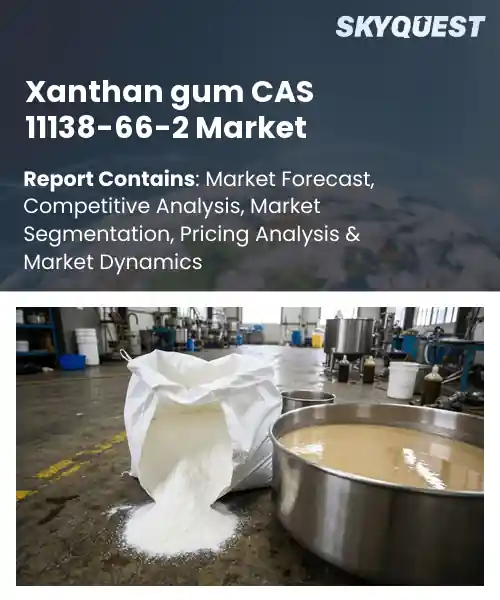
Xanthan gum CAS 11138-66-2 Market
Report ID: SQMIG15E4231
Report ID: SQMIG15E4231
[email protected]
USA +1 351-333-4748
Report ID:
SQMIG15E4231 |
Region:
Global |
Published Date: August, 2026
Pages:
157
|Tables:
143
|Figures:
78


Global Xanthan Gum Cas 11138-66-2 Market size was valued at USD 1.68 Billion in 2024 and is poised to grow from USD 1.78 Billion in 2025 to USD 2.8 Billion by 2033, growing at a CAGR of 5.8% during the forecast period (2026-2033).
The global xanthan gum market, identified by CAS 11138‑66‑2, supplies a microbial polysaccharide that stabilizes and thickens products across food, cosmetics, and oil‑field applications. Its importance stems from the ability to provide consistent viscosity at low concentrations, a feature that has driven adoption since the 1960s when manufacturers first employed it to improve salad‑dressing texture. Over the past decade, demand accelerated as health‑conscious consumers sought clean‑label thickeners, prompting food processors to replace synthetic hydrocolloids with xanthan. This evolution reflects a broader shift toward natural ingredients, positioning the market as a cornerstone of formulation science and sustainable product development worldwide today.
Growth in the global xanthan gum cas 11138-66-2 sector is now propelled primarily by the rise of plant‑based protein foods, where the polymer acts as a moisture‑retaining matrix that mimics the mouthfeel of animal fats. As manufacturers launch vegan cheeses and meat analogues, they rely on xanthan to achieve the desired elasticity and sliceability, creating a feedback loop that expands volume sales. Simultaneously, the oil‑recovery industry adopts the gum for enhanced water‑flooding efficiency, reducing operational costs and environmental impact. These applications generate new revenue streams, encouraging investment in bio‑fermentation capacity and stimulating price competitiveness across regions and fostering long‑term supply chain resilience globally.
How is AI Driving Sustainability in the Xanthan Gum (CAS 11138-66-2) Market?
AI is reshaping the xanthan gum market by optimizing microbial fermentation, reducing waste, and lowering energy consumption. Machine‑learning models analyze real‑time sensor data to fine‑tune temperature, pH, and nutrient feed, ensuring the bacteria produce the polymer more efficiently. Predictive maintenance alerts prevent equipment downtime, extending the life of bioreactors and cutting the need for spare parts. Digital twins simulate scale‑up scenarios, allowing manufacturers to test process changes virtually before implementation, which shortens development cycles and minimizes trial‑and‑error waste. These AI‑driven tools make production greener while maintaining the high thickening and stabilizing performance that food, cosmetics, and pharmaceutical users expect.
In March 2026, Cargill has been increasingly applying digital and AI-driven approaches across food formulation and ingredient development, supporting faster optimization of hydrocolloid applications. While Cargill has not announced a CK-specific AI product, these capabilities can indirectly benefit the xanthan gum market by improving formulation precision, fermentation optimization, quality consistency, and development of customized texture solutions for food manufacturers.
Market snapshot - (2026-2033)
Global Market Size
USD 1.68 Billion
Largest Segment
Food Grade
Fastest Growth
Pharmaceutical Grade
Growth Rate
5.8% CAGR
To get more insights on this market click here to Request a Free Sample Report
Global xanthan gum cas 11138-66-2 market is segmented by grade, application, form, end user, distribution channel and region. Based on grade, the market is segmented into food grade, pharmaceutical grade and industrial grade. Based on application, the market is segmented into food & beverage, oil & gas, pharmaceuticals and cosmetics. Based on form, the market is segmented into powder and granules. Based on end user, the market is segmented into food manufacturers, oilfield service companies and pharmaceutical companies. Based on distribution channel, the market is segmented into direct sales and distributors. Based on region, the market is segmented into North America, Europe, Asia Pacific, Latin America and Middle East & Africa.
Based on the global xanthan gum CAS 11138-66-2 market growth, food grade segment dominates because it meets stringent safety standards required by the food industry, ensuring consumer trust and regulatory compliance. Its versatility in providing texture, stability, and shelf life benefits makes it the preferred choice for manufacturers seeking consistent product quality. The widespread adoption across diverse food categories fuels its leading position in the Xanthan gum market. Additionally, its compatibility with natural labeling trends and clean label initiatives reinforces demand from brands aiming for transparency.
However, pharmaceutical grade segment is witnessing the strongest growth momentum because rising demand for advanced drug delivery systems and biologics drives the need for high purity stabilizers. Its compliance with stringent pharmacopeial specifications and ability to enhance formulation stability attract pharmaceutical innovators, accelerating market expansion and creating new opportunities for Xanthan gum applications.
Food & beverage segment dominates because it serves as the primary driver of Xanthan gum consumption, offering essential thickening, emulsifying, and stabilizing functions across a wide array of products. Manufacturers rely on its ability to improve mouthfeel, extend shelf life, and meet clean label expectations, which aligns with consumer demand for convenient and consistent food experiences. This pervasive utility secures its leading role in market activity across global supply chains and product innovation pipelines.
Meanwhile, cosmetics application emerges as the fastest growing area because rising consumer interest in natural personal care products fuels demand for sustainable thickening agents. Xanthan gum’s biodegradable nature and skin friendly properties enable formulators to create stable emulsions and gels, expanding its use in premium beauty lines and driving market diversification.
To get detailed segments analysis, Request a Free Sample Report
As per the global xanthan gum CAS 11138-66-2 market share, North America benefits from a mature food‑processing ecosystem that demands consistent thickening and stabilizing solutions, positioning xanthan gum as a preferred ingredient across diverse applications. Extensive biotechnological expertise and a network of reliable manufacturers provide a seamless supply chain, while strong regulatory frameworks ensure product safety and market confidence. Consumer preferences for clean‑label and functional foods further amplify demand, and the presence of major research institutions drives continual innovation in formulation techniques. Together, these factors create a synergistic environment that sustains North America’s leading role in the global market.
Xanthan gum CAS 11138-66-2 market thrives in the United States due to its expansive processed‑food sector, which leverages the gum for texture improvement and shelf‑life extension. The country’s advanced manufacturing capabilities enable rapid scaling of production, while a proactive regulatory agency fosters consumer trust. Additionally, a culture of culinary experimentation encourages foodservice operators to adopt functional ingredients, reinforcing the gum’s pervasive use across both industrial and artisan food segments.
Xanthan gum CAS 11138-66-2 market in Canada is buoyed by a strong dairy and bakery industry that relies on the additive for viscosity control and product consistency. The nation’s emphasis on natural and clean‑label solutions aligns well with xanthan gum’s reputation as a plant‑based stabilizer. Collaborative research initiatives between universities and manufacturers enhance formulation expertise, while supportive trade policies facilitate import and export activities, reinforcing Canada’s active participation in the broader North American market.
Based on global xanthan gum CAS 11138-66-2 regional forecast, Asia Pacific region experiences heightened demand driven by rapid urbanization and evolving dietary habits that favor convenience foods and ready‑to‑eat meals. Consumers increasingly seek texture‑enhanced products, prompting food manufacturers to integrate xanthan gum for its thickening and emulsifying properties. Concurrently, advancements in biotechnology within the region improve production efficiency, and trade agreements simplify cross‑border movement of raw materials. Rising focus on health‑focused formulations, such as low‑fat and gluten‑free items, further positions xanthan gum as a versatile solution, accelerating market growth across key economies.
Xanthan gum CAS 11138-66-2 market in Japan benefits from a sophisticated culinary culture that prizes texture and mouthfeel, driving adoption in confectionery, sauces, and beverage sectors. The nation’s emphasis on food safety and quality aligns with the gum’s consistent performance and clean‑label appeal. Strong collaborations between food corporations and research institutes foster continuous product innovation, while a well‑established distribution network ensures efficient delivery to manufacturers, reinforcing its entrenched role within Japanese food processing.
Xanthan gum CAS 11138-66-2 market in South Korea is propelled by a vibrant snack and instant‑meal industry that relies on the additive for viscosity control and uniform texture. The country’s rapid product development cycles encourage the use of versatile stabilizers, and its focus on health‑conscious reformulations—such as low‑sugar and reduced‑fat options—creates additional application opportunities. Robust supply‑chain integration and supportive government initiatives for food technology further embed xanthan gum within South Korean food manufacturing practices.
As per global xanthan gum CAS 11138-66-2 regional outlook, Europe advances its industry standing through a combination of stringent quality standards, a strong tradition of food innovation, and an increasing shift toward sustainable and natural ingredients. The region’s regulatory environment promotes transparency and consumer confidence, encouraging manufacturers to adopt xanthan gum as a reliable clean‑label alternative. Collaborative research across multinational enterprises and academic institutions drives novel applications in dairy alternatives, plant‑based proteins, and specialty cosmetics. Additionally, well‑established logistics networks and a focus on circular economy principles enhance supply stability and reinforce Europe’s competitive edge in the global arena.
Xanthan gum CAS 11138-66-2 market in Germany is anchored by a robust food manufacturing sector that values precision and consistency in product formulation. German producers prioritize high‑quality stabilizers for bakery, dairy, and meat alternatives, aligning with the gum’s functional attributes. Ongoing collaborations with research institutes foster advancements in low‑fat and high‑protein formulations, while a strong commitment to sustainability encourages the adoption of biodegradable additives, solidifying the gum’s integral role in German food processing.
Xanthan gum CAS 11138-66-2 market in the United Kingdom thrives amid a dynamic foodservice landscape that emphasizes convenience and innovative textures. British manufacturers integrate the gum into sauces, dressings, and plant‑based products to achieve desired mouthfeel and stability. The market benefits from a proactive regulatory climate that endorses clean‑label ingredients, while partnerships between industry and academic bodies accelerate development of health‑focused applications, reinforcing the additive’s prominence across UK food and beverage sectors.
Xanthan gum CAS 11138-66-2 market in France is supported by a distinguished culinary tradition that seeks refined texture and consistent quality in both artisanal and industrial food items. French producers leverage the gum in pâtisserie, dairy desserts, and gourmet sauces to enhance mouthfeel without compromising natural positioning. Ongoing research collaborations with culinary schools and food science institutes drive novel uses in low‑sugar and fortified products, while a strong emphasis on traceability ensures consumer confidence, cementing its role within the French market.
To know more about the market opportunities by region and country, click here to
Buy The Complete Report
Increasing Food Industry Demand
The global surge in processed and functional food consumption drives a heightened need for stabilizers, thickeners, and emulsifiers, positioning xanthan gum as a preferred solution due to its versatile rheological properties, compatibility with diverse formulations, and ability to improve texture and shelf life across a wide range of products, thereby encouraging manufacturers to incorporate it more extensively in formulations, which in turn fuels demand growth across multiple food categories. The trend also supports innovation in clean‑label offerings, reinforcing the gum’s role in meeting consumer expectations for quality and healthfulness.
Growth Of Plant‑Based Products
The expanding market for plant‑based alternatives creates a strong demand for texture‑enhancing agents capable of mimicking animal‑derived properties, and xanthan gum fulfills this need through its ability to provide viscosity, stability, and mouthfeel in dairy‑free, meat‑free, and egg‑free formulations, encouraging food developers to adopt it as a key ingredient, thereby accelerating market adoption and reinforcing its position as an essential component in the evolving plant‑based sector. Manufacturers also value the gum’s clean‑label status, which aligns with consumer preferences for simple, recognizable ingredients, further driving its integration into plant‑based product lines.
Fluctuating Raw Material Prices
Variations in the cost of carbohydrate feedstocks such as corn and glucose syrup introduce price volatility for xanthan gum production, compelling manufacturers to manage tighter margins and potentially delay capacity expansions, which can suppress market growth as end‑users face higher procurement costs and may seek alternative stabilizers, thereby limiting the overall uptake of xanthan gum in price‑sensitive applications and reducing its competitive advantage in cost‑driven market segments. Additionally, prolonged periods of high raw material expense can discourage new entrants and limit investment in research and development aimed at product differentiation.
Stringent Regulatory Compliance Requirements
Regulatory frameworks governing food additive approvals and labeling mandates vary across regions, requiring extensive safety assessments, documentation, and periodic re‑evaluation for xanthan gum, which can lengthen time‑to‑market for new applications and increase compliance costs, prompting manufacturers to allocate additional resources toward regulatory affairs; this complexity may deter some producers from expanding product lines that incorporate the gum, especially in markets with rigorous standards, thereby restraining broader market penetration. The need for ongoing certification also slows adoption of novel formulations globally.
Request Free Customization of this report to help us to meet your business objectives.
The global xanthan gum CAS 11138-66-2 market outlook is dominated by legacy producers such as CP Kelco, Cargill and Ingredion, whose recent M&A and partnership activities intensify competition. CP Kelco’s acquisition of biotech firm Xanthogen in 2022 expanded its high‑viscosity portfolio, while Cargill’s partnership with biotech startup FermentX in 2023 accelerates sustainable fermentation. These moves drive innovation and pressure rivals to enhance product performance and cost efficiency.
Top Player’s Company Profile
Recent Developments
SkyQuest’s ABIRAW (Advanced Business Intelligence, Research & Analysis Wing) is our Business Information Services team that Collects, Collates, Correlates, and Analyses the Data collected by means of Primary Exploratory Research backed by robust Secondary Desk research.
As per SkyQuest analysis, the global xanthan gum CAS 11138-66-2 industry is being propelled primarily by the rising demand for processed and functional foods, which drives manufacturers to seek reliable thickeners, while the rapid expansion of plant‑based products adds a second boost by requiring texture‑enhancing agents; the Food Grade segment remains the clear leader because it meets strict safety standards and supports a wide array of applications. North America dominates the market thanks to its mature food‑processing ecosystem and strong regulatory framework. However, fluctuating raw‑material prices act as a restraint, tightening margins and tempering capacity expansion. Companies are also leveraging AI‑driven fermentation to improve efficiency, which further underpins growth.
| Report Metric | Details |
|---|---|
| Market size value in 2024 | USD 1.68 Billion |
| Market size value in 2033 | USD 2.8 Billion |
| Growth Rate | 5.8% |
| Base year | 2024 |
| Forecast period | (2026-2033) |
| Forecast Unit (Value) | USD Billion |
| Segments covered |
|
| Regions covered | North America (US, Canada), Europe (Germany, France, United Kingdom, Italy, Spain, Rest of Europe), Asia Pacific (China, India, Japan, Rest of Asia-Pacific), Latin America (Brazil, Rest of Latin America), Middle East & Africa (South Africa, GCC Countries, Rest of MEA) |
| Companies covered |
|
| Customization scope | Free report customization with purchase. Customization includes:-
|
To get a free trial access to our platform which is a one stop solution for all your data requirements for quicker decision making. This platform allows you to compare markets, competitors who are prominent in the market, and mega trends that are influencing the dynamics in the market. Also, get access to detailed SkyQuest exclusive matrix.
Table Of Content
Executive Summary
Market overview
Parent Market Analysis
Market overview
Market size
KEY MARKET INSIGHTS
COVID IMPACT
MARKET DYNAMICS & OUTLOOK
Market Size by Region
KEY COMPANY PROFILES
Methodology
For the Xanthan gum CAS 11138-66-2 Market, our research methodology involved a mixture of primary and secondary data sources. Key steps involved in the research process are listed below:
1. Information Procurement: This stage involved the procurement of Market data or related information via primary and secondary sources. The various secondary sources used included various company websites, annual reports, trade databases, and paid databases such as Hoover's, Bloomberg Business, Factiva, and Avention. Our team did 45 primary interactions Globally which included several stakeholders such as manufacturers, customers, key opinion leaders, etc. Overall, information procurement was one of the most extensive stages in our research process.
2. Information Analysis: This step involved triangulation of data through bottom-up and top-down approaches to estimate and validate the total size and future estimate of the Xanthan gum CAS 11138-66-2 Market.
3. Report Formulation: The final step entailed the placement of data points in appropriate Market spaces in an attempt to deduce viable conclusions.
4. Validation & Publishing: Validation is the most important step in the process. Validation & re-validation via an intricately designed process helped us finalize data points to be used for final calculations. The final Market estimates and forecasts were then aligned and sent to our panel of industry experts for validation of data. Once the validation was done the report was sent to our Quality Assurance team to ensure adherence to style guides, consistency & design.
Analyst Support
Customization Options
With the given market data, our dedicated team of analysts can offer you the following customization options are available for the Xanthan gum CAS 11138-66-2 Market:
Product Analysis: Product matrix, which offers a detailed comparison of the product portfolio of companies.
Regional Analysis: Further analysis of the Xanthan gum CAS 11138-66-2 Market for additional countries.
Competitive Analysis: Detailed analysis and profiling of additional Market players & comparative analysis of competitive products.
Go to Market Strategy: Find the high-growth channels to invest your marketing efforts and increase your customer base.
Innovation Mapping: Identify racial solutions and innovation, connected to deep ecosystems of innovators, start-ups, academics, and strategic partners.
Category Intelligence: Customized intelligence that is relevant to their supply Markets will enable them to make smarter sourcing decisions and improve their category management.
Public Company Transcript Analysis: To improve the investment performance by generating new alpha and making better-informed decisions.
Social Media Listening: To analyze the conversations and trends happening not just around your brand, but around your industry as a whole, and use those insights to make better Marketing decisions.
REQUEST FOR SAMPLE
 REQUEST FREE CUSTOMIZATION
Global Xanthan Gum Cas 11138-66-2 Market size was valued at USD 1.68 Billion in 2024 and is poised to grow from USD 1.78 Billion in 2025 to USD 2.8 Billion by 2033, growing at a CAGR of 5.8% during the forecast period (2026-2033).
The xanthan gum market is dominated by legacy producers such as CP Kelco, Cargill and Ingredion, whose recent M&A and partnership activities intensify competition. CP Kelco’s acquisition of biotech firm Xanthogen in 2022 expanded its high‑viscosity portfolio, while Cargill’s partnership with biotech startup FermentX in 2023 accelerates sustainable fermentation. These moves drive innovation and pressure rivals to enhance product performance and cost efficiency. 'CP Kelco U.S., Inc.', 'Cargill, Incorporated', 'Fufeng Group Limited', 'Meihua Holdings Group Co., Ltd.', 'Jungbunzlauer Suisse AG', 'Deosen Biochemical Ltd.', 'Hebei Xinhe Biochemical Co., Ltd.', 'Neimenggu Rainbow Biotech Co., Ltd.', 'Ingredion Incorporated', 'ADM', 'Tate & Lyle PLC', 'Solvay S.A.', 'Shandong Fufeng Fermentation Co., Ltd.', 'Qingdao Dea Chem Co., Ltd.', 'Airedale Chemical Company Limited', 'Gino Gums Stabilizers, Inc.', 'Unionchem Co., Ltd.', 'Lucid Colloids Ltd.', 'Iro Alginate Industry Co., Ltd.', 'Meron Group'
Sustainable Packaging Drives Adoption: Increasing consumer demand for environmentally friendly packaging is prompting food and beverage manufacturers to seek biodegradable thickeners, positioning xanthan gum as a preferred solution due to its renewable carbohydrate origin and ability to reduce synthetic additive usage. Its high viscosity at low concentrations also enables thinner film structures, lowering material weight and waste while maintaining product stability, which aligns with corporate sustainability goals and regulatory pressures for reduced plastic footprints across supply chains. Consequently, procurement teams prioritize xanthan gum today.
Why does North America Dominate the Global Xanthan gum CAS 11138-66-2 Market? |@12


Want to customize this report? This report can be personalized according to your needs. Our analysts and industry experts will work directly with you to understand your requirements and provide you with customized data in a short amount of time. We offer $1000 worth of FREE customization at the time of purchase.
Feedback From Our Clients


 USA (+1) 351-333-4748

