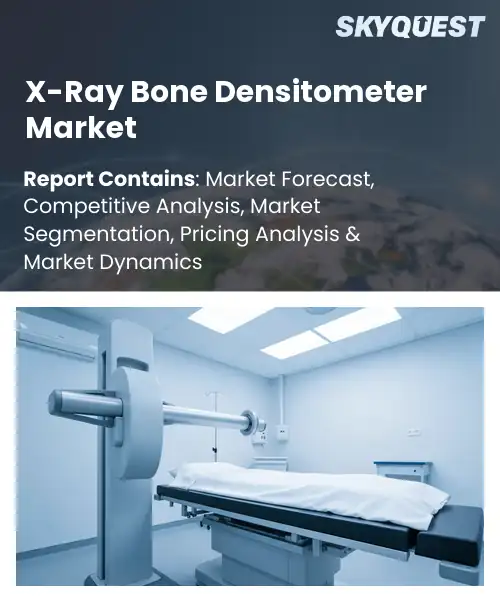
X-Ray Bone Densitometer Market
Report ID: SQMIG35A4257
Report ID: SQMIG35A4257
[email protected]
USA +1 351-333-4748
Report ID:
SQMIG35A4257 |
Region:
Global |
Published Date: July, 2026
Pages:
157
|Tables:
141
|Figures:
78


Global X-Ray Bone Densitometer Market size was valued at USD 1.68 Billion in 2024 and is poised to grow from USD 1.79 Billion in 2025 to USD 3.04 Billion by 2033, growing at a CAGR of 6.8% during the forecast period (2026-2033).
The global X‑ray bone densitometer market centers on devices that use dual‑energy X‑ray absorptiometry to measure bone mineral density, an indicator for diagnosing osteoporosis and estimating fracture risk. Its relevance grows as an aging population increasingly seeks bone‑health screening, prompting clinicians to embed densitometry into routine care. The market launched in the early 1990s when portable scanners supplanted bulky hospital units, enabling clinics to offer testing. When insurers began reimbursing scans, adoption surged, exemplified by a 45 % increase in North American scanner sales between 2005 and 2015. This progression has forged an ecosystem of manufacturers, software providers, and service networks that now sustains demand. The growth catalyst for the X‑ray bone densitometer market is the widening of clinical guidelines that require bone density checks for at‑risk patients, which pushes hospitals and outpatient clinics to purchase scanners. When physicians screen women, diabetic individuals, or patients on steroids, demand rises, encouraging manufacturers to embed algorithms that cut scan time and boost confidence. A network reported a 12 % drop in fracture rates after adding densitometry to its preventive program, proving savings and drawing payer endorsement. This success fuels opportunities in emerging economies where aging populations and scarce radiology resources make affordable, portable densitometers appealing, prompting local partnerships that broaden market access.
How is AI improving diagnostic accuracy in the X‑ray bone densitometer market?
AI is reshaping X ray bone densitometers by embedding deep learning algorithms that automatically segment vertebrae and femoral regions, correct positioning errors, and quantify mineral density with higher consistency. These models learn from large clinical datasets, allowing the system to flag subtle fractures or early osteopenia that human readers might miss. Real time feedback guides technicians to adjust exposure, reducing repeat scans and radiation dose. By standardizing interpretation across sites, AI lowers diagnostic variability and speeds reporting, which is critical as the market expands and more clinics adopt densitometry for preventive care. The result is a more reliable, efficient workflow that supports broader screening programs.Hologic March 2024 introduced an AI enhanced X ray bone densitometer that automatically calibrates scans and provides instant bone health scores, cutting interpretation time and boosting diagnostic confidence, which in turn fuels market adoption and operational efficiency. The system also integrates with electronic health records, enabling seamless data sharing and longitudinal patient monitoring, further reinforcing its value to providers.
Market snapshot - (2026-2033)
Global Market Size
USD 1.68 Billion
Largest Segment
Central DEXA Systems
Fastest Growth
Peripheral DEXA Systems
Growth Rate
6.8% CAGR
To get more insights on this market click here to Request a Free Sample Report
Global x-ray bone densitometer market is segmented by product type, application, end user, portability, patient group and region. Based on product type, the market is segmented into Central DEXA Systems and Peripheral DEXA Systems. Based on application, the market is segmented into Osteoporosis Diagnosis, Fracture Risk Assessment and Body Composition Analysis. Based on end user, the market is segmented into Hospitals, Diagnostic Imaging Centers and Specialty Clinics. Based on portability, the market is segmented into Fixed and Portable. Based on patient group, the market is segmented into Adult and Pediatric. Based on region, the market is segmented into North America, Europe, Asia Pacific, Latin America and Middle East & Africa.
Central DEXA Systems segment dominates because hospitals and imaging centers prioritize comprehensive bone health evaluation, requiring full body scanning capabilities that only central units provide. These systems integrate advanced software algorithms, offering precise volumetric density measurements and reproducible longitudinal tracking, which align with clinical guidelines for osteoporosis management. Their ability to support multiple clinical protocols drives procurement decisions, reinforcing their leadership in the X‑Ray Bone Densitometer market globally and continued growth.
Meanwhile, Peripheral DEXA Systems segment emerges as the most rapidly expanding area because its compact design enables deployment in primary care and community clinics, extending bone density testing beyond specialty centers. Innovations in miniaturized detectors and wireless data transmission lower acquisition costs, accelerating adoption and creating new avenues for market penetration.
Osteoporosis Diagnosis segment leads because clinicians rely on bone densitometry as the primary tool for detecting low bone mass, which directly influences treatment pathways and reimbursement. The strong alignment with evidence based guidelines, combined with rising awareness of age related bone loss, pushes providers to invest in high precision densitometers. Consequently, manufacturers prioritize features that enhance diagnostic accuracy, cementing this application’s preeminence in the market across global healthcare systems today and research continues.
On the other hand, Fracture Risk Assessment segment is witnessing the strongest growth momentum because predictive algorithms now merge densitometry results with clinical risk factors to forecast fractures. This capability attracts preventive health programs and insurers, spurring rapid adoption of densitometers with integrated risk analysis software and expanding market opportunities.
To get detailed segments analysis, Request a Free Sample Report
North America leads the global X‑Ray bone densitometer market because the region combines a highly advanced health‑care ecosystem with strong research and development capabilities, supportive reimbursement policies, and early adoption of innovative imaging solutions. Robust clinical guidelines promote routine bone health assessment, driving consistent demand across hospitals, outpatient clinics and specialty centers. Established manufacturers and a dense network of distributors ensure rapid product introduction and after‑sales support. Collaborative partnerships between academic institutions and device firms accelerate technology refinement, while regulatory frameworks provide clear pathways for market entry. The region also benefits from a mature payer environment that recognizes bone density testing as a preventive measure, facilitating broader patient coverage. Moreover, a culture of evidence‑based practice encourages clinicians to integrate densitometry into routine diagnostic pathways, reinforcing market penetration.
X-Ray Bone Densitometer Market in the United States is characterized by a large network of academic medical centers and specialty clinics that prioritize early detection of osteoporosis. Strong reimbursement mechanisms and widespread insurance acceptance encourage routine scanning. Close collaboration between leading manufacturers and research universities drives continual product enhancement. The market benefits from an established supply chain that ensures swift device availability and comprehensive technical support for end users nationwide.
X-Ray Bone Densitometer Market in Canada benefits from a funded health system that integrates bone health screening into standard preventive care protocols. Provincial health authorities support acquisition of advanced imaging equipment, fostering a stable demand base across urban hospitals. Partnerships between device suppliers and Canadian research institutes promote localization of training programs and service infrastructure. The market is further reinforced by a strong emphasis on patient outcomes and evidence‑based clinical pathways.
Europe experiences rapid expansion of the X‑Ray bone densitometer market driven by a convergence of favorable policy frameworks, heightened clinical awareness of bone health, and a collaborative research ecosystem. Harmonized regulatory standards across member states simplify product registration, encouraging manufacturers to launch innovative solutions throughout the region. Health‑care systems increasingly embed bone density testing into preventive guidelines, supported by reimbursement mechanisms that lower barriers for patients and providers alike. Academic centers in major economies spearhead clinical studies that validate new technologies, fostering confidence among clinicians. Additionally, a robust network of original equipment manufacturers and specialized distributors accelerates market penetration, while sustainability initiatives promote the adoption of energy‑efficient imaging devices. These intertwined factors generate a dynamic environment that propels sustained market growth across Europe.
X-Ray Bone Densitometer Market in Germany is anchored by a well‑established health‑care infrastructure that prioritizes early osteoporosis detection. Government reimbursement programs and comprehensive diagnostic guidelines ensure widespread utilization in hospitals and outpatient clinics. Strong collaboration between device manufacturers and German biomedical research institutes fuels continuous product refinement and local clinical validation. The market benefits from efficient distribution channels and a focus on high‑quality patient care, reinforcing Germany’s leading position in Europe.
X-Ray Bone Densitometer Market in the United Kingdom is experiencing accelerated growth due to national health initiatives that emphasize bone health screening across age groups. Integration of densitometry into primary care pathways, supported by favorable funding models, expands access beyond specialist centers. Partnerships with British universities drive research into advanced imaging algorithms, enhancing diagnostic accuracy. A responsive supply chain and focus on patient‑centred service delivery further stimulate adoption, positioning the United Kingdom as the fastest‑growing European market.
X-Ray Bone Densitometer Market in France is emerging as a notable segment driven by increased awareness of osteoporosis and supportive health‑policy measures. Reimbursement frameworks encourage hospitals and private clinics to adopt densitometry for preventive care. Collaboration between French medical device firms and research laboratories fosters innovation in portable and low‑dose technologies. Growing emphasis on integrated patient management and a steady expansion of diagnostic centres contribute to market momentum within the French health system.
Asia Pacific is steadily strengthening its position in the X‑Ray bone densitometer market through a combination of rising health‑care investment, growing prevalence of bone‑related disorders, and strategic focus on technology adoption. Governments across the region are expanding public health programs that incorporate bone density assessment as a core component of preventive care, thereby broadening patient access. Local manufacturers are increasingly partnering with global equipment providers to localize production, reduce costs and accelerate delivery. Advances in digital health and tele‑medicine platforms enable remote interpretation of densitometry results, enhancing reach in underserved areas. Moreover, a surge in medical tourism and cross‑border collaborations fuels knowledge exchange and drives demand for high‑performance imaging solutions. These dynamics collectively reinforce the region’s emergence as a pivotal market for next‑generation bone densitometry technologies.
X-Ray Bone Densitometer Market in Japan benefits from a health‑care system that integrates bone density testing into geriatric care protocols. Government support for medical imaging promotes adoption of densitometers in academic hospitals and community clinics. Collaboration between Japanese engineering firms and clinical researchers drives development of compact, low‑radiation devices tailored to the aging population. Efficient reimbursement channels and a focus on preventive health further accelerate market penetration, positioning Japan as a key regional contributor.
X-Ray Bone Densitometer Market in South Korea is driven by health‑policy directives that prioritize osteoporosis detection and preventive care. Public‑private partnerships enable diffusion of advanced densitometry equipment across tertiary hospitals and diagnostic centres. Korean manufacturers collaborate with international technology leaders to integrate AI‑driven analysis, enhancing diagnostic confidence. Reimbursement schemes aligned with clinical guidelines and a growing emphasis on outcomes support sustained market uptake, reinforcing South Korea’s role as a hub for bone health technologies.
To know more about the market opportunities by region and country, click here to
Buy The Complete Report
Increasing Aging Population
Advancements in DEXA Technology
High Initial Equipment Cost
Limited Reimbursement Policies
Request Free Customization of this report to help us to meet your business objectives.
Competition in the global X‑ray bone densitometer market is intensifying as incumbent OEMs upgrade digital imaging lines while agile newcomers leverage AI and secured capital to differentiate. Recent examples include Osteoboost’s $8 million financing to expand its portable densitometer platform and Evidenced’s $24 million fund aimed at embedding predictive analytics into existing devices, underscoring a shift toward integrated, data‑driven solutions.
Top Player’s Company Profile
Recent Developments
SkyQuest’s ABIRAW (Advanced Business Intelligence, Research & Analysis Wing) is our Business Information Services team that Collects, Collates, Correlates, and Analyses the Data collected by means of Primary Exploratory Research backed by robust Secondary Desk research. As per SkyQuest analysis the global X‑Ray bone densitometer market is being propelled primarily by an aging population that fuels demand for routine osteoporosis screening, while continual advancements in DEXA technology that improve image quality, reduce scan time and lower radiation exposure act as a second catalyst accelerating adoption across hospitals and clinics. High upfront equipment cost remains the chief restraint, limiting uptake in budget‑constrained facilities. North America continues to dominate the market thanks to robust reimbursement policies and a mature health‑care infrastructure, and within the product portfolio the Central DEXA Systems segment leads, offering comprehensive whole‑body scanning that aligns with clinical guidelines.
| Report Metric | Details |
|---|---|
| Market size value in 2024 | USD 1.68 Billion |
| Market size value in 2033 | USD 3.04 Billion |
| Growth Rate | 6.8% |
| Base year | 2024 |
| Forecast period | (2026-2033) |
| Forecast Unit (Value) | USD Billion |
| Segments covered |
|
| Regions covered | North America (US, Canada), Europe (Germany, France, United Kingdom, Italy, Spain, Rest of Europe), Asia Pacific (China, India, Japan, Rest of Asia-Pacific), Latin America (Brazil, Rest of Latin America), Middle East & Africa (South Africa, GCC Countries, Rest of MEA) |
| Companies covered |
|
| Customization scope | Free report customization with purchase. Customization includes:-
|
To get a free trial access to our platform which is a one stop solution for all your data requirements for quicker decision making. This platform allows you to compare markets, competitors who are prominent in the market, and mega trends that are influencing the dynamics in the market. Also, get access to detailed SkyQuest exclusive matrix.
Table Of Content
Executive Summary
Market overview
Parent Market Analysis
Market overview
Market size
KEY MARKET INSIGHTS
COVID IMPACT
MARKET DYNAMICS & OUTLOOK
Market Size by Region
KEY COMPANY PROFILES
Methodology
For the X-Ray Bone Densitometer Market, our research methodology involved a mixture of primary and secondary data sources. Key steps involved in the research process are listed below:
1. Information Procurement: This stage involved the procurement of Market data or related information via primary and secondary sources. The various secondary sources used included various company websites, annual reports, trade databases, and paid databases such as Hoover's, Bloomberg Business, Factiva, and Avention. Our team did 45 primary interactions Globally which included several stakeholders such as manufacturers, customers, key opinion leaders, etc. Overall, information procurement was one of the most extensive stages in our research process.
2. Information Analysis: This step involved triangulation of data through bottom-up and top-down approaches to estimate and validate the total size and future estimate of the X-Ray Bone Densitometer Market.
3. Report Formulation: The final step entailed the placement of data points in appropriate Market spaces in an attempt to deduce viable conclusions.
4. Validation & Publishing: Validation is the most important step in the process. Validation & re-validation via an intricately designed process helped us finalize data points to be used for final calculations. The final Market estimates and forecasts were then aligned and sent to our panel of industry experts for validation of data. Once the validation was done the report was sent to our Quality Assurance team to ensure adherence to style guides, consistency & design.
Analyst Support
Customization Options
With the given market data, our dedicated team of analysts can offer you the following customization options are available for the X-Ray Bone Densitometer Market:
Product Analysis: Product matrix, which offers a detailed comparison of the product portfolio of companies.
Regional Analysis: Further analysis of the X-Ray Bone Densitometer Market for additional countries.
Competitive Analysis: Detailed analysis and profiling of additional Market players & comparative analysis of competitive products.
Go to Market Strategy: Find the high-growth channels to invest your marketing efforts and increase your customer base.
Innovation Mapping: Identify racial solutions and innovation, connected to deep ecosystems of innovators, start-ups, academics, and strategic partners.
Category Intelligence: Customized intelligence that is relevant to their supply Markets will enable them to make smarter sourcing decisions and improve their category management.
Public Company Transcript Analysis: To improve the investment performance by generating new alpha and making better-informed decisions.
Social Media Listening: To analyze the conversations and trends happening not just around your brand, but around your industry as a whole, and use those insights to make better Marketing decisions.
REQUEST FOR SAMPLE
 REQUEST FREE CUSTOMIZATION


Want to customize this report? This report can be personalized according to your needs. Our analysts and industry experts will work directly with you to understand your requirements and provide you with customized data in a short amount of time. We offer $1000 worth of FREE customization at the time of purchase.
Feedback From Our Clients


 USA (+1) 351-333-4748

