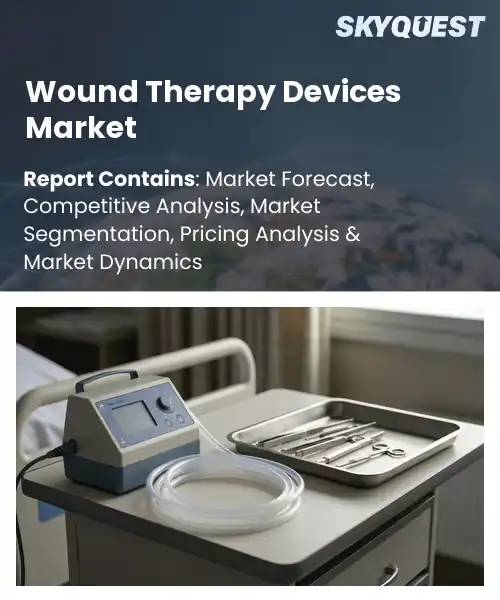
Wound Therapy Devices Market
Report ID: SQMIG35A3840
Report ID: SQMIG35A3840
[email protected]
USA +1 351-333-4748
Report ID:
SQMIG35A3840 |
Region:
Global |
Published Date: June, 2026
Pages:
157
|Tables:
125
|Figures:
77


Global Wound Therapy Devices Market size was valued at USD 3.5 Billion in 2024 and is poised to grow from USD 3.68 Billion in 2025 to USD 5.43 Billion by 2033, growing at a CAGR of 5.0% during the forecast period (2026-2033).
Wound therapy devices encompass products from basic dressings to advanced negative pressure systems and bioengineered skin substitutes, forming an essential segment of wound care because they address rising chronic wounds and post-surgical complications that burden healthcare systems. The primary driver is demographic and disease trends: aging populations and escalating diabetes rates have increased incidence of diabetic ulcers, pressure injuries and surgical site complications, prompting adoption of device-based interventions. Over two decades the market shifted from gauze and topical antiseptics toward evidence-backed technologies such as portable NPWT and cellular therapies, exemplified by wider hospital and homecare adoption globally.
For example, reimbursement for negative pressure therapies and outpatient care enabled hospitals to discharge patients sooner, which spurred development of portable single-use devices that support home management and reduce readmissions. Demonstrated cost savings from faster healing encouraged clinics to adopt bioengineered skin substitutes and antimicrobial dressings, prompting manufacturers to invest in sensor integration and remote-monitoring platforms that open opportunities in emerging markets and extend reach.
How is AI transforming the wound therapy devices market?
Artificial Intelligence is revolutionizing how the wound care devices market is evolving using AI-enabled wound care devices by integrating smart imaging with predictive analytics and sensor connectivity for improved diagnosis and therapy decisions. Automated wound assessments via digital images taken in a clinical setting, remote monitoring to keep patients and clinicians in touch with each other, and decision support tools to help personalize dressing/device combination choices will lead to the realization of this vision. The combination of new AI technologies and existing therapies will allow for the development of "smarter" pathways for care and earlier interventions. Clinicians are beginning to experience faster rates of triage, greater consistency in documenting patients' wounds, and using data to support wound care operations outside of specialist clinics or hospitals.
In May 2026, Spectral AI was granted FDA De Novo clearance for their predictive imaging product, DeepView, which gives burns a predicted healing outcome at initial presentation. The ability for clinicians to accurately target therapy much sooner using this innovative technology will allow for more immediate and appropriate selection of devices and increased efficiency in monitoring the patient's progress, which will ultimately facilitate the wider use of AI-enabled wound products in providing care to patients.
Market snapshot - (2026-2033)
Global Market Size
USD 3.5 Billion
Largest Segment
Negative Pressure Wound Therapy (NPWT) Devices
Fastest Growth
Wound Assessment & Monitoring Devices
Growth Rate
5.0% CAGR
To get more insights on this market click here to Request a Free Sample Report
Global wound therapy devices market is segmented by product type, wound type, application, end user and region. Based on product type, the market is segmented into Negative Pressure Wound Therapy (NPWT) Devices, Hyperbaric Oxygen Therapy Devices, Pressure Relief Devices, Electrical Stimulation Devices, Wound Assessment & Monitoring Devices and Others. Based on wound type, the market is segmented into Chronic Wounds and Acute Wounds. Based on application, the market is segmented into Diabetic Foot Ulcers, Pressure Ulcers, Venous Leg Ulcers, Surgical Wounds, Burn Wounds, Traumatic Wounds and Others. Based on end user, the market is segmented into Hospitals, Ambulatory Surgical Centers, Specialty Clinics, Homecare Settings and Others. Based on region, the market is segmented into North America, Europe, Asia Pacific, Latin America and Middle East & Africa.
Negative pressure wound therapy (NPWT) devices segment dominates with large wound therapy devices market share because clinicians consider NPWT a proven therapeutic backbone for complex and nonhealing wounds, driving adoption across acute and chronic care settings. Clinical effectiveness in promoting granulation and fluid management combined with evolving portable designs and payer acceptance creates sustained procurement, fostering clinician preference and supplier investment that reinforce market leadership. Manufacturers focus on accessory ecosystems and clinician training which reduces complications and shortens care pathways, prompting health providers to prioritize NPWT in formularies and long term wound care strategies.
As per wound therapy devices market outlook, wound assessment & monitoring devices are emerging as the most rapidly expanding segment due to rising demand for objective wound analytics, remote patient monitoring and integration with telehealth platforms. Advances in digital imaging, sensor technology and AI driven risk stratification enable the early intervention and data driven care pathways, unlocking new service models and commercialization opportunities across care settings.
As per wound therapy devices market forecast, chronic wounds segment leads because persistent wounds require prolonged multidisciplinary therapy and continuous device support, directing research and procurement toward durable, long term solutions. The high burden of recurring ulcers and comorbid conditions compels payers and providers to favor technologies that reduce readmissions and care costs, stimulating innovation in advanced dressings, sustained therapeutic modalities and homecare compatible systems that align with chronic care management strategies.
As per wound therapy devices market analysis, acute wounds are witnessing the strongest growth momentum as demand for rapid closure technologies and single use devices rises with procedural volumes and trauma care advancements. Miniaturized, user friendly solutions and point of care diagnostics accelerate adoption in perioperative and emergency settings, driving manufacturers to expand portfolios and creating new market opportunities in short term intervention products.
To get detailed segments analysis, Request a Free Sample Report
North America dominates the major share in the global wound therapy devices market due to a combination of supporting healthcare infrastructure, advanced clinical adoption and concentrated industry presence. Highly integrated hospital systems and specialty wound care centres permit rapid uptake of innovative modalities and allow clinical validation. Major manufacturers’ strong investment in R&D and collaborative connections among clinicians, payers and regulators speed product introduction and refining. Strong distribution networks, professional training, and reimbursement structures that recognize the value of advanced wound care sustain demand. In addition, the region has a robust regulatory system that balances safety with timely market access, allowing both established companies and rising innovators to scale products and shape global standards of care. Regional collaboration enhances impact through information sharing and multicenter clinical programs.
As per wound therapy devices market outlook, United States is characterized by mature clinical adoption, concentrated manufacturing and active research. Care pathways and reimbursement frameworks support integration of advanced modalities while specialized wound centers drive expertise. Collaboration between industry and academic institutions fosters device refinement and clinician training. Established commercial channels and distributors enable access across care settings. Market leadership from the United States guides global product development and practice norms.
As per wound therapy devices market forecast, in Canada, the market is driven by public healthcare delivery, centralized procurement and emphasis on cost effective treatment paths. Adoption centres in hospitals and community programmes backed by provincial frameworks. Selective use of advanced modalities with stewardship of budget with focus on clinical outcomes. Collaboration between producers, health authorities and academic centres supports pilot evaluations and training.
As per wound therapy devices industry analysis, European growth is supported by a mix of enhanced clinical pathways, an increased focus on outcome oriented treatment and greater harmonization of regulatory and reimbursement frameworks that support market access. Across the region there are a range of treatment settings from specialty centres to integrated community services offering opportunities for the implementation of improved wound modalities. Working with manufacturers, hospitals and payer bodies helps to demonstrate value and achieve wider procurement. Clinical networks and multicenter trials that improve clinician confidence enable technological adoption, including minimally invasive and complementary therapy. Market maturation in important markets and targeted commercialization tactics by global and regional enterprises have hastened the availability and clinician training of novel wound care products, resulting in a more receptive environment. Scale adoption is supported by public private partnerships and cross border activities. Increased usage of digital wound assessment and remote monitoring complements device uptake and clinical decision making.
Germany is anchored by a strong medical device manufacturing base, organized hospital networks and culture of clinical innovation. Hospital procurement practices and specialized wound care centers facilitate adoption of advanced modalities. Collaboration among industry, research institutions and certification bodies supports evaluation and commercialization. German clinical guidelines and practice patterns inform European approaches, while distribution channels broadly ensure availability across acute and post acute care settings.
UK market is driven by dynamic policy-driven adoption across public and private care channels. Health commissioning and pilot programs are evaluating improved wound modalities. Commercialization is being pushed by private providers . Strong clinical networks and academic interactions to facilitate creation of real world evidence and training of clinicians. Emphasising cost effective outcomes and use of digital wound evaluation technologies to increase clinical acceptance. Availability supported by competitive suppliers and distributors.
France is emerging in specialized hospitals and regional networks. Emphasis on clinical outcomes and cost conscious procurement increasingly encourages uptake of advanced modalities. Collaboration between manufacturers, clinical centers and health authorities supports evaluations and evidence generation. Interest in digital wound assessment and integrated care pathways enhances device relevance in outpatient and community settings. Evolving national guidance and expanding distribution channels strengthen availability and clinician familiarity.
Asia Pacific is building its position through local innovation, improving clinical capability and forward-looking regulatory convergence that enables commercialization. Clinician training is improving, and key markets are establishing specialist wound clinics and digital health systems to facilitate remote assessment and continuity of care. Local manufacturers and regional distributors are raising their game, partnering with multinational companies to localize product offers and logistics. Government activities around healthcare modernization and reimbursement reform are generating more predictable avenues for adoption. Clinical collaborations and multicenter research around the region are boosting evidence production and clinician confidence while increased awareness of cost effective wound management is promoting wider inclusion of advanced device classes into standard care. Investment in precise manufacturing and quality management boosts supply chain resilience and export capability and is assisting regional Centres of Excellence to advance high quality clinical research and adoption of cutting edge technology.
Japan is driven by advanced clinical infrastructure, strong domestic research and manufacturing standards. Hospitals and specialized clinics adopt innovative wound care modalities supported by industry and academic collaborations. Regulatory pathways and payer mechanisms enable targeted product introduction while distribution networks and clinical educators support clinician uptake. Japan often functions as a regional hub for clinical studies and product refinement prior to broader Asia Pacific commercialization.
South Korea benefits from a vibrant medical technology sector, rapid clinical adoption and government support. Hospitals and specialized clinics adopt advanced wound modalities supported by clinician training and academic partnerships. Local manufacturers focus on high technology product development and export strategies while distributors provide market coverage. Integration of digital health and telemedicine complements device use and supports continuity of care across inpatient and outpatient settings.
To know more about the market opportunities by region and country, click here to
Buy The Complete Report
Rising Chronic Wound Prevalence
Advances In Therapeutic Technologies
High Treatment and Device Costs
Regulatory Complexity and Reimbursement
Request Free Customization of this report to help us to meet your business objectives.
Competitive dynamics in global wound therapy devices industry are driven by consolidation, strategic partnerships and technology differentiation as firms seek clinical and channel advantage. Large medtechs pursue acquisitions and bolt on deals to expand portfolios, for example 3M's acquisition of Acelity and Convatec's bolt on moves, while vendors form digital integrations and startups introduce novel modalities such as pulsed field ablation and simplified NPWT.
SkyQuest’s ABIRAW (Advanced Business Intelligence, Research & Analysis Wing) is our Business Information Services team that Collects, Collates, Correlates, and Analyses the Data collected by means of Primary Exploratory Research backed by robust Secondary Desk research.
As per SkyQuest analysis, the global wound therapy devices market growth is set for steady expansion, with a key driver being demographic and disease trends such as aging populations and rising diabetes that increase chronic wound prevalence. A second driver is rapid technological innovation, including portable NPWT, AI-enabled wound assessment and connected monitoring that enable homecare and cost savings. One restraint is high treatment and device costs coupled with varied reimbursement that can limit uptake in resource-constrained settings. North America remains the dominating region due to advanced infrastructure, supportive reimbursement and strong industry presence, while Negative Pressure Wound Therapy devices are the dominating segment given clinical effectiveness and widespread adoption.
| Report Metric | Details |
|---|---|
| Market size value in 2024 | USD 3.5 Billion |
| Market size value in 2033 | USD 5.43 Billion |
| Growth Rate | 5.0% |
| Base year | 2024 |
| Forecast period | (2026-2033) |
| Forecast Unit (Value) | USD Billion |
| Segments covered |
|
| Regions covered | North America (US, Canada), Europe (Germany, France, United Kingdom, Italy, Spain, Rest of Europe), Asia Pacific (China, India, Japan, Rest of Asia-Pacific), Latin America (Brazil, Rest of Latin America), Middle East & Africa (South Africa, GCC Countries, Rest of MEA) |
| Companies covered |
|
| Customization scope | Free report customization with purchase. Customization includes:-
|
To get a free trial access to our platform which is a one stop solution for all your data requirements for quicker decision making. This platform allows you to compare markets, competitors who are prominent in the market, and mega trends that are influencing the dynamics in the market. Also, get access to detailed SkyQuest exclusive matrix.
Table Of Content
Executive Summary
Market overview
Parent Market Analysis
Market overview
Market size
KEY MARKET INSIGHTS
COVID IMPACT
MARKET DYNAMICS & OUTLOOK
Market Size by Region
KEY COMPANY PROFILES
Methodology
For the Wound Therapy Devices Market, our research methodology involved a mixture of primary and secondary data sources. Key steps involved in the research process are listed below:
1. Information Procurement: This stage involved the procurement of Market data or related information via primary and secondary sources. The various secondary sources used included various company websites, annual reports, trade databases, and paid databases such as Hoover's, Bloomberg Business, Factiva, and Avention. Our team did 45 primary interactions Globally which included several stakeholders such as manufacturers, customers, key opinion leaders, etc. Overall, information procurement was one of the most extensive stages in our research process.
2. Information Analysis: This step involved triangulation of data through bottom-up and top-down approaches to estimate and validate the total size and future estimate of the Wound Therapy Devices Market.
3. Report Formulation: The final step entailed the placement of data points in appropriate Market spaces in an attempt to deduce viable conclusions.
4. Validation & Publishing: Validation is the most important step in the process. Validation & re-validation via an intricately designed process helped us finalize data points to be used for final calculations. The final Market estimates and forecasts were then aligned and sent to our panel of industry experts for validation of data. Once the validation was done the report was sent to our Quality Assurance team to ensure adherence to style guides, consistency & design.
Analyst Support
Customization Options
With the given market data, our dedicated team of analysts can offer you the following customization options are available for the Wound Therapy Devices Market:
Product Analysis: Product matrix, which offers a detailed comparison of the product portfolio of companies.
Regional Analysis: Further analysis of the Wound Therapy Devices Market for additional countries.
Competitive Analysis: Detailed analysis and profiling of additional Market players & comparative analysis of competitive products.
Go to Market Strategy: Find the high-growth channels to invest your marketing efforts and increase your customer base.
Innovation Mapping: Identify racial solutions and innovation, connected to deep ecosystems of innovators, start-ups, academics, and strategic partners.
Category Intelligence: Customized intelligence that is relevant to their supply Markets will enable them to make smarter sourcing decisions and improve their category management.
Public Company Transcript Analysis: To improve the investment performance by generating new alpha and making better-informed decisions.
Social Media Listening: To analyze the conversations and trends happening not just around your brand, but around your industry as a whole, and use those insights to make better Marketing decisions.
REQUEST FOR SAMPLE
 REQUEST FREE CUSTOMIZATION
Global Wound Therapy Devices Market size was valued at USD 3.5 Billion in 2024 and is poised to grow from USD 3.68 Billion in 2025 to USD 5.43 Billion by 2033, growing at a CAGR of 5.0% during the forecast period (2026-2033).
Competitive dynamics in global wound therapy devices are driven by consolidation, strategic partnerships and technology differentiation as firms seek clinical and channel advantage. Large medtechs pursue acquisitions and bolt on deals to expand portfolios, for example 3M's acquisition of Acelity and Convatec's bolt on moves, while vendors form digital integrations and startups introduce novel modalities such as pulsed field ablation and simplified NPWT. '3M Company', 'Smith & Nephew plc', 'Cardinal Health, Inc.', 'Convatec Group plc', 'Mölnlycke Health Care AB', 'Medela AG', 'Coloplast A/S', 'Integra LifeSciences Holdings Corporation', 'Paul Hartmann AG', 'Baxter International Inc.', 'DeRoyal Industries, Inc.', 'Talley Group Ltd.', 'Zimmer Biomet Holdings, Inc.', 'Essity AB', 'Medtronic plc', 'Acelity L.P. Inc.', 'Organogenesis Holdings Inc.', 'MiMedx Group, Inc.', 'ConvaTec Inc.', 'Devon Medical Products'
The increasing incidence of chronic wounds, driven by aging populations and a rise in diabetes and vascular conditions, expands demand for specialized wound therapy devices. Clinicians and healthcare systems prioritize effective modalities to improve healing outcomes and reduce complications, prompting broader adoption of advanced dressings, negative pressure systems, and biologic therapies. This persistent clinical need stimulates investment in product innovation and commercialization, encourages training and protocol development, and creates steady procurement requirements across care settings, cumulatively supporting sustained market expansion.
Personalized Wound Care Adoption: Manufacturers and clinicians are increasingly prioritizing tailored therapies that address individual wound etiologies and patient comorbidities, driving demand for customizable dressings, advanced biomaterials and adaptive device platforms. This trend encourages partnerships with diagnostics and regenerative medicine developers, supports clinician preference for precision treatment pathways, and necessitates flexible manufacturing and commercialization strategies. Payers and care providers are responding to perceived clinical value by emphasizing outcomes-focused procurement, prompting suppliers to differentiate through evidence of individualized efficacy and integrated care workflows and scalability.
Why does North America Dominate the Global Wound Therapy Devices Market? |@12


Want to customize this report? This report can be personalized according to your needs. Our analysts and industry experts will work directly with you to understand your requirements and provide you with customized data in a short amount of time. We offer $1000 worth of FREE customization at the time of purchase.
Feedback From Our Clients


 USA (+1) 351-333-4748

