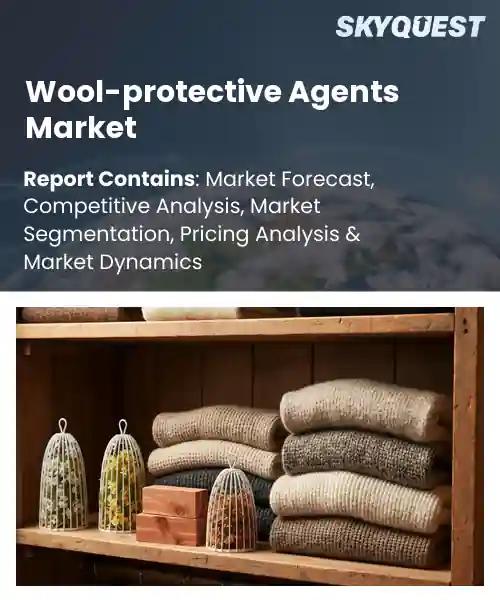
Wool-protective Agents Market
Report ID: SQMIG15E4057
Report ID: SQMIG15E4057
[email protected]
USA +1 351-333-4748
Report ID:
SQMIG15E4057 |
Region:
Global |
Published Date: July, 2026
Pages:
157
|Tables:
145
|Figures:
78


Global Wool-Protective Agents Market size was valued at USD 286.4 Million in 2024 and is poised to grow from USD 300.43 Million in 2025 to USD 440.51 Million by 2033, growing at a CAGR of 4.9% during the forecast period (2026-2033).
The wool‑protective agents market encompasses chemicals and biological treatments designed to guard wool fibers against moth damage, microbial decay, and environmental degradation. Its relevance stems from wool’s premium status in apparel, interior textiles, and high‑performance composites, where any loss of integrity directly reduces product value. Historically, the market emerged in the 1970s with simple lanolin‑based repellents, evolved through the 1990s as synthetic pyrethroids offered broader insect control, and accelerated in the 2010s with nanocoatings that combine UV shielding and moisture resistance. This evolution reflects increasing consumer demand for sustainable, long‑lasting wool goods and regulatory pressure to replace hazardous preservatives today. The main growth driver today is the combination of bio‑based biocides with controlled‑release carriers, meeting demand for sustainability while adhering to pesticide rules. Micro‑encapsulating plant‑derived terpene oils yields a formulation that protects wool for weeks and reduces environmental leaching, opening markets in regions like the European Union where traditional chemicals face bans. This cause‑effect link fuels R&D investment and has produced partnerships; a Japanese biotech firm and an Italian fashion label created a biodegradable coating that raised wool durability by 40 % in field tests. Demonstrated benefits prompt apparel brands to adopt solution, expanding market and creating revenue streams for producers.
How is AI driving innovation in the wool-protective agents market?
AI is reshaping the wool protective agents market by enabling faster formulation, smarter quality control and more efficient distribution. Machine learning models analyse raw material properties and predict optimal chemical blends that guard wool against moisture, microbes and UV damage. Real time sensors feed data to AI systems that monitor wool condition during processing, allowing immediate adjustment of protective coatings. Predictive analytics also forecast demand patterns, helping manufacturers align production with seasonal trends and reduce waste. These capabilities turn traditionally lab intensive work into a data driven workflow that accelerates product cycles and lowers costs.24 Chemical Research, January 2026, introduced an AI powered formulation platform that quickly designs ecofriendly wool protective chemicals and shortens development cycles. The tool leverages machine learning to test ingredient interactions, improving product performance while cutting resource use and supporting market growth.
Market snapshot - (2026-2033)
Global Market Size
USD 286.4 Million
Largest Segment
Mothproofing Agents
Fastest Growth
Softening Agents
Growth Rate
4.9% CAGR
To get more insights on this market click here to Request a Free Sample Report
Global wool-protective agents market is segmented by product type, form, application, end user, distribution channel and region. Based on product type, the market is segmented into Mothproofing Agents, Shrink-Resist Agents, Anti-Felting Agents and Softening Agents. Based on form, the market is segmented into Liquid, Powder and Concentrate. Based on application, the market is segmented into Wool Processing, Garment Manufacturing, Carpet Manufacturing and Textile Finishing. Based on end user, the market is segmented into Textile Mills, Garment Manufacturers and Carpet Manufacturers. Based on distribution channel, the market is segmented into Direct Sales and Chemical Distributors. Based on region, the market is segmented into North America, Europe, Asia Pacific, Latin America and Middle East & Africa.
Mothproofing Agents segment dominates because manufacturers prioritize long term protection against moth damage, which directly preserves wool value. The inherent ability of these agents to create a barrier against insect activity aligns with industry goals of extending product lifespan. This alignment drives widespread adoption across processing stages, and manufacturers favor them for their proven efficacy, reliability, and compatibility with existing wool treatment workflows and cost effectiveness in meeting sustainability targets.
Meanwhile, Anti Fletting Agents segment emerges as the most rapidly expanding area because innovative formulations reduce fiber entanglement, catering to premium textile designers seeking softer hand and enhanced durability. This focus on quality improvement fuels increased demand, encouraging R&D investment and creating new application niches that accelerate market expansion.
Liquid segment leads because it offers immediate usability and seamless integration into existing wool processing lines, allowing manufacturers to apply protective treatments without extensive equipment changes. The ready to use nature simplifies handling, reduces preparation time, and aligns with production schedules, making it the preferred choice for high volume operations. Its versatility across various application stages further reinforces its market leadership and supports consistent quality outcomes across different wool grades.
Conversely, Concentrate segment is witnessing the strongest growth momentum because formulators are developing highly potent blends that reduce dosage while delivering superior protection. This efficiency appeals to eco conscious producers seeking lower waste and cost, and it enables customized dosing for specialized wool applications, driving broader adoption and opening new market opportunities.
To get detailed segments analysis, Request a Free Sample Report
Asia Pacific leads the wool‑protective agents market through a confluence of deep textile heritage, expansive wool‑producing zones, and aggressive innovation ecosystems. The region benefits from a well‑established supply chain that links raw wool growers to advanced chemical manufacturers, enabling rapid product development and quick market adoption. Consumer preference for high‑quality, sustainably treated fabrics drives demand for advanced protective agents, while regulatory frameworks encourage environmentally responsible formulations. Strong collaboration between research institutions and industry players fuels continuous improvement of performance‑enhancing additives. Moreover, the presence of major textile hubs supports economies of scale that lower production costs, reinforcing the region’s price competitiveness on a global stage. Export orientation amplifies the region’s influence as producers supply protective agents to emerging markets worldwide, reinforcing its leadership. Furthermore, intense focus on digitalization and data‑driven formulation accelerates the introduction of next‑generation agents that meet evolving performance criteria.
Wool-protective Agents Market in Japan thrives on a rich tradition of fine wool processing combined with cutting‑edge chemical research. Domestic manufacturers leverage strong ties with textile mills to co‑develop customized solutions that meet precise performance standards. Emphasis on environmental stewardship drives adoption of biodegradable additives, while consumer demand for premium garment care fuels continuous product refinement. Collaborative initiatives with universities further enhance formulation expertise, positioning Japan as a benchmark for quality and innovation.
Wool-protective Agents Market in South Korea benefits from a highly integrated manufacturing landscape that couples advanced polymer science with responsive textile clusters. Local firms prioritize rapid prototyping and agile scaling, allowing swift alignment with market feedback. Growing consumer consciousness around sustainable garment care accelerates the shift toward low‑impact protective compounds. Government incentives for green chemistry reinforce R&D investment, fostering a pipeline of innovative additives that reinforce South Korea’s reputation for technological excellence.
The European wool‑protective agents market expands rapidly due to a blend of stringent sustainability mandates, sophisticated textile engineering, and strong brand focus on premium apparel. Regulatory bodies promote eco‑friendly formulations, prompting manufacturers to innovate biodegradable and low‑toxicity agents. Highly skilled research communities across the continent enable collaborative development of high‑performance additives that enhance durability while preserving fabric softness. Consumer expectations for responsible fashion drive adoption of protective solutions that meet both performance and environmental criteria. Additionally, well‑established distribution networks and a culture of cross‑border cooperation accelerate market penetration, allowing European producers to set benchmarks that influence global standards. The region’s emphasis on circular textile initiatives further fuels demand for agents that facilitate recycling and prolong garment life. Leading fashion houses actively partner with chemical innovators to co‑create bespoke protective treatments, reinforcing Europe’s position as a trendsetter in sustainable apparel care.
Wool-protective Agents Market in Germany is anchored by a robust engineering tradition and a decisive shift toward green chemistry. Leading chemical firms collaborate closely with textile manufacturers to formulate high‑efficiency additives that meet rigorous quality standards. Strong emphasis on lifecycle assessment drives development of agents that support fabric recyclability and reduce environmental impact. Federal support for research intensifies innovation pipelines, ensuring Germany remains a dominant force in delivering reliable, sustainable protective solutions.
Wool-protective Agents Market in United Kingdom experiences fast growth fueled by a vibrant start‑up ecosystem and strong ties to fashion innovators. Companies prioritize rapid commercialization of bio‑based additives that align with the nation’s sustainability agenda. Collaborative platforms connect academic research with industry needs, accelerating the translation of scientific breakthroughs into market‑ready products. Consumer demand for ethically produced garments amplifies interest in protective agents that enhance durability without compromising environmental integrity.
Wool-protective Agents Market in France shows emerging strength as domestic textile clusters adopt innovative protective chemistries to differentiate premium offerings. Emphasis on artisanal quality drives interest in agents that preserve natural wool characteristics while meeting modern performance expectations. Government programmes encourage sustainable research, fostering collaborations between boutique manufacturers and specialty chemical providers. This supportive environment nurtures a growing niche of high‑value protective solutions that position France as an upcoming influencer in the European market.
North America strengthens its position in the wool‑protective agents market through a combination of deep scientific expertise, sizable textile infrastructure, and a proactive approach to sustainability. The region’s research institutions excel at developing high‑performance, low‑impact additives that address both durability and environmental concerns. Industry alliances foster swift translation of laboratory breakthroughs into commercial products, while consumer awareness of eco‑friendly garment care drives market demand. Robust supply chains and advanced manufacturing capabilities enable rapid scaling of innovative formulations. Together, these elements reinforce North America’s role as a key driver of global advancements in wool protection technologies. Regulatory incentives encourage the adoption of biodegradable agents, and significant investment in digital analytics optimizes formulation performance across diverse climate zones, further cementing the region’s leadership.
Wool-protective Agents Market in United States is propelled by a vast network of research universities and large‑scale chemical producers that emphasize innovation and regulatory compliance. Collaboration between apparel brands and ingredient specialists yields tailored solutions that meet high performance and sustainability criteria. Consumer preference for long‑lasting, responsibly treated garments fuels demand for advanced agents. Government programs supporting green chemistry accelerate development of next‑generation additives, reinforcing the United States’ leadership in market evolution.
Wool-protective Agents Market in Canada benefits from a strong emphasis on environmentally conscious manufacturing and close ties to the North American textile corridor. Companies prioritize the creation of low‑toxicity, biodegradable additives that align with national sustainability goals. Collaborative research initiatives with local universities enhance the ability to develop niche formulations suited to diverse climate conditions. Growing consumer demand for responsibly processed wool garments further drives market expansion, positioning Canada as a forward‑looking contributor to the sector.
To know more about the market opportunities by region and country, click here to
Buy The Complete Report
Increasing Demand For Sustainable Textiles
Regulatory Support For Eco Friendly Treatments
High Cost Of Advanced Formulations
Limited Awareness Of Treatment Benefits
Request Free Customization of this report to help us to meet your business objectives.
Intense rivalry among incumbents and emerging bio‑based firms is driving rapid product differentiation in the wool‑protective agents market. Companies are pursuing strategic partnerships, such as Woola’s collaboration with European packaging manufacturers, and investing in technology that converts waste wool into sustainable alternatives to synthetic foams. Recent M&A activity sees larger chemical groups acquiring niche biotech assets to broaden eco‑friendly portfolios, accelerating market consolidation.
Top Player’s Company Profile
Recent Developments
SkyQuest’s ABIRAW (Advanced Business Intelligence, Research & Analysis Wing) is our Business Information Services team that Collects, Collates, Correlates, and Analyses the Data collected by means of Primary Exploratory Research backed by robust Secondary Desk research. As per SkyQuest analysis, the global wool‑protective agents market is projected to grow at a 4.9% CAGR, driven primarily by the rising demand for sustainable textiles that push manufacturers toward biodegradable bio‑based agents, and a second catalyst is strengthening regulatory support that encourages eco‑friendly treatments and accelerates product adoption. The market is led by the mothproofing agents segment, which commands the largest share because it directly safeguards wool value, while the liquid form remains the preferred delivery method for processing efficiency. Asia Pacific dominates the landscape, benefiting from a deep textile heritage, extensive supply chains and cost‑competitive production, yet the high cost of advanced formulations constrains broader uptake, especially among price‑sensitive producers.
| Report Metric | Details |
|---|---|
| Market size value in 2024 | USD 286.4 Million |
| Market size value in 2033 | USD 440.51 Million |
| Growth Rate | 4.9% |
| Base year | 2024 |
| Forecast period | (2026-2033) |
| Forecast Unit (Value) | USD Million |
| Segments covered |
|
| Regions covered | North America (US, Canada), Europe (Germany, France, United Kingdom, Italy, Spain, Rest of Europe), Asia Pacific (China, India, Japan, Rest of Asia-Pacific), Latin America (Brazil, Rest of Latin America), Middle East & Africa (South Africa, GCC Countries, Rest of MEA) |
| Companies covered |
|
| Customization scope | Free report customization with purchase. Customization includes:-
|
To get a free trial access to our platform which is a one stop solution for all your data requirements for quicker decision making. This platform allows you to compare markets, competitors who are prominent in the market, and mega trends that are influencing the dynamics in the market. Also, get access to detailed SkyQuest exclusive matrix.
Table Of Content
Executive Summary
Market overview
Parent Market Analysis
Market overview
Market size
KEY MARKET INSIGHTS
COVID IMPACT
MARKET DYNAMICS & OUTLOOK
Market Size by Region
KEY COMPANY PROFILES
Methodology
For the Wool-protective Agents Market, our research methodology involved a mixture of primary and secondary data sources. Key steps involved in the research process are listed below:
1. Information Procurement: This stage involved the procurement of Market data or related information via primary and secondary sources. The various secondary sources used included various company websites, annual reports, trade databases, and paid databases such as Hoover's, Bloomberg Business, Factiva, and Avention. Our team did 45 primary interactions Globally which included several stakeholders such as manufacturers, customers, key opinion leaders, etc. Overall, information procurement was one of the most extensive stages in our research process.
2. Information Analysis: This step involved triangulation of data through bottom-up and top-down approaches to estimate and validate the total size and future estimate of the Wool-protective Agents Market.
3. Report Formulation: The final step entailed the placement of data points in appropriate Market spaces in an attempt to deduce viable conclusions.
4. Validation & Publishing: Validation is the most important step in the process. Validation & re-validation via an intricately designed process helped us finalize data points to be used for final calculations. The final Market estimates and forecasts were then aligned and sent to our panel of industry experts for validation of data. Once the validation was done the report was sent to our Quality Assurance team to ensure adherence to style guides, consistency & design.
Analyst Support
Customization Options
With the given market data, our dedicated team of analysts can offer you the following customization options are available for the Wool-protective Agents Market:
Product Analysis: Product matrix, which offers a detailed comparison of the product portfolio of companies.
Regional Analysis: Further analysis of the Wool-protective Agents Market for additional countries.
Competitive Analysis: Detailed analysis and profiling of additional Market players & comparative analysis of competitive products.
Go to Market Strategy: Find the high-growth channels to invest your marketing efforts and increase your customer base.
Innovation Mapping: Identify racial solutions and innovation, connected to deep ecosystems of innovators, start-ups, academics, and strategic partners.
Category Intelligence: Customized intelligence that is relevant to their supply Markets will enable them to make smarter sourcing decisions and improve their category management.
Public Company Transcript Analysis: To improve the investment performance by generating new alpha and making better-informed decisions.
Social Media Listening: To analyze the conversations and trends happening not just around your brand, but around your industry as a whole, and use those insights to make better Marketing decisions.
REQUEST FOR SAMPLE
 REQUEST FREE CUSTOMIZATION


Want to customize this report? This report can be personalized according to your needs. Our analysts and industry experts will work directly with you to understand your requirements and provide you with customized data in a short amount of time. We offer $1000 worth of FREE customization at the time of purchase.
Feedback From Our Clients


 USA (+1) 351-333-4748

