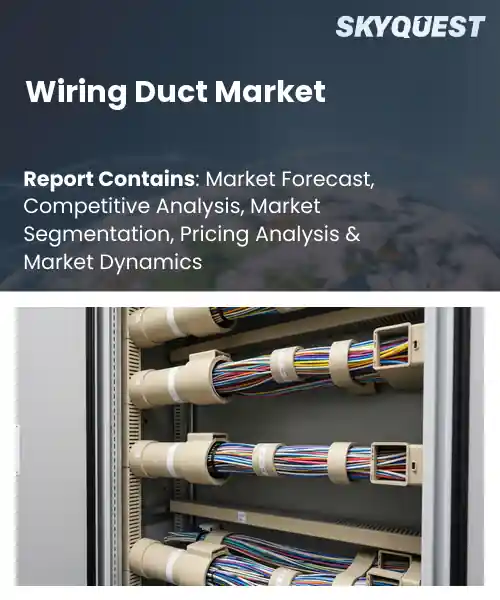
Wiring Duct Market
Report ID: SQMIG20D2682
Report ID: SQMIG20D2682
[email protected]
USA +1 351-333-4748
Report ID:
SQMIG20D2682 |
Region:
Global |
Published Date: June, 2026
Pages:
157
|Tables:
120
|Figures:
77


Global Wiring Duct Market size was valued at USD 402.21 Million in 2024 and is poised to grow from USD 418.7 Million in 2025 to USD 577.44 Million by 2033, growing at a CAGR of 4.1% during the forecast period (2026-2033).
The global wiring duct market covers the whole thing, like the design, manufacturing, and supplying of conduit systems that protect electrical cables in homes, offices, and industrial sites. It matters because people are relying more and more on power and data networks, and those networks need dependable routing, for safety as well performance, non negotiable. One major driver for the wiring duct market growth is that smart building technologies are expanding fast, so builders are being pushed to swap older raceways with modular, fire‑rated ducts, that can handle fiber optics and power lines together.
Recently, renewable integration has turned into a catalyst, since things like rooftop solar and offshore wind generate the need for cabling that has to survive tougher weather and conditions. That pressure pushes manufacturers to build corrosion‑resistant ducts that work well for tunnels, platforms, and exposed locations, and in practice it helps reduce installation effort while still meeting safety requirements. For example, polymer ducts used in the United Kingdom’s offshore wind farms have helped projects move faster, while duct kits used in Brazil’s grid upgrades have cut capital costs. All of this broadens the demand for flexible solutions that stay compliant with standards, and it also creates openings for new suppliers to lock in market share through extra service packages, like support and integration help.
AI and IoT are basically turning wiring ducts from passive hardware into something more “aware” and intelligent. Sensors placed inside the ducts can collect temperature levels, vibration signals and load data, then AI models crunch that stream to forecast wear and also recommend a better routing approach. Designers are also leaning on digital twins, to simulate installations before anyone does the real work, which cuts back on annoying trial and error. With IoT connectivity, cable health can be monitored remotely, so maintenance teams may step in earlier, before a failure happens. On the production side, AI powered demand forecasting helps manufacturers align output with construction timetables, and that can reduce inventory waste. Put together, these tech shifts speed up product improvements, increase safety, and lower total lifecycle costs, making wiring ducts more adaptable to smart building demands.
Market snapshot - (2026-2033)
Global Market Size
USD 402.21 Million
Largest Segment
Slotted Wiring Duct
Fastest Growth
Flexible Wiring Duct
Growth Rate
4.1% CAGR
To get more insights on this market click here to Request a Free Sample Report
The global wiring duct market is segmented by product form factor design, raw material substrate, structural application area, end-use industry sector, and region. Based on product form factor design, the market is categorized into Slotted Wiring Duct, Solid-Wall Wiring Duct, and Flexible Wiring Duct. By raw material substrate, the market is segmented into Polyvinyl Chloride (PVC), Halogen-Free Plastics, Polycarbonate, and Others. Based on structural application area, the market is divided into Control Panels, Machine Enclosures, Heavy Machinery Assemblies, and Others. By end-use industry sector, the market is segmented into Manufacturing Plants, Telecommunications Networks, Construction and Infrastructure, and Energy and Power Facilities. Regionally, the market is analyzed across North America, Europe, Asia Pacific, Latin America, and the Middle East & Africa.
As per the wiring duct market analysis, the slotted wiring duct segment dominates, mainly because its longish linear geometry lines up very nicely with the standardized routing patterns witnessed in today’s control panels. Those pre‑engineered slots remove the whole on‑site cutting thing, so installation time drops, and there’s less risk of errors. Designers like that predictability a lot , so manufacturers tend to prioritize mass production. And this built‑in efficiency also helps with meeting strict electromagnetic shielding requirements, which makes it a leading pick in the wiring duct market, like a core component that keeps showing up.
On the other hand, the flexible wiring duct seems to be the most rapidly expanding area because the bendable structure fits awkward machinery layouts where rigid runs just won’t work. That bend‑friendly construction gives elasticity, which helps teams handle quick redesigns and it supports the rise of compact automation equipment. In turn it opens up fresh installation possibilities and drives new demand across the wiring duct market too.
According to the wiring duct market forecast, the Halogen‑free plastics category leads, because its non‑toxic makeup matches the tight fire‑safety rules for machine enclosures. When corrosive halogen gases are removed, smoke generation is reduced , and evacuation during incidents tends to be safer. OEMs lean into this material to get compliance and also to sell their products as more environmentally responsible, so suppliers then focus on scalable production. Plus the material’s natural durability further cements its leadership in the wiring duct market across various industrial sectors worldwide.
Conversely, polycarbonate grows fastest because its strong impact resistance along with optical clarity supports innovative transparent conduit designs. This approach allows lightweight yet sturdy assemblies, which appeals to manufacturers who want visual inspection options. As demand for visible wiring pathways increases, adoption speeds up as well, and that widens market opportunities inside the wiring duct sector.
To get detailed segments analysis, Request a Free Sample Report
As per the wiring duct market regional forecats, Asia-Pacific dominated the market due to a mix of advanced manufacturing ecosystems, deep tying into smart-city programs, and a long-standing push for high-density infrastructure buildouts. There’s been solid electrical construction work across industrial spaces, offices, and housing, and it keeps feeding steady demand. At the same time, strict safety and quality rules tend to bump up the bar on what product performance should look like. Big economies are also putting real money into research and development, so there are more clever duct designs coming out, especially for buildings with increasingly tangled layouts and architecture. Plus the supply-chain system stays fairly efficient, and there’s this attitude of fast adoption of new construction methods, which helps the region set the pace and grab a larger slice of global market activity, than expected.
Japan Wiring Duct Market
The Wiring Duct Market penetration in Japan is pushed by the country’s emphasis on high-tech manufacturing and ongoing updates for older building stock. Strong regulatory guardrails basically force the adoption of better duct solutions in both new builds and retrofit jobs. Meanwhile, auto and electronics companies need conduit systems that are precise, reliable, and able to handle complex wiring routes. Industry teamwork helps bring out lightweight, fire-resistant material concepts and that helps lock in Japan’s image for quality and invention in wiring infrastructure.
South Korea Wiring Duct Market
The Wiring Duct Market expansion in South Korea ties into fast urbanization and a aggressive rollout of smart-building technologies. Government incentives make it easier to plug in energy-efficient conduit options, supporting big commercial developments as well as residential ones. South Korea’s manufacturing strength makes it feasible to produce high-performance ducts that still satisfy tight safety standards. At the same time, the export-minded manufacturing approach opens doors for wider influence and for broader acceptance of Korean-engineered solutions.
North America is seeing lively growth because data-center construction is ramping up, renewable energy integration is getting more attention, and building-code changes are moving toward stronger safety and energy efficiency goals. The construction industry is leaning more toward modular and preassembled approaches, and that creates demand for wiring duct options that can adapt and still speed up installation. Industry collaborations back the development of lightweight and corrosion-resistant materials, and as awareness of indoor environmental quality climbs, adoption accelerates across commercial, residential, and industrial projects.
United States Wiring Duct Market
The Wiring Duct Market share in the United States is increased by wide infrastructure renewal efforts and a strong commercial real-estate environment. Green building certifications steer the market toward duct systems that support fire safety, and also lower material waste. The country’s deep engineering talent keeps feeding iterative improvements in product designs, matching newer code expectations and helping deliver large-scale deployments in data centers, healthcare sites, and transportation hubs.
Canada Wiring Duct Market
The Wiring Duct sector in Canada benefits from system-wide initiatives meant to modernize aging electrical networks, while also improving construction sustainability. Strict safety rules encourage high-performance duct solutions across residential buildings, plus institutional and public structures too. Local geography and climate conditions tend to boost demand for ducts that can hold up well and offer stronger thermal resistance. And there’s cooperation between industry teams and academic groups, which supports novel material uses that are tailored for the Canadian market.
Europe seems to lock in its market position via a very steady commitment to sustainability, plus strict regulatory surroundings and a lot of cross-border effort around standards creation. There is also heavy investment in renewable power infrastructure and an ongoing, broad renovation push for older building stock, so offer steady stream for advanced duct solutions. At the same time, the region’s circular economy mindset encourages the shift toward recyclable and low‑impact materials. And because the engineering know-how is strong, modular easy‑install systems are being introduced more often, they basically fit with the changing way European construction is done, which is not exactly a small thing.
Germany Wiring Duct Market
The wiring duct industry in Germany is supported by its top-tier engineering track record and a fairly proactive stance on energy‑efficient construction. Broad building codes tend to require high-quality conduit systems, so manufacturers usually focus on durability and fire safety first. Also, Germany’s Industry 4.0 direction helps enable smart duct designs that can support automated installation, plus real-time monitoring. This, in turn, reinforces Germany’s influence on continental standards, and it feels like everyone ends up following along.
United Kingdom Wiring Duct Market
For the UK wiring duct market, the story is mostly about a strong retrofit push and net‑zero carbon goals. Regulatory structures, with the right incentives, encourage duct solutions that improve fire protection while also cutting down on material waste. A fairly active construction services ecosystem increases demand for modular, lightweight ducts, and that helps projects move faster. Meanwhile partnerships between universities and industry are pushing new, eco‑friendly conduit technologies, sometimes earlier than you’d expect.
France Wiring Duct Market
In France, the wiring duct market is moving forward due to large public-sector building programs and a deep cultural focus on keeping architectural heritage intact. Strict safety requirements mean duct systems have to be advanced, and they need to work well in both historic renovations, and newer builds too. Collaborative research initiatives also help bring forward high‑performance materials that are low in emissions, and this makes France a catalyst for sustainable wiring infrastructure across Europe.
To know more about the market opportunities by region and country, click here to
Buy The Complete Report
Increasing Demand for Sustainable Infrastructure
Advancements in Flexible Duct Materials
High Initial Capital Expenditure
Complex Installation and Maintenance Requirements
Request Free Customization of this report to help us to meet your business objectives.
The competitive landscape is shaped by heavy rivalry between conduit makers, all trying to grab growth tied to cable management upgrades and smart building demand. A lot of companies are pushing faster technology rollouts and also leaning into strategic partnerships, even if it seems a bit messy. In March 2026, Panasonic announced, like, a high durability conduit material aimed at smart factories and buildings. This shows how product innovation is used as a differentiation method, to win market share even in crowded conditions.
Top Player’s Company Profile
Recent Developments in the Wiring Duct Market
SkyQuest’s ABIRAW (Advanced Business Intelligence, Research & Analysis Wing) is our Business Information Services team that Collects, Collates, Correlates, and Analyses the Data collected by means of Primary Exploratory Research backed by robust Secondary Desk research.
As per SkyQuest analysis, the market is being pushed mostly by demand for sustainable infrastructure, it nudges architects and engineers to choose recyclable low impact wiring ducts. A second push comes from the rapid rollin of smart‑building IoT systems that need flexible modular conduit designs, to fit dense cable bundles and enable remote monitoring. The biggest slice is slotted wiring duct, mainly because its linear layout makes it faster for control‑panel installations and it also satisfies shielding standards. Asia Pacific leads it overall because of huge construction activity, big smart city investments, and a strong manufacturing base. Still, the high upfront capital expense stays a drag, and that limits adoption among developers who are, more cost conscious, than enthusiastic about spending early.
| Report Metric | Details |
|---|---|
| Market size value in 2024 | USD 402.21 Million |
| Market size value in 2033 | USD 577.44 Million |
| Growth Rate | 4.1% |
| Base year | 2024 |
| Forecast period | (2026-2033) |
| Forecast Unit (Value) | USD Million |
| Segments covered |
|
| Regions covered | North America (US, Canada), Europe (Germany, France, United Kingdom, Italy, Spain, Rest of Europe), Asia Pacific (China, India, Japan, Rest of Asia-Pacific), Latin America (Brazil, Rest of Latin America), Middle East & Africa (South Africa, GCC Countries, Rest of MEA) |
| Companies covered |
|
| Customization scope | Free report customization with purchase. Customization includes:-
|
To get a free trial access to our platform which is a one stop solution for all your data requirements for quicker decision making. This platform allows you to compare markets, competitors who are prominent in the market, and mega trends that are influencing the dynamics in the market. Also, get access to detailed SkyQuest exclusive matrix.
Table Of Content
Executive Summary
Market overview
Parent Market Analysis
Market overview
Market size
KEY MARKET INSIGHTS
COVID IMPACT
MARKET DYNAMICS & OUTLOOK
Market Size by Region
KEY COMPANY PROFILES
Methodology
For the Wiring Duct Market, our research methodology involved a mixture of primary and secondary data sources. Key steps involved in the research process are listed below:
1. Information Procurement: This stage involved the procurement of Market data or related information via primary and secondary sources. The various secondary sources used included various company websites, annual reports, trade databases, and paid databases such as Hoover's, Bloomberg Business, Factiva, and Avention. Our team did 45 primary interactions Globally which included several stakeholders such as manufacturers, customers, key opinion leaders, etc. Overall, information procurement was one of the most extensive stages in our research process.
2. Information Analysis: This step involved triangulation of data through bottom-up and top-down approaches to estimate and validate the total size and future estimate of the Wiring Duct Market.
3. Report Formulation: The final step entailed the placement of data points in appropriate Market spaces in an attempt to deduce viable conclusions.
4. Validation & Publishing: Validation is the most important step in the process. Validation & re-validation via an intricately designed process helped us finalize data points to be used for final calculations. The final Market estimates and forecasts were then aligned and sent to our panel of industry experts for validation of data. Once the validation was done the report was sent to our Quality Assurance team to ensure adherence to style guides, consistency & design.
Analyst Support
Customization Options
With the given market data, our dedicated team of analysts can offer you the following customization options are available for the Wiring Duct Market:
Product Analysis: Product matrix, which offers a detailed comparison of the product portfolio of companies.
Regional Analysis: Further analysis of the Wiring Duct Market for additional countries.
Competitive Analysis: Detailed analysis and profiling of additional Market players & comparative analysis of competitive products.
Go to Market Strategy: Find the high-growth channels to invest your marketing efforts and increase your customer base.
Innovation Mapping: Identify racial solutions and innovation, connected to deep ecosystems of innovators, start-ups, academics, and strategic partners.
Category Intelligence: Customized intelligence that is relevant to their supply Markets will enable them to make smarter sourcing decisions and improve their category management.
Public Company Transcript Analysis: To improve the investment performance by generating new alpha and making better-informed decisions.
Social Media Listening: To analyze the conversations and trends happening not just around your brand, but around your industry as a whole, and use those insights to make better Marketing decisions.
REQUEST FOR SAMPLE
 REQUEST FREE CUSTOMIZATION
Global Wiring Duct Market size was valued at USD 402.21 Million in 2024 and is poised to grow from USD 418.7 Million in 2025 to USD 577.44 Million by 2033, growing at a CAGR of 4.1% during the forecast period (2026-2033).
The competitive landscape is shaped by intense rivalry among conduit manufacturers seeking to capture growth from organized cable‑management and smart‑building demand; firms are accelerating technology rollouts and strategic collaborations. Notably, Panasonic announced in March 2026 a high‑durability conduit material tailored for smart factories and buildings, illustrating how product innovation is used to differentiate and win market share. 'Schneider Electric SE', 'Legrand SA', 'ABB Ltd', 'Eaton Corporation PLC', 'Atkore International Inc.', 'Aliaxis Group', 'Panduit Corp.', 'HellermannTyton Group PLC', 'Iboco Corporation', 'Phoenix Contact GmbH & Co. KG', 'Hager Group', 'Mitsubishi International Corporation', 'Rittal GmbH & Co. KG', 'Thomas & Betts Corporation', 'Dietzel Univolt', 'Kopp Germany', 'Fränkische Industrial Pipes GmbH & Co. KG', 'OBO Bettermann Holding GmbH & Co. KG', 'Pipelife International GmbH', 'Tehalit GmbH'
The shift toward greener construction practices is prompting architects and engineers to prioritize wiring solutions that reduce material waste and lower energy consumption. Sustainable infrastructure standards encourage the adoption of duct systems that support recycling and minimize environmental impact, which in turn drives broader acceptance among project stakeholders. As regulatory bodies reinforce eco‑friendly guidelines, manufacturers are motivated to innovate designs that align with these objectives, creating a positive feedback loop that sustains market expansion through increased collaboration between suppliers and construction firms.
Smart Infrastructure Integration: The rapid adoption of Internet of Things platforms and building automation systems is driving demand for wiring ducts that can accommodate high‑density cable bundles, sensor networks, and future upgrades. Manufacturers are prioritizing modular designs, flexible material choices, and standardized dimensions to simplify integration across residential, commercial, and industrial projects. This trend enables faster construction cycles, reduces retrofit complexities, and supports the seamless rollout of smart city initiatives worldwide while enhancing overall network reliability and energy efficiency globally and across sectors.
Why does Asia Pacific Dominate the Global Wiring Duct Market? |@12


Want to customize this report? This report can be personalized according to your needs. Our analysts and industry experts will work directly with you to understand your requirements and provide you with customized data in a short amount of time. We offer $1000 worth of FREE customization at the time of purchase.
Feedback From Our Clients


 USA (+1) 351-333-4748

