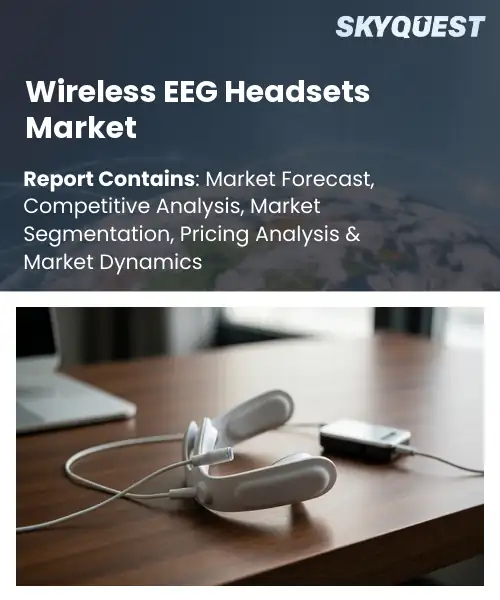
Wireless EEG Headsets Market
Report ID: SQMIG35A4290
Report ID: SQMIG35A4290
[email protected]
USA +1 351-333-4748
Report ID:
SQMIG35A4290 |
Region:
Global |
Published Date: July, 2026
Pages:
157
|Tables:
145
|Figures:
78


Global Wireless Eeg Headsets Market size was valued at USD 438.7 Million in 2024 and is poised to grow from USD 493.98 Million in 2025 to USD 1276.48 Million by 2033, growing at a CAGR of 12.6% during the forecast period (2026-2033).
The global wireless EEG headset market comprises compact, battery‑powered devices that capture brainwave activity without tethered cables, enabling real‑time neurofeedback for research, clinical, and consumer applications. Its significance stems from the convergence of neurotechnology, wearable electronics, and data analytics, which together lower barriers to brain‑computer interface adoption. Historically, the market emerged from early laboratory‑grade EEG systems in the 1990s, progressed through Bluetooth‑enabled prototypes in the 2000s, and accelerated after 2015 when companies such as Emotiv and NeuroSky introduced affordable, cloud‑connected models. This evolution has broadened user bases from neuroscientists to gamers, creating a foundation for rapid expansion in the sector.
The major driver of growth for wireless EEG headsets is increasing demand for remote patient monitoring that encourages spending on tele-neurology and home diagnostics. Wireless technology allows medical professionals to collect data on brain activity in the patients' everyday surroundings and detect early signs of epilepsy, sleep disorders, and cognitive deterioration. An international chain of hospitals supplied patients who had undergone surgery with wireless headsets, resulting in a 12 % decrease in adverse events and reduced costs of rehospitalization. At the same time, entertainment companies implement neurofeedback in real time to customize games for their state and generate additional income.
How is AI Enhancing Data Accuracy in the Wireless EEG Headset Market?
AI is reshaping wireless EEG headsets by sharpening signal quality and reducing the need for manual cleaning. Machine‑learning models learn to distinguish brain activity from motion artefacts, enabling real‑time artifact suppression. Adaptive algorithms calibrate each device to the wearer’s scalp, maintaining consistent contact without frequent adjustments. Cloud‑based AI pipelines aggregate data across users, spotting patterns that improve algorithm accuracy over time. These capabilities turn noisy, portable recordings into clinically reliable streams, supporting applications from mental‑health monitoring to seizure detection. As manufacturers embed more processing power, the technology becomes faster, lighter and more user‑friendly, driving broader market uptake.
Market snapshot - (2026-2033)
Global Market Size
USD 438.7 Million
Largest Segment
Clinical EEG Headsets
Fastest Growth
Consumer EEG Headsets
Growth Rate
12.6% CAGR
To get more insights on this market click here to Request a Free Sample Report
Global wireless eeg headsets market is segmented by product type, channel count, application, end user, connectivity and region. Based on product type, the market is segmented into Clinical EEG Headsets, Consumer EEG Headsets and Research EEG Headsets. Based on channel count, the market is segmented into 1–8 Channels, 9–32 Channels and Above 32 Channels. Based on application, the market is segmented into Neurological Diagnosis, Brain-Computer Interface (BCI), Cognitive Research and Neurofeedback. Based on end user, the market is segmented into Hospitals, Academic & Research Institutes and Consumers. Based on connectivity, the market is segmented into Bluetooth, Wi-Fi and Proprietary Wireless. Based on region, the market is segmented into North America, Europe, Asia Pacific, Latin America and Middle East & Africa.
Consumer EEG headsets are leading the way as they leverage the fast-growing personal wellness ecosystem and provide consumers with cost-effective and stylish gadgets that can easily be connected with smartphones. They are also easy to use, which has helped to break down barriers for their adoption on a wide scale. User experience and application ecosystems have been key drivers for the success of this product segment.
Meanwhile, Research EEG Headsets segment is witnessing the strongest growth momentum because advanced neuroscientific studies require higher fidelity data and flexible deployment. Universities and biotech firms invest in wireless modalities that support complex protocols, spurring sensor innovation and analytics. This surge expands the market pipeline and attracts new technology partners.
Bluetooth connectivity segment dominates because it offers universal compatibility with mobile devices, enabling effortless pairing and low power consumption that aligns with user expectations for wearable technology. The widespread presence of Bluetooth chips reduces production costs and accelerates time to market, making it attractive for manufacturers targeting both consumer and research markets. Its ease of integration also supports rapid software development cycles, reinforcing market leadership and long term support.
Whereas the Wi-Fi connectivity component is seen as the most important high-growth opportunity due to its ability to provide higher bandwidth for brain computer interface in real time. The need for seamless multichannel streaming has forced companies to equip their systems with reliable Wi-Fi modules, which is leading to greater clinical applications and BCI opportunities.
To get detailed segments analysis, Request a Free Sample Report
North America remains ahead in the global wireless EEG headsets segment owing to the synergy of strong research networks, clinical adoption, and health-conscious consumers. The region has strong partnerships between leading neuroscience centers and technologists, which results in faster prototype testing and validation. An enabling regulatory environment fast-tracks product approvals and the existence of a number of reimbursement routes motivates investment into these technologies. Awareness on brain-computer interfaces among consumers contributes to demand for the segment in both clinical and personal spaces. The availability of large venture capital networks facilitates ongoing funding of startups and scale-ups, ensuring the flow of innovative products.
Wireless EEG Headsets Market in United States thrives on strong university‑driven research and a vibrant start‑up community that translates academic breakthroughs into commercial products. Close proximity of technology hubs to medical centers encourages joint development projects, while large health‑care providers adopt the devices for neurodiagnostic and therapeutic programs. Consumer interest in mindfulness and cognitive performance further expands retail channels, reinforcing a dynamic ecosystem of innovation and adoption.
Wireless EEG Headsets Market in Canada is propelled by federal investment in neuroscience research and a collaborative environment linking hospitals, universities, and technology firms. Emphasis on indigenous health initiatives integrates brain‑monitoring tools into community health programs, while public funding schemes support early‑stage innovators. The convergence of health‑care providers seeking advanced diagnostic capabilities and a growing wellness market creates a fertile ground for sustained market expansion.
There is fast growth in the use of wireless EEG headsets in Europe owing to the combination of advanced academic studies, robust engineering abilities in industry, and health policy measures. Networking across the boundaries results in common standards and quick validation of neurotechnology innovations. EU's focus on the digital health solution integrates reimbursement routes and market access across the boundaries. Interest among the consumers towards cognitive wellbeing and tele-medicine services increase demand even outside clinical applications. Major companies get advantage out of an established supply chain and precision engineering culture in Europe.
Wireless EEG Headsets Market in Germany is anchored by world‑renowned biomedical engineering institutes and a tradition of precision device manufacturing. Close ties between research laboratories and industrial partners accelerate technology transfer, while the country’s health‑care system adopts the devices for both clinical neurodiagnostic services and rehabilitation programs. Strong export orientation also positions German solutions as benchmarks across the continent, reinforcing the market’s dominant status.
Wireless EEG Headsets Market in United Kingdom benefits from a vibrant digital health ecosystem and a proactive government stance on neuroscience innovation. Leading academic centers collaborate with fintech‑savvy start‑ups to embed brain‑monitoring capabilities into consumer health platforms. The NHS’s exploration of remote monitoring pilot projects drives clinical interest, while a robust venture capital community fuels rapid scale‑up of emerging firms, propelling the market’s fast‑growing trajectory.
The Market for Wireless EEG Headsets in France is developing owing to targeted investments in the formation of neurotechnology research hubs, along with public-private partnerships. Innovative hospitals are incorporating wireless EEG systems in multidisciplinary treatment chains, and the design skills of French manufacturers add comfort and ergonomics to devices. Rising consumer interest in mental health management opens new retail possibilities, thus making France a promising market in Europe.
The Asia Pacific region is bolstering its presence in the wireless EEG headsets market by virtue of its swift uptake of technology, government focus on digital health, and increasing numbers of consumers interested in tracking their wellness parameters. Countries like Japan and South Korea benefit from their advanced capabilities of semiconductor production and electronic manufacturing to manufacture small and high-end devices. Neuro-monitoring in health-care organizations and research initiatives that connect academia with industry are becoming common practices. The region's openness towards wearable technology and tele-health facilities also contribute to its fast penetration in the market.
Wireless EEG Headsets Market in Japan is propelled by a deep tradition of precision electronics and a health‑care system that emphasizes early detection and preventative care. Collaborative initiatives between leading neuroscientists and consumer‑electronics firms generate devices that blend clinical accuracy with everyday usability. Government programs encouraging digital health integration support pilot deployments in hospitals and senior‑care facilities, while a tech‑savvy population drives demand for personal brain‑monitoring wearables.
The Market for Wireless EEG Headsets in South Korea grows thanks to the complementary mix of the latest knowledge of semiconductor technology and favorable policies in health technologies. Large conglomerates work with neuroscience institutes developing ultra-light high-resolution headsets that quickly become popular in both scientific and consumer fitness applications. The presence of advanced broadband networks and the culture of wearing innovative devices help the market grow even further, positioning South Korea as an important player in regional development.
To know more about the market opportunities by region and country, click here to
Buy The Complete Report
Increasing Demand for Remote Monitoring
Advancements in Wearable Sensor Technology
High Cost of Specialized Devices
Regulatory and Data Privacy Concerns
Request Free Customization of this report to help us to meet your business objectives.
With stiff competition, there is always fast innovation in the wireless EEG headset market where players are competing to get hospital deals, incorporate AI analytics, and move into consumer wellness. The recent M&A in the industry includes a large neuro technology company buying out a dry electrode company, while partnerships like a top wireless headset company partnering with a cloud AI company are growing fast.
SkyQuest’s ABIRAW (Advanced Business Intelligence, Research & Analysis Wing) is our Business Information Services team that Collects, Collates, Correlates, and Analyses the Data collected by means of Primary Exploratory Research backed by robust Secondary Desk research.
As per SkyQuest analysis, the wireless EEG headset market is driven mainly by the rising need for remote monitoring, through which clinicians can obtain information regarding brain activity outside clinics. The other driving factor in the market is the improvement in wearable sensor technology where miniaturized sensors, Bluetooth chips and advanced AI signal processing makes it easier to obtain better quality of data, hence more appealing for clinical and consumer markets. The major challenge facing the market is the expensive nature of the devices, and it hinders their use in budget-limited healthcare facilities and laboratories. North America leads the market owing to strong research and development activities, venture capital support and adoption of consumer-wellness applications, and the consumer EEG headset segment is the dominant one in the market.
| Report Metric | Details |
|---|---|
| Market size value in 2024 | USD 438.7 Million |
| Market size value in 2033 | USD 1276.48 Million |
| Growth Rate | 12.6% |
| Base year | 2024 |
| Forecast period | (2026-2033) |
| Forecast Unit (Value) | USD Million |
| Segments covered |
|
| Regions covered | North America (US, Canada), Europe (Germany, France, United Kingdom, Italy, Spain, Rest of Europe), Asia Pacific (China, India, Japan, Rest of Asia-Pacific), Latin America (Brazil, Rest of Latin America), Middle East & Africa (South Africa, GCC Countries, Rest of MEA) |
| Companies covered |
|
| Customization scope | Free report customization with purchase. Customization includes:-
|
To get a free trial access to our platform which is a one stop solution for all your data requirements for quicker decision making. This platform allows you to compare markets, competitors who are prominent in the market, and mega trends that are influencing the dynamics in the market. Also, get access to detailed SkyQuest exclusive matrix.
Table Of Content
Executive Summary
Market overview
Parent Market Analysis
Market overview
Market size
KEY MARKET INSIGHTS
COVID IMPACT
MARKET DYNAMICS & OUTLOOK
Market Size by Region
KEY COMPANY PROFILES
Methodology
For the Wireless EEG Headsets Market, our research methodology involved a mixture of primary and secondary data sources. Key steps involved in the research process are listed below:
1. Information Procurement: This stage involved the procurement of Market data or related information via primary and secondary sources. The various secondary sources used included various company websites, annual reports, trade databases, and paid databases such as Hoover's, Bloomberg Business, Factiva, and Avention. Our team did 45 primary interactions Globally which included several stakeholders such as manufacturers, customers, key opinion leaders, etc. Overall, information procurement was one of the most extensive stages in our research process.
2. Information Analysis: This step involved triangulation of data through bottom-up and top-down approaches to estimate and validate the total size and future estimate of the Wireless EEG Headsets Market.
3. Report Formulation: The final step entailed the placement of data points in appropriate Market spaces in an attempt to deduce viable conclusions.
4. Validation & Publishing: Validation is the most important step in the process. Validation & re-validation via an intricately designed process helped us finalize data points to be used for final calculations. The final Market estimates and forecasts were then aligned and sent to our panel of industry experts for validation of data. Once the validation was done the report was sent to our Quality Assurance team to ensure adherence to style guides, consistency & design.
Analyst Support
Customization Options
With the given market data, our dedicated team of analysts can offer you the following customization options are available for the Wireless EEG Headsets Market:
Product Analysis: Product matrix, which offers a detailed comparison of the product portfolio of companies.
Regional Analysis: Further analysis of the Wireless EEG Headsets Market for additional countries.
Competitive Analysis: Detailed analysis and profiling of additional Market players & comparative analysis of competitive products.
Go to Market Strategy: Find the high-growth channels to invest your marketing efforts and increase your customer base.
Innovation Mapping: Identify racial solutions and innovation, connected to deep ecosystems of innovators, start-ups, academics, and strategic partners.
Category Intelligence: Customized intelligence that is relevant to their supply Markets will enable them to make smarter sourcing decisions and improve their category management.
Public Company Transcript Analysis: To improve the investment performance by generating new alpha and making better-informed decisions.
Social Media Listening: To analyze the conversations and trends happening not just around your brand, but around your industry as a whole, and use those insights to make better Marketing decisions.
REQUEST FOR SAMPLE
 REQUEST FREE CUSTOMIZATION
Global Wireless Eeg Headsets Market size was valued at USD 438.7 Million in 2024 and is poised to grow from USD 493.98 Million in 2025 to USD 1276.48 Million by 2033, growing at a CAGR of 12.6% during the forecast period (2026-2033).
Intense competition drives rapid innovation in the wireless EEG headset market, as incumbents and newcomers race to secure hospital contracts, integrate AI analytics, and expand into consumer wellness. Recent M&A activity includes a major neuro‑technology firm acquiring a dry‑electrode specialist, while partnerships such as a leading headset maker collaborating with a cloud‑AI provider accelerate product differentiation and market penetration. 'EMOTIV Inc.', 'Advanced Brain Monitoring, Inc.', 'Compumedics Limited', 'Brain Products GmbH', 'ANT Neuro B.V.', 'Neuroelectrics Barcelona S.L.U.', 'Wearable Sensing', 'g.tec medical engineering GmbH', 'Bitbrain Technologies S.L.', 'Cognionics, Inc.', 'OpenBCI', 'Neurosity, Inc.', 'InteraXon Inc.', 'Natus Medical Incorporated', 'Electrical Geodesics, Inc.', 'mBrainTrain Sp. z o.o.', 'BIOPAC Systems, Inc.', 'Artinis Medical Systems B.V.', 'Cadwell Industries, Inc.', 'Brain Scientific Inc.'
Increasing remote healthcare services drive adoption of wireless EEG headsets, as clinicians seek portable solutions that enable continuous brain activity monitoring beyond traditional facilities. These devices facilitate real‑time data transmission, allowing specialists to assess neurological conditions from distant locations. By reducing the need for physical appointments, they enhance patient convenience and improve access for underserved populations. The flexibility offered by wireless technology also supports longitudinal studies, enabling researchers to capture naturalistic brain patterns over extended periods. Consequently, this growing reliance on remote monitoring fuels market expansion.
Telehealth Integration Accelerates: Clinicians and patients are increasingly embracing wireless EEG headsets as core components of remote neurological assessments, enabling real‑time data capture without the constraints of a physical clinic. This shift is driven by expanding broadband coverage, growing comfort with digital health platforms, and the need for continuous monitoring of conditions such as epilepsy and sleep disorders. As a result, manufacturers are prioritizing seamless cloud connectivity, intuitive user interfaces, and robust data encryption to meet the expectations of a evolving telehealth ecosystem.
Why does North America Dominate the Global Wireless EEG Headsets Market? |@12


Want to customize this report? This report can be personalized according to your needs. Our analysts and industry experts will work directly with you to understand your requirements and provide you with customized data in a short amount of time. We offer $1000 worth of FREE customization at the time of purchase.
Feedback From Our Clients


 USA (+1) 351-333-4748

