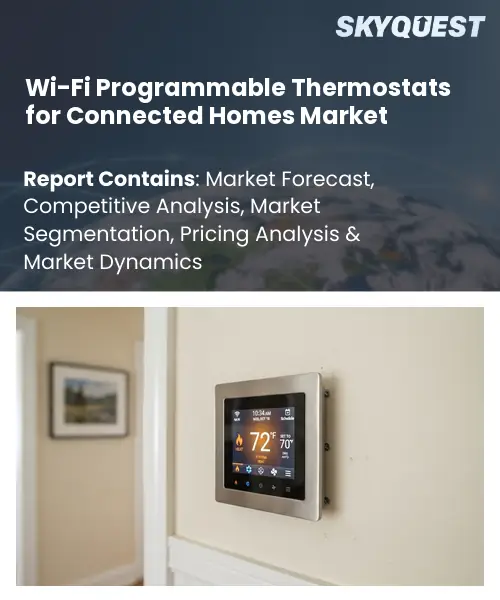
Wi-Fi Programmable Thermostats for Connected Homes Market
Report ID: SQMIG45J3004
Report ID: SQMIG45J3004
[email protected]
USA +1 351-333-4748
Report ID:
SQMIG45J3004 |
Region:
Global |
Published Date: October, 2026
Pages:
157
|Tables:
145
|Figures:
78


Global Wi-Fi Programmable Thermostats For Connected Homes Market size was valued at USD 3.2 Billion in 2024 and is poised to grow from USD 3.6 Billion in 2025 to USD 9.24 Billion by 2033, growing at a CAGR of 12.5% during the forecast period (2026-2033).
Energy‑Fi Wi‑Fi programmable thermostat market serves connected homes by allowing users to adjust heating and cooling through mobile apps or voice assistants. Its primary driver is the adoption of smart‑home ecosystems, which creates demand for devices that can be managed remotely and integrated with platforms such as Amazon Alexa, Google Home, and Apple HomeKit. As broadband penetration and IoT sensor costs have fallen, manufacturers have introduced models like the Nest Learning Thermostat and Ecobee SmartThermostat, expanding awareness. This evolution transforms energy management from a manual task into a service, reducing utility bills and supporting sustainability goals, thereby reinforcing market relevance. Energy‑efficiency regulation emerges as the key factor propelling market expansion, because governments are mandating lower residential carbon footprints and offering rebates for smart‑thermostat installations. When utilities provide time‑of‑use pricing, homeowners install Wi‑Fi thermostats to shift heating or cooling to off‑peak periods, translating tariff incentives into measurable savings. For example, a Denver utility’s rebate program reported a 12 % reduction in peak demand after 30 % of households adopted programmable devices. This regulatory push also spurs OEMs to embed algorithms that predict occupancy and weather, creating differentiation that appeals to consumers and opens B2B partnerships with energy service companies, thereby unlocking revenue streams.
How is AI driving personalization in Wi‑Fi programmable thermostats for connected homes?
AI is reshaping how Wi Fi programmable thermostats learn and adapt to each household. The core of personalization lies in machine learning models that analyze occupancy patterns, weather forecasts and user preferences. Sensors collect temperature and motion data, while cloud algorithms predict optimal set points before occupants even adjust a dial. Vendors now offer voice integration that recalls past schedules and adjusts for seasonal shifts, making heating and cooling feel intuitive. The market sees a surge of devices that blend energy efficiency with comfort, turning a simple thermostat into a proactive climate manager that reacts to daily routines.Ecobee announced a new AI powered thermostat in June 2023, leveraging predictive analytics to fine tune temperature based on real time occupancy and weather data, which accelerates adoption and improves home comfort while reducing energy waste. The feature integrates with existing smart home hubs and learns from seasonal usage, delivering a seamless personalized climate experience.
Market snapshot - (2026-2033)
Global Market Size
USD 3.2 Billion
Largest Segment
Smart Programmable Thermostats
Fastest Growth
Smart Programmable Thermostats
Growth Rate
12.5% CAGR
To get more insights on this market click here to Request a Free Sample Report
Global wi-fi programmable thermostats for connected homes market is segmented by product type, hvac compatibility, connectivity, application, distribution channel and region. Based on product type, the market is segmented into Programmable Thermostats and Smart Programmable Thermostats. Based on hvac compatibility, the market is segmented into Heating Systems, Cooling Systems, Heating & Cooling Systems and Heat Pump Systems. Based on connectivity, the market is segmented into Wi-Fi and Wi-Fi with Other Wireless Protocols. Based on application, the market is segmented into Residential HVAC Control, Energy Management, Remote Temperature Control and Home Automation. Based on distribution channel, the market is segmented into Specialty Stores, Home Improvement Stores, Online Retail and HVAC Distributors. Based on region, the market is segmented into North America, Europe, Asia Pacific, Latin America and Middle East & Africa.
Smart programmable thermostats segment dominates because they integrate advanced algorithms, learning capabilities, and seamless mobile interfaces, delivering personalized climate control that resonates with modern homeowners. Their ability to adapt to occupancy patterns and provide energy insights drives preference among consumers seeking convenience and cost savings, positioning them as the leading choice in the market. Additionally, integration with voice assistants and third‑party platforms expands functionality, reinforcing their appeal across diverse smart‑home ecosystems.
However, wi‑fi with other wireless protocols segment emerges as the key high‑growth area because manufacturers are bundling zigbee, thread, or bluetooth low energy to enable broader device interoperability and future‑proof installations. This convergence fuels demand from tech‑savvy homeowners and accelerates market expansion by unlocking new integration possibilities.
Heating & Cooling Systems segment dominates because it offers universal compatibility across the majority of residential hvac equipment, simplifying installation and reducing friction for end users. This broad fit ensures that both new builds and retrofit projects can adopt wi‑fi thermostats without extensive system redesign, fostering confidence among installers and homeowners alike. The resulting ease of integration drives widespread preference and solidifies its leadership in the market. Additionally, manufacturers prioritize firmware updates that align with diverse system protocols, further reinforcing its appeal.
Meanwhile, Energy Management application segment emerges as the fastest expanding area because homeowners increasingly seek tools that translate temperature control into measurable utility savings. Integrated analytics and demand‑response features empower users to align heating and cooling with dynamic pricing, spurring adoption and creating new revenue streams for service providers, thereby accelerating market growth.
To get detailed segments analysis, Request a Free Sample Report
North America dominates the global Wi‑Fi programmable thermostats for connected homes market due to a confluence of advanced consumer technology adoption, extensive broadband penetration, and a mature ecosystem of smart‑home device manufacturers. Homeowners exhibit strong willingness to integrate energy‑saving solutions, supported by utility incentives and progressive regulatory frameworks that encourage digital climate control. The presence of leading technology firms and a robust distribution network accelerates product availability and consumer confidence. Furthermore, a culture of home renovation and retrofit projects creates continual demand for intelligent temperature management. Industry alliances also foster collaborative standards that streamline integration across platforms, while consumer education campaigns deepen understanding of energy efficiency benefits. United States Wi‑Fi Programmable Thermostats for Connected Homes Market (subheading)
Wi‑Fi Programmable Thermostats for Connected Homes Market in Canada is shaped by a dispersed housing stock that encourages demand for remote temperature management. Provincial energy policies endorse smart‑energy solutions, prompting utility partners to offer rebates that lower entry barriers. Retail distribution blends electronics chains with regional specialty stores, ensuring accessibility across urban and rural communities. Consumer preference for compatibility with adopted voice platforms drives manufacturers to align product ecosystems with national standards.
Europe experiences rapid expansion of Wi‑Fi programmable thermostats for connected homes as sustainability objectives intersect with rising consumer appetite for digital convenience. Stringent energy‑efficiency directives across the bloc create regulatory pressure that encourages integration of intelligent climate control within building codes. A vibrant network of technology startups and established appliance manufacturers fuels continuous innovation, while collaborative standards initiatives ensure cross‑brand interoperability. Homeowners value the ability to manage heating through mobile devices, especially in multigenerational households, driving demand for user‑friendly interfaces. Moreover, utility companies increasingly partner with device providers to deliver incentive schemes that lower adoption costs, reinforcing the market’s upward momentum across diverse European markets. Retail environments in major cities showcase immersive demo spaces that allow shoppers to experience real‑time energy savings, further cementing brand loyalty. Government housing renovation programs also integrate smart thermostats as standard upgrades, amplifying penetration in both new constructions and retrofits. Germany Wi‑Fi Programmable Thermostats for Connected Homes Market (subheading)
Wi‑Fi Programmable Thermostats for Connected Homes Market in France is emerging as renewable heating solutions gain traction among environmentally conscious consumers. National energy strategies prioritize energy‑saving retrofits, encouraging the inclusion of smart thermostats in renovation grants. Distribution combines large retail chains with boutique electronics stores, widening consumer exposure. Interest in integration with popular smartphone ecosystems drives manufacturers to develop localized applications that respect privacy regulations, fostering gradual but steady market acceptance across French households.
Asia Pacific is strengthening its position in the Wi‑Fi programmable thermostats for connected homes market through a blend of technological leadership, rising urbanization, and supportive governmental agendas that prioritize smart‑energy integration. Countries in the region invest heavily in high‑speed internet expansion, ensuring reliable connectivity for cloud‑based climate control. Homebuilders increasingly embed smart thermostats into new developments, creating ready‑made ecosystems for occupants. Local manufacturers collaborate with global technology firms to tailor solutions that accommodate diverse heating and cooling preferences, from compact apartment units to expansive residential complexes. Consumer awareness is bolstered by media campaigns highlighting cost‑saving and environmental advantages, while utility partnerships introduce incentive structures that lower barriers to entry. Collectively these dynamics drive a swift upscale of adoption across the Asia Pacific landscape. Japan Wi‑Fi Programmable Thermostats for Connected Homes Market (subheading)
Wi‑Fi Programmable Thermostats for Connected Homes Market in South Korea benefits from digital adoption and a government push toward smart‑city initiatives that incorporate residential energy management. High penetration of broadband and mobile networks enables reliable remote thermostat operation. Retail distribution leverages large electronics chains alongside tech‑focused concept stores, providing consumers with experience. Incentive programs linked to utility tariffs motivate households to replace heating controls with alternatives, while local manufacturers tailor firmware to harmonize with Korean smart‑home platforms.
To know more about the market opportunities by region and country, click here to
Buy The Complete Report
Smart Home Integration Boosts Adoption
Energy Savings Incentives Drive Purchases
High Initial Cost Limits Adoption
Compatibility Issues Hinder Integration
Request Free Customization of this report to help us to meet your business objectives.
The competitive landscape is shaped by aggressive product differentiation and strategic collaborations, with incumbents leveraging M&A to acquire niche sensor technologies while new entrants form partnerships with utility providers to embed demand‑response capabilities; for example, a leading thermostat maker recently integrated a cloud‑based AI energy optimizer from a recently acquired startup, accelerating its smart‑home ecosystem rollout.
Top Player’s Company Profile
Recent Developments
SkyQuest’s ABIRAW (Advanced Business Intelligence, Research & Analysis Wing) is our Business Information Services team that Collects, Collates, Correlates, and Analyses the Data collected by means of Primary Exploratory Research backed by robust Secondary Desk research. As per SkyQuest analysis the global Wi‑Fi programmable thermostat market is propelled primarily by smart‑home integration, which lets users control temperature through voice assistants and mobile apps, driving rapid adoption. A secondary engine is AI‑driven energy optimization that learns occupancy patterns and weather forecasts to fine‑tune setpoints, enhancing comfort while cutting bills. North America remains the dominant region thanks to high broadband penetration, strong retailer networks and generous utility rebates. The smart programmable thermostat segment leads the market as it combines advanced learning algorithms with seamless connectivity. However, the high initial cost of these feature‑rich devices restrains wider uptake, especially in price‑sensitive markets.
| Report Metric | Details |
|---|---|
| Market size value in 2024 | USD 3.2 Billion |
| Market size value in 2033 | USD 9.24 Billion |
| Growth Rate | 12.5% |
| Base year | 2024 |
| Forecast period | (2026-2033) |
| Forecast Unit (Value) | USD Billion |
| Segments covered |
|
| Regions covered | North America (US, Canada), Europe (Germany, France, United Kingdom, Italy, Spain, Rest of Europe), Asia Pacific (China, India, Japan, Rest of Asia-Pacific), Latin America (Brazil, Rest of Latin America), Middle East & Africa (South Africa, GCC Countries, Rest of MEA) |
| Companies covered |
|
| Customization scope | Free report customization with purchase. Customization includes:-
|
To get a free trial access to our platform which is a one stop solution for all your data requirements for quicker decision making. This platform allows you to compare markets, competitors who are prominent in the market, and mega trends that are influencing the dynamics in the market. Also, get access to detailed SkyQuest exclusive matrix.
Table Of Content
Executive Summary
Market overview
Parent Market Analysis
Market overview
Market size
KEY MARKET INSIGHTS
COVID IMPACT
MARKET DYNAMICS & OUTLOOK
Market Size by Region
KEY COMPANY PROFILES
Methodology
For the Wi-Fi Programmable Thermostats for Connected Homes Market, our research methodology involved a mixture of primary and secondary data sources. Key steps involved in the research process are listed below:
1. Information Procurement: This stage involved the procurement of Market data or related information via primary and secondary sources. The various secondary sources used included various company websites, annual reports, trade databases, and paid databases such as Hoover's, Bloomberg Business, Factiva, and Avention. Our team did 45 primary interactions Globally which included several stakeholders such as manufacturers, customers, key opinion leaders, etc. Overall, information procurement was one of the most extensive stages in our research process.
2. Information Analysis: This step involved triangulation of data through bottom-up and top-down approaches to estimate and validate the total size and future estimate of the Wi-Fi Programmable Thermostats for Connected Homes Market.
3. Report Formulation: The final step entailed the placement of data points in appropriate Market spaces in an attempt to deduce viable conclusions.
4. Validation & Publishing: Validation is the most important step in the process. Validation & re-validation via an intricately designed process helped us finalize data points to be used for final calculations. The final Market estimates and forecasts were then aligned and sent to our panel of industry experts for validation of data. Once the validation was done the report was sent to our Quality Assurance team to ensure adherence to style guides, consistency & design.
Analyst Support
Customization Options
With the given market data, our dedicated team of analysts can offer you the following customization options are available for the Wi-Fi Programmable Thermostats for Connected Homes Market:
Product Analysis: Product matrix, which offers a detailed comparison of the product portfolio of companies.
Regional Analysis: Further analysis of the Wi-Fi Programmable Thermostats for Connected Homes Market for additional countries.
Competitive Analysis: Detailed analysis and profiling of additional Market players & comparative analysis of competitive products.
Go to Market Strategy: Find the high-growth channels to invest your marketing efforts and increase your customer base.
Innovation Mapping: Identify racial solutions and innovation, connected to deep ecosystems of innovators, start-ups, academics, and strategic partners.
Category Intelligence: Customized intelligence that is relevant to their supply Markets will enable them to make smarter sourcing decisions and improve their category management.
Public Company Transcript Analysis: To improve the investment performance by generating new alpha and making better-informed decisions.
Social Media Listening: To analyze the conversations and trends happening not just around your brand, but around your industry as a whole, and use those insights to make better Marketing decisions.
REQUEST FOR SAMPLE
 REQUEST FREE CUSTOMIZATION


Want to customize this report? This report can be personalized according to your needs. Our analysts and industry experts will work directly with you to understand your requirements and provide you with customized data in a short amount of time. We offer $1000 worth of FREE customization at the time of purchase.
Feedback From Our Clients


 USA (+1) 351-333-4748

