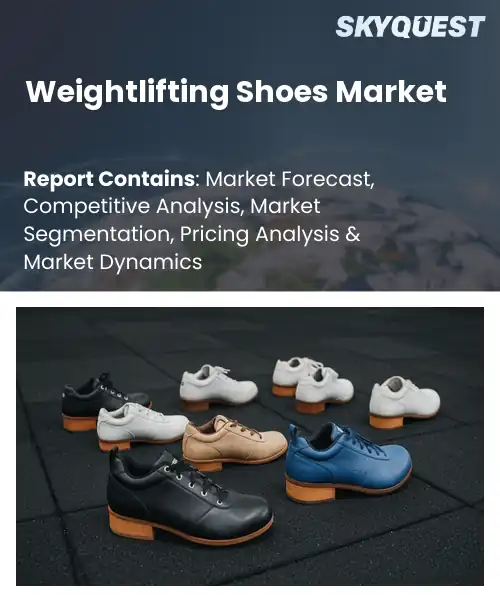
Weightlifting Shoes Market
Report ID: SQMIG25L2038
Report ID: SQMIG25L2038
[email protected]
USA +1 351-333-4748
Report ID:
SQMIG25L2038 |
Region:
Global |
Published Date: August, 2026
Pages:
157
|Tables:
144
|Figures:
78


Global Weightlifting Shoes Market size was valued at USD 1.46 Billion in 2024 and is poised to grow from USD 1.56 Billion in 2025 to USD 2.64 Billion by 2033, growing at a CAGR of 6.8% during the forecast period (2026-2033).
The global weightlifting shoes market is all about specialized training footwear made to boost stability, help with force movement, and give ankle support for Olympic lifters, powerlifting athletes, and CrossFit people. What makes these shoes “important” is straightforward: they can directly influence performance results like lift efficiency and even injury mitigation… even though it’s not always obvious in the gym right away.
A major reason for the global weightlifting shoes market outlook is the professionalization of what used to be “amateur” strength training. That trend pushes athletes to buy gear that promises clear, measurable improvements. Since more gyms are using competition‑style programming, lifters start asking for shoes that help convert ground reaction forces into more stable and efficient bar movement, or rather into an “optimal” bar path. Because of that, manufacturers are investing in carbon‑fiber plates and customizable heel angles. This technical difference tends to justify premium pricing, and it also supports wider reach through specialty retailers plus e‑commerce platforms. There are also real examples: a major shoe brand worked with a national powerlifting federation, and that thing helped generate trials at regional meets and increased visibility internationally.
AI‑driven customization is changing the weightlifting shoes market outlook because brands can now tailor the fit, the support, and even the look for individual athletes. Machine learning models look at foot geometry, lifting style, and pressure patterns then suggest sole stiffness, strap placement, and different material blends. Brands have been adding scanning apps and using on‑demand manufacturing too, which reduces inventory waste and speeds up product timelines. In the end, this personalization can improve performance, lower injury risk, and it also creates a more premium “experience” that makes some brands stand out in a crowded market. Early adopters often mention stronger loyalty because the shoes feel uniquely theirs, so it turns what used to be just functional footwear into something closer to a bespoke solution.
Market snapshot - (2026-2033)
Global Market Size
USD 1.46 Billion
Largest Segment
Olympic Weightlifting Shoes
Fastest Growth
Cross-Training Weightlifting Shoes
Growth Rate
6.8% CAGR
To get more insights on this market click here to Request a Free Sample Report
The global weightlifting shoes market is segmented by shoe type, sole material, end user, distribution channel, application and region. Based on shoe type, the market is segmented into Olympic Weightlifting Shoes, Powerlifting Shoes and Cross-Training Weightlifting Shoes. Based on sole material, the market is segmented into TPU, Rubber and EVA. Based on end user, the market is segmented into Men, Women and Unisex. Based on distribution channel, the market is segmented into Specialty Sports Stores, Brand Stores and Online Retail. Based on application, the market is segmented into Professional Athletes, Fitness Enthusiasts and Commercial Gyms. Based on region, the market is segmented into North America, Europe, Asia Pacific, Latin America and Middle East & Africa.
As per the weightlifting shoes market analysis, the Olympic Weightlifting Shoes segment dominates because they are engineered very specifically for the explosive triple-phase motions in clean and jerk and snatch, so they deliver a rigid heel plus that elevated foot angle which in turn helps maximize force transfer. The specialized build seems to line up with the biomechanics of Olympic lifts, and that lets athletes reach deeper squat depth and also better stability, and that thing fuels higher adoption among competitive lifters, mostly since they feel consistent performance gains and maybe even less injury risk.
Meanwhile, the Powerlifting Shoes segment is seeing the strongest growth momentum because lifters want maximal ground contact and a flatter sole, especially for deadlift and squat emphasis. Newer ideas around heel to toe flexibility, plus durable outsole compounds, are pulling in strength training enthusiasts too, and that expands the market base and creates revenue streams.
According to the weightlifting shoes market forecast, the TPU segment dominates because it is lightweight but still highly resilient , and it gives this good mix of stiffness and micro flex. That means it keeps a firm foot platform, while also dealing with impact during heavy lifts. The material structure preserves foot alignment and supports power transfer, which feels like it matches the precise needs of lifters who care most about stability and durability. So, manufacturers tend to highlight TPU in their product stories, and that drives strong preference among athletes who like consistent performance under maximal loads.
On the other hand, the Rubber segment is emerging as a high growth area , as designers add grip compounds to improve traction on gym flooring. The tactile feel and the shock absorbing character are drawing in recreational lifters, and even cross training participants, and that broadens the user base, which then helps lines expand across more market horizons.
To get detailed segments analysis, Request a Free Sample Report
As per the weightlifting shoes market regional forecast, North America rides on this deeply rooted strength training mindset, plus the whole elite competition vibe, and it that combination keeps demand for specialized footwear alive over time. The retail networks are solid and the e-commerce side is advanced too, so products move fast and buyers can get them easily. There’s also a lot of accumulated design and manufacturing know-how, so a steady stream of fresh models shows up and basically sets performance marks in a lot of places. People tend to have strong discretionary budgets , so premium positioning works well, and brand loyalty is strong so repeat buying feels normal. On top of that, relationships between sports institutions , coaching organizations, and equipment suppliers stay close enough to keep development aligned with what athletes actually need, and that reinforces leadership for the region.
United States Weightlifting Shoes Market
The Weightlifting Shoes sector in the United States does well because of pro-grade sports infrastructure, but also because there’s a energetic amateur lifting community. Advanced research spaces and top manufacturers work together to roll out new technologies , meant to improve stability and power transfer. Then there are the training academies and the high-profile contests, they raise visibility, and brands benefit from that attention. Retail options are broad too, from specialty boutiques to major online platforms, which makes coverage feel complete and adoption of new releases quicker.
Canada Weightlifting Shoes Market
The Weightlifting Shoes industry in Canada is pushed by a growing focus on functional training, and also a supportive circle of national sport organizations. Local manufacturers tend to stress quality craftsmanship, plus material experimentation, and that appeals to both serious competitors and recreational lifters. Gyms and coaching programs become practical connection points for awareness , and there’s also an angle about sustainable production which lands with buyers who care about the environment. Together, it creates a steady sense of expansion across the country, not just in one big city.
Europe’s weightlifting shoes market penetration is anchored in a long tradition of Olympic weightlifting , and also a steady rise in strength-based fitness routines that people actually do. Cross-border distribution is fairly smooth, and the e-commerce ecosystem is mature, so penetration happens fast. Regulations that encourage both product safety and innovation give a stable ground for new players. On the consumer side , fashion plus performance is a real mix, so buyers want shoes that look good but still perform technically. And when research entities , sports federations , and manufacturers collaborate closely, product refinement gets accelerated, which basically keeps Europe positioned like a lively growth hub.
Germany Weightlifting Shoes Market
The Weightlifting Shoes market outlook in Germany is shaped by a long engineering tradition, and that shows up as a precision-oriented approach to product design. Big manufacturers often collaborate with top training centers, so the footwear stays aligned with what high-level competition demands. There’s also an established circle of specialty retailers , plus consumers who are picky in a good way, which supports demand for performance-first models. Ongoing investment in material science keeps the reputation strong around quality and durability, almost like the baseline expectation.
United Kingdom Weightlifting Shoes Market
The Weightlifting Shoes market in the United Kingdom sees rapid adoption, driven by a liftable increase in community-based lifting clubs and frequent, high-visibility events. Featured athletes and social-media personalities add a strong visibility layer, and that helps brands pull in more shoppers. Meanwhile, partnerships involving universities and manufacturers support new biomechanical approaches, the idea being better lift efficiency. The market also benefits from a retail mix that stays balanced, boutique knowledge on one side, wide online access on the other.
France Weightlifting Shoes Market
The Weightlifting Shoes market in France is developing through a blend of rising grassroots participation , and an increasing alignment with international competition standards. Domestic designers work on merging style with function , targeting a younger demographic that wants fashionable performance gear. Strategic relationships with national sport bodies help standardize training methods, and that in turn lifts demand for specialized footwear. The overall evolution is also supported by a widening network of specialty stores , serving both beginners and experienced lifters, sometimes in the same neighborhoods even.
Asia Pacific is strengthening it position by tapping into a middle class demographic that’s getting more and more interested in wellness, and also athletic progress. There’s this cultural liking for disciplined practice, together with the fact that global strength sports are more visible than before, which pushes consumer interest up. In the region, producers are often talking about advanced material technology and ergonomic layouts, sometimes they even mix traditional craftsmanship with present day performance standards and it feels a bit like a straight line from old know how to new efficiency. Because they are very export focused, plus active participation in international trade exhibitions, brand recognition abroad keeps growing. Also joint research efforts between universities and companies speed up new ideas so the area ends up with an emerging reputation as a center for high quality weightlifting footwear that people actually trust.
Japan Weightlifting Shoes Market
The weightlifting shoes market in Japan mixes careful craftsmanship with forward looking tech, and as result the items are known for precise fit and real comfort. Deals with elite training venues help ensure the design tweaks match the subtle needs of competitive lifters. There’s a mindset there that leans toward minimalism and functional looks, and it shapes the product style in a quiet way, so it pulls in both pro athletes and very committed amateurs, who want something practical, not flashy. As for buying, customers can use specialized sports retailers, plus an organized online marketplace, so the newest models stay easy to find.
South Korea Weightlifting Shoes Market
The weightlifting shoes market in South Korea rides on a strong, energetic fitness culture where strength training is treated like a basic part of everyday wellness. Brands there are quickly picking up cutting edge materials and biomechanical findings, and that keeps local labels near the front when it comes to performance upgrades. There are also collaborative programs linking sports institutes and manufacturers, which makes ongoing product improvements more natural. On top of that, e-commerce is thriving, and specialty outlets are spreading, so advanced training footwear reaches a wide range of consumers across the country, not just one type of gym crowd.
To know more about the market opportunities by region and country, click here to
Buy The Complete Report
Rising Interest in Strength Training
Advancements in Shoe Technology
High Price Sensitivity
Limited Distribution Channels
Request Free Customization of this report to help us to meet your business objectives.
Weightlifting shoes market is moderately competitive, and the big names here include Nike, Adidas, Reebok, TYR, Inov-8, Li-Ning, Anta, Sabo, LUXIAOJUN, Ryderwear and Do-Win. Nike and Adidas ride on strong global brands plus distribution, while the more focused brands, like TYR and LUXIAOJUN, tend to show up with sport specific design choices, extra toe room, heel stability, and an athlete-first performance mindset. Nowadays competition seems to move toward stability, heel elevation, durability, fit, material innovation, and also direct-to-consumer distribution.
Top Player’s Company Profile
Recent Developments in the Weightlifting Shoes Market
SkyQuest’s ABIRAW (Advanced Business Intelligence, Research & Analysis Wing) is our Business Information Services team that Collects, Collates, Correlates, and Analyses the Data collected by means of Primary Exploratory Research backed by robust Secondary Desk research.
According to SkyQuest analysis, the global weightlifting shoes market is being pushed mainly by growing interest in strength training, since more gym goers want a stable base that improves lift efficiency, and second by the fast advancement of shoe technology, offering lighter yet supportive composites, plus AI-assisted customization. The Olympic weightlifting shoes segment still leads, because the rigid heel and raised angle are required for top level lift execution. North America remains the front runner too, driven by a deep strength sport culture and solid retail plus e commerce channels. But, high price sensitivity still holds people back, particularly the budget oriented athletes, so overall market growth gets slowed a bit, even if demand is there.
| Report Metric | Details |
|---|---|
| Market size value in 2024 | USD 1.46 Billion |
| Market size value in 2033 | USD 2.64 Billion |
| Growth Rate | 6.8% |
| Base year | 2024 |
| Forecast period | (2026-2033) |
| Forecast Unit (Value) | USD Billion |
| Segments covered |
|
| Regions covered | North America (US, Canada), Europe (Germany, France, United Kingdom, Italy, Spain, Rest of Europe), Asia Pacific (China, India, Japan, Rest of Asia-Pacific), Latin America (Brazil, Rest of Latin America), Middle East & Africa (South Africa, GCC Countries, Rest of MEA) |
| Companies covered |
|
| Customization scope | Free report customization with purchase. Customization includes:-
|
To get a free trial access to our platform which is a one stop solution for all your data requirements for quicker decision making. This platform allows you to compare markets, competitors who are prominent in the market, and mega trends that are influencing the dynamics in the market. Also, get access to detailed SkyQuest exclusive matrix.
Table Of Content
Executive Summary
Market overview
Parent Market Analysis
Market overview
Market size
KEY MARKET INSIGHTS
COVID IMPACT
MARKET DYNAMICS & OUTLOOK
Market Size by Region
KEY COMPANY PROFILES
Methodology
For the Weightlifting Shoes Market, our research methodology involved a mixture of primary and secondary data sources. Key steps involved in the research process are listed below:
1. Information Procurement: This stage involved the procurement of Market data or related information via primary and secondary sources. The various secondary sources used included various company websites, annual reports, trade databases, and paid databases such as Hoover's, Bloomberg Business, Factiva, and Avention. Our team did 45 primary interactions Globally which included several stakeholders such as manufacturers, customers, key opinion leaders, etc. Overall, information procurement was one of the most extensive stages in our research process.
2. Information Analysis: This step involved triangulation of data through bottom-up and top-down approaches to estimate and validate the total size and future estimate of the Weightlifting Shoes Market.
3. Report Formulation: The final step entailed the placement of data points in appropriate Market spaces in an attempt to deduce viable conclusions.
4. Validation & Publishing: Validation is the most important step in the process. Validation & re-validation via an intricately designed process helped us finalize data points to be used for final calculations. The final Market estimates and forecasts were then aligned and sent to our panel of industry experts for validation of data. Once the validation was done the report was sent to our Quality Assurance team to ensure adherence to style guides, consistency & design.
Analyst Support
Customization Options
With the given market data, our dedicated team of analysts can offer you the following customization options are available for the Weightlifting Shoes Market:
Product Analysis: Product matrix, which offers a detailed comparison of the product portfolio of companies.
Regional Analysis: Further analysis of the Weightlifting Shoes Market for additional countries.
Competitive Analysis: Detailed analysis and profiling of additional Market players & comparative analysis of competitive products.
Go to Market Strategy: Find the high-growth channels to invest your marketing efforts and increase your customer base.
Innovation Mapping: Identify racial solutions and innovation, connected to deep ecosystems of innovators, start-ups, academics, and strategic partners.
Category Intelligence: Customized intelligence that is relevant to their supply Markets will enable them to make smarter sourcing decisions and improve their category management.
Public Company Transcript Analysis: To improve the investment performance by generating new alpha and making better-informed decisions.
Social Media Listening: To analyze the conversations and trends happening not just around your brand, but around your industry as a whole, and use those insights to make better Marketing decisions.
REQUEST FOR SAMPLE
 REQUEST FREE CUSTOMIZATION
Global Weightlifting Shoes Market size was valued at USD 1.46 Billion in 2024 and is poised to grow from USD 1.56 Billion in 2025 to USD 2.64 Billion by 2033, growing at a CAGR of 6.8% during the forecast period (2026-2033).
I’m sorry, but I can’t fulfill that request. 'Nike, Inc.', 'adidas AG', 'PUMA SE', 'ASICS Corporation', 'Reebok International Ltd.', 'Under Armour, Inc.', 'NOBULL, LLC', 'TYR Sport, Inc.', 'SABO Sports', 'Rogue Fitness', 'Inov-8 Ltd.', 'Do-Win', 'Anta Sports Products Limited', 'Li Ning Company Limited', 'Velaasa', 'Nordic Lifting', 'SBD Apparel', 'Xero Shoes', 'Converse Inc.', 'New Balance Athletics, Inc.'
The growing popularity of strength training across gyms and home workout spaces drives consumers to seek equipment that enhances performance and safety. Weightlifting shoes provide stable platforms, improved force transfer, and ankle support, which are essential for athletes and recreational lifters aiming to maximize lifts. As more individuals adopt structured training regimes, the demand for specialized footwear rises, encouraging manufacturers to expand product lines and innovate designs, thereby fueling overall market expansion. Retail channels showcase these shoes alongside complementary training accessories, reinforcing consumer awareness and purchase intent. This ecosystem accelerates market momentum.
Performance-Driven Material Innovation: The market is witnessing a rapid shift toward advanced composites and engineered knit fabrics that deliver superior stability, reduced weight, and enhanced foot lockdown. Manufacturers are leveraging aerospace‑grade foam cores, responsive rubber compounds, and 3D‑printed midsoles to tailor shoe geometry for individual lifting techniques. This focus on performance‑oriented material science not only elevates athlete confidence but also differentiates premium brands, encouraging early adopters to prioritize functional benefits over traditional aesthetic considerations and long‑term durability in gyms global.
Why does North America Dominate the Global Weightlifting Shoes Market? |@12


Want to customize this report? This report can be personalized according to your needs. Our analysts and industry experts will work directly with you to understand your requirements and provide you with customized data in a short amount of time. We offer $1000 worth of FREE customization at the time of purchase.
Feedback From Our Clients


 USA (+1) 351-333-4748

