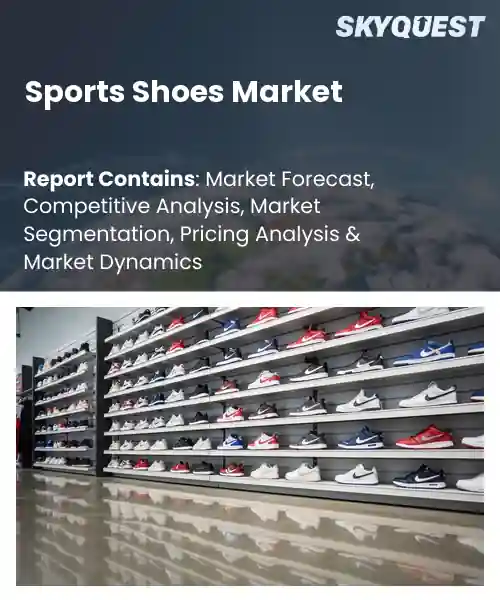
Sports Shoes Market
Report ID: SQMIG25L2034
Report ID: SQMIG25L2034
[email protected]
USA +1 351-333-4748
Report ID:
SQMIG25L2034 |
Region:
Global |
Published Date: May, 2026
Pages:
157
|Tables:
211
|Figures:
80


Global Sports Shoes Market size was valued at USD 151.10 Billion in 2024 and is poised to grow from USD 158.81 Billion in 2025 to USD 236.42 Billion by 2033, growing at a CAGR of 5.1% during the forecast period (2026-2033).
The sports shoes market trends are the entire athletics and leisure landscape, which would comprise a large portion of this market. With that being said, there have been so many changes in how these athletic shoes have occurred during the past several decades. The shoes represent both performance and lifestyle aspects; however, it is both of these characteristics combined (performance + lifestyle) that is driving much of the growth within the shoes segment today. Within the past twenty years performance science has driven new technology lightweight foams, engineered/knitting as well as carbon plates to create better/greater performance enhancing product designs. But, the increase in performance driven athletic footwear design has also been due to the success (growing popularity) of street wear becoming symbols of culture which has created new premium segments, resale marketplaces, etc.; through limited drops from large sneaker companies and collaborations with popular artists. Large Asian manufacturers have taken advantage of new manufacturing techniques that will increase their respective production capabilities as well as helped to reshape traditional distribution channels to create exponential opportunities in their respective markets over the next several decades.
With changing consumer behavior, continuous innovation in terms of both product and business model will be the main driver of sports shoes market growth, due to advances in technology and the need for sustainability that have contributed to changes in consumer buying habits. When brands provide evidence of notable performance enhancements, such as the way carbon-filled running shoes enabled runners to complete marathons at record speeds and to charge much higher prices for those products, those brands' sales and visibility among elite athletes provide accelerated adoption rates by average consumers and greater investment in R&D. Further, collaboration on repurposing marine debris into recycled materials, with complete disclosure of the environmental impact of all elements of a product's life cycle, creates entry points for environmentally and socially-conscious consumers as well as regulatory incentives for creating circular supply chains or providing resale/refurbishment services that increase the lifetime customer value of a product and accelerate the premiumization of the product.
How is AI Enhancing Personalization in the Sports Shoes Market?
When referring to AI personalization within the sports shoes industry, we are talking about utilizing consumer analytics and sophisticated algorithms to provide a custom fit for form and performance. The major components of this process would be three-dimensional foot scanning as a means of accurately recommending a shoe size; fit recommendation systems to provide proper athletic footwear based upon the activity, and personal preference; generative design as a means of producing custom midsoles and uppers; and virtual try-ons that can reduce uncertainty.
Currently, top footwear companies are utilizing both online and physical retail tools together so the concept of customized athletic footwear becomes scalable. The sports shoes market share is gravitating away from mass producing athletics shoes to producing footwear that better responds to specific requests via an available inventory of made-to-order shoes. Custom colorways, and experimental on-demand manufacturing, are perfect examples of how personalization increases the relevance of a product and results in building loyalty with consumers.
For instance, in March 2026, Puma implemented an AI-powered store concierge at its Las Vegas flagship store, in which a customer will attempt to purchase a certain type of footwear and the store concierge will provide customized recommendations of footwear based on that customer's running style, along with directions on how to access the customization service. The implementation of an AI store concierge creates an expedited or immediate feedback loop for custom athletic footwear, resulting in increased sales and operational efficiency, while making custom goods easier to deliver to the consumer.
Market snapshot - (2026-2033)
Global Market Size
USD 151.1 Billion
Largest Segment
Running Shoes
Fastest Growth
Lifestyle Sports Shoes
Growth Rate
5.1% CAGR
To get more insights on this market click here to Request a Free Sample Report
Global sports shoes market is segmented into by product type, end user, material type, sole type, distribution channel, price range, application and region. Based on by product type, the market is segmented into running shoes, walking shoes, training & gym shoes, basketball shoes, football & soccer shoes, tennis shoes, hiking & trail running shoes, lifestyle sports shoes and others. Based on by end user, the market is segmented into men, women and children. Based on by material type, the market is segmented into synthetic materials, leather, mesh fabric, knit fabric and others. Based on by sole type, the market is segmented into rubber soles, EVA soles, polyurethane soles and others. Based on by distribution channel, the market is segmented into brand outlets, supermarkets & hypermarkets, specialty sports stores, online retail and others. Based on by price range, the market is segmented into economy, mid-range and premium. Based on by application, the market is segmented into professional sports, fitness & training, casual wear, outdoor activities and others. Based on region, the market is segmented into North America, Europe, Asia Pacific, Latin America and Middle East & Africa.
The running shoes segment is the largest by far due to consumer demand for performance, injury prevention, and comfort leading to significant R&D and marketing resources associated with this segment, which in turn has driven continuous advancements in cushioning, stability/motion control, and lightweight construction. High-profile athlete endorsements combined with event-driven product "micro-cycles" give brands a strong focus, while cross-over appeal into everyday fitness results in extensive retail distribution, and manufacturers focus on material innovation and testing to create design standards within the broader sports footwear market.
Lifestyle sports shoes are experiencing the greatest growth momentum as athleisure trends generate increased consumer demand for hybrid performance and fashion products; collaborations with fashion labels, the influence of social media, and innovations around comfort drive rapid adoption across demographics. This rapid growth in lifestyle footwear is diversifying the footwear segment and creating new opportunities for premiumization, new distribution partnerships, and design-led extension of brands.
The online retail segment has the highest volume of consumer purchases because of its convenience, large variety of products, and personalized recommendation systems; it allows for rapid scaling of direct-to-consumer business models and helps brands manage inventory and display product offerings more effectively based on consumer trends. Brands use the data gleaned from their online channels to refine products and improve marketing effectiveness; buyers benefit from seamless checkout experiences, flexible return options, and timely delivery of products, thus reducing the friction associated with purchasing goods, encouraging experimental launches of products, and promoting growth of niche models within the sports shoes category.
At the same time, the specialty sports store is fast becoming a growth segment due to the expert fitting services, product demonstrations, and community-based experiences that build customer loyalty, as well as brand partnerships that allow brands to deliver exclusive product launches and conduct product testing. In addition, brands can leverage in-store technology and coaching programs to turn consumers into loyal customers and increase the number of premium products sold in the market, creating long-term growth opportunities within the specialty sports store segment.
To get detailed segments analysis, Request a Free Sample Report
Engagement levels among Asian-Pacific countries continue to rise due in large part to consumers' increasing interest in fitness and athleisure-related products; thickly settled cities; expansive networks of both retail stores and online shopping platforms; fast-moving technology advancements to facilitate use of both; and economies of scale enjoyed by regional companies that combine competitive pricing for their goods and services with flexibility for designing new products. Market penetration is aided by strong brands backed up by effective marketing strategies, sponsorship of sponsored athletes or celebrities, and localized versions of their products. Competitive supply chain integration among both manufacturing sites and component suppliers provides an efficient movement of product through the entire production/distribution channel, while materials development and environmental sustainability will all contribute toward building loyalty from conscientious buyers and create viable alternatives for entrance into emerging marketplaces through international e-commerce and worldwide distribution partnerships to ensure future growth through multiple product categories at varying retail price points.
The sports footwear market regional forecast in Japan is made up of very fussy consumers who want extremely high-quality athletic shoes that combine advanced technologies with simple designs. Local and foreign manufacturers design shoes on the basis of high-value added through craftsmanship, comfort, and ongoing expansion of their product lines through innovation. An emphasis is put on providing customers an experiential shopping experience via retail channels offering great collections of products; urban running as well as niche sports communities are driving demand for these types of specialty shoes. Sustainability and durability are also factors that motivate consumers to purchase shoes from companies that offer premium products and/or price points paired with an affordable version(s).
The sports shoes market outlook in South Korea is accelerated due to fast-paced fashion cycles, high consumer friendliness, and the impact of entertainment and streetwear cultures on overall fashion trends. As a result, many brands use bold aesthetics, limited editions, and digital interaction via social media and influencers to convey their message about new styles to consumers. Additionally, even though technical performance is still important to the active consumer, customization and DTC have all contributed to increasing brand loyalty over time. Retail strategies combine omnichannel convenience and pop-up experiences to meet consumer needs for "trendy" products, as well as provide consumers with access to innovative products.
The rapid growth of North America is being driven by a unique combination of active style, athleisure acceptance, and a mature retail environment that has allowed brands to experiment with new ideas on a large scale. Consumers are looking for versatile shoes that can be worn for both performance-related activities and as part of their daily lives, which has resulted in brands launching cross-category products and leveraging high-impact marketing efforts, athlete partnerships, and lifestyle collaborations. By utilizing direct-to-consumer strategies, experiential retail experiences, and strong digital retail capabilities, brands can quickly launch products and target customers effectively. Through the increasing popularity of running events, outdoor recreation, and fitness boutiques, there continues to be demand for specialized product lines. Retailers and other players in the industry are focusing more on sustainability credentials and transparent sourcing in order to keep up with the changing expectations of the consumer. In addition to resale and limited-edition product offerings, the growth of running events, outdoor recreation, and fitness boutiques has led to increased demand for specialized products. All together, the ongoing popularity of the running community throughout North America will continue to solidify North America as a region of strategic importance to global brands.
The sports shoes industry in United States has an affinity for brand heritage; high levels of consumer involvement with performance running, basketball and lifestyle categories; as well as a variety of retail distribution models that allow for fast product turn. Leading Brands utilize athlete endorsements and cultural collaborations to create demand, while smaller independent companies have established themselves within niche segments. Direct-to-consumer channels and experiential retail store formats build loyalty, while retailers focus on the breadth of assortment available in performance and fashion that reinforces the United States as a leader in new trends.
The sports shoes market regional outlook in Canada marketplace reflects a strong focus on outdoor performance, trail running, and all-weather capabilities to meet the needs of consumers interested in durable and functional footwear. Retailers emphasize technical product offerings and expert advice, while brands are enhancing cushioning and traction technology to accommodate differing geographical climates. At the same time, urban athleisure trends exist alongside everyday use footwear. Retailers also support widespread distribution through regional partnership agreements with manufacturers. Sustainability and responsible sourcing are key differentiators for many Canadian buyers who desire long-lasting value from their products.
By blending heritage brand equity with innovative and sustainable products, European brands are reinforcing their position in the marketplace. The combination of established design houses as well as specialized sports brands is supporting premium brand positioning. While established brands are competing in the marketplace using creative business models such as emerging competitors through collaborations and limited editions, companies are investing in recyclable materials and circular product take-back programs to build brand credibility with consumers, which is further supported by an increasing focus on regulatory requirements of sustainability and circularity. Retail ecosystems consisting of flagship stores and specialty retailers combined with digital marketplaces are facilitating curated consumer journeys. A large and diverse community of athletes, outdoor enthusiasts, and urban consumers across multiple categories/departments, along with supporting cross-border trade and logistics networks, are enabling brands to efficiently distribute and penetrate highly fragmented national markets. The collective investments being made into brand equity and competitiveness will elevate long-term brand competitiveness.
The sports shoes industry trends in Germany focuses heavily on engineering-based performance, technical precision and durability – demonstrating a real desire from consumers for functional footwear that can be used outdoors or for urban sport. When designing and producing products, domestic producers and specialty-brand companies are focused on quality materials as well as testing products’ ability to perform properly. Retailers sell products through specialty stores as well as through store chains that are focused on performance; retailers also partner with research institutions to support new product development. Due to a consumer preference for long-lasting products and concern of sustainability, many brands promote themselves as sourcing materials responsibly and developing repairable products.
The sports shoes market penetration in United Kingdom is impacted by both heritage sports brands as well as active streetwear cultures, with collaborations with designers serving as an additional driving force of interest in this category among consumers. Consumer retailers in the UK combine flagship boutique locations, traditional department store formats, and e-commerce channels to create a retail landscape that supports a growing number of limited release footwear products and lifestyle narratives. The demand for athletic footwear continues to be supported by running communities and urban fitness movements, while sustainable practices and goal-oriented supply chain transparency have a significant influence on the way consumers purchase athletic footwear products. To maintain relevancy with a wide variety of consumer class levels, brands in this category engage in various forms of cultural partnership.
The sports shoes market in France combines aesthetically appealing designs with an increasing demand for functional and lifestyle-based shoes. Consumers want wisely designed silhouettes that mirror their taste in fashion and to find stylish shoes made from high-quality materials with unique features. Specialty retailers and concept stores play a major part in providing unique selections of shoes, while digital platforms serve to promote and facilitate designer collaborations and exclusive product launches. Sustainability and artisanal manufacturing also influence the sales position of the brands, which forces them to balance aesthetics with function when designing and producing their products.
To know more about the market opportunities by region and country, click here to
Buy The Complete Report
Growing Health Consciousness Among Consumers
Technological Innovation In Footwear
High Manufacturing and Material Costs
Counterfeit and Gray Market Distribution
Request Free Customization of this report to help us to meet your business objectives.
The global sports shoe market has seen changes in its competitive landscape due to mergers and acquisitions (M&A), direct to consumer entrants led by athletes, and differentiation through technology (e.g., carbon plate shoes and digital footwear). Some of the most exemplary changes in the competitive landscape have been Allbirds' asset sale, Nike's acquisition of RTFKT as a digital innovator, and athlete brand partnerships such as Saysh's collaboration with Athleta, which will change competition in retail and design.
Top Player’s Company Profile
Recent Developments in the Sports Shoes Market
SkyQuest’s ABIRAW (Advanced Business Intelligence, Research & Analysis Wing) is our Business Information Services team that Collects, Collates, Correlates, and Analyses the Data collected by means of Primary Exploratory Research backed by robust Secondary Desk research.
As per SkyQuest analysis, global sporting shoes are driven by continuous product development and innovation in business models, but increasing health consciousness of consumers also provides a secondary impetus for growth. Running shoes continue to be by far the largest segment of the global market, while the Pacific Asia region drives the bulk of regional demand due to several factors, including large-scale manufacturing, digital adoption, and high consumer interest. High manufacturing and material costs are two of the key barriers inhibiting growth; these pressures reduce margins and limit affordable growth opportunities. Brands with performance-focused R&D, sustainable operational practices, improved digital retail experiences (e.g., e-commerce), will be best positioned to capitalize on growing trends of premiumization and personalization through the capture of customers and the development of lifetime customer value while addressing issues related to high price and counterfeit product risks, as well as through the growth of a direct-to-consumer and circular service model for elevating customer retention and growing lifetime customer value.
| Report Metric | Details |
|---|---|
| Market size value in 2024 | USD 151.1 Billion |
| Market size value in 2033 | USD 236.42 Billion |
| Growth Rate | 5.1% |
| Base year | 2024 |
| Forecast period | (2026-2033) |
| Forecast Unit (Value) | USD Billion |
| Segments covered |
|
| Regions covered | North America (US, Canada), Europe (Germany, France, United Kingdom, Italy, Spain, Rest of Europe), Asia Pacific (China, India, Japan, Rest of Asia-Pacific), Latin America (Brazil, Rest of Latin America), Middle East & Africa (South Africa, GCC Countries, Rest of MEA) |
| Companies covered |
|
| Customization scope | Free report customization with purchase. Customization includes:-
|
To get a free trial access to our platform which is a one stop solution for all your data requirements for quicker decision making. This platform allows you to compare markets, competitors who are prominent in the market, and mega trends that are influencing the dynamics in the market. Also, get access to detailed SkyQuest exclusive matrix.
Table Of Content
Executive Summary
Market overview
Parent Market Analysis
Market overview
Market size
KEY MARKET INSIGHTS
COVID IMPACT
MARKET DYNAMICS & OUTLOOK
Market Size by Region
KEY COMPANY PROFILES
Methodology
For the Sports Shoes Market, our research methodology involved a mixture of primary and secondary data sources. Key steps involved in the research process are listed below:
1. Information Procurement: This stage involved the procurement of Market data or related information via primary and secondary sources. The various secondary sources used included various company websites, annual reports, trade databases, and paid databases such as Hoover's, Bloomberg Business, Factiva, and Avention. Our team did 45 primary interactions Globally which included several stakeholders such as manufacturers, customers, key opinion leaders, etc. Overall, information procurement was one of the most extensive stages in our research process.
2. Information Analysis: This step involved triangulation of data through bottom-up and top-down approaches to estimate and validate the total size and future estimate of the Sports Shoes Market.
3. Report Formulation: The final step entailed the placement of data points in appropriate Market spaces in an attempt to deduce viable conclusions.
4. Validation & Publishing: Validation is the most important step in the process. Validation & re-validation via an intricately designed process helped us finalize data points to be used for final calculations. The final Market estimates and forecasts were then aligned and sent to our panel of industry experts for validation of data. Once the validation was done the report was sent to our Quality Assurance team to ensure adherence to style guides, consistency & design.
Analyst Support
Customization Options
With the given market data, our dedicated team of analysts can offer you the following customization options are available for the Sports Shoes Market:
Product Analysis: Product matrix, which offers a detailed comparison of the product portfolio of companies.
Regional Analysis: Further analysis of the Sports Shoes Market for additional countries.
Competitive Analysis: Detailed analysis and profiling of additional Market players & comparative analysis of competitive products.
Go to Market Strategy: Find the high-growth channels to invest your marketing efforts and increase your customer base.
Innovation Mapping: Identify racial solutions and innovation, connected to deep ecosystems of innovators, start-ups, academics, and strategic partners.
Category Intelligence: Customized intelligence that is relevant to their supply Markets will enable them to make smarter sourcing decisions and improve their category management.
Public Company Transcript Analysis: To improve the investment performance by generating new alpha and making better-informed decisions.
Social Media Listening: To analyze the conversations and trends happening not just around your brand, but around your industry as a whole, and use those insights to make better Marketing decisions.
REQUEST FOR SAMPLE
 REQUEST FREE CUSTOMIZATION
Global Sports Shoes Market size was valued at USD 151.1 Billion in 2024 and is poised to grow from USD 158.81 Billion in 2025 to USD 236.42 Billion by 2033, growing at a CAGR of 5.1% during the forecast period (2026-2033).
Competitive landscape in the global sports shoes market is shaped by strategic M&A and asset sales, athlete led direct to consumer entrants, and tech driven product differentiation such as carbon plate performance shoes and virtual footwear. Leading examples include Allbirds' recent asset sale, Nike's acquisition of RTFKT for digital innovation, and athlete brand partnerships like Saysh with Athleta, which change retail and design competition. 'Nike', 'Adidas', 'Puma', 'ASICS', 'New Balance', 'Skechers', 'Under Armour', 'Reebok', 'Fila', 'Mizuno', 'Li-Ning', 'Anta Sports', 'Brooks Sports', 'Hoka', 'Saucony', 'On Holding', 'Yonex', 'Decathlon', 'Salomon', 'Columbia Sportswear'
The increasing focus on personal health and active lifestyles motivates consumers to purchase sports shoes that enhance comfort, support, and performance, thereby expanding overall demand for specialized footwear. As more individuals prioritize exercise, rehabilitation, and everyday movement, manufacturers and retailers respond with wider assortments and targeted marketing that make products more accessible. This cyclical response fuels investment in design and distribution, encourages brand engagement, and strengthens retail channels, collectively supporting sustained market expansion by converting health awareness into consistent purchasing behavior across demographic groups.
Sustainable Circular Design: Brands are shifting toward circularity by designing shoes for longevity, repairability and end-of-life recovery, responding to consumer expectations for responsible products and ethical sourcing. This approach encourages partnerships across supply chains to enable take-back, refurbishment and material recycling programs, creating new service revenue streams and stronger brand loyalty. Emphasis on transparent materials and traceable sourcing enhances reputational value, stimulates product innovation and fosters collaboration with specialized recyclers and repair networks to close material loops and reduce environmental impact.
Why does Asia Pacific Dominate the Global Sports Shoes Market? |@12


Want to customize this report? This report can be personalized according to your needs. Our analysts and industry experts will work directly with you to understand your requirements and provide you with customized data in a short amount of time. We offer $1000 worth of FREE customization at the time of purchase.
Feedback From Our Clients


 USA (+1) 351-333-4748

