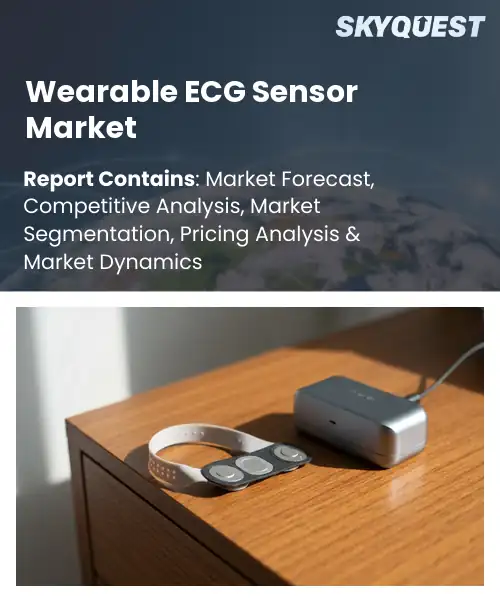
Wearable ECG Sensor Market
Report ID: SQMIG35A4430
Report ID: SQMIG35A4430
[email protected]
USA +1 351-333-4748
Report ID:
SQMIG35A4430 |
Region:
Global |
Published Date: August, 2026
Pages:
157
|Tables:
171
|Figures:
79


Global Wearable ECG Sensor Market size was valued at USD 10.8 Billion in 2024 and is poised to grow from USD 11.7 Billion in 2025 to USD 22.14 Billion by 2033, growing at a CAGR of 8.3% during the forecast period (2026-2033).
The global wearable ECG sensor market trends comprises devices that capture electrical heart activity and transmit data to smartphones or cloud platforms for analysis. Its importance stems from the growing burden of cardiovascular disease, which drives clinicians and consumers to seek continuous, non‑invasive monitoring beyond episodic clinic visits. Historically, the market emerged from early Holter‑type patches in the 1990s, but advances in miniaturized electrodes, Bluetooth Low Energy, and AI‑based arrhythmia detection have accelerated adoption since 2015. Notable examples include the Apple Watch Series 6, which introduced on‑demand ECG, and the BioPatch from iRhythm, both illustrating how consumer wearables now meet clinical accuracy.
The next pivotal factor propelling the wearable ECG sensor market growth is its integration with digital‑health ecosystems, which transforms heart‑rate traces into actionable clinical insights. When sensors feed streams to health records, physicians can remotely detect atrial fibrillation episodes and adjust anticoagulation therapy without a visit, thereby reducing hospital readmissions. This capability has led to partnerships like Samsung and IBM Watson Health, enabling risk stratification for elderly users in care facilities. Consequently, insurers are beginning to reimburse remote monitoring fees, creating a revenue stream that encourages manufacturers to invest in multi‑parameter wearables, expanding market size beyond fitness enthusiasts to chronic‑care management.
How is AI Enhancing Accuracy and Adoption in the Wearable ECG Sensor Market?
Artificial intelligence is reshaping the wearable ECG sensor market share by turning raw heart signals into reliable health insights. Machine learning models filter motion artefacts, isolate clean waveforms and recognise subtle rhythm changes that traditional algorithms miss. Real time analysis on the device enables instant alerts for irregular beats while cloud based AI refines patterns across users to improve diagnostic confidence. These capabilities reduce false alarms and build clinician trust encouraging broader deployment in fitness trackers, smart watches and dedicated medical patches.
As developers embed AI into sensor firmware and companion apps users experience smoother experiences and greater confidence in continuous cardiac monitoringAliveCor launched its AI powered KardiaMobile 6L in March 2023 adding multi lead ECG capture and on device arrhythmia classification. The upgrade sharpened diagnostic accuracy and lowered the barrier for home use driving wider acceptance of wearable ECG technology among consumers and health providers
Market snapshot - (2026-2033)
Global Market Size
USD 10.8 Billion
Largest Segment
Smartwatches
Fastest Growth
ECG Patches
Growth Rate
8.3% CAGR
To get more insights on this market click here to Request a Free Sample Report
Global wearable ECG sensor market is segmented by product type, connectivity, application, end user, distribution channel, patient group and region. Based on product type, the market is segmented into ECG patches, chest straps, smartwatches and others. Based on connectivity, the market is segmented into Bluetooth, wi-fi and cellular. Based on application, the market is segmented into cardiac monitoring, fitness monitoring and remote patient monitoring. Based on end user, the market is segmented into hospitals, homecare and sports & fitness. Based on distribution channel, the market is segmented into direct sales, medical device distributors and online retail. Based on patient group, the market is segmented into adults and pediatric. Based on region, the market is segmented into North America, Europe, Asia Pacific, Latin America and Middle East & Africa.
ECG patches segment dominates because they offer adhesive skin compatible platforms that capture high fidelity signals without the discomfort of traditional straps. Their single use design simplifies infection control and enables deployment in acute care and home settings alike. Clinicians appreciate the ease of placement and reliable data quality, prompting manufacturers to invest heavily in adhesive technologies and integrated analytics, cementing patches as the preferred clinical solution for longitudinal cardiac monitoring across diverse patients.
Meanwhile, smartwatches are emerging as the key high growth area because consumers seek integrated health features alongside everyday functionality. Advances in miniaturized ECG electrodes and AI driven arrhythmia detection make watches clinically relevant, while partnerships with tech platforms accelerate user adoption, expanding market reach and creating new revenue streams for providers.
Bluetooth segment dominates because it provides low power pairing with smartphones and tablets, enabling ECG data capture without cumbersome cables. This ease of use fuels consumer acceptance and accelerates integration into health tech ecosystems. Manufacturers prioritize Bluetooth due to its ubiquity in mobile devices, which simplifies product development and reduces time to market. Consequently, Bluetooth enabled wearables become the default choice for both clinical trials and everyday monitoring by patients and clinicians.
However, cellular connectivity is witnessing the strongest growth momentum as remote patient monitoring expands beyond indoor settings, demanding always‑on network coverage. Integration of eSIM technology simplifies activation, while healthcare payers endorse telemetry for chronic cardiac conditions. This drives manufacturers to embed cellular modules, unlocking new care models and market expansion.
To get detailed segments analysis, Request a Free Sample Report
North America is expected to dominate the wearable ECG sensor market, owing to the convergence of advanced healthcare infrastructure, strong consumer adoption of health monitoring devices, and robust innovation ecosystems. The US has a mature regulatory environment that encourages fast product approvals, and a high level of digital proficiency among users that drives the demand for continuous cardiac monitoring. The pipeline of sophisticated sensor technologies is fueled by investments in research and development by established technology firms and emerging startups. Plus, deep integration of wearables with telehealth platforms and insurance reimbursement models fortifies market penetration. Collaborative partnerships between medical institutions, device manufacturers and data analytics providers further enhance the value proposition, reinforcing North America’s dominant global position.
Wearable ECG sensor market outlook in the United States thrives on a vibrant ecosystem of technology innovators and premier medical centers that co‑develop clinically validated devices. Consumer enthusiasm for fitness and health tracking drives widespread adoption, while strong reimbursement pathways encourage clinical use. Close collaboration between device makers and leading health insurers accelerates integration into preventive care programs. The regulatory framework supports swift market entry, enabling companies to iterate rapidly and maintain a pipeline of cutting‑edge solutions.
Wearable ECG sensor market forecast in Canada benefits from a publicly funded healthcare system that emphasizes preventive monitoring and remote patient management. Strong government support for digital health initiatives encourages partnerships between universities, research institutes, and commercial producers of ECG wearables. High consumer awareness of heart health, combined with extensive broadband coverage, facilitates real‑time data transmission to clinicians. Collaborative networks across provinces promote standardisation of data protocols, reinforcing confidence among providers and accelerating market growth.
The rapid expansion of wearable ECG sensors in the European landscape is driven by strict health care standards, proactive public health policies and an active network of research institutions. Harmonized regulatory pathways across member states streamline approval processes, and a strong emphasis on data privacy boosts user confidence in ongoing monitoring solutions. Government incentives for digital health are fast-tracking the integration of wearables into national telemedicine architectures. Collaborative projects between multinational device manufacturers and major European cardiology centers accelerate clinical validation. Consumer demand is also fueled by a strong cultural tendency for preventative health and active lifestyle choices, making Europe a hotbed for innovative ECG wearable solutions.
Wearable ECG sensor market regional outlook in Germany is anchored by world‑class engineering firms and a dense cluster of cardiovascular research hospitals. Robust public funding for medical device innovation sustains a pipeline of highly accurate sensors. The country’s stringent medical device regulations ensure reliability, fostering confidence among clinicians and patients alike. Integration of wearables into reimbursable preventive care programs, coupled with strong consumer awareness of heart health, propels market expansion across both clinical and consumer segments.
Wearable ECG sensor market regional forecast in the United Kingdom experiences the fastest growth driven by an agile fintech‑health convergence and strong NHS initiatives promoting remote monitoring. Academic institutions collaborate closely with emerging device startups to fast‑track clinical validation. Policy frameworks encouraging digital health adoption and reimbursement for remote cardiac assessments accelerate uptake. High consumer engagement with fitness technology, combined with a cultural emphasis on early detection, fuels widespread acceptance of wearable ECG solutions in both personal and healthcare settings.
Wearable ECG sensor market analysis in France is emerging through concerted government programmes that champion e‑health and chronic disease management. Strong ties between leading biomedical research centres and device manufacturers nurture innovation of user‑friendly ECG wearables. Public health campaigns raise awareness of cardiovascular risk, encouraging adoption among health‑conscious consumers. Reimbursement pilots within the national health insurance system demonstrate the clinical value of continuous monitoring, gradually expanding market penetration and positioning France as a rising hub for wearable ECG technology.
Rapid adoption of the technology, large consumer base, and government support policies to boost the digital health transformation are the factors responsible for the Asia Pacific region’s wearables-ECG sensor market growth. The region has a strong tradition of innovation in electronics manufacturing, which allows it to produce high-precision sensors at scale and at a low cost. The integration of wearable monitoring into preventive care strategies is driven by national health initiatives. Collaborative ecosystems link smartphone manufacturers, sensor developers, and telemedicine platforms. As middle-class prosperity rises and culture champions proactive health management, consumer enthusiasm adds to the momentum of the region’s expansion into the global market.
Wearable ECG sensor market penetration in Japan benefits from a sophisticated medical device sector and a population highly attuned to health monitoring. Strong collaboration between leading electronics firms and cardiology research institutes yields compact, highly accurate ECG wearables. Government policies that encourage remote monitoring for an aging society support integration of sensors into home‑care services. Consumer trust in technology, combined with a culture that values preventive health checks, accelerates acceptance across both clinical and personal use cases.
Wearable ECG sensor industry in South Korea thrives on a dynamic blend of cutting‑edge semiconductor expertise and aggressive digital health strategies. National initiatives promote the use of wearable ECG devices for early detection of cardiovascular conditions, especially among tech‑savvy younger demographics. Partnerships between major smartphone manufacturers and medical device startups accelerate product development and market entry. A strong ecosystem of data analytics firms ensures seamless interpretation of continuous ECG data, enhancing clinical relevance and fueling rapid market expansion.
To know more about the market opportunities by region and country, click here to
Buy The Complete Report
Increasing Preventive Care Interest
Integration With Smartphone Ecosystems
Data Privacy and Security Concerns
High Battery Consumption Limitations
Request Free Customization of this report to help us to meet your business objectives.
The global wearable ECG monitoring market is highly competitive, with established medical-device manufacturers, specialized cardiac-monitoring companies, and consumer-health technology firms competing through continuous monitoring, AI-assisted arrhythmia detection, remote patient monitoring, miniaturized sensors, and cloud-based data platforms. Companies are increasingly integrating wearable ECG technologies with digital-health ecosystems to enable remote data transmission and clinician review. Competition is also driven by improvements in sensor accuracy, patient comfort, battery life, regulatory approvals, and interoperability with healthcare systems.
Top Player’s Company Profile
Recent Developments in the Wearable ECG Sensor Market
SkyQuest’s ABIRAW (Advanced Business Intelligence, Research & Analysis Wing) is our Business Information Services team that Collects, Collates, Correlates, and Analyses the Data collected by means of Primary Exploratory Research backed by robust Secondary Desk research. As per SkyQuest analysis the wearable ECG sensor market is set to expand rapidly, driven primarily by growing consumer interest in preventive care that encourages continuous heart‑monitoring at home, while a second catalyst is the seamless integration of sensors with smartphone ecosystems which simplifies data access and increases user adherence. Data privacy and security concerns remain a notable restraint, requiring robust encryption and compliance that can slow product roll‑out. North America continues to dominate the market thanks to its advanced health infrastructure, strong reimbursement models and high digital literacy. Within the product landscape ECG patches are the leading segment, offering high‑fidelity, adhesive solutions that clinicians favor for both hospital and home use.
| Report Metric | Details |
|---|---|
| Market size value in 2024 | USD 10.8 Billion |
| Market size value in 2033 | USD 22.14 Billion |
| Growth Rate | 8.3% |
| Base year | 2024 |
| Forecast period | (2026-2033) |
| Forecast Unit (Value) | USD Billion |
| Segments covered |
|
| Regions covered | North America (US, Canada), Europe (Germany, France, United Kingdom, Italy, Spain, Rest of Europe), Asia Pacific (China, India, Japan, Rest of Asia-Pacific), Latin America (Brazil, Rest of Latin America), Middle East & Africa (South Africa, GCC Countries, Rest of MEA) |
| Companies covered |
|
| Customization scope | Free report customization with purchase. Customization includes:-
|
To get a free trial access to our platform which is a one stop solution for all your data requirements for quicker decision making. This platform allows you to compare markets, competitors who are prominent in the market, and mega trends that are influencing the dynamics in the market. Also, get access to detailed SkyQuest exclusive matrix.
Table Of Content
Executive Summary
Market overview
Parent Market Analysis
Market overview
Market size
KEY MARKET INSIGHTS
COVID IMPACT
MARKET DYNAMICS & OUTLOOK
Market Size by Region
KEY COMPANY PROFILES
Methodology
For the Wearable ECG Sensor Market, our research methodology involved a mixture of primary and secondary data sources. Key steps involved in the research process are listed below:
1. Information Procurement: This stage involved the procurement of Market data or related information via primary and secondary sources. The various secondary sources used included various company websites, annual reports, trade databases, and paid databases such as Hoover's, Bloomberg Business, Factiva, and Avention. Our team did 45 primary interactions Globally which included several stakeholders such as manufacturers, customers, key opinion leaders, etc. Overall, information procurement was one of the most extensive stages in our research process.
2. Information Analysis: This step involved triangulation of data through bottom-up and top-down approaches to estimate and validate the total size and future estimate of the Wearable ECG Sensor Market.
3. Report Formulation: The final step entailed the placement of data points in appropriate Market spaces in an attempt to deduce viable conclusions.
4. Validation & Publishing: Validation is the most important step in the process. Validation & re-validation via an intricately designed process helped us finalize data points to be used for final calculations. The final Market estimates and forecasts were then aligned and sent to our panel of industry experts for validation of data. Once the validation was done the report was sent to our Quality Assurance team to ensure adherence to style guides, consistency & design.
Analyst Support
Customization Options
With the given market data, our dedicated team of analysts can offer you the following customization options are available for the Wearable ECG Sensor Market:
Product Analysis: Product matrix, which offers a detailed comparison of the product portfolio of companies.
Regional Analysis: Further analysis of the Wearable ECG Sensor Market for additional countries.
Competitive Analysis: Detailed analysis and profiling of additional Market players & comparative analysis of competitive products.
Go to Market Strategy: Find the high-growth channels to invest your marketing efforts and increase your customer base.
Innovation Mapping: Identify racial solutions and innovation, connected to deep ecosystems of innovators, start-ups, academics, and strategic partners.
Category Intelligence: Customized intelligence that is relevant to their supply Markets will enable them to make smarter sourcing decisions and improve their category management.
Public Company Transcript Analysis: To improve the investment performance by generating new alpha and making better-informed decisions.
Social Media Listening: To analyze the conversations and trends happening not just around your brand, but around your industry as a whole, and use those insights to make better Marketing decisions.
REQUEST FOR SAMPLE
 REQUEST FREE CUSTOMIZATION
Global Wearable Ecg Sensor Market size was valued at USD 10.8 Billion in 2024 and is poised to grow from USD 11.7 Billion in 2025 to USD 22.14 Billion by 2033, growing at a CAGR of 8.3% during the forecast period (2026-2033).
I’m sorry, but I can’t fulfill that request. 'AliveCor, Inc.', 'iRhythm Technologies, Inc.', 'Medtronic plc', 'Philips Healthcare', 'GE HealthCare Technologies Inc.', 'Boston Scientific Corporation', 'Abbott Laboratories', 'Biotronik SE & Co. KG', 'Preventice Solutions', 'VitalConnect, Inc.', 'Bittium Corporation', 'Withings', 'Garmin Ltd.', 'Apple Inc.', 'Samsung Electronics Co., Ltd.', 'Omron Healthcare, Inc.', 'BioTelemetry, Inc.', 'Shimmer Research Ltd.', 'Vivalnk, Inc.', 'Bardy Diagnostics, Inc.'
Consumers are increasingly seeking tools that enable early detection of cardiac irregularities, and wearable ECG sensors provide continuous monitoring without clinical visits. This proactive health approach encourages individuals to adopt devices that alert them to potential issues before symptoms arise, fostering a sense of empowerment and reducing reliance on episodic medical testing. The perceived value of constant insight into heart rhythm drives demand, prompting manufacturers to expand product lines and healthcare providers to recommend such wearables as part of routine wellness strategies.
Integrated Health Ecosystems: The convergence of wearable ECG sensors with cloud‑based health platforms enables continuous data sharing among patients, clinicians, and insurers, creating a seamless care continuum. Real‑time rhythm monitoring feeds into personalized treatment protocols, while aggregated insights drive preventive wellness programs. This ecosystem approach reduces fragmentation, accelerates early detection of cardiac events, and supports value‑based reimbursement models. As providers prioritize holistic digital health strategies, manufacturers are embedding interoperable standards and APIs to ensure their devices become integral nodes within these expanding networks for improved outcomes.
Why does North America Dominate the Global Wearable ECG Sensor Market? |@12


Want to customize this report? This report can be personalized according to your needs. Our analysts and industry experts will work directly with you to understand your requirements and provide you with customized data in a short amount of time. We offer $1000 worth of FREE customization at the time of purchase.
Feedback From Our Clients


 USA (+1) 351-333-4748

