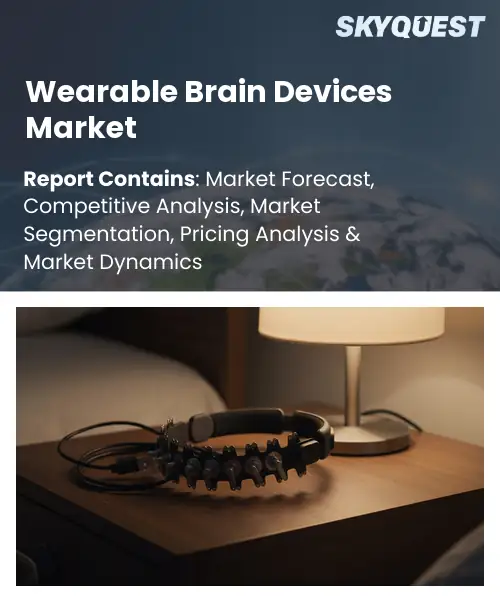
Wearable Brain Devices Market
Report ID: SQMIG35A3464
Report ID: SQMIG35A3464
[email protected]
USA +1 351-333-4748
Report ID:
SQMIG35A3464 |
Region:
Global |
Published Date: May, 2026
Pages:
157
|Tables:
119
|Figures:
72


Global Wearable Brain Devices Market size was valued at USD 2.52 Billion in 2024 and is poised to grow from USD 2.89 Billion in 2025 to USD 8.85 Billion by 2033, growing at a CAGR of 14.82% during the forecast period (2026-2033).
The wearable brain device market growth is driven by sensor miniaturization and sophisticated signal processing algorithms that have enabled bulky, laboratory-based electroencephalograms to be converted into affordable, compact, head-mounted and ear-wearable EEG systems that can be used outside of clinical environments. There are two categories of non-invasive wearable brain devices that classify brain activity: those that monitor brain activity and those that modulate brain activity, and their importance is that they reduce barriers to collecting brain data, allowing for personalized neurotherapy. In the last ten years, companies like Muse and Emotiv have demonstrated that there is consumer interest in the use of wearable brain devices and have provided evidence through clinical pilot studies on the potential therapeutic uses of wearable brain devices in the treatment of epilepsy and depression. As a result, there has been a shift in the industry toward commercially scalable solutions.
In addition to hardware advancements, the integration of machine learning and cloud-based analytics is driving growth in the wearable brain devices sector because the algorithms used to process the data generated by the wearable brain devices are improving at converting noisy biosignals into clinically actionable insights that justify investment and adoption of the products. As algorithms continue to become more accurate in identifying seizure precursors, attention lapses and stress markers, clinicians will be able to implement epilepsy monitoring, employers will be able to implement neuroergonomic tools to decrease cognitive overload, and therapists will be able to scale up the use of personalized neurofeedback toward treating anxiety and attention deficit hyperactivity disorder (ADHD). This data-driven clarity attracts partnerships with cloud platforms and payers, creates subscription care models, and opens opportunity for regulatory approval and reimbursement that fuels further product refinement and market expansion.
How is AI Enhancing Diagnostic Accuracy In The Wearable Brain Devices Market?
In the wearable brain devices industry AI will significantly increase the accuracy of diagnosing diseases. With AI technology you can achieve clearer signals, extract data features that are more complex through the use of algorithms and have better pattern recognition ability. New features that will provide a better user experience are advanced techniques for rejecting artifacts from data collected, providing for machine learned (ML) biomarkers, creating personalized baselines that develop dynamically with each user, and conjunto (fusion) motion and blood flow sensor data. Currently there is a large amount of computational power both on the device itself and in the cloud to provide users with both near real time alerting and the ability to develop continuous (longitudinal) trend analysis. Because of these new functionalities, smart watches have gone from being just a tracker of activity to a clinically graded device (e.g., used to assess sleep, screen for epilepsy, and monitor a person during rehabilitation). Various products are available in the market today (e.g., EEG headbands) to wearable fNIRS devices are dependent on AI to improve their ability to show clearer representations of the brain's activity.
On February 19, 2026, NextSense will begin selling its product Smartbuds. Smartbuds are in ear EEG (electroencephalography) ear buds that have onboard AI that provides the wearer with information regarding their sleep-related brain activity. This type of product allows for improved diagnostics (sharper signals), and greater efficiencies associated with the remote evaluation of sleep, thereby broadening the market as well as improving the efficiency of the clinical workflow.
Market snapshot - (2026-2033)
Global Market Size
USD 2.52 Billion
Largest Segment
EEG Headsets
Fastest Growth
fNIRS Wearables
Growth Rate
14.82% CAGR
To get more insights on this market click here to Request a Free Sample Report
Global wearable brain devices market is segmented by product type, application, end-user, distribution and region. Based on product type, the market is segmented into EEG Headsets, tDCS Devices, TMS Devices and fNIRS Wearables. Based on application, the market is segmented into Neurofeedback & Meditation, Clinical Diagnosis, Cognitive Enhancement and Sleep Monitoring. Based on end-user, the market is segmented into Consumers, Healthcare Professionals and Research Institutes. Based on distribution, the market is segmented into Online Retail, Medical Device Distributors and Direct Sales. Based on region, the market is segmented into North America, Europe, Asia Pacific, Latin America and Middle East & Africa.
As per wearable brain devices market analysis, EEG Headsets have the largest share of the global market because their non-invasive and easy to use design, along with their ability to directly measure electrical activity in the brain, makes them the primary interface for both consumers and clinicians using wearable devices. The established methods of interpreting EEG signals combined with the strong integration of EEG App's, Training Protocols, and Neurofeedback Services decreases the barriers to adoption and supports numerous applications from tracking sleep patterns to meditating. Because of these numerous applications and the already established ecosystem supporting these devices, EEG based products are being prioritized by manufacturers and developers.
As per wearable brain devices market forecast, the second fastest growing segment of products is fNIR Wearables with the development of smaller optical sensors, improved signal processing capabilities, and advancement of the technology which expand the applications of fNIR Use Cases to include Cognitive Workload Monitoring and Clinical Assessment. Increased manufacturer interest in the space combined with an increase in cross disciplinary research partnerships will drive new application development and open up new commercialization avenues and investment opportunities.
As per wearable brain devices market outlook, the tDCS devices segment will reign supreme amid the rise of neuro-enhancement technologies due to their unique ability as targeted neuromodulatory devices to modify the excitability of the cortex directly and their close alignment with performance enhancement objectives related to learning, attention and motor skill training. The general form factor worn by tDCS devices and simplicity of the stimulating protocol associated with them minimizes the complexity for the end-user, and thus allows for the integration of tDCS devices into cognitive training platforms and for use as part of consumer wellness products. This regulatory movement for low-intensity stimulation devices coupled with the continued positive findings of benefit will lead manufacturers to focus on tDCS-based solutions for enhancement applications.
Meanwhile, EEG headsets are experiencing the most accelerated growth as a result of the increasing demand for closed loop enhancement systems that combine real-time monitoring with adaptive stimulation. With the advancement of dry electrode technology and mobile analytics, EEG headsets will provide seamless feedback-driven protocols, which are attracting both consumer and research funds and expediting the product development roadmaps toward hybrid devices and additional commercial applications.
To get detailed segments analysis, Request a Free Sample Report
As per wearable brain devices market regional analysis, due to a combination of advanced research capabilities, established clinical pathways, and a strong technology and startup ecosystem that accelerates product development and commercialization, North America is currently at the forefront of innovation. There is a high degree of collaboration between academic medical centers, neurotechnology companies, and large technology companies, which facilitates the iterative process of developing and validating wearable brain devices through rapid prototyping. The mature regulatory and reimbursement environments in North America also support the clinical adoption and integration of wearable brain devices into clinical and patient care pathways. Additionally, the high level of private investment in neurotechnology, combined with strategic partnerships, contributes to the ability to scale to the market. Increased clinician awareness, as well as patient acceptance, of non-invasive monitoring technology, has helped to further increase the adoption of these devices. The existing supply chain and wide range of specialist manufacturers and service providers in North America will aid in the operational aspects of deploying wearable brain devices across clinical and consumer segments. With a large number of clinical trials being conducted within North America, as well as a strong data infrastructure, there is a significant amount of evidence being generated and shared, leading to increased interoperability between electronic health record systems and research-to-product cycles. Finally, North America has a large, skilled workforce that supports the innovation and commercialization of wearable brain device technologies through an abundance of talent in engineering, neuroscience, and data science.
The United States wearable brain devices market enjoys the advantages of a significant concentration of top-tier research institutions, leading technology companies, and specialized clinical centers, creating a setting in which innovation and validation happen. A collaborative ecosystem connects academia, industry, and healthcare providers to aid in moving prototype development rapidly into clinical trials and consumer-ready products. With access to mature regulatory pathways and established funding sources for commercialization, and the availability of a highly skilled workforce in the fields of neuroscience and engineering to support product development and market refinement, the U.S. wearable brain device industry is well positioned for continued growth.
The Canadian wearable brain devices market has demonstrated considerable strength due to robust academic research hubs, cooperative clinical networks, and a supportive climate for innovation, with regards to both the development and validation processes. The presence of significant regional technology clusters and opportunities for collaboration/partnership across the United States and Canada provides an excellent avenue for cross-border partnerships and knowledge sharing. Strong policy frameworks that focus on the needs of patients and support real-world testing through clinical programs foster success at the local level. Finally, an emphasis on interdisciplinary research and collaboration between universities, hospitals, and industry partners enhances product refinement in the region and promotes regional acceptance.
As per wearable brain devices market regional forecast, concerted efforts by research networks across Europe, high demand for clinical services in the fields of neurology and mental health, and the increasing prevalence of medtech companies focusing on conducting non-invasive monitoring and neuromodulation activities have resulted in rapid growth across Europe. Additionally, collaborative multinational consortia provide the opportunity for multicenter validation of technologies and establish standardized processes that eliminate barriers to clinical adoption. A large number of specialized hospitals and neuro-technology incubators within Europe support iterative development of monitoring technologies as well as user-centered design. In many markets, aligned regulatory frameworks and favorable public procurement policies provide incentives for pilot projects to be implemented. Collaboration between the academic and industry sectors is fostering a well-balanced ecosystem, which will accelerate the refinement and commercial readiness of products for application in various healthcare systems. Clinical leadership at the country level through centers of excellence in cardiology and neurology will facilitate the adoption of monitoring technologies, and efforts to improve market access pathways through the standardization of reimbursement practices and the harmonization of clinical evidence requirements are leading to greater investment in solutions developed by companies operating domestically.
The using of Wearable Brain Devices in Germany is driven by a solid foundation of engineering proficiency (precision) in manufacturing, as well as clinical quality and capability, through a network of highly developed clinical research professionals (clinical research associations), and through multiple advanced and specialized Neurology facilities which provide avenues for validation of new products and pilot deployment of new devices. Strong relationships among manufacturers, research institutions, and health care organizations lead to high clinical quality standards. Existing public sector procurement practices, as well as a focus on reliable and scalable solutions, will enable these products to be effectively incorporated into clinical workflow.
The market for Wearable Brain Devices in United Kingdom has a vibrant and rapidly expanding ecosystem of start up companies, multiple digital health innovation programs, and extensive cooperative efforts with leading healthcare entities that are facilitating the rapid development of new products and the associated testing, use, and adoption by the public. A highly supportive governmental innovation agenda, as well as an efficient and streamlined process for the technology assessment of new products, facilitates pilot testing of new Wearable Brain Devices. Using Artificial Intelligence (AI) technology for analytics to support product development and commercialization of Wearable Brain Devices; and cooperative partnerships among universities, clinical treatment facilities, and technology companies will further accelerate the commercial viability of Wearable Brain Devices.
The wearable brain devices market in France is developing rapidly with new opportunities through focused programs of research and innovative Start-Ups to assist in the growth of this product category. There is considerable institutional strength within university hospitals and clinical groups that support the clinical validation of new products and the testing of these products based on user needs. Creating human-centered designs using digital health platforms to help influence the design will make it easier for consumers to access these solutions. Continued collaboration between research institutes, private firms, and regional incubator organizations is moving these products closer to being ready for market.
Asia Pacific continues to build on its stronghold in the market by using a combination of manufacturing power, targeted research funding, and close collaboration with both technology companies and clinical organizations. Electronics manufacturers in the region enable the fast-tracking of wearables through their manufacturing strength, and there are local start-ups and laboratories that provide cost-effective design and miniaturization that meet the needs of the many different types of healthcare environments. Governments and industry consortia are financing pilot programs and attempting to streamline the process by which medical devices receive regulatory approval. Cross-border research partnerships and the rapidly growing capabilities in data analytics and integrated digital platforms will serve to increase clinical validation and market readiness of new technologies. An increased focus on remote monitoring and community health care models will also provide new ways to address the growing number of applications that could benefit from these technologies while driving more interest from domicile and global developers. The local talent pool in engineering and neuroscience, as well as active collaboration with academia, will ensure that innovative and adaptable solutions will continue to be developed to fit the specific region's clinical needs.
Japan's Wearable Brain Devices sector is supported by existing electronics manufacturing infrastructure, precision engineering tradition, and advanced sensor development through strong research institutions. The close collaboration between consumer electronics and medical device manufacturers provides high-quality hardware and user centric design. Healthcare providers offer clinical validation and iterative improvement for these devices. Cultural focus on reliability and product quality supports durable products that can be used in both the clinic and at home.
The South Korean Wearable Brain Devices Market benefits from having leading electronics and semiconductor manufacturing capabilities, a dynamic technology ecosystem, and support for digital health initiatives that allow for rapid prototyping and integration into existing systems. Strong expertise in artificial intelligence (AI) and signal processing contributes to an enhanced analytics and user experience. Strong collaboration between hospitals, universities, and industry speeds up clinical testing and refinement. Strong domestic supply chain for neurotechnology and widespread acceptance of technology support the efficient implementation and improvement of wearable neurotechnology solutions.
To know more about the market opportunities by region and country, click here to
Buy The Complete Report
Advancements In Sensor Technology
Growing Acceptance In Clinical Settings
Regulatory Complexity And Compliance
Privacy Concerns And Data Security
Request Free Customization of this report to help us to meet your business objectives.
The competitive environment for wearable brain devices is largely determined by clinical validation and strategic partnerships and alliances and therefore, are the basis for how products differentiate through innovation, acquisitions and mergers, or partnerships. Startups appear to be focused on achieving regulatory milestone goals and raising seed money in order to compete with sensor companies that have already established themselves as leaders. Examples include Zeit Medical, who is working toward obtaining breakthrough status from the FDA, i-BrainTech has obtained pilot sports club programs, and InteraXon has continued to integrate additional sensors via developer SDKs.
SkyQuest’s ABIRAW (Advanced Business Intelligence, Research & Analysis Wing) is our Business Information Services team that Collects, Collates, Correlates, and Analyses the Data collected by means of Primary Exploratory Research backed by robust Secondary Desk research.
As per SkyQuest analysis, the global wearable brain devices market is poised for strong growth driven primarily by sensor miniaturization that has turned bulky laboratory EEG into compact, affordable consumer and clinical wearables. Complementing this, the integration of machine learning and cloud analytics is accelerating adoption by enabling cleaner signals, personalized baselines and actionable insights. However regulatory complexity and compliance pose a significant restraint by prolonging time to market and increasing development costs. North America remains the dominating region owing to deep research ecosystems, regulatory maturity and investor support. EEG headsets are the dominating segment due to their user friendliness, established ecosystems and broad application range.
| Report Metric | Details |
|---|---|
| Market size value in 2024 | USD 2.52 Billion |
| Market size value in 2033 | USD 8.85 Billion |
| Growth Rate | 14.82% |
| Base year | 2024 |
| Forecast period | (2026-2033) |
| Forecast Unit (Value) | USD Billion |
| Segments covered |
|
| Regions covered | North America (US, Canada), Europe (Germany, France, United Kingdom, Italy, Spain, Rest of Europe), Asia Pacific (China, India, Japan, Rest of Asia-Pacific), Latin America (Brazil, Rest of Latin America), Middle East & Africa (South Africa, GCC Countries, Rest of MEA) |
| Companies covered |
|
| Customization scope | Free report customization with purchase. Customization includes:-
|
To get a free trial access to our platform which is a one stop solution for all your data requirements for quicker decision making. This platform allows you to compare markets, competitors who are prominent in the market, and mega trends that are influencing the dynamics in the market. Also, get access to detailed SkyQuest exclusive matrix.
Table Of Content
Executive Summary
Market overview
Parent Market Analysis
Market overview
Market size
KEY MARKET INSIGHTS
COVID IMPACT
MARKET DYNAMICS & OUTLOOK
Market Size by Region
KEY COMPANY PROFILES
Methodology
For the Wearable Brain Devices Market, our research methodology involved a mixture of primary and secondary data sources. Key steps involved in the research process are listed below:
1. Information Procurement: This stage involved the procurement of Market data or related information via primary and secondary sources. The various secondary sources used included various company websites, annual reports, trade databases, and paid databases such as Hoover's, Bloomberg Business, Factiva, and Avention. Our team did 45 primary interactions Globally which included several stakeholders such as manufacturers, customers, key opinion leaders, etc. Overall, information procurement was one of the most extensive stages in our research process.
2. Information Analysis: This step involved triangulation of data through bottom-up and top-down approaches to estimate and validate the total size and future estimate of the Wearable Brain Devices Market.
3. Report Formulation: The final step entailed the placement of data points in appropriate Market spaces in an attempt to deduce viable conclusions.
4. Validation & Publishing: Validation is the most important step in the process. Validation & re-validation via an intricately designed process helped us finalize data points to be used for final calculations. The final Market estimates and forecasts were then aligned and sent to our panel of industry experts for validation of data. Once the validation was done the report was sent to our Quality Assurance team to ensure adherence to style guides, consistency & design.
Analyst Support
Customization Options
With the given market data, our dedicated team of analysts can offer you the following customization options are available for the Wearable Brain Devices Market:
Product Analysis: Product matrix, which offers a detailed comparison of the product portfolio of companies.
Regional Analysis: Further analysis of the Wearable Brain Devices Market for additional countries.
Competitive Analysis: Detailed analysis and profiling of additional Market players & comparative analysis of competitive products.
Go to Market Strategy: Find the high-growth channels to invest your marketing efforts and increase your customer base.
Innovation Mapping: Identify racial solutions and innovation, connected to deep ecosystems of innovators, start-ups, academics, and strategic partners.
Category Intelligence: Customized intelligence that is relevant to their supply Markets will enable them to make smarter sourcing decisions and improve their category management.
Public Company Transcript Analysis: To improve the investment performance by generating new alpha and making better-informed decisions.
Social Media Listening: To analyze the conversations and trends happening not just around your brand, but around your industry as a whole, and use those insights to make better Marketing decisions.
REQUEST FOR SAMPLE
 REQUEST FREE CUSTOMIZATION
Global Wearable Brain Devices Market size was valued at USD 2.52 Billion in 2024 and is poised to grow from USD 2.89 Billion in 2025 to USD 8.85 Billion by 2033, growing at a CAGR of 14.82% during the forecast period (2026-2033).
Competitive landscape in wearable brain devices is concentrated around clinical validation and strategic alliances, driving platform differentiation through product innovation, M&A and partnerships. Startups pursue regulatory milestones and seed funding to compete with established sensor firms; for example Zeit Medical advanced toward FDA breakthrough designation while athlete focused i-BrainTech has secured sports club pilots, and InteraXon expanded sensor integration via developer SDKs. 'Emotiv Inc.', 'Neurable', 'Muse (InteraXon)', 'Neurosity', 'NeuroSky', 'OpenBCI', 'Dreem (ResMed)', 'Zeto Inc.', 'BrainCo', 'Flow Neuroscience', 'Halo Neuroscience', 'Highland Instruments', 'NeuroPace Inc.', 'Synchron Inc.', 'Kernel (Kernel Co.)'
Interoperable Ecosystem Expansion: Growing demand for interoperable device ecosystems is driving manufacturers and platform providers to prioritize compatibility, standardized interfaces, and open development frameworks. This trend encourages strategic partnerships across device makers, software vendors, and clinical stakeholders to enable seamless data exchange and cross device workflows. Improved interoperability reduces integration friction, accelerates application development, and broadens use case adoption in clinical and consumer settings. As ecosystems mature, developers can deliver richer, multimodal experiences that combine sensing, analytics, and care pathways while preserving flexibility.
Why does North America Dominate the Global Wearable Brain Devices Market? |@12


Want to customize this report? This report can be personalized according to your needs. Our analysts and industry experts will work directly with you to understand your requirements and provide you with customized data in a short amount of time. We offer $1000 worth of FREE customization at the time of purchase.
Feedback From Our Clients


 USA (+1) 351-333-4748

