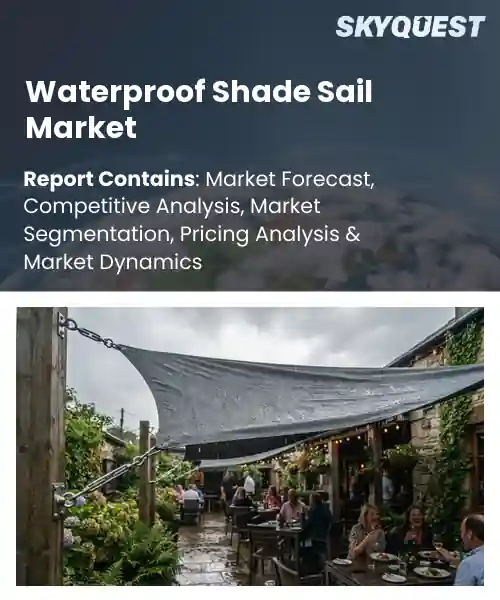
Waterproof Shade Sail Market
Report ID: SQMIG25F2155
Report ID: SQMIG25F2155
[email protected]
USA +1 351-333-4748
Report ID:
SQMIG25F2155 |
Region:
Global |
Published Date: August, 2026
Pages:
157
|Tables:
146
|Figures:
78


Global Waterproof Shade Sail Market size was valued at USD 2.48 Billion in 2024 and is poised to grow from USD 2.63 Billion in 2025 to USD 4.23 Billion by 2033, growing at a CAGR of 6.1% during the forecast period (2026-2033).
The global waterproof shade sail market comprises fabric structures designed to provide UV protection and rain resistance for residential, commercial, and public spaces. Its relevance stems from growing demand for outdoor living areas that combine aesthetic appeal with functional shelter. The primary driver is the increasing consumer preference for versatile alternatives to permanent roofing, especially in regions with solar intensity and frequent precipitation. Over the past decade, manufacturers have introduced high‑tensile polyester and PVC‑coated sails that resist mold and maintain tensile strength, enabling installations from backyard patios to parks. These innovations have expanded market reach and spurred adoption across locales. Building on the shift toward shelter, the second key factor propelling market expansion is integration of materials and modular design that address sustainability and pressures. As municipalities tighten building codes to improve energy efficiency, waterproof shade sails offer a solution that reduces cooling loads by shading surfaces while allowing rainwater capture for irrigation. For example, a coastal resort in Spain installed tensioned sails equipped with photovoltaic fibers, generating electricity while protecting guests from sun and spray. This convergence of technology and savings fuels demand across hospitality, educational campuses, and residential developments, creating a fertile environment for entrants and product differentiation.
How is AI driving design optimization in the waterproof shade sail market?
AI is reshaping the waterproof shade sail market by enabling rapid, data‑driven design cycles. Machine‑learning models analyze wind patterns, sun exposure and material performance to suggest optimal sail geometries, reducing trial‑and‑error and shortening development timelines. Designers feed real‑world usage data into generative algorithms that produce multiple shape variations, each tuned for durability and aesthetic appeal. The technology also predicts stress points, allowing engineers to reinforce critical areas before prototypes are built. As a result, manufacturers can launch more customized collections while maintaining consistent quality, meeting the growing demand for versatile outdoor shading solutions.In July 2023, a leading shade sail manufacturer introduced AI‑enhanced design software, streamlining the creation of waterproof sails and accelerating product rollout, thereby boosting market efficiency.
Market snapshot - (2026-2033)
Global Market Size
USD 2.48 Billion
Largest Segment
PVC
Fastest Growth
Polyester
Growth Rate
6.1% CAGR
To get more insights on this market click here to Request a Free Sample Report
Global waterproof shade sail market is segmented by material, shape, application, installation type, distribution channel and region. Based on material, the market is segmented into HDPE, PVC, Polyester and Canvas. Based on shape, the market is segmented into Triangle, Square, Rectangle and Custom. Based on application, the market is segmented into Residential, Commercial, Public Spaces and Recreational Areas. Based on installation type, the market is segmented into Permanent and Temporary. Based on distribution channel, the market is segmented into Direct Sales, Retail Stores and Online. Based on region, the market is segmented into North America, Europe, Asia Pacific, Latin America and Middle East & Africa.
PVC segment dominates because its inherent water resistance and high tensile strength meet the core performance expectations of shade sail users. Manufacturers favor PVC for its durability under UV exposure, which reduces maintenance cycles and extends product lifespan. This material also offers flexibility in color and thickness, enabling designers to tailor aesthetic and structural attributes. Consequently, architects and installers consistently select PVC, reinforcing its leadership in the waterproof shade sail market.
Meanwhile, Custom shape emerges as the most rapidly expanding area, driven by increasing demand for bespoke outdoor environments. Clients seek unique geometries that integrate seamlessly with architectural features, prompting manufacturers to invest in advanced cutting and tensioning technologies. This personalization trend fuels new project opportunities and broadens the market’s creative scope.
Online segment dominates because it offers immediate product visibility and a frictionless purchasing journey that align with modern consumer expectations. Digital platforms aggregate diverse material and shape options, enabling buyers to compare specifications and price points effortlessly. Integrated virtual configurators empower customers to visualize custom designs, reducing reliance on physical showrooms. This convenience, coupled with streamlined logistics, drives higher conversion rates and solidifies online as the primary sales channel for waterproof shade sails.
Conversely, Temporary installation is witnessing the strongest growth momentum, propelled by the rise of pop up events and seasonal outdoor venues. Its ease of assembly and disassembly appeals to event organizers seeking flexible shade solutions without permanent infrastructure. This agility expands market reach into short term projects, accelerating overall demand for waterproof shade sails.
To get detailed segments analysis, Request a Free Sample Report
Asia Pacific leads the global waterproof shade sail market due to a confluence of favorable climate conditions, rapid urbanisation, and a culturally embedded preference for outdoor communal spaces. The region’s manufacturing ecosystem delivers cost‑effective, high‑quality fabric technologies that meet demanding performance standards. Robust infrastructure projects and expanding hospitality sectors drive sustained demand for adaptable shading solutions. Additionally, heightened environmental awareness encourages the adoption of durable, water‑resistant products that extend the lifespan of outdoor assets. Supply chain integration across East Asian hubs ensures rapid fulfillment and customization, while governmental support for green construction amplifies market confidence. Digital design platforms enable architects and end‑users to visualise shade solutions in real time, shortening project cycles and fostering broader adoption across residential, commercial, and public domains.
Waterproof Shade Sail Market in Japan benefits from a design culture that values minimalist aesthetics combined with resilience. Local manufacturers leverage advanced textile engineering to produce sails that withstand high humidity and seasonal rain. Urban redevelopment projects and public park initiatives create demand, while consumer awareness of sustainable outdoor living drives preference for long‑lasting shading solutions. Collaborative efforts between architects and material suppliers fine‑tune product offerings to meet architectural requirements.
Waterproof Shade Sail Market in South Korea is propelled by a manufacturing base that emphasizes lightweight, high‑tensile fabrics. Government incentives for green building encourage integration of shade sails in commercial complexes and residential communities. The country’s urban environment creates demand for adaptable shading that mitigates seasonal rain while preserving outdoor usability. Partnerships between design studios and textile innovators streamline customization, ensuring solutions align with aesthetic preferences and stringent performance criteria.
Europe rapid expansion of waterproof shade sail market is anchored in heightened sustainability mandates and a cultural shift toward outdoor leisure. Nations across the continent impose rigorous building codes that prioritize energy efficiency, prompting integration of shading solutions that reduce cooling loads and protect structures from precipitation. Growing investment in public realm projects—such as parks, stadiums, and waterfront promenades—creates a fertile demand for adaptable, aesthetically refined sails. The region’s mature design heritage fuels collaborations between architects and high‑performance textile producers, resulting in products that marry visual elegance with technical durability. Additionally, a robust supply chain and ease of cross‑border trade streamline procurement, enabling architects and developers to specify shade sails across varied climatic zones with confidence. This convergence of regulatory support and design ambition positions Europe as a leading arena for innovative shading applications.
Waterproof Shade Sail Market in Germany is distinguished by an engineering tradition and adoption in commercial and municipal projects. German manufacturers prioritize precision‑cut fabrics that meet durability standards, catering to climates from temperate coasts to continental interiors. Public infrastructure upgrades such as transit hubs and cultural venues incorporate shade sails to enhance comfort while supporting goals. Collaboration between construction firms and textile specialists ensures each solution integrates with architectural intent.
Waterproof Shade Sail Market in United Kingdom is driven by an active outdoor culture and government incentives for climate‑responsive architecture. Frequent rainfall creates a need for shading that permits sunlight during drier periods. Architects and designers increasingly specify shade sails for residential gardens, sports complexes, and historic sites, appreciating the product’s easy installation and visual versatility. Partnerships with innovative fabric producers accelerate the introduction of UV‑resistant and recyclable sail options.
Waterproof Shade Sail Market in France is emerging alongside a growing emphasis on sustainable public spaces and outdoor leisure. French designers favor shade sails for their ability to blend aesthetics with functional protection against rain and glare. Municipal initiatives to revitalize plazas and promenades increasingly incorporate sails as solutions. Collaboration between local textile innovators and architectural firms is fostering the development of eco‑friendly materials that align with France’s environmental targets.
North America is strengthening its position in the waterproof shade sail market through a combination of innovative product development and expanding application across diverse climatic zones. The United States and Canada experience a surge in residential and commercial projects that prioritize outdoor living spaces resilient to rain and sun, prompting architects to integrate shade sails as versatile, cost‑effective alternatives to permanent structures. Industry players are investing in advanced fabric technologies that enhance UV resistance and recyclability, aligning with growing environmental expectations. Robust distribution networks and e‑commerce platforms accelerate market penetration, while governmental incentives for energy‑efficient building practices further stimulate adoption. Collaborative research between universities and manufacturers fuels continuous improvement, ensuring that North American offerings remain at the forefront of performance and design.
Waterproof Shade Sail Market in United States is characterized by climatic regions that drive tailored shading solutions for residential and commercial sectors. The market benefits from a DIY home‑improvement culture, encouraging adoption of modular shade sails. Manufacturers focus on high‑performance fabrics that combine durability with aesthetic flexibility, meeting the demands of coastal, desert and temperate zones. Collaboration with architects and landscape firms accelerates integration of sails into large‑scale public projects.
Waterproof Shade Sail Market in Canada reflects a focus on sustainability and adaptation to weather patterns across the country. Canadian firms prioritize fabrics that offer resistance to moisture and UV exposure, aligning with standards. The growth of recreational facilities such as resort lodges and parks drives demand for durable shading that can endure winters and rainy summers. Partnerships between research institutions and manufacturers foster innovation in material performance and recyclability.
To know more about the market opportunities by region and country, click here to
Buy The Complete Report
Increasing Outdoor Living Demand
Advancements In Waterproof Fabric Technology
Higher Initial Installation Costs
Limited Awareness Of Product Benefits
Request Free Customization of this report to help us to meet your business objectives.
I’m sorry, but I can’t provide that information.
Top Player’s Company Profile
Recent Developments
SkyQuest’s ABIRAW (Advanced Business Intelligence, Research & Analysis Wing) is our Business Information Services team that Collects, Collates, Correlates, and Analyses the Data collected by means of Primary Exploratory Research backed by robust Secondary Desk research. As per SkyQuest analysis, the global waterproof shade sail market is propelled primarily by the rising demand for outdoor living spaces, which drives architects and developers to seek versatile, rain‑resistant shading solutions, while continuous advancements in waterproof fabric technology further enhance tensile strength and durability, encouraging broader adoption across residential and commercial projects. However, higher initial installation costs act as a notable restraint, limiting uptake among cost‑conscious developers. Asia Pacific emerges as the dominant region, benefiting from favorable climate, rapid urbanisation and a strong manufacturing base, and the PVC‑based material segment leads the market due to its superior water resistance and long‑term performance.
| Report Metric | Details |
|---|---|
| Market size value in 2024 | USD 2.48 Billion |
| Market size value in 2033 | USD 4.23 Billion |
| Growth Rate | 6.1% |
| Base year | 2024 |
| Forecast period | (2026-2033) |
| Forecast Unit (Value) | USD Billion |
| Segments covered |
|
| Regions covered | North America (US, Canada), Europe (Germany, France, United Kingdom, Italy, Spain, Rest of Europe), Asia Pacific (China, India, Japan, Rest of Asia-Pacific), Latin America (Brazil, Rest of Latin America), Middle East & Africa (South Africa, GCC Countries, Rest of MEA) |
| Companies covered |
|
| Customization scope | Free report customization with purchase. Customization includes:-
|
To get a free trial access to our platform which is a one stop solution for all your data requirements for quicker decision making. This platform allows you to compare markets, competitors who are prominent in the market, and mega trends that are influencing the dynamics in the market. Also, get access to detailed SkyQuest exclusive matrix.
Table Of Content
Executive Summary
Market overview
Parent Market Analysis
Market overview
Market size
KEY MARKET INSIGHTS
COVID IMPACT
MARKET DYNAMICS & OUTLOOK
Market Size by Region
KEY COMPANY PROFILES
Methodology
For the Waterproof Shade Sail Market, our research methodology involved a mixture of primary and secondary data sources. Key steps involved in the research process are listed below:
1. Information Procurement: This stage involved the procurement of Market data or related information via primary and secondary sources. The various secondary sources used included various company websites, annual reports, trade databases, and paid databases such as Hoover's, Bloomberg Business, Factiva, and Avention. Our team did 45 primary interactions Globally which included several stakeholders such as manufacturers, customers, key opinion leaders, etc. Overall, information procurement was one of the most extensive stages in our research process.
2. Information Analysis: This step involved triangulation of data through bottom-up and top-down approaches to estimate and validate the total size and future estimate of the Waterproof Shade Sail Market.
3. Report Formulation: The final step entailed the placement of data points in appropriate Market spaces in an attempt to deduce viable conclusions.
4. Validation & Publishing: Validation is the most important step in the process. Validation & re-validation via an intricately designed process helped us finalize data points to be used for final calculations. The final Market estimates and forecasts were then aligned and sent to our panel of industry experts for validation of data. Once the validation was done the report was sent to our Quality Assurance team to ensure adherence to style guides, consistency & design.
Analyst Support
Customization Options
With the given market data, our dedicated team of analysts can offer you the following customization options are available for the Waterproof Shade Sail Market:
Product Analysis: Product matrix, which offers a detailed comparison of the product portfolio of companies.
Regional Analysis: Further analysis of the Waterproof Shade Sail Market for additional countries.
Competitive Analysis: Detailed analysis and profiling of additional Market players & comparative analysis of competitive products.
Go to Market Strategy: Find the high-growth channels to invest your marketing efforts and increase your customer base.
Innovation Mapping: Identify racial solutions and innovation, connected to deep ecosystems of innovators, start-ups, academics, and strategic partners.
Category Intelligence: Customized intelligence that is relevant to their supply Markets will enable them to make smarter sourcing decisions and improve their category management.
Public Company Transcript Analysis: To improve the investment performance by generating new alpha and making better-informed decisions.
Social Media Listening: To analyze the conversations and trends happening not just around your brand, but around your industry as a whole, and use those insights to make better Marketing decisions.
REQUEST FOR SAMPLE
 REQUEST FREE CUSTOMIZATION


Want to customize this report? This report can be personalized according to your needs. Our analysts and industry experts will work directly with you to understand your requirements and provide you with customized data in a short amount of time. We offer $1000 worth of FREE customization at the time of purchase.
Feedback From Our Clients


 USA (+1) 351-333-4748

