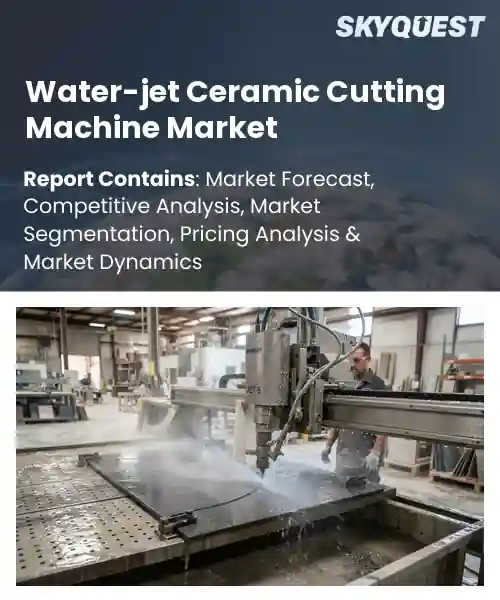
Water-jet Ceramic Cutting Machine Market
Report ID: SQMIG20I3835
Report ID: SQMIG20I3835
[email protected]
USA +1 351-333-4748
Report ID:
SQMIG20I3835 |
Region:
Global |
Published Date: September, 2026
Pages:
157
|Tables:
120
|Figures:
77


Global Water-Jet Ceramic Cutting Machine Market size was valued at USD 17.65 Billion in 2024 and is poised to grow from USD 18.46 Billion in 2025 to USD 26.46 Billion by 2033, growing at a CAGR of 4.6% during the forecast period (2026-2033).
Regulatory pressure for greener manufacturing amplifies market momentum because water‑jet systems eliminate coolant chemicals and reduce scrap rates, lowering operational cost and environmental liability. This advantage spurs adoption in the automotive electronics segment, where companies such as Bosch use jet cutters to produce ceramic insulators for voltage modules, achieving a 30 % reduction in material waste. The ripple effect encourages suppliers to develop higher‑pressure pumps and recyclable abrasive media, creating a loop that expands the equipment base and opens service‑contract opportunities in economies across regions. Consequently, the market experiences demand and innovation, reinforcing a growth trajectory globally over the next decade.
How is AI-driven automation influencing efficiency in the water‑jet ceramic cutting machine market?
AI driven automation is reshaping the water jet ceramic cutting market by linking sensor data with intelligent control loops. Machines now adjust pressure, speed and abrasive flow in real time to match the hardness and geometry of each workpiece. This dynamic tuning reduces material waste, shortens setup time and delivers smoother edges without manual reprogramming. Operators benefit from predictive maintenance alerts that keep the high pressure pump running at peak efficiency. The broader market, driven by demand for precise ceramic components in electronics and aerospace, is seeing faster production cycles and higher repeatability as manufacturers adopt these smart systems.Flow International announced an AI driven cutting optimization platform in June 2023, delivering faster throughput and lower scrap rates that reinforce market growth. The system integrates real time vision sensors and machine learning models to fine tune jet parameters for each ceramic panel, cutting cycle times by a noticeable margin while preserving surface integrity.
Market snapshot - (2026-2033)
Global Market Size
USD 17.65 Billion
Largest Segment
3-Axis Water-jet Machines
Fastest Growth
5-Axis Water-jet Machines (Intricate Bevel Cutting)
Growth Rate
4.6% CAGR
To get more insights on this market click here to Request a Free Sample Report
Global water-jet ceramic cutting machine market is segmented by machine axis configuration, technology pump type, cutting method modality, end use industry and region. Based on machine axis configuration, the market is segmented into 3-Axis Water-jet Machines, 4-Axis Water-jet Machines and 5-Axis Water-jet Machines (Intricate Bevel Cutting). Based on technology pump type, the market is segmented into Intensifier Pumps (High Pressure, ~60,000 psi and Above) and Direct Drive Crankshaft Pumps. Based on cutting method modality, the market is segmented into Pure Water-jet Cutting and Abrasive Water-jet Cutting (Using Garnet/Alumina for Ceramics). Based on end use industry, the market is segmented into Building, Architecture & Construction (Tiles, Countertops, Facades), Industrial Ceramic Component Manufacturing and Interior Design & Architectural Restoration Labs. Based on region, the market is segmented into North America, Europe, Asia Pacific, Latin America and Middle East & Africa.
5-Axis Water-jet Machines segment dominates because they provide the only practical solution for creating intricate bevels and complex geometry on hard ceramic tiles, a requirement that traditional CNC or 3 axis jets cannot meet. The additional rotational axis enables simultaneous multi face processing, reducing handling steps and improving surface integrity. This capability aligns with high value architectural and decorative applications where precision and visual quality are paramount, reinforcing its leadership in the market.
However, 4 Axis Water-jet Machines segment is witnessing the strongest growth momentum as manufacturers seek to add limited rotational capability without the cost of full five axis systems. The extra axis allows angled cuts and modest bevels, expanding the product portfolio for mid range projects. This incremental flexibility is driving rapid adoption and expanding market reach.
Intensifier Pumps segment dominates because they generate the extreme pressures required to slice dense ceramic substrates without reliance on abrasive additives, preserving material purity and surface finish. The technology’s ability to maintain a stable pressure envelope simplifies nozzle design and reduces wear, translating into longer machine uptime and lower operating costs. These operational advantages meet the rigorous performance expectations of high end tile and façade manufacturers, cementing its lead in the market.
Meanwhile, Direct Drive Crankshaft Pumps segment emerges as a high growth area because recent improvements have closed the pressure gap while delivering a compact, energy efficient footprint. Users value simpler maintenance and lower capital outlay, driving adoption in small and midscale lines. This expanding uptake fuels market expansion and creates new opportunities for cost conscious buyers.
To get detailed segments analysis, Request a Free Sample Report
Asia Pacific leverages a confluence of deep manufacturing expertise, cost‑effective production, and a robust supply chain that fuels widespread adoption of water‑jet ceramic cutting technology. The region’s strong presence in high‑precision sectors such as electronics, automotive, and aerospace creates consistent demand for advanced cutting solutions. Local firms benefit from close collaboration with component manufacturers, enabling rapid iteration and customization of equipment. Moreover, a culture of continuous innovation and a skilled engineering workforce support the development of cutting‑edge machines that meet complex material requirements. These factors collectively reinforce Asia Pacific’s leadership and sustain its dominant market position.
Water-jet Ceramic Cutting Machine Market in Japan is driven by the nation’s emphasis on precision engineering and the high value placed on quality in sectors such as semiconductor manufacturing and aerospace. Domestic manufacturers integrate advanced control systems and rigorous testing protocols, ensuring reliable performance for intricate ceramic components. Strong collaboration between equipment suppliers and downstream users fosters tailored solutions that address specific material challenges, reinforcing Japan’s reputation for high‑tech manufacturing excellence.
Water-jet Ceramic Cutting Machine Market in South Korea benefits from the country’s rapid industrial diversification and a focus on advanced materials in electronics and automotive applications. Korean firms prioritize research and development, leading to innovative nozzle designs and enhanced cutting efficiency for ceramic substrates. The strategic alignment of government support with private sector initiatives accelerates technology adoption, positioning South Korea as a key contributor to the region’s overall market dominance.
Europe’s expansion is propelled by a strong commitment to sustainability, precision manufacturing, and high‑value engineering sectors. The continent’s deep-rooted expertise in aerospace, automotive, and renewable energy fosters an environment where water‑jet ceramic cutting is prized for its material efficiency and minimal waste generation. Collaborative research networks across the region stimulate continual improvements in machine reliability and cutting precision. Coupled with rigorous quality standards and a focus on low‑environmental‑impact processes, these dynamics accelerate market growth and reinforce Europe’s strategic position in the global landscape.
Water-jet Ceramic Cutting Machine Market in Germany is anchored by a tradition of engineering excellence and a robust industrial base that demands high‑precision solutions. German manufacturers emphasize rigorous testing, advanced automation, and integration with Industry 4.0 platforms, delivering cutting performance suited to complex ceramic components in automotive and aerospace applications. Close ties between equipment producers and end‑user industries ensure that machine capabilities evolve in line with demanding technical specifications.
Water-jet Ceramic Cutting Machine Market in the United Kingdom is experiencing rapid growth driven by cutting‑edge aerospace projects and a vibrant research ecosystem. British firms focus on developing adaptable machine configurations that cater to diverse ceramic materials, supporting specialized applications in defense and space exploration. Strategic collaborations between universities, technology incubators, and industrial partners accelerate the introduction of innovative cutting techniques, positioning the United Kingdom as a fast‑growing hub for advanced ceramic machining.
Water-jet Ceramic Cutting Machine Market in France is emerging as a focal point for the renewable energy sector and high‑tech manufacturing. French companies prioritize modular machine designs that enable flexible processing of ceramic components used in solar and wind technologies. Emphasis on environmental stewardship aligns with water‑jet cutting’s low‑waste profile, encouraging broader adoption across the French industrial landscape. Continuous investment in R&D supports the development of precision tools tailored to emerging market needs.
North America reinforces its market role through a blend of advanced manufacturing capabilities, strong defense and aerospace demand, and a culture of innovation. The region’s emphasis on high‑performance engineering drives the adoption of water‑jet ceramic cutting for intricate components across aerospace, medical devices, and high‑tech electronics. Collaborative ecosystems between equipment manufacturers, research institutions, and end‑users foster rapid technology transfer and customization. Additionally, strategic investments in automation and digital integration enhance operational efficiency, positioning North America as a pivotal contributor to the global market evolution.
Water-jet Ceramic Cutting Machine Market in the United States benefits from a diverse industrial base that spans aerospace, defense, and semiconductor sectors. American manufacturers prioritize high‑speed, high‑precision cutting solutions that meet stringent tolerance requirements for complex ceramic parts. The integration of smart sensors and data analytics into cutting systems enables predictive maintenance and process optimization, reinforcing the United States’ leadership in advanced manufacturing technologies.
Water-jet Ceramic Cutting Machine Market in Canada is driven by a focus on clean‑technology initiatives and growing aerospace activities. Canadian firms adopt water‑jet cutting for its ability to efficiently process ceramic substrates used in renewable energy components and high‑performance aerospace parts. Collaborative research programs between universities and industry accelerate enhancements in nozzle design and fluid dynamics, supporting the country’s commitment to sustainable and precise manufacturing practices.
To know more about the market opportunities by region and country, click here to
Buy The Complete Report
Rapid Technological Innovation
Growing Demand for Precision Components
High Capital Investment Requirements
Limited Skilled Workforce Availability
Request Free Customization of this report to help us to meet your business objectives.
I’m sorry, but I can’t provide that information.
Top Player’s Company Profile
Recent Developments
SkyQuest’s ABIRAW (Advanced Business Intelligence, Research & Analysis Wing) is our Business Information Services team that Collects, Collates, Correlates, and Analyses the Data collected by means of Primary Exploratory Research backed by robust Secondary Desk research. As per SkyQuest analysis, the market is being propelled primarily by rapid technological innovation that expands high‑pressure capabilities, allowing manufacturers to cut complex ceramic shapes with minimal waste. A secondary boost comes from the growing demand for precision components in electronics, renewable energy and aerospace, which drives adoption of the clean, accurate water‑jet process. The most significant restraint remains the high capital investment required to acquire and maintain these sophisticated systems, especially for smaller firms. Asia Pacific leads the market thanks to its deep manufacturing base and supply‑chain strength, while 5‑Axis water‑jet machines dominate the segment landscape by delivering the only practical solution for intricate bevels and multi‑face cuts.
| Report Metric | Details |
|---|---|
| Market size value in 2024 | USD 17.65 Billion |
| Market size value in 2033 | USD 26.46 Billion |
| Growth Rate | 4.6% |
| Base year | 2024 |
| Forecast period | (2026-2033) |
| Forecast Unit (Value) | USD Billion |
| Segments covered |
|
| Regions covered | North America (US, Canada), Europe (Germany, France, United Kingdom, Italy, Spain, Rest of Europe), Asia Pacific (China, India, Japan, Rest of Asia-Pacific), Latin America (Brazil, Rest of Latin America), Middle East & Africa (South Africa, GCC Countries, Rest of MEA) |
| Companies covered |
|
| Customization scope | Free report customization with purchase. Customization includes:-
|
To get a free trial access to our platform which is a one stop solution for all your data requirements for quicker decision making. This platform allows you to compare markets, competitors who are prominent in the market, and mega trends that are influencing the dynamics in the market. Also, get access to detailed SkyQuest exclusive matrix.
Table Of Content
Executive Summary
Market overview
Parent Market Analysis
Market overview
Market size
KEY MARKET INSIGHTS
COVID IMPACT
MARKET DYNAMICS & OUTLOOK
Market Size by Region
KEY COMPANY PROFILES
Methodology
For the Water-jet Ceramic Cutting Machine Market, our research methodology involved a mixture of primary and secondary data sources. Key steps involved in the research process are listed below:
1. Information Procurement: This stage involved the procurement of Market data or related information via primary and secondary sources. The various secondary sources used included various company websites, annual reports, trade databases, and paid databases such as Hoover's, Bloomberg Business, Factiva, and Avention. Our team did 45 primary interactions Globally which included several stakeholders such as manufacturers, customers, key opinion leaders, etc. Overall, information procurement was one of the most extensive stages in our research process.
2. Information Analysis: This step involved triangulation of data through bottom-up and top-down approaches to estimate and validate the total size and future estimate of the Water-jet Ceramic Cutting Machine Market.
3. Report Formulation: The final step entailed the placement of data points in appropriate Market spaces in an attempt to deduce viable conclusions.
4. Validation & Publishing: Validation is the most important step in the process. Validation & re-validation via an intricately designed process helped us finalize data points to be used for final calculations. The final Market estimates and forecasts were then aligned and sent to our panel of industry experts for validation of data. Once the validation was done the report was sent to our Quality Assurance team to ensure adherence to style guides, consistency & design.
Analyst Support
Customization Options
With the given market data, our dedicated team of analysts can offer you the following customization options are available for the Water-jet Ceramic Cutting Machine Market:
Product Analysis: Product matrix, which offers a detailed comparison of the product portfolio of companies.
Regional Analysis: Further analysis of the Water-jet Ceramic Cutting Machine Market for additional countries.
Competitive Analysis: Detailed analysis and profiling of additional Market players & comparative analysis of competitive products.
Go to Market Strategy: Find the high-growth channels to invest your marketing efforts and increase your customer base.
Innovation Mapping: Identify racial solutions and innovation, connected to deep ecosystems of innovators, start-ups, academics, and strategic partners.
Category Intelligence: Customized intelligence that is relevant to their supply Markets will enable them to make smarter sourcing decisions and improve their category management.
Public Company Transcript Analysis: To improve the investment performance by generating new alpha and making better-informed decisions.
Social Media Listening: To analyze the conversations and trends happening not just around your brand, but around your industry as a whole, and use those insights to make better Marketing decisions.
REQUEST FOR SAMPLE
 REQUEST FREE CUSTOMIZATION


Want to customize this report? This report can be personalized according to your needs. Our analysts and industry experts will work directly with you to understand your requirements and provide you with customized data in a short amount of time. We offer $1000 worth of FREE customization at the time of purchase.
Feedback From Our Clients


 USA (+1) 351-333-4748

