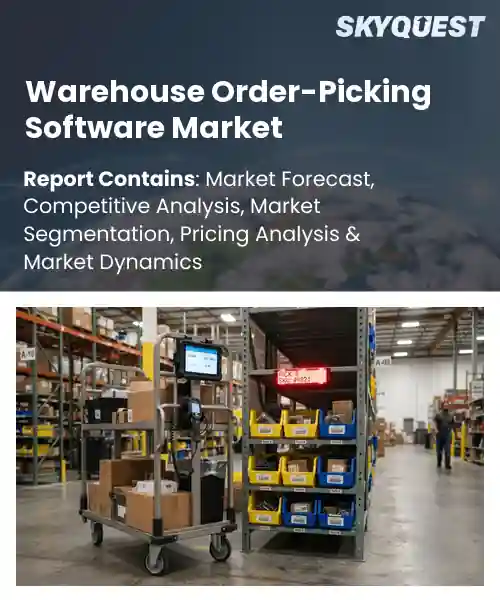
Warehouse Order-Picking Software Market
Report ID: SQMIG45E3352
Report ID: SQMIG45E3352
[email protected]
USA +1 351-333-4748
Report ID:
SQMIG45E3352 |
Region:
Global |
Published Date: November, 2026
Pages:
157
|Tables:
121
|Figures:
77


Global Warehouse Order-Picking Software Market size was valued at USD 3.1 Billion in 2024 and is poised to grow from USD 3.43 Billion in 2025 to USD 7.81 Billion by 2033, growing at a CAGR of 10.8% during the forecast period (2026-2033).
The global warehouse order‑picking software market comprises solutions that direct workers, robots or automated conveyors to collect items efficiently within distribution centers. Its importance stems from the rising cost pressure on e‑commerce fulfillment and the necessity to shorten delivery cycles. The primary driver is the surge in online shopping, which forces retailers to process higher SKU volumes while maintaining accuracy. Over the past decade, software such as Manhattan Associates’ Wave Management and SAP EWM have evolved from simple pick‑list generators to AI‑optimized, real‑time routing platforms. These advances illustrate how the market has shifted from manual assistance to predictive, integrated ecosystems. The next major factor propelling market expansion is the integration of robotics and IoT sensors that enable pick verification and dynamic workload balancing. When warehouses deploy autonomous mobile robots equipped with location data, software must continuously recalibrate routes, reducing travel distance and preventing bottlenecks. Companies such as Amazon Robotics report up to a 25 % lift in throughput after coupling their Kiva units with adaptive picking algorithms. This cause‑effect chain creates opportunities for vendors to offer analytics modules that monetize performance insights. Consequently, investment in cloud‑native, modular platforms accelerates as midsize distributors seek scalable solutions that align with their automation roadmaps.
How is AI-driven automation reshaping the warehouse order-picking software market?
AI‑driven automation is redefining how warehouses select and move items. The core of the change lies in real‑time data processing, predictive slotting and dynamic pick routes that adapt to demand spikes. Modern software now blends voice guidance, computer vision and autonomous robots to reduce travel time and errors. Operators experience smoother workflows as the system learns from each pick and continuously refines its recommendations. The market has shifted from static pick lists to intelligent platforms that balance labor capacity with order urgency. Companies are adopting these tools to meet rising e‑commerce expectations while keeping labor costs manageable through enhanced visibility.Blue Yonder May 2023, introduced its AI‑driven Luminate Warehouse solution that integrates predictive analytics with real‑time pick sequencing. The rollout accelerates order throughput and cuts manual intervention, illustrating how intelligent automation fuels growth and efficiency across the warehouse order‑picking software market for global fulfillment operations in large distribution centers today.
Market snapshot - (2026-2033)
Global Market Size
USD 3.1 Billion
Largest Segment
Warehouse Management System-Based Picking Software
Fastest Growth
Robotic & Automated Picking Software
Growth Rate
10.8% CAGR
To get more insights on this market click here to Request a Free Sample Report
Global warehouse order-picking software market is segmented by software type, picking method, deployment model, end user and region. Based on software type, the market is segmented into Warehouse Management System-Based Picking Software, Standalone Order-Picking Software, Voice-Directed Picking Software and Robotic & Automated Picking Software. Based on picking method, the market is segmented into Piece Picking, Batch Picking, Zone Picking and Wave Picking. Based on deployment model, the market is segmented into Cloud-Based, On-Premise and Hybrid. Based on end user, the market is segmented into Third-Party Logistics Providers, Retail & E-Commerce, Manufacturing, Food & Beverage and Pharmaceuticals & Healthcare. Based on region, the market is segmented into North America, Europe, Asia Pacific, Latin America and Middle East & Africa.
Warehouse Management System-Based Picking Software segment dominates because it integrates order orchestration directly with inventory control, eliminating data silos and enabling real time visibility across the fulfillment flow. This tight coupling reduces error rates, shortens cycle times, and aligns picking logic with replenishment processes, which appeals to enterprises seeking end to end optimization. The inherent scalability and proven return on investment reinforce its preference among large scale adopters, solidifying its leadership in the market.
Meanwhile, Robotic & Automated Picking Software emerges as the most rapidly expanding area because advances in AI driven navigation and collaborative robot designs lower entry barriers for midsize warehouses. These solutions deliver operation, heightened accuracy, and labor cost mitigation, prompting organizations to replace manual stations. Their adoption fuels integration opportunities and drives broader market expansion.
Wave Picking segment leads because it synchronizes large order batches into timed execution windows, allowing multiple workstations to operate in coordinated bursts. This approach maximizes labor utilization and equipment throughput while minimizing travel distance, which is critical for high volume distribution centers. The ability to integrate with labor management and real time analytics enhances decision making, making wave picking the preferred method for enterprises targeting operational efficiency and cost control across the fulfillment network.
On the other hand, Zone Picking experiences the strongest growth momentum because it allocates specific product categories to dedicated zones, reducing picker travel and enabling specialization. Demands for faster same day delivery and proliferation of smaller SKU assortments encourage firms to adopt zone designs. This shift unlocks efficiency gains and catalyzes software enhancements, propelling market expansion.
To get detailed segments analysis, Request a Free Sample Report
The region benefits from a mature logistics ecosystem where large distribution networks intersect with advanced technology hubs. High adoption of automation and cloud‑based platforms is driven by a culture of continuous improvement and strong capital availability. Leading software vendors collaborate closely with major retailers and third‑party logistics providers, creating tightly integrated solutions that enhance accuracy and speed. A robust regulatory framework supports data security and interoperability, while a skilled workforce accelerates implementation and customization. Together these elements reinforce a feedback loop of innovation, customer demand, and operational excellence that sustains North America’s leading position.
Warehouse Order-Picking Software Market in the United States is shaped by a concentration of e‑commerce giants and sophisticated supply‑chain operators seeking real‑time visibility and adaptive routing. The market is propelled by extensive investment in robotics and AI, fostering solutions that blend predictive analytics with user‑friendly interfaces. Partnerships between software developers and hardware manufacturers further enhance system reliability, enabling complex order fulfillment scenarios across a diverse retailer landscape.
Warehouse Order-Picking Software Market in Canada reflects a strong emphasis on operational efficiency within a geographically expansive landscape. Providers focus on cloud‑enabled platforms that support multi‑site coordination and seamless integration with transportation management tools. The market benefits from collaborative research initiatives and government incentives that encourage adoption of intelligent automation, helping businesses balance cost pressures with the need for high service levels.
European growth is fueled by a combination of stringent delivery expectations, evolving labor dynamics, and a commitment to sustainability. Retailers and manufacturers alike pursue software that optimizes pick paths, reduces travel time, and minimizes waste, aligning with regional environmental agendas. Cross‑border trade within the bloc encourages interoperable solutions that can handle varied regulations and customs processes. A vibrant ecosystem of specialized vendors collaborates closely with academic institutions, delivering innovations in machine learning and human‑machine interaction that resonate with the region’s focus on precision and scalability.
Warehouse Order-Picking Software Market in Germany is anchored by a strong engineering tradition and a dense network of industrial clusters. Solutions often integrate with existing enterprise resource planning systems, delivering a high degree of customization for complex manufacturing and distribution environments. Emphasis on reliability and compliance supports widespread adoption across automotive, chemicals, and consumer goods sectors, where precision and traceability are paramount.
Warehouse Order-Picking Software Market in the United Kingdom is characterized by rapid adoption of flexible fulfillment models driven by e‑commerce acceleration. Providers prioritize modular architectures that enable swift scaling and integration with omnichannel retail platforms. The market also reflects an increasing focus on workforce augmentation, with user‑centric interfaces designed to support a diverse labor pool and enhance productivity.
Warehouse Order-Picking Software Market in France is emerging through a blend of innovative startups and established technology firms targeting fashion, luxury, and food distribution sectors. Emphasis on real‑time analytics and seamless mobile connectivity addresses the demand for swift, accurate order processing. Collaborative initiatives with research centers foster the development of AI‑driven optimization tools that align with the country’s focus on efficiency and customer experience.
Asia Pacific advances through a dynamic mix of rapid digital transformation, expanding e‑commerce penetration, and strategic investments in automation. Markets in the region prioritize solutions that can handle high order volumes while adapting to diverse product assortments and variable labor costs. Close collaboration between software vendors and hardware manufacturers drives the creation of integrated ecosystems that streamline pick‑to‑ship workflows. Additionally, a growing emphasis on regional standards and data interoperability facilitates cross‑border logistics, reinforcing the region’s role as a hub for innovative order‑picking technology.
Warehouse Order-Picking Software Market in Japan leverages a focus on precision engineering and sophisticated robotics to enhance picking efficiency. Solutions are often embedded with advanced sensor technologies that support error‑free execution in tightly controlled environments. The market also emphasizes seamless integration with legacy manufacturing execution systems, reflecting a need to modernize while preserving established operational frameworks.
Warehouse Order-Picking Software Market in South Korea is driven by a strong ICT infrastructure and a culture of rapid technology adoption. Vendors deliver cloud‑native platforms that enable real‑time coordination across dense urban fulfillment centers and sprawling distribution hubs. Emphasis on AI‑powered decision support and ergonomic user interfaces supports high productivity levels despite fluctuating labor availability.
To know more about the market opportunities by region and country, click here to
Buy The Complete Report
Increasing E‑commerce Order Volumes
Warehouse Automation leveraging AI
High Initial Implementation Costs
Integration Challenges With Legacy Systems
Request Free Customization of this report to help us to meet your business objectives.
The competitive landscape is shaped by aggressive M&A activity, strategic partnerships, and rapid tech innovation, with incumbents acquiring niche AI firms to enhance picking algorithms, while new entrants collaborate with robotics manufacturers to integrate real‑time decision engines; these moves intensify pressure on pricing, accelerate feature rollouts, and drive differentiation through predictive analytics and cloud‑native scalability.
Top Player’s Company Profile
Recent Developments
SkyQuest’s ABIRAW (Advanced Business Intelligence, Research & Analysis Wing) is our Business Information Services team that Collects, Collates, Correlates, and Analyses the Data collected by means of Primary Exploratory Research backed by robust Secondary Desk research. As per SkyQuest analysis the global warehouse order‑picking software market is propelled primarily by surging e‑commerce order volumes that demand faster, more accurate fulfillment, while a second strong driver is the rapid adoption of AI‑powered warehouse automation which optimizes pick routes and labor utilization. The market is led by North America, where mature logistics networks and ample capital foster early adoption, and the Warehouse Management System‑based picking software segment dominates because it seamlessly integrates inventory control and order orchestration. However, high initial implementation costs act as a restraint, slowing uptake among smaller distributors who must justify investment against tight budgets.
| Report Metric | Details |
|---|---|
| Market size value in 2024 | USD 3.1 Billion |
| Market size value in 2033 | USD 7.81 Billion |
| Growth Rate | 10.8% |
| Base year | 2024 |
| Forecast period | (2026-2033) |
| Forecast Unit (Value) | USD Billion |
| Segments covered |
|
| Regions covered | North America (US, Canada), Europe (Germany, France, United Kingdom, Italy, Spain, Rest of Europe), Asia Pacific (China, India, Japan, Rest of Asia-Pacific), Latin America (Brazil, Rest of Latin America), Middle East & Africa (South Africa, GCC Countries, Rest of MEA) |
| Companies covered |
|
| Customization scope | Free report customization with purchase. Customization includes:-
|
To get a free trial access to our platform which is a one stop solution for all your data requirements for quicker decision making. This platform allows you to compare markets, competitors who are prominent in the market, and mega trends that are influencing the dynamics in the market. Also, get access to detailed SkyQuest exclusive matrix.
Table Of Content
Executive Summary
Market overview
Parent Market Analysis
Market overview
Market size
KEY MARKET INSIGHTS
COVID IMPACT
MARKET DYNAMICS & OUTLOOK
Market Size by Region
KEY COMPANY PROFILES
Methodology
For the Warehouse Order-Picking Software Market, our research methodology involved a mixture of primary and secondary data sources. Key steps involved in the research process are listed below:
1. Information Procurement: This stage involved the procurement of Market data or related information via primary and secondary sources. The various secondary sources used included various company websites, annual reports, trade databases, and paid databases such as Hoover's, Bloomberg Business, Factiva, and Avention. Our team did 45 primary interactions Globally which included several stakeholders such as manufacturers, customers, key opinion leaders, etc. Overall, information procurement was one of the most extensive stages in our research process.
2. Information Analysis: This step involved triangulation of data through bottom-up and top-down approaches to estimate and validate the total size and future estimate of the Warehouse Order-Picking Software Market.
3. Report Formulation: The final step entailed the placement of data points in appropriate Market spaces in an attempt to deduce viable conclusions.
4. Validation & Publishing: Validation is the most important step in the process. Validation & re-validation via an intricately designed process helped us finalize data points to be used for final calculations. The final Market estimates and forecasts were then aligned and sent to our panel of industry experts for validation of data. Once the validation was done the report was sent to our Quality Assurance team to ensure adherence to style guides, consistency & design.
Analyst Support
Customization Options
With the given market data, our dedicated team of analysts can offer you the following customization options are available for the Warehouse Order-Picking Software Market:
Product Analysis: Product matrix, which offers a detailed comparison of the product portfolio of companies.
Regional Analysis: Further analysis of the Warehouse Order-Picking Software Market for additional countries.
Competitive Analysis: Detailed analysis and profiling of additional Market players & comparative analysis of competitive products.
Go to Market Strategy: Find the high-growth channels to invest your marketing efforts and increase your customer base.
Innovation Mapping: Identify racial solutions and innovation, connected to deep ecosystems of innovators, start-ups, academics, and strategic partners.
Category Intelligence: Customized intelligence that is relevant to their supply Markets will enable them to make smarter sourcing decisions and improve their category management.
Public Company Transcript Analysis: To improve the investment performance by generating new alpha and making better-informed decisions.
Social Media Listening: To analyze the conversations and trends happening not just around your brand, but around your industry as a whole, and use those insights to make better Marketing decisions.
REQUEST FOR SAMPLE
 REQUEST FREE CUSTOMIZATION


Want to customize this report? This report can be personalized according to your needs. Our analysts and industry experts will work directly with you to understand your requirements and provide you with customized data in a short amount of time. We offer $1000 worth of FREE customization at the time of purchase.
Feedback From Our Clients


 USA (+1) 351-333-4748

