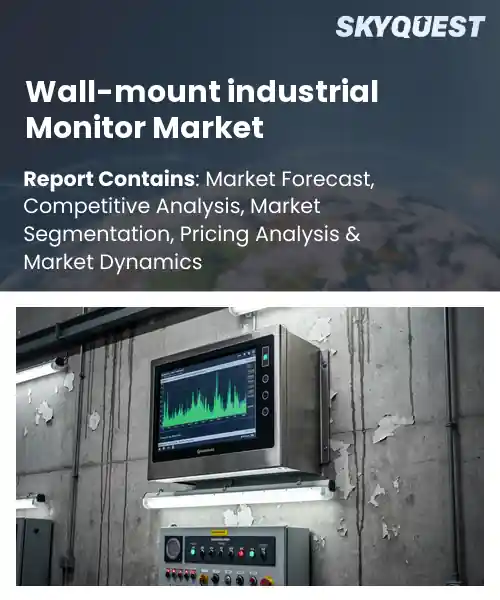
Wall-mount industrial Monitor Market
Report ID: SQMIG45J2432
Report ID: SQMIG45J2432
[email protected]
USA +1 351-333-4748
Report ID:
SQMIG45J2432 |
Region:
Global |
Published Date: March, 2026
Pages:
157
|Tables:
118
|Figures:
77


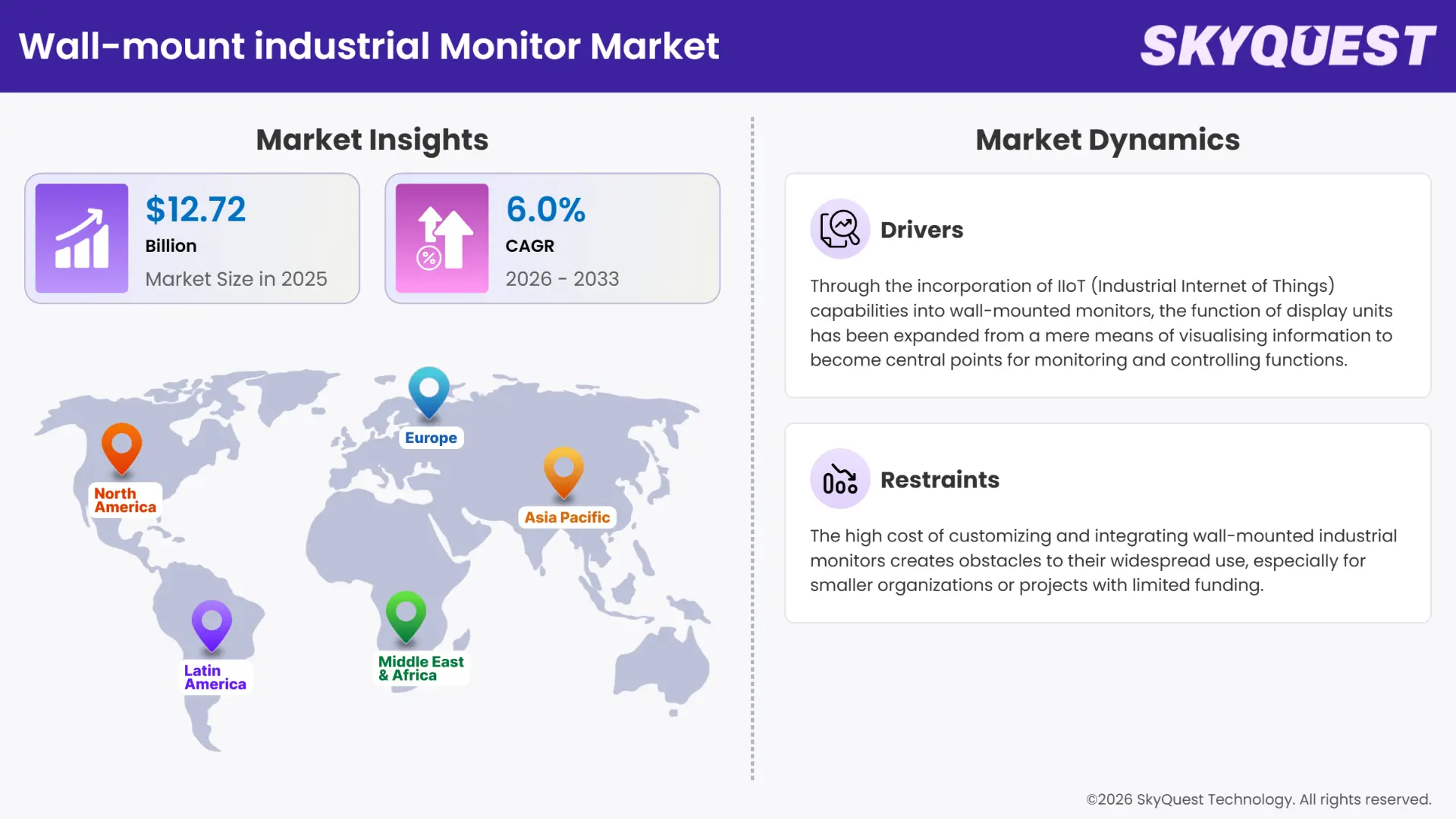
Global Wall-Mount Industrial Monitor Market size was valued at USD 12.00 Billion in 2024 and is poised to grow from USD 12.72 Billion in 2025 to USD 20.27 Billion by 2033, growing at a CAGR of 6.0% during the forecast period (2026-2033).
Key Takeaways: Market Trends & Insights
The primary driver of the wall-mount industrial monitor market is the accelerating adoption of automation and human-machine interfaces across factories, utilities, and transportation systems. Wall-mount industrial monitors are rugged displays designed for duty on control-room walls or production floors, and they matter because that improve safety and throughput. Over time the market has evolved from bulky cathode-ray tubes to thin, sunlight-readable LCDs with capacitive touch and IP-rated enclosures, and vendors supply fanless wide-temperature units for extreme sites. As production systems digitized, demand shifted toward higher reliability and integrated connectivity, prompting innovation and deployment.
Building on that digitization, a key trend driving the global Wall-mount industrial monitor sector growth is the convergence of IIoT connectivity and edge computing, which forces operators to place reliable visualization hardware on-site. Because sensors and PLCs generate continuous streams of telemetry, wall-mount monitors located in control rooms and along production lines provide low-latency dashboards that enable faster interventions and reduce unplanned downtime, as seen in automotive plants where real-time quality metrics immediately halt faulty lines. Manufacturers have responded by providing options for Modular I/O and cyber security features to ease retrofitting as well as standardizing mounting, which will lead to an increase in brownfield upgrade projects, infrastructure, smart city installations around the world and hospitals globally.
How is IoT Transforming Functionality in the Wall-Mount Industrial Monitor Market?
IoT is reshaping wall mount industrial monitors by turning passive displays into connected edge nodes that collect sensor signals, stream status to control systems, and run analytics locally. The primary focus is on the use of local connectivity and PoE to make it easier to mount devices to walls; centrally managing devices to simplify co-ordination of the provision/updates so they can be securely provisioned/updated as well. The market is moving from standalone HMIs to managed fleets that lower downtime and simplify maintenance. Vendors now offer rugged mount friendly units and integrated management ecosystems that make deployment and lifecycle support practical on factory floors and harsh environments.
In February 2026, announced edge AI ready platforms and 5G modules that enable wall mounted monitors to perform real time image analytics and receive secure remote updates at the edge. This supports market growth by reducing latency and simplifying fleet management while improving operational visibility across plants.
To get more insights on this market click here to Request a Free Sample Report
Global wall-mount industrial monitor market is segmented by display size & resolution, protection & ruggedization, touchscreen technology, end-use industry and region. Based on display size & resolution, the market is segmented into small format, standard industrial and large format. Based on protection & ruggedization, the market is segmented into IP65/IP67 rated, sunlight readable and anti-vibration & shock resistant. Based on touchscreen technology, the market is segmented into projected capacitive (PCAP) multi-touch, resistive touch and non-touch industrial displays. Based on end-use industry, the market is segmented into manufacturing & shop floor (HMI), oil & gas / hazardous areas, food & beverage and logistics & warehouse management. Based on region, the market is segmented into North America, Europe, Asia Pacific, Latin America and Middle East & Africa.
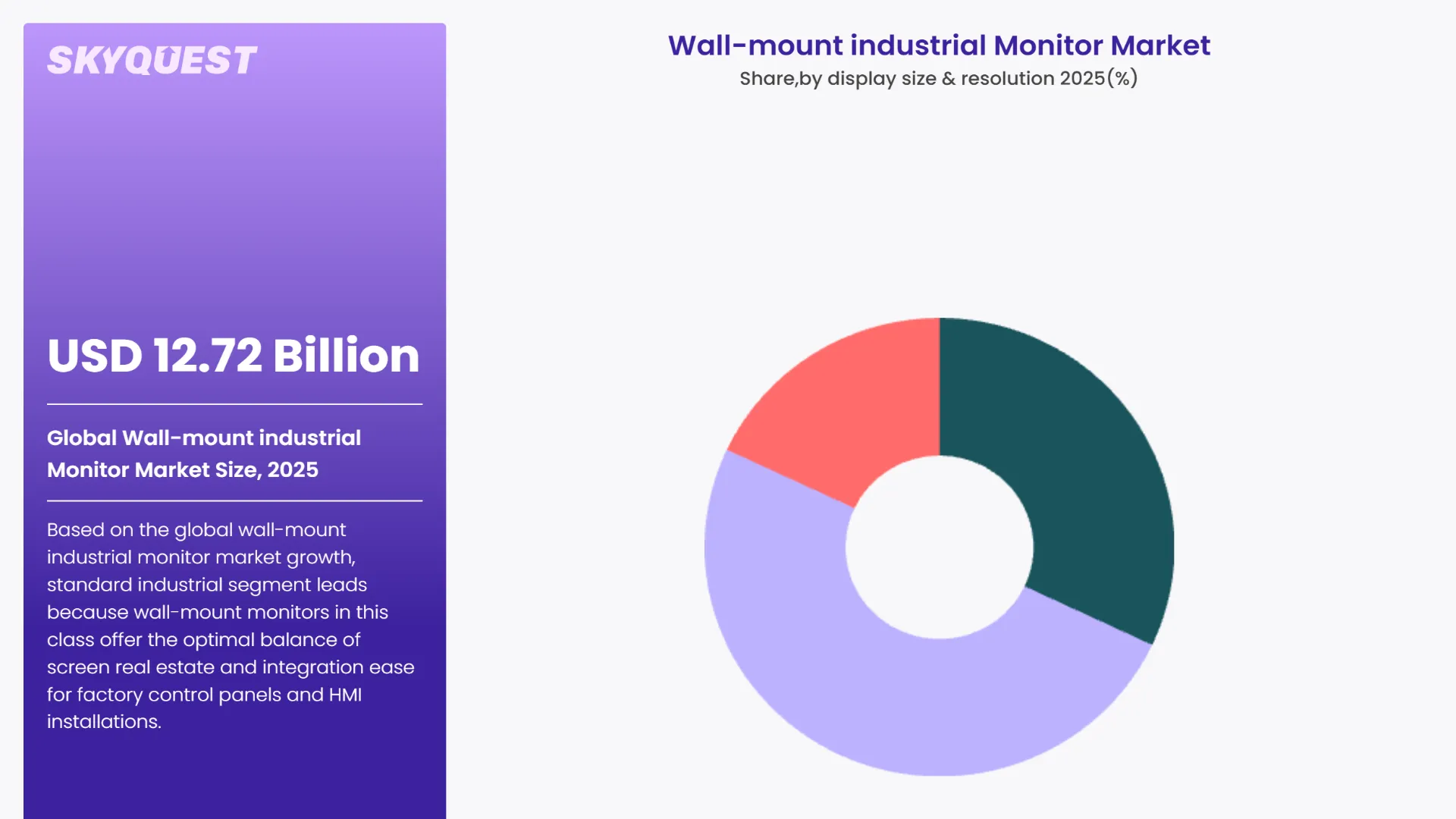
Based on the global wall-mount industrial monitor market growth, standard industrial segment leads because wall-mount monitors in this class offer the optimal balance of screen real estate and integration ease for factory control panels and HMI installations. As they are designed to fit existing racks and cabinets, their retrofitting should be straightforward and their overall interoperability with automation systems should help to make it easy for the suppliers to procure and provide to customers, which will increase both vendor selection for procurement and supplier investment on delivering reliable performance and long-term lifecycle support.
However, large format is emerging as the most rapidly expanding area due to demand for high-visibility operator interfaces on complex process lines and control rooms. New developments in thermal management and smaller enclosure designs have enabled the feasibility of deploying monitor displays on the walls of both monitoring centers and other facilities wanting to use these immersive dashboard technology systems for quick and effective decision making and oversight.
Projected capacitive (PCAP) multi-touch segment leads because its responsive gesture interface and durable glass surfaces match modern operator expectations for intuitive HMIs, enabling faster navigation and multi-operator collaboration on wall-mount displays. To enable rugged coatings, multi-touch accuracy and seamless automation-software interfacing for PCAP design development by suppliers, thus enabling adoption in complex control-room environments seeking increased efficiency and lower training costs. This performance/usability combination and the rugged design makes PCAP the interface of choice for future-generation wall-mounted solutions.
However, resistive touch is witnessing the strongest growth momentum as users prioritize reliable input with gloves and tools in harsh shop floor conditions. Its proven performance with moisture and contaminant exposure, combined with lower procurement cost and ease of retrofit into legacy enclosures, accelerates deployment across applications that demand tactile reliability and minimal changes to existing operator workflows.
To get detailed segments analysis, Request a Free Sample Report
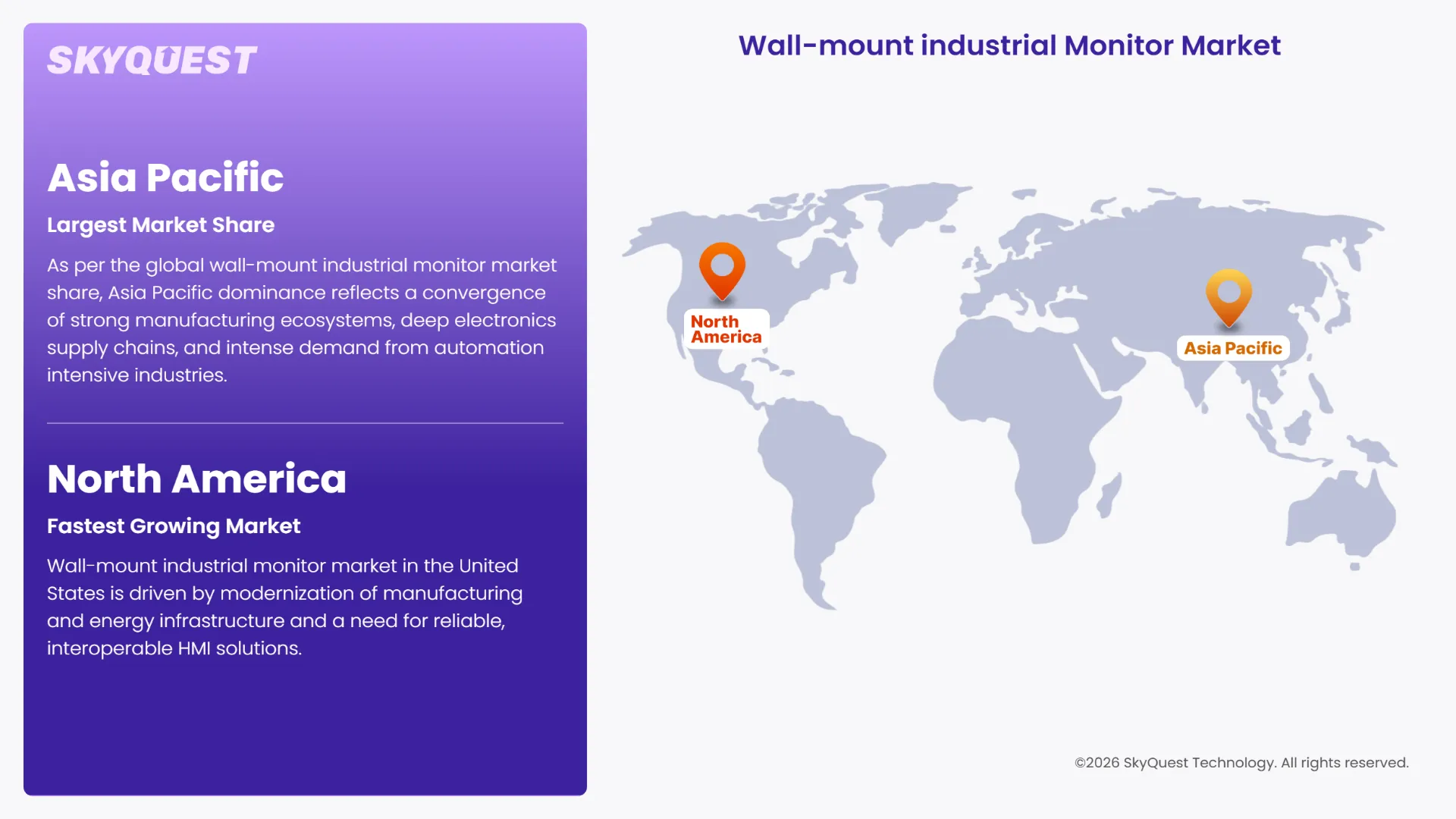
As per the global wall-mount industrial monitor market share, Asia Pacific dominance reflects a convergence of strong manufacturing ecosystems, deep electronics supply chains, and intense demand from automation intensive industries. Local ability to produce display devices and integrate them into ruggedized applications gives a competitive edge. Significant numbers of original equipment manufacturers and system integrators prefer to procure customized, wall-mounted monitors with demanding specifications for durability and connectivity from local sources. Strategic investment in smart manufacturing and aftermarket service centers and close working relationships between component manufacturers and end-users provide the foundation for maintaining market leadership. Strong export orientation, in conjunction with effective logistics and product innovation provide additional means of expanding the region's capacity to support a wide variety of industrial verticals, positioning the region as the focal point for global sourcing and technology implementation.
Wall-mount industrial monitor market in Japan is shaped by demand for high reliability, precision engineering, and integration with advanced automation systems. Durable displays are the manufacturer's top priority for factory automation and transport applications due to their severe quality control processes and extended lifespan. Manufacturers have established close working relationships with electronics suppliers to provide custom solutions and innovate incrementally. In choosing their products, industrial OEMs look at factors such as the product's serviceability versus adherence to domestic technical standards.
Wall-mount industrial monitor market in South Korea is characterized by rapid adoption of cutting-edge display technologies and strong ties to semiconductor and electronics sectors. There is a strong focus on monitors that are compact, perform well, and these are important for advanced manufacturing and the smart plant initiative. Local suppliers and integrators are working together with their end-users/ customers to provide customized and rugged solutions for the fast-paced and demanding environment of today’s industrial world. Agile supply chains are helping manufacturers meet both domestic modernization needs and exporting quality industrial display systems.
Based on global wall-mount industrial monitor regional forecast, expansion in North America is propelled by accelerated industrial modernization, widespread deployment of automation, and integration of monitoring systems with enterprise software platforms. A strong distributor and service provider network enables companies to roll these products into their operations and to receive after-market support in a wide variety of geographical areas. System integrators and OEMs are motivated to adopt these products because of a strong emphasis on interoperability as well as security (cybersecurity), and the fact that they can be customised to meet individual customer needs. The US market place is currently benefiting from a large capital investment in refurbishing and upgrading their existing facilities, focusing on operational resiliency, and promoting a culture of new ideas around instrumentation and controls.
Wall-mount industrial monitor market in the United States is driven by modernization of manufacturing and energy infrastructure and a need for reliable, interoperable HMI solutions. Buyers emphasize rugged construction, long term support, and compatibility with automation platforms and software ecosystems. System Integrators and OEMs choose configurable displays which are ideal for specific operational workflows with their operational needs. Strong service and competitive supply networks enable a rapid deployment and life cycle management process. Cybersecurity and regulatory compliance will drive how products are procured.
Wall-mount industrial monitor market in Canada reflects demand from resource extraction, manufacturing, and process industries that require durable, climate resistant display solutions. Purchasing decisions are made based on the reliability of the products being purchased, how easily they can work with existing systems, and the level of customer service available after the sale has been made. Large geographic areas with many clients will generally use local integrators to supply monitors that will provide the best performance in harsh climates, as well as those that are easily integrated into existing automation or monitoring systems.
As per global wall-mount industrial monitor regional outlook, Europe is reinforcing its market position through a combination of advanced manufacturing adoption, harmonized technical standards, and a strong focus on industrial digitalization. The partnerships that companies establish with their suppliers, research organizations and customers allow them to develop rugged products, ergonomic user design and more connected products through collaborative research & development initiatives; as a result, these partnerships foster rapid technological advancements. In addition, consolidation of dedicated specialty suppliers and improvement of after sales service capabilities enables these manufacturers to expand their geographic territories by providing automotive/chemical/transportation/ export driven manufacturing to their competitors in those specific industries
Wall-mount industrial monitor market in Germany is anchored by a strong manufacturing base that demands high precision, robustness, and integration with sophisticated automation systems. Monitors that can provide HMI requirements and also allow for safety and quality are the most popular among buyers. Suppliers and industrial OEMs work together to create highly specific and very engineering solutions. Enabling the systems to last for more than one application, providing maintenance support, and ensuring they will work well with existing control structures is what will create innovation in rugged monitor technology and influence purchasing actions.
Wall-mount industrial monitor market in United Kingdom is shaped by diverse industrial needs across manufacturing, utilities, and transport sectors that require flexible and secure display solutions. A modular, serviceable monitor that is suitable for a variety of control environments contributes to the development of a dynamic supplier ecosystem. Digitalization and remote operations support connected displays that are easy to integrate with software. Local System Integrators are important in customizing global products to meet the regulatory and operational requirements of the local area.
Wall-mount industrial monitor market in France is characterized by demand from aerospace, automotive, and process industries for reliable, high-performance displays that meet exacting technical specifications. When making a purchase, you must consider conforming to safety standards and environmental regulations, a level of after-sale support, aswell as a local engineer to assist with the installation. Suppliers have developed custom ruggedized monitors designed to work in conjunction with more complex automated systems or infrastructure projects.
To know more about the market opportunities by region and country, click here to
Buy The Complete Report
Industrial IoT Integration Driving Adoption
Rising Demand For Robust HMIs
High Customization and Integration Costs
Limited Standardization Across Protocols
Request Free Customization of this report to help us to meet your business objectives.
The competitive landscape in the global wall-mount industrial monitor market outlook centers on differentiation through ruggedization, integrated edge compute, and channel partnerships, with market drivers coming from OEM demand for certified, easy to clean wall mount HMIs. Incumbents execute alliances and acquisitions to lock software and supply chains, for example Advantech's capital and business alliance with Omron. Startups push IP69k stainless steel and high brightness panels as shown by WEROCK's recent product launch.
SkyQuest’s ABIRAW (Advanced Business Intelligence, Research & Analysis Wing) is our Business Information Services team that Collects, Collates, Correlates, and Analyses the Data collected by means of Primary Exploratory Research backed by robust Secondary Desk research. As per SkyQuest analysis, the global wall-mount industrial monitor industry is being driven primarily by accelerating adoption of automation and human-machine interfaces across factories, utilities and transportation, and further strengthened by IIoT convergence and edge computing that place connected, low-latency visualization at the equipment edge. Growth is limited due to high levels of customization and integration resulting in greater total cost of ownership and longer times to deploy. The Asia Pacific region holds the largest market share based on its strong electronics supply chain, multiple OEM's from Asia Pacific who have formed key production clusters and investments into smart factories; while the Standard Industrial segment provides the best combination of screen real estate and retrofit compatibility favored by system integrators & OEM’s for this type of device.
| Report Metric | Details |
|---|---|
| Market size value in 2024 | USD 12.00 Billion |
| Market size value in 2033 | USD 20.27 Billion |
| Growth Rate | 6.0% |
| Base year | 2024 |
| Forecast period | 2026-2033 |
| Forecast Unit (Value) | USD Billion |
| Segments covered |
|
| Regions covered | North America (US, Canada), Europe (Germany, France, United Kingdom, Italy, Spain, Rest of Europe), Asia Pacific (China, India, Japan, Rest of Asia-Pacific), Latin America (Brazil, Rest of Latin America), Middle East & Africa (South Africa, GCC Countries, Rest of MEA) |
| Companies covered |
|
| Customization scope | Free report customization with purchase. Customization includes:-
|
To get a free trial access to our platform which is a one stop solution for all your data requirements for quicker decision making. This platform allows you to compare markets, competitors who are prominent in the market, and mega trends that are influencing the dynamics in the market. Also, get access to detailed SkyQuest exclusive matrix.
Table Of Content
Executive Summary
Market overview
Parent Market Analysis
Market overview
Market size
KEY MARKET INSIGHTS
COVID IMPACT
MARKET DYNAMICS & OUTLOOK
Market Size by Region
KEY COMPANY PROFILES
Methodology
For the Wall-mount industrial Monitor Market, our research methodology involved a mixture of primary and secondary data sources. Key steps involved in the research process are listed below:
1. Information Procurement: This stage involved the procurement of Market data or related information via primary and secondary sources. The various secondary sources used included various company websites, annual reports, trade databases, and paid databases such as Hoover's, Bloomberg Business, Factiva, and Avention. Our team did 45 primary interactions Globally which included several stakeholders such as manufacturers, customers, key opinion leaders, etc. Overall, information procurement was one of the most extensive stages in our research process.
2. Information Analysis: This step involved triangulation of data through bottom-up and top-down approaches to estimate and validate the total size and future estimate of the Wall-mount industrial Monitor Market.
3. Report Formulation: The final step entailed the placement of data points in appropriate Market spaces in an attempt to deduce viable conclusions.
4. Validation & Publishing: Validation is the most important step in the process. Validation & re-validation via an intricately designed process helped us finalize data points to be used for final calculations. The final Market estimates and forecasts were then aligned and sent to our panel of industry experts for validation of data. Once the validation was done the report was sent to our Quality Assurance team to ensure adherence to style guides, consistency & design.
Analyst Support
Customization Options
With the given market data, our dedicated team of analysts can offer you the following customization options are available for the Wall-mount industrial Monitor Market:
Product Analysis: Product matrix, which offers a detailed comparison of the product portfolio of companies.
Regional Analysis: Further analysis of the Wall-mount industrial Monitor Market for additional countries.
Competitive Analysis: Detailed analysis and profiling of additional Market players & comparative analysis of competitive products.
Go to Market Strategy: Find the high-growth channels to invest your marketing efforts and increase your customer base.
Innovation Mapping: Identify racial solutions and innovation, connected to deep ecosystems of innovators, start-ups, academics, and strategic partners.
Category Intelligence: Customized intelligence that is relevant to their supply Markets will enable them to make smarter sourcing decisions and improve their category management.
Public Company Transcript Analysis: To improve the investment performance by generating new alpha and making better-informed decisions.
Social Media Listening: To analyze the conversations and trends happening not just around your brand, but around your industry as a whole, and use those insights to make better Marketing decisions.
REQUEST FOR SAMPLE
 REQUEST FREE CUSTOMIZATION
Global Wall-Mount Industrial Monitor Market size was valued at USD 12.0 Billion in 2024 and is poised to grow from USD 12.72 Billion in 2025 to USD 20.27 Billion by 2033, growing at a CAGR of 6.0% during the forecast period (2026-2033).
The competitive landscape centers on differentiation through ruggedization, integrated edge compute, and channel partnerships, with market drivers coming from OEM demand for certified, easy to clean wall mount HMIs. Incumbents execute alliances and acquisitions to lock software and supply chains, for example Advantech's capital and business alliance with Omron. Startups push IP69k stainless steel and high brightness panels as shown by WEROCK's recent product launch. 'Advantech', 'Siemens AG', 'Rockwell Automation', 'Schneider Electric', 'Beckhoff Automation', 'Pepperl+Fuchs', 'Hope Industrial Systems', 'Winmate Inc.', 'Axiomtek', 'IEI Integration Corp', 'Kontron', 'ADLINK Technology', 'Moxa Inc.', 'Sparton Corp', 'Teguar Computers', 'Computer Dynamics', 'VarTech Systems', 'Industrial PC Inc.', 'TRU-Vu Monitors', 'Lanner Electronics'
Integration of industrial Internet of Things capabilities into wall mount monitors has expanded the role of displays from simple visualization to central nodes for monitoring and control. By enabling continuous remote access, consolidated data streams, and enhanced interoperability with other plant systems, IoT enabled monitors support improved decision making and operational resilience. This qualitatively increases demand for durable, network capable displays that can host analytics and visual dashboards, prompting OEMs and system integrators to prioritize wall mount solutions that facilitate real time situational awareness and streamlined industrial workflows.
Edge Integration Growth: Edge integration in wall-mount industrial monitors is accelerating as manufacturers embed local processing to enable real-time analytics, machine vision, and on-device AI. This trend reduces dependence on centralized servers, improves operational resilience in constrained network environments, and simplifies latency-sensitive control tasks. Monitors with edge capabilities offer more flexible deployment for predictive maintenance workflows and interactive operator interfaces while easing integration with operational technology stacks. Vendors emphasize secure firmware, modular compute modules, and standardized APIs to streamline adoption across industrial applications.
Asia Pacific Dominate the Global Wall-mount industrial Monitor Market.
The Standard Industrial segment holds the largest market share due to its balance of screen visibility, installation flexibility, and compatibility with industrial control systems and retrofit projects.
IoT technology is transforming industrial monitors from simple display devices into connected edge nodes capable of collecting sensor data, supporting remote monitoring, enabling predictive maintenance, and improving operational visibility.
Edge computing enables wall-mount industrial monitors to process data locally, supporting real-time analytics, machine vision, and AI-driven applications while reducing latency and dependence on centralized servers.


Want to customize this report? This report can be personalized according to your needs. Our analysts and industry experts will work directly with you to understand your requirements and provide you with customized data in a short amount of time. We offer $1000 worth of FREE customization at the time of purchase.
Feedback From Our Clients


 USA (+1) 351-333-4748

