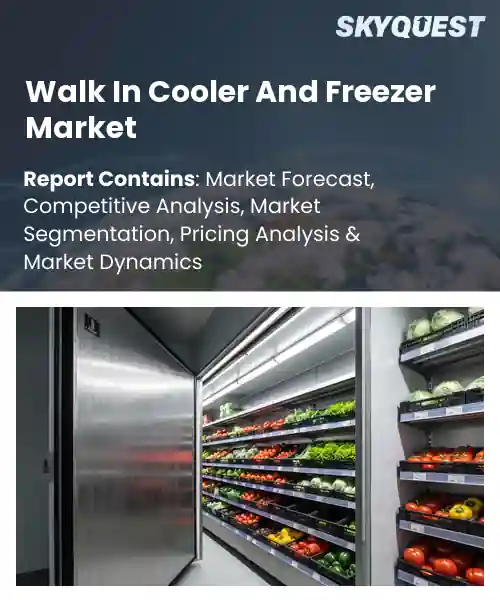
Walk In Cooler And Freezer Market
Report ID: SQMIG20B2205
Report ID: SQMIG20B2205
[email protected]
USA +1 351-333-4748
Report ID:
SQMIG20B2205 |
Region:
Global |
Published Date: July, 2026
Pages:
157
|Tables:
176
|Figures:
79


Global Walk in Cooler and Freezer Market size was valued at USD 12.4 Billion in 2024 and is poised to grow from USD 13.81 Billion in 2025 to USD 32.76 Billion by 2033, growing at a CAGR of 11.4% during the forecast period (2026-2033).
The key growth driver for the walk-in cooler and freezer market is increasing demand for foodservice, retail, and cold storage transport as consumers across the world move towards fresher, frozen, and ready-to-eat products. Walk-in coolers and freezers are basically large, refrigerated rooms that can be found in restaurants, grocery stores, drugstores, and warehouse facilities in order to keep perishable items safe at regulated temperatures, which makes this market important since it plays an integral role in food safety, efficient stock management, and supply chain management. In the past, the market developed from basic insulated rooms in standalone grocery stores to sophisticated modules with sensors due to the tightening of safety standards and the emergence of grocery delivery services around the world.
Energy efficiency and control through digitization emerge as the determining factor in the expansion of the global market for walk-in coolers and freezers due to increased cost of energy and need for compliance with regulations, forcing operators to minimize operational costs and carbon footprint. In this respect, suppliers use technologies such as variable speed compressors and high insulation materials as well as incorporate IoT systems enabling failure predictions and optimized defrost cycles, thus reducing downtime and operational costs for supermarkets, cold storage facilities and vaccine distributors. This results in greater investment into retrofits and modular systems, and it creates an opportunity for leasing cold rooms, micro fulfillment centers and last mile cold chain services.
How is IoT Improving Energy Efficiency in the Walk-in Cooler and Freezer Market?
IoT is enhancing the energy efficiency of walk-in coolers and freezers market through transforming individual parts of the refrigeration process into an interconnected ecosystem capable of learning from current situations. Information from smart sensors and telemetry helps in analyzing data in cloud-based analytics platforms that allow for predictive maintenance and adaptive control that cut down compressor operations and prevent inefficient operations. Currently, there are a lot of people who prefer retrofitted sensors and integrated controllers which alert operators about need to defrost automatically or adjust set points according to occupancy. Some examples of that would be leak detection, which prevents energy inefficiency in the long run, and predictive analytics, which schedule services before breakdowns happen.
Market snapshot - (2026-2033)
Global Market Size
USD 12.4 Billion
Largest Segment
Walk-In Coolers
Fastest Growth
Combination Walk-In Cooler & Freezer Units
Growth Rate
11.4% CAGR
To get more insights on this market click here to Request a Free Sample Report
Combination Walk-In Cooler & Freezer Units. Based on installation type, the market is segmented into Indoor and Outdoor. Based on components, the market is segmented into Panels, Doors, Refrigeration Systems, Shelving & Storage Systems and Accessories & Others. Based on insulation material, the market is segmented into Polyurethane (PU) Panels, Polystyrene (EPS/XPS) Panels, and Other Insulation Materials. Based on end user, the market is segmented into Food Service, Food Retail, Food Processing, Pharmaceutical & Healthcare, Cold Storage & Logistics, Floral Industry and Others. Based on distribution channels, the market is segmented into Direct Sales, Distributors & Dealers, and System Integrators & Contractors. Based on region, the market is segmented into North America, Europe, Asia Pacific, Latin America and Middle East & Africa.
The Doors category leads as it directly affects the point of heat transfer and regular use, thus making doors critical in terms of maintaining constant temperature in walk-in coolers and freezers. Quality doors help prevent infiltrations, minimize temperature variations, and lower refrigeration loads, which pushes users' requests for robust seals, quick-closing devices, and sanitary coatings to make the processes more efficient and less costly in their lifecycle.
On the contrary, refrigeration units demonstrate the highest dynamics, as there were made great advancements in such fields as compressors' efficiency, refrigerants, and controls to provide better energy efficiency and compliance with the standards. There was observed an increased interest in remote monitoring systems and modular units that create new procurement possibilities for the companies.
The PU Panels segment occupies a dominant position in the market because of the excellent thermal resistance and structural integrity that enable them to provide thin and light walls while offering efficient thermal performance for the walk-in coolers and freezers. The improved insulation leads to reduced steady-state heat gain and compressor operation, which helps in cutting down the operational costs and increasing the longevity of machinery.
Owing to the most rapidly growing area in the insulated panels market is the EPS/XPS panels segment owing to the low cost of materials, enhanced compressive strength, and the capability to be used in modular and retrofits installations.
To get detailed segments analysis, Request a Free Sample Report
This continent's leadership stems from the existence of well-developed cold chain facilities, concentration of end-user demand, and a healthy manufacturing and OEM industry that ensures wide availability and services. The position is strengthened by the popularity of cutting-edge refrigeration systems, focusing on energy saving, and food safety/storage legislation that promotes the need for updates and compliance. Efficient large-scale distribution and logistics centers ensure swift implementation and after-sales services. Diverse applications of the products across sectors such as catering, grocery stores, pharmaceuticals, and logistics make a varied demand, while efficient financial and contracting models make the process of installation easier.
The Walk-In Cooler and Freezer market in United States features considerable retail consolidation and well-developed foodservice industry that call for customized cooling equipment. The need arises from full-service restaurants, quick service restaurants, chains of grocery stores, and logistics firms looking for dependable, energy efficient refrigeration and good servicing contracts. The industry environment encourages companies that manufacture their products in modular form, provide retrofitting options, and facilitate remote monitoring of the installations through widespread distribution of installations and servicing facilities.
Market of Walk-In Coolers and Freezers in Canada shows the problems of regional logistics, as well as the need for durable construction and high energy performance in different climates. Consumers prefer durable insulation, good energy efficiency of refrigeration packages, and the availability of services in local areas, which will serve food stores and processors with scattered populations. Expansion of the market is determined by the need to comply with regulations about the safety of food and environment, which leads to upgrading.
Europe is currently witnessing the growth of fast expanding markets due to pressure from the regulators to raise food safety standards and energy efficiency, modernization of the retail formats, and investments in logistics and central cold stores. Such a trend is supported by the availability of an engineering infrastructure, which allows designing effective and compliant systems that would meet different demands of different markets. Such factors as the development of the e commerce grocery business, demand for high-quality and fresh perishable products, and renovation of existing facilities promote implementation of advanced cooling systems. Cross border operations and standards contribute to the development, and service providers help implement such solutions.
Market for Walk in Coolers and Freezers in Germany is driven by the strong engineering heritage in the country that provides premium and efficient systems for the local and export markets. Consumers appreciate accuracy and reliability and the need to comply with rigorous regulatory standards, thus prompting innovation in refrigeration technology and control. Collaboration between manufacturers and logistics providers facilitates the development of custom-made solutions for the food retail, processing and warehousing industries.
Walk-In Cooler & Freezer Market in the UK is characterized by a dynamic retail and food service business that values flexibility and fast deployment of modular and scalable walk-in coolers and freezers systems. This is driven by changing patterns of consumer shopping and the need for agility in the operation of retail stores and the back of the store areas. It requires fast installation, efficient energy management, and remote monitoring capabilities. This market gives an advantage to those suppliers who can add value to their service through financing and maintenance networks.
Market for Walk in Cooler and Freezers in France is developing owing to modernization of food retail business and a robust gastronomy culture requiring high-end cooling solutions. Growing demand for systems that are efficient, silent and fulfill design and environmental requirements of boutique stores and artisanal foods suppliers is being witnessed. Modernization of current infrastructure and targeted investments in cold centers ensure supply of fresh products. Providers who offer high performance and design sensitivity along with after-sales services gain an edge in the market.
Asia Pacific is gaining market ground by means of rapid industrialization of food processing and retailing, increasing expertise in the manufacture of refrigerators and increased adoption of smaller and energy-efficient refrigeration solutions that suit urban areas. Refrigerator manufacturers in the region are taking advantage of their strength in electronics and components to incorporate intelligent control systems in their appliances. Investments in the cold chain and increased demand for refrigerated and frozen foods motivate localized production and customization of products. Collaboration with global OEMs across borders in addition to technology transfer enhances quality, while service ecosystems offer installation and maintenance services.
Walk In Cooler and Freezer Market in Japan is characterized by exacting engineering and an emphasis on efficient use of space. The buyer is looking for energy efficiency, compatibility with automation, and compact design to be used at retail and food manufacturing sites in cities. Sellers compete based on control technology, silent running, and service agreements to match their high-performance expectations.
Walk-In Cooler and Freezer Market in South Korea capitalizes on its expertise in electronic devices and the Internet of Things that helps incorporate advanced solutions such as smart monitoring, predictive maintenance, and energy management in refrigeration solutions. The market prefers solutions that are modular and quick to implement for convenience stores, modern retail stores, and exports-focused processors. Local competitors are nimble, innovative, and work with service partners that ensure that products can be quickly adapted to customer needs.
To know more about the market opportunities by region and country, click here to
Buy The Complete Report
Rising Retail and Foodservice Demand
The rise in inventories and products that require refrigerated storage will increase the need for walk-in coolers and freezers. They facilitate longer shelf life and higher-quality perishables, thereby providing the rationale for purchases and improvements in equipment. The requirement for flexibility in layout and quick implementation due to evolving assortments leads to a preference for modular options. Firms focus on supply chain resilience, and fresher products will translate into greater dependency on dedicated cold storage.
Stringent Food Safety Regulations
Raising the bar with respect to the food safety standards and inspection demands will mean that the producers, distributors, and sellers of food products will have to create environments with regulated temperatures, thus, demanding high-quality walk-in coolers and freezers. Food safety standards place the importance of maintaining consistent temperatures, traceability, and hygienic nature of the equipment used for cold storage, which makes them upgrade their facilities and buy certified equipment. The need to maintain the integrity of the products and reduce spoilage drives their efforts.
High Energy Consumption Concerns
The considerable energy usage inherent in big refrigeration systems causes cost and sustainability issues that may hinder the acceptance of walk-in coolers and freezers, especially in cost-conscious organizations. The perception of continuous expenses and negative effects on the environment results in the delay of extension or the preference for small-scale systems, as well as the increasing interest in improvement over new installations. Consequently, the outcome is delayed purchase, prolonged life of equipment, and slowed market growth in some sectors.
Complex Installation and Maintenance
Technical difficulty associated with installation and maintenance of commercial walk-in refrigerator technology poses logistical problems and costs that may limit industry growth. Technical difficulties related to contracting out, preparing the site for installation, integrating the system into an already existing one, as well as preventative maintenance increase both time and risk of new installations, discouraging smaller players from investing in the technology. The likelihood of disruptions and the need for professional technical expertise makes rapid growth impossible in some regions.
Request Free Customization of this report to help us to meet your business objectives.
The competitive landscape is driven by regulatory pressure for low global warming potential refrigerants as well as pressure from retailers for energy-efficient modular solutions, leading to consolidation and partnerships. Significant developments are the takeover of Hussmann by Panasonic, the efforts of Hillphoenix in the development of CO2 commercial refrigeration solutions, and the introduction of state-of-the-art vapour injection systems and modular cold solutions by various manufacturers.
Sustainability Focus in Design: The use of eco-friendly materials, low GWP refrigerants, and modular designs to ensure the longevity of equipment has become a top priority for manufacturers. The demand for sustainable solutions among buyers is growing, pushing companies to engage in more collaborative processes to facilitate circularity and adaptability. This approach allows for designing equipment to last longer and be easy to recycle and maintain while reducing environmental impact. Such equipment has great potential to position itself as premium with a possibility to generate income through services and customer loyalty due to its proven sustainability.
Integration with Smart Supply Chains: The manufacturers of coolers and freezers are incorporating connectivity and sensors to help them achieve real-time visibility, remote monitoring, and condition-based servicing for increased uptime and extended life. With the ability to interoperate with warehouse management and logistics systems, it becomes possible to rotate stock and maintain the right temperature throughout transportation. The suppliers of these devices are using the data being generated through the devices to offer result-driven services, maintenance, and after-sale support.
SkyQuest’s ABIRAW (Advanced Business Intelligence, Research & Analysis Wing) is our Business Information Services team that Collects, Collates, Correlates, and Analyses the Data collected by means ofPrimary Exploratory Research backed by robust Secondary Desk research.
As per SkyQuest analysis, the global walk-in coolers and freezers industry growth is mainly attributed to increased demands in the food service, retail, and cold chain logistics sector from consumers’ preference towards fresh, frozen, and ready-to-eat food products, and the second major growth driver is the need for increased energy efficiency and digitization for cost savings and predictive maintenance capability. The major factor that acts as the limitation on this industry is the high energy consumption along with high operational costs of the big refrigeration systems. North America is the largest market in terms of share due to the developed cold chain system and OEM ecosystem, and doors are the dominating market segment.
| Report Metric | Details |
|---|---|
| Market size value in 2024 | USD 12.4 Billion |
| Market size value in 2033 | USD 32.76 Billion |
| Growth Rate | 11.4% |
| Base year | 2024 |
| Forecast period | (2026-2033) |
| Forecast Unit (Value) | USD Billion |
| Segments covered |
|
| Regions covered | North America (US, Canada), Europe (Germany, France, United Kingdom, Italy, Spain, Rest of Europe), Asia Pacific (China, India, Japan, Rest of Asia-Pacific), Latin America (Brazil, Rest of Latin America), Middle East & Africa (South Africa, GCC Countries, Rest of MEA) |
| Companies covered |
|
| Customization scope | Free report customization with purchase. Customization includes:-
|
To get a free trial access to our platform which is a one stop solution for all your data requirements for quicker decision making. This platform allows you to compare markets, competitors who are prominent in the market, and mega trends that are influencing the dynamics in the market. Also, get access to detailed SkyQuest exclusive matrix.
Table Of Content
Executive Summary
Market overview
Parent Market Analysis
Market overview
Market size
KEY MARKET INSIGHTS
COVID IMPACT
MARKET DYNAMICS & OUTLOOK
Market Size by Region
KEY COMPANY PROFILES
Methodology
For the Walk In Cooler And Freezer Market, our research methodology involved a mixture of primary and secondary data sources. Key steps involved in the research process are listed below:
1. Information Procurement: This stage involved the procurement of Market data or related information via primary and secondary sources. The various secondary sources used included various company websites, annual reports, trade databases, and paid databases such as Hoover's, Bloomberg Business, Factiva, and Avention. Our team did 45 primary interactions Globally which included several stakeholders such as manufacturers, customers, key opinion leaders, etc. Overall, information procurement was one of the most extensive stages in our research process.
2. Information Analysis: This step involved triangulation of data through bottom-up and top-down approaches to estimate and validate the total size and future estimate of the Walk In Cooler And Freezer Market.
3. Report Formulation: The final step entailed the placement of data points in appropriate Market spaces in an attempt to deduce viable conclusions.
4. Validation & Publishing: Validation is the most important step in the process. Validation & re-validation via an intricately designed process helped us finalize data points to be used for final calculations. The final Market estimates and forecasts were then aligned and sent to our panel of industry experts for validation of data. Once the validation was done the report was sent to our Quality Assurance team to ensure adherence to style guides, consistency & design.
Analyst Support
Customization Options
With the given market data, our dedicated team of analysts can offer you the following customization options are available for the Walk In Cooler And Freezer Market:
Product Analysis: Product matrix, which offers a detailed comparison of the product portfolio of companies.
Regional Analysis: Further analysis of the Walk In Cooler And Freezer Market for additional countries.
Competitive Analysis: Detailed analysis and profiling of additional Market players & comparative analysis of competitive products.
Go to Market Strategy: Find the high-growth channels to invest your marketing efforts and increase your customer base.
Innovation Mapping: Identify racial solutions and innovation, connected to deep ecosystems of innovators, start-ups, academics, and strategic partners.
Category Intelligence: Customized intelligence that is relevant to their supply Markets will enable them to make smarter sourcing decisions and improve their category management.
Public Company Transcript Analysis: To improve the investment performance by generating new alpha and making better-informed decisions.
Social Media Listening: To analyze the conversations and trends happening not just around your brand, but around your industry as a whole, and use those insights to make better Marketing decisions.
REQUEST FOR SAMPLE
 REQUEST FREE CUSTOMIZATION
Global Walk In Cooler And Freezer Market size was valued at USD 12.4 Billion in 2024 and is poised to grow from USD 13.81 Billion in 2025 to USD 32.76 Billion by 2033, growing at a CAGR of 11.4% during the forecast period (2026-2033).
Competitive landscape is shaped by regulatory and retailer pressure to adopt low global warming potential refrigerants and energy efficient modular systems, prompting consolidation, strategic partnerships, and product innovation. Major moves include Panasonic’s acquisition of Hussmann, Hillphoenix’s push on CO2 commercial refrigeration, and manufacturers launching advanced vapour injection and modular cold solutions while pilots and partnerships by retailers and integrators scale new service and financing models. 'Carrier Global Corporation', 'Daikin Industries, Ltd.', 'Johnson Controls International plc', 'Dover Corporation', 'Hussmann Corporation', 'Epta S.p.A.', 'Viessmann Refrigeration Solutions GmbH', 'Master-Bilt Products, LLC', 'Norlake, Inc.', 'Bally Refrigerated Boxes, Inc.', 'American Panel Corporation', 'SRC Refrigeration', 'Polar King International, Inc.', 'Imperial Brown, Inc.', 'Foster Refrigerator', 'Williams Refrigeration', 'Arneg S.p.A.', 'Kysor Warren EPTA US Corporation', 'Thermo-Kool Corporation', 'Kolpak, LLC'
Retailers and foodservice operators are expanding inventory and product offerings that require reliable temperature-controlled storage, which drives demand for walk-in coolers and freezers. These facilities support extended shelf life and consistent quality for perishable goods, encouraging investment in new units and upgrades. The need for customizable layouts and rapid deployment to meet changing assortments further encourages specification of modular solutions. As operators prioritize supply chain resiliency and product freshness, reliance on dedicated cold storage grows, supporting steady market expansion and supplier innovation.
Sustainability Focus In Design: Manufacturers are prioritizing environmentally conscious materials, refrigerant alternatives with lower global warming potential, and modular architectures that extend equipment lifecycles. Buyers increasingly require products aligned with corporate sustainability goals and certification schemes, prompting deeper collaboration across supply chains to enable circularity and easier retrofitting. This trend emphasizes design for durability, end of life recovery, and reduced operational footprint, creating opportunities for premium positioning, service-based revenue models, and stronger customer loyalty driven by demonstrable environmental performance and measurable sustainability reporting practices.
Why does North America Dominate the Global Walk In Cooler And Freezer Market? |@12


Want to customize this report? This report can be personalized according to your needs. Our analysts and industry experts will work directly with you to understand your requirements and provide you with customized data in a short amount of time. We offer $1000 worth of FREE customization at the time of purchase.
Feedback From Our Clients


 USA (+1) 351-333-4748

