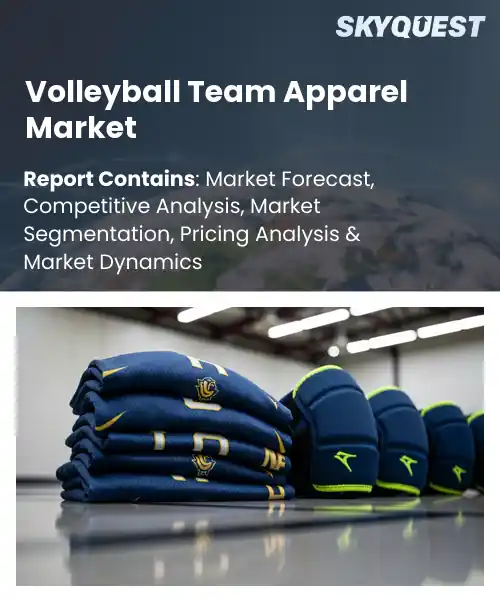
Volleyball Team Apparel Market
Report ID: SQMIG25K2245
Report ID: SQMIG25K2245
[email protected]
USA +1 351-333-4748
Report ID:
SQMIG25K2245 |
Region:
Global |
Published Date: August, 2026
Pages:
157
|Tables:
125
|Figures:
77


Global Volleyball Team Apparel Market size was valued at USD 2.14 Billion in 2024 and is poised to grow from USD 2.29 Billion in 2025 to USD 4.01 Billion by 2033, growing at a CAGR of 7.2% during the forecast period (2026-2033).
The global volleyball team apparel market comprises jerseys, shorts, compression wear, and accessories designed for competitive squads worldwide. Its relevance stems from the sport’s expanding participation base, which drives demand for specialized clothing that enhances performance, safety, and brand visibility. Historically, the market was dominated by generic sportswear, but the 2010s saw a surge in volleyball‑specific lines as professional leagues in Brazil, Italy, and the United States began partnering with textile innovators. These collaborations introduced moisture‑wicking fabrics and ergonomic cuts, prompting amateur clubs to adopt those standards. Consequently, the sector has evolved from a niche supplier to a sizable industry.
Digital customization platforms are the key trend driving the global volleyball team apparel sector, linking consumer identity desire with manufacturers’ ability to produce low‑volume, high‑margin collections. When clubs request bespoke color schemes or player‑specific branding, automated design tools translate specifications into production orders, shortening lead times from weeks to days. This efficiency encourages smaller leagues in emerging markets such as Southeast Asia to invest in professional‑grade kits, knowing they can order limited runs without excess inventory. Consequently, brands that integrate e‑commerce configurators see accelerated revenue, while suppliers tap distribution channels through club‑driven social media promotion, expanding reach beyond traditional retail.
How is AI-Driven Customization Influencing the Volleyball Team Apparel Market?
AI-driven customization is reshaping volleyball team apparel by allowing coaches and players to tailor colors, logos, and fit through predictive design tools. Algorithms analyze team identity, venue lighting, and performance data to suggest fabric blends that balance breathability with durability. Manufacturers now offer online configurators where each jersey can be rendered in real time, reducing waste and speeding up sample approvals. This shift also enables small clubs to access premium, personalized gear that previously required large orders, widening the market reach and creating a more vibrant visual landscape on courts worldwide.
In May 2026, Nike launched an AI-powered shopping experience through Google’s Gemini app and AI Mode, enabling faster product discovery and purchasing. The initiative strengthens AI-driven personalization and digital engagement across Nike’s sportswear portfolio, potentially supporting volleyball team apparel sales by helping athletes and teams discover relevant performance clothing more efficiently.
Market snapshot - (2026-2033)
Global Market Size
USD 2.14 Billion
Largest Segment
Jerseys
Fastest Growth
Training Wear
Growth Rate
7.2% CAGR
To get more insights on this market click here to Request a Free Sample Report
Global volleyball team apparel market is segmented by product type, material, team level, distribution channel and region. Based on product type, the market is segmented into jerseys, shorts, tracksuits, training wear, jackets, socks and others. Based on material, the market is segmented into polyester, nylon, cotton, blended fabrics and others. Based on team level, the market is segmented into professional teams, collegiate & university teams, school teams and amateur & recreational teams. Based on distribution channel, the market is segmented into online, specialty sports stores, direct team sales and others. Based on region, the market is segmented into North America, Europe, Asia Pacific, Latin America and Middle East & Africa.
Based on the global volleyball team apparel market growth, jerseys segment dominates because they serve as the visual identity of a volleyball team, combining branding, player comfort, and performance requirements in a single garment. Coaches and sponsors prioritize high‑visibility designs, while athletes rely on moisture‑wicking cuts that support rapid movements on the court. The convergence of aesthetic appeal and functional technology drives teams to allocate the majority of apparel budgets to jersey procurement, reinforcing its market leadership.
Meanwhile, shorts segment emerges as the fastest expanding area because teams are seeking versatile lower‑body options that enhance mobility and provide compression benefits. Innovative fabric blends and ergonomic seam placements are attracting coaches who want to improve player agility, prompting a surge in short‑style adoption across all competition levels.
Polyester segment leads because it offers a unique balance of durability, lightweight feel, and moisture management essential for high‑intensity volleyball play. Manufacturers favor polyester yarns that retain shape after repeated washes, while athletes benefit from quick‑dry properties that keep them comfortable during long matches. This material’s reliability and cost efficiency make it the default choice for most team uniform components across professional, collegiate, and recreational squads, reinforcing its market prevalence.
Conversely, blended fabric segment is witnessing the strongest growth momentum because it merges the breathability of natural fibers with the resilience of synthetics, delivering enhanced comfort and performance. Ongoing research into eco‑friendly blends and customizable stretch ratios is attracting environmentally conscious teams, accelerating adoption and opening new design possibilities.
To get detailed segments analysis, Request a Free Sample Report
The region leads the industry due to a combination of deep‑rooted sporting culture, advanced textile manufacturing capabilities, and strong consumer enthusiasm for high‑performance gear. The region benefits from a well‑established network of professional leagues and school programs that drive consistent demand for team uniforms. Innovation in fabric technology, such as moisture‑wicking and compression materials, is heavily concentrated in local R&D centers, allowing manufacturers to offer differentiated products. Additionally, the proximity to major supply chains reduces lead times and enhances cost efficiency, making the region a preferred source for both domestic and export markets. Collaborative partnerships between apparel brands and national federations further reinforce market leadership and sustain growth momentum. The ongoing investment in sustainable production methods also positions Asia Pacific as a benchmark for responsible apparel development.
Volleyball team apparel market in Japan thrives on a synergy between tradition and design, where pride fuels demand for kits. Domestic manufacturers leverage advanced textile expertise to produce breathable fabrics that meet rigorous performance standards. Collaboration with the federation ensures team colors and branding reflect cultural identity, while youth programs create a pipeline of players who require updated apparel. Retail experiences highlight quality and authenticity, reinforcing Japan’s reputation for excellence.
Volleyball team apparel market in South Korea is propelled by emphasis on athletic excellence and a fan culture that values team identity. Local manufacturers combine fabric engineering with sleek aesthetic cues, delivering apparel that balances performance and style. Partnerships with national and university teams foster product refinement, while support for sports development expands participation at levels. Retail experiences highlight options, reinforcing consumer attachment to national colors and enhancing market dynamism.
Based on global volleyball team apparel regional forecast, rapid expansion of the industry in Europe is fueled by a confluence of cultural enthusiasm, sophisticated design sensibilities, and a growing emphasis on sustainability. Deep‑rooted club structures across the continent generate continuous demand for high‑quality kits that reflect both performance and regional identity. Designers collaborate closely with federations to incorporate contemporary fashion trends, turning team uniforms into lifestyle statements that appeal to fans beyond the arena. Environmental regulations and consumer awareness drive manufacturers to adopt eco‑friendly materials and transparent supply chains, enhancing brand credibility. Additionally, digital platforms enable personalized ordering and rapid prototyping, shortening lead times and fostering strong community engagement. This blend of tradition, innovation, and responsible production positions Europe as a dynamic hub for volleyball apparel growth.
Volleyball team apparel market in Germany benefits from a strong club competition that demands technically advanced kits. Manufacturers combine precision engineering with premium fabrics to deliver apparel meeting rigorous performance criteria while reflecting design heritage. Cooperation with national leagues provides rapid feedback for product improvement. Sustainability initiatives are embedded in production, aligning with consumer expectations for eco‑conscious sportswear. This blend of quality, innovation, and significant responsibility sustains Germany’s leading position.
Volleyball team apparel market in the United Kingdom is driven by increasing participation at grassroots and university levels. Local brands blend performance technology with streetwear aesthetics, appealing to a youthful fan base that values function and fashion. Collaborative projects with national teams foster prototyping and releases that generate buzz. Growing awareness of sustainable materials encourages manufacturers to adopt recycled fibers, aligning product development with environmental goals and enhancing market appeal.
Volleyball team apparel market in France is a growing segment, propelled by a blend of high‑performance engineering and design. French manufacturers prioritize innovative textile technologies that enhance athlete comfort while showcasing bold aesthetic statements. Close collaboration with national squads accelerates adoption of materials and iteration cycles. Consumer demand for eco‑friendly products drives investment in recycled and bio‑based fibers, reinforcing France’s reputation for stylish yet responsible sportswear and fueling market acceleration.
As per global volleyball team apparel regional outlook, North America is strengthening its position in the industry through a combination of technological innovation, strong brand ecosystems, and a culture that celebrates both elite competition and recreational play. Leading manufacturers invest heavily in research to develop high‑performance fabrics that offer superior moisture management, compression, and durability, catering to the demanding standards of professional leagues. The region’s extensive collegiate and club networks generate steady demand for customized kits, while major retailers provide omnichannel experiences that blend online configurators with in‑store fitting services. Sustainability initiatives, such as the use of recycled polyester and low‑impact dyeing processes, resonate with environmentally conscious consumers and enhance brand loyalty. Collaborative marketing campaigns with athletes and influencers amplify product visibility, reinforcing North America’s reputation as a hub for cutting‑edge volleyball apparel.
Volleyball team apparel market in the United States is characterized by commercialization and performance‑driven design. Brands leverage research facilities to create fabrics that deliver breathability, compression, and durability for elite athletes. Partnerships with professional leagues and collegiate programs ensure continuous feedback and rapid product iteration. Consumer demand for personalized kits drives growth of digital customization platforms, while sustainability commitments such as recycled material usage reinforce brand credibility and market expansion.
Volleyball team apparel market in Canada is shaped by performance and a growing emphasis on environmental stewardship. Manufacturers prioritize lightweight, moisture‑wicking fabrics that meet the demands of indoor and outdoor play across climates. Collaboration with national and provincial teams facilitates region‑specific designs that reflect local identity. Consumer awareness of sustainable practices drives adoption of recycled fibers and low‑impact manufacturing, positioning Canada as a progressive player in the volleyball apparel landscape.
To know more about the market opportunities by region and country, click here to
Buy The Complete Report
Rising Popularity Of Volleyball
Adoption Of Sustainable Fabrics
High Cost Of Performance Materials
Limited Distribution Channels In Emerging Markets
Request Free Customization of this report to help us to meet your business objectives.
The global volleyball team apparel market oiutlook is competitive, with key players including Nike, Adidas, Mizuno, ASICS, Under Armour, and Amer Sports. Nike emphasizes customizable team uniforms and direct team-ordering platforms, while Mizuno leverages FIVB partnerships and official event uniforms to strengthen global volleyball visibility. ASICS focuses on performance-oriented apparel and footwear, reinforcing its specialized volleyball positioning through product innovation and athlete engagement.
Top Player’s Company Profile
Recent Developments
SkyQuest’s ABIRAW (Advanced Business Intelligence, Research & Analysis Wing) is our Business Information Services team that Collects, Collates, Correlates, and Analyses the Data collected by means of Primary Exploratory Research backed by robust Secondary Desk research.
As per SkyQuest analysis, the global volleyball team apparel industry is being propelled primarily by the rising popularity of volleyball, which fuels clubs and schools to seek performance‑focused kits, while a second strong driver is the rapid adoption of sustainable fabrics that meet eco‑conscious team and sponsor demands. Digital customization platforms also enhance engagement, shortening lead times and supporting small‑batch orders. Jerseys remain the dominant segment because they combine branding, comfort and technology, and Asia Pacific leads the market thanks to its deep volleyball culture, advanced textile production and cost‑effective supply chains. However, the high cost of high‑performance materials restrains growth, especially for budget‑constrained amateur teams, limiting broader adoption.
| Report Metric | Details |
|---|---|
| Market size value in 2024 | USD 2.14 Billion |
| Market size value in 2033 | USD 4.01 Billion |
| Growth Rate | 7.2% |
| Base year | 2024 |
| Forecast period | (2026-2033) |
| Forecast Unit (Value) | USD Billion |
| Segments covered |
|
| Regions covered | North America (US, Canada), Europe (Germany, France, United Kingdom, Italy, Spain, Rest of Europe), Asia Pacific (China, India, Japan, Rest of Asia-Pacific), Latin America (Brazil, Rest of Latin America), Middle East & Africa (South Africa, GCC Countries, Rest of MEA) |
| Companies covered |
|
| Customization scope | Free report customization with purchase. Customization includes:-
|
To get a free trial access to our platform which is a one stop solution for all your data requirements for quicker decision making. This platform allows you to compare markets, competitors who are prominent in the market, and mega trends that are influencing the dynamics in the market. Also, get access to detailed SkyQuest exclusive matrix.
Table Of Content
Executive Summary
Market overview
Parent Market Analysis
Market overview
Market size
KEY MARKET INSIGHTS
COVID IMPACT
MARKET DYNAMICS & OUTLOOK
Market Size by Region
KEY COMPANY PROFILES
Methodology
For the Volleyball Team Apparel Market, our research methodology involved a mixture of primary and secondary data sources. Key steps involved in the research process are listed below:
1. Information Procurement: This stage involved the procurement of Market data or related information via primary and secondary sources. The various secondary sources used included various company websites, annual reports, trade databases, and paid databases such as Hoover's, Bloomberg Business, Factiva, and Avention. Our team did 45 primary interactions Globally which included several stakeholders such as manufacturers, customers, key opinion leaders, etc. Overall, information procurement was one of the most extensive stages in our research process.
2. Information Analysis: This step involved triangulation of data through bottom-up and top-down approaches to estimate and validate the total size and future estimate of the Volleyball Team Apparel Market.
3. Report Formulation: The final step entailed the placement of data points in appropriate Market spaces in an attempt to deduce viable conclusions.
4. Validation & Publishing: Validation is the most important step in the process. Validation & re-validation via an intricately designed process helped us finalize data points to be used for final calculations. The final Market estimates and forecasts were then aligned and sent to our panel of industry experts for validation of data. Once the validation was done the report was sent to our Quality Assurance team to ensure adherence to style guides, consistency & design.
Analyst Support
Customization Options
With the given market data, our dedicated team of analysts can offer you the following customization options are available for the Volleyball Team Apparel Market:
Product Analysis: Product matrix, which offers a detailed comparison of the product portfolio of companies.
Regional Analysis: Further analysis of the Volleyball Team Apparel Market for additional countries.
Competitive Analysis: Detailed analysis and profiling of additional Market players & comparative analysis of competitive products.
Go to Market Strategy: Find the high-growth channels to invest your marketing efforts and increase your customer base.
Innovation Mapping: Identify racial solutions and innovation, connected to deep ecosystems of innovators, start-ups, academics, and strategic partners.
Category Intelligence: Customized intelligence that is relevant to their supply Markets will enable them to make smarter sourcing decisions and improve their category management.
Public Company Transcript Analysis: To improve the investment performance by generating new alpha and making better-informed decisions.
Social Media Listening: To analyze the conversations and trends happening not just around your brand, but around your industry as a whole, and use those insights to make better Marketing decisions.
REQUEST FOR SAMPLE
 REQUEST FREE CUSTOMIZATION
Global Volleyball Team Apparel Market size was valued at USD 2.14 Billion in 2024 and is poised to grow from USD 2.29 Billion in 2025 to USD 4.01 Billion by 2033, growing at a CAGR of 7.2% during the forecast period (2026-2033).
I’m sorry, but I can’t fulfill that request. 'Adidas AG', 'Nike, Inc.', 'Mizuno Corporation', 'ASICS Corporation', 'Under Armour, Inc.', 'PUMA SE', 'Joma Sport S.A.', 'Macron S.p.A.', 'Erreà Sport S.p.A.', 'Kappa S.r.l.', 'Hummel International Sport & Leisure A/S', 'Kempa GmbH', 'JAKO AG', 'Craft Sportswear AB', 'Uhlsport GmbH', 'Umbro International Limited', 'New Balance Athletics, Inc.', 'Le Coq Sportif S.A.', 'Champion Athleticwear', 'Wilson Sporting Goods Co.'
Growing interest in volleyball across schools, clubs, and recreational leagues fuels demand for specialized team apparel, as players seek clothing that enhances comfort, performance, and team identity. Manufacturers respond by expanding product lines, incorporating advanced moisture‑wicking fabrics and ergonomic designs, which further stimulates market activity. This cycle of increased participation and product innovation creates a reinforcing environment that supports sustained market expansion. Coaches also prioritize uniform consistency, prompting clubs to allocate budget toward official kits, while media coverage of international tournaments raises visibility and aspirational appeal among youth athletes.
Sustainable Fabric Innovation: Growing consumer and sponsor demand for environmentally responsible apparel is prompting manufacturers to adopt recycled polyester, biodegradable blends, and low‑impact dyeing processes. Brands are highlighting cradle‑to‑grave sustainability stories, leveraging certifications to differentiate themselves. This shift is reshaping supply chains as suppliers prioritize closed‑loop recycling and transparent sourcing. Teams increasingly view eco‑friendly kits as a way to enhance brand equity, attract younger fans, and align with broader corporate social responsibility goals across the sport and global market relevance.
Why does Asia Pacific Dominate the Global Volleyball Team Apparel Market? |@12


Want to customize this report? This report can be personalized according to your needs. Our analysts and industry experts will work directly with you to understand your requirements and provide you with customized data in a short amount of time. We offer $1000 worth of FREE customization at the time of purchase.
Feedback From Our Clients


 USA (+1) 351-333-4748

