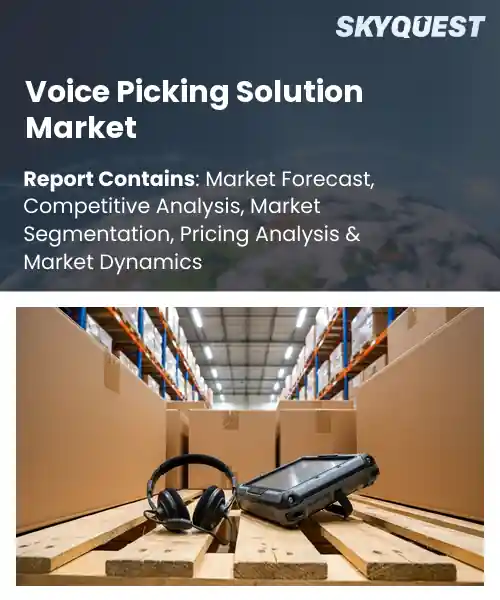
Voice Picking Solution Market
Report ID: SQMIG45F2319
Report ID: SQMIG45F2319
[email protected]
USA +1 351-333-4748
Report ID:
SQMIG45F2319 |
Region:
Global |
Published Date: June, 2026
Pages:
157
|Tables:
146
|Figures:
78


Global Voice Picking Solution Market size was valued at USD 2.75 Billion in 2024 and is poised to grow from USD 3.16 Billion in 2025 to USD 9.67 Billion by 2033, growing at a CAGR of 15.0% during the forecast period (2026-2033).
Voice picking solutions, often called voice-directed warehousing, are systems that guide warehouse workers through instructions to pick and confirm items, and their primary driver has been the need to boost labor efficiency amid tightening labor markets and surging e-commerce demand. The market is affected positively by companies, like DHL and top retailers, that early adopted voice technology; they reported measurable improvements in productivity because of the new technology. The voice market has changed from basic headset prompting to Cloud Based Platforms that include many different types of technology to provide users with access to speech recognition capabilities and noise reduction for traditional warehouse environments, while also integrating with warehouse management systems, mobile devices and other types of technology.
As e-commerce volumes and labor constraints persist, companies implementing voice picking trigger cascades that drive market growth, the immediate effect of simplified, hands-free workflows increases line-rate efficiency and reduces mispicks, which in turn lowers returns and labor spend, prompting wider investment. Industries using real-world applications include cold storage food distributors using voice as a mechanism to help keep accuracy with gloved hands; pharmaceutical warehouses leveraging voice to support compliance and lot tracking; and omnichannel retailers enhancing same-day fulfillment. The benefits of these applications also create opportunities within the voice platform world by way of cloud delivery, speech analytics driven with AI, as well as through the integration of robotics with WMS for scalable deployments within small to mid-sized business and emerging markets looking for a measurable return on investment.
How is Ai-driven Automation Enhancing Efficiency in the Voice Picking Solutions Market?
Through the use of powerful speech recognition, giving context to the task through guidance and then optimising routes through machine learning; AI driven automated voice pick has increased the efficiency of the picking process. To achieve this accuracy in noisy environments, dynamic sequencing is incorporated to reduce the distance travelled, and providing adaptable instructions reduces the potential for errors and increases the training time required. The shift from pilots to wider adoption of voice picking solutions has been primarily driven by the increase in use of warehouse management systems (WMS) and the desire for consistent accuracy and faster integration into the supply chain by retailers and third party logistics providers. Real world deployments from established voice vendors highlight multilingual support and easier operator adoption which strengthens return on automation investment.
In March 2026, Vecna Robotics announced CaseFlow Voice which fully integrates voice with case picking automation. This development shows how voice plus AI reduces handoffs and enables multilingual operator interaction. The result is smoother workflows and faster adoption which supports market growth and efficiency through better human machine collaboration.
Market snapshot - (2026-2033)
Global Market Size
USD 2.75 Billion
Largest Segment
Software
Fastest Growth
Services
Growth Rate
15.0% CAGR
To get more insights on this market click here to Request a Free Sample Report
Global voice picking solution market is segmented by component, deployment, enterprise size, application, industry vertical and region. Based on component, the market is segmented into software and services. Based on deployment, the market is segmented into cloud and on-premises. Based on enterprise size, the market is segmented into large enterprises and small & medium enterprises (SMEs). Based on application, the market is segmented into order picking, inventory management, sorting & put-away and receiving & loading. Based on industry vertical, the market is segmented into retail & E-commerce, logistics & transportation, healthcare, food & beverage, automotive, manufacturing and others. Based on region, the market is segmented into North America, Europe, Asia Pacific, Latin America and Middle East & Africa.
Cloud segment leads because its delivery model reduces deployment friction and enables rapid scalability for voice picking solutions, allowing providers to push continuous software updates and integrate with warehouse management systems in near real time. This lowers operational barriers for customers, fosters faster innovation through centralized analytics and voice recognition improvements, and encourages subscription economics that drive vendor investment in feature expansion and interoperability, thus reinforcing market preference.
However, on-premises segment is emerging as the most rapidly expanding area as organizations demand data sovereignty, predictable performance, and deep customization for voice picking workflows to satisfy compliance and legacy integration. This drives vendor focus on modular architectures and professional services that enable complex deployments and unlock long term operational value.
Order picking segment dominates because voice picking directly addresses core fulfillment workflows where accuracy, speed, and worker productivity yield immediate operational gains. Utilizing voice guided instructions can help minimize the number of mistakes that happen during training by integrating closely with warehouse management systems and the picking algorithms of warehouse operations. Additionally, these instructions adapt to a high level of sku variability and allow intermittent employees to use them effectively leading to clear efficiencies and cost savings which will encourage many fulfillment centric operations to adopt voice only solutions as a preferred method of investment.
Meanwhile, inventory management segment is witnessing the strongest growth momentum as organizations demand continuous inventory accuracy across omnichannel operations and cycle counting. Voice enabled audits combined with analytics and mobile tools drive adoption for routine reconciliations and loss prevention, creating service opportunities and broadening market potential beyond traditional picking applications.
To get detailed segments analysis, Request a Free Sample Report
North America commands the global voice picking solution market due to a convergence of mature logistics ecosystems, advanced warehouse automation adoption, and strong vendor presence that drives rapid innovation. Major retailers and online marketplace operators emphasize efficiency in their operations as well as productivity from their labor force, sustaining consistent demand for voiced-directed workflows. Availability of a solid IT back-end and for distribution center operators to test out integrated voice systems are driving scalable rollouts in the marketplace. There is a significant number of system integrators, software vendors, and hardware suppliers available as partners who can support customized solutions for complicated supply chains. Furthermore, the commitment to worker safety, ergonomic solutions, and multilingual functionality is increasing acceptance of these solutions and helping to maintain market leadership and create standards that other areas will try to replicate.
Voice picking solution market in United States benefits from dense logistics networks, high automation awareness among large retailers and third party logistics providers, and strong integration between voice software and enterprise systems. The rise in popularity of mobile and wearable technology as well as the increased focus on increasing labor productivity while utilizing an extensive range of integrated systems will drive innovative deployment models that enable organisations to leverage voice workflows. In addition, an active pilot program marketplace combined with an emerging community of suppliers will provide an environment where suppliers continuously iterative voice workflow development and provide useful training to users.
Voice picking solution market in Canada centers on adoption within distribution centers that emphasize worker safety and bilingual support. A focus on ensuring that all warehousing management systems are able to integrate seamlessly with each other and provide operators with multi-lingual voice prompts for ease of use allows for a greater level of acceptance among operators. In addition, local system integration will help to achieve efficient solutions at multiple locations while maintaining an ergonomic environment and consistent maintenance methods across all facilities.
Europe is experiencing rapid expansion in the voice picking solution market driven by cross border supply chain complexity, increasing demand for warehouse efficiency, and strong interest in automation among both established industrial players and nimble e commerce firms. Workers are being encouraged by regulators to adopt voice guided systems, without using their hands to perform tasks, due to an increase focus on welfare and ergonomics. Regional system integrators have invested more, and partnered more frequently, with specialized vendors to fast track customized implementation solutions for companies working in multilingual settings. Germany continues to be leading the movement toward widespread industrial level deployments, but every European country is benefiting through ongoing interoperability initiatives, as well as the gradual modernization of legacy distribution centers. The integration of robotics and WMS will lead to better orchestration of processes, while the use of scalable modules will result in removing obstacles for smaller distribution operations interested in transitioning to voice guided processes.
Voice picking solution market in Germany reflects strong industrial demand for high throughput, precision picking and integration with manufacturing supply chains. Large scale warehousing operations favor robust, enterprise grade voice platforms with interoperability and security features. The collaboration of automation manufacturers and systems integrators leads to customized solutions for difficult logistical procedures. An emphasis on quality assurance, employee ergonomics, and support for multi-language businesses is driving the continual accept of automated solutions in automotive and retail distribution systems.
Voice picking solution market in United Kingdom is characterized by rapid adoption among ecommerce fulfillment centers and logistics providers seeking flexible, scalable picking solutions. To promote effective use of the workforce and fast turnaround times for orders, companies are adopting voice-enabled workflows that work tightly with the warehouse management systems already in use. Supporting operator adoption are multilingual capabilities, ergonomic design, and intuitive interfaces. The ability for technology providers and 3PLs to collaborate on localized development and training for their systems is also accelerating.
Voice picking solution market in France is emerging through focused deployments in retail and regional distribution centers with ergonomic and multilingual priorities. Local integrators emphasize tailored voice prompts and training to suit workforce diversity. Interest among mid sized retailers and logistics providers is driving pilots that improve order accuracy and operator comfort. The market favors flexible, configurable systems able to seamlessly integrate with national and cross border supply chain operations.
Asia Pacific is strengthening its position in the voice picking solution market through targeted investments in warehouse modernization, increasing adoption among high volume logistics hubs, and growing vendor ecosystems that adapt solutions to local languages and operational practices. The quick growth rate of mobile device technology and the faster pace of collaboration between system integrators and software developers are allowing for more localized feature sets and expedited deployment. The cost efficiencies, productivity of labor and the integration with broader automation technology such as sortation and robotics underpin the ability to implement a tailored solution. Predominantly, the e-commerce sector and logistics networks drive this market momentum by looking for scalable voice-directed workflows to accommodate regional differences in language and design of warehouse layouts. Regional companies also provide training programs and multilingual user interfaces to help improve operator acceptance.
Voice picking solution market in Japan emphasizes precision, reliability and seamless integration with existing manufacturing and distribution processes. Adoption is motivated largely by expectations of high accuracy, low warehouse footprint requirements, and integration with robotic and automated systems. Local suppliers and systems integrators provide support for multiple languages, as well as intuitive interfaces that can be customized for various operational requirements. Operator training and ergonomic procedures help to maintain consistent operating performance throughout the entire supply chain and the ongoing maintenance of those supplies.
Voice picking solution market in South Korea advances through integration of mobile technologies and automation in urban logistics centers. Working together with both robotics and conveyor manufacturers results in creating a seamless integration of material handling solutions. Increased focus on training workers and using ergonomically designed equipment helps to increase operator acceptance of these systems. There seems to be a preference in the marketplace for modular systems which can be deployed across multiple facilities and used in many different last mile delivery methods.
To know more about the market opportunities by region and country, click here to
Buy The Complete Report
Integration With Warehouse Systems
Improved Worker Productivity Gains
High Implementation Complexity
Data Security and Privacy
Request Free Customization of this report to help us to meet your business objectives.
The global voice picking solution market is characterized by the presence of established warehouse automation and supply chain technology providers competing through innovation, software integration, and operational efficiency enhancements. Companies in this industry segment include Ivanti Wavelink, Zebra Technologies, Honeywell, Dematic, Körber Supply Chain, and Lucas Systems. Honeywell works on ways to integrate voice-enabled workflow processes with warehouse management systems to improve productivity and accuracy. Zebra Technologies puts an emphasis on wearable computing and mobility solutions and Lucas systems uses AI-powered voice picking along with analytical capabilities.
Top Player’s Company Profile
Recent Developments
In March 2026, CaseFlow Voice, developed by Vecna Robotics, coupled voice-directed instructions to the case picking automation, allowing for seamless operator interaction without using hands and coordinated robot/picker operations. Furthermore, its use of natural language instructions, ease of training for operators, and enhanced collaboration between humans and robots enable the expansion of voice technology solutions that may someday be found in fully automated case picking environments.
In January 2026, Honeywell has officially announced the release of Performance+ for Guided Work, adding to their Guided Work solution offering an advanced AI and voice features for hands free picking, packing and inspecting. With this announcement comes better performance in speech recognition across multiple types of accents, supervisor reports with analytics from a more integrated solution and simplified task flows to help onboard users quicker.
in November 2025, In two cold storage distribution centers, Dematic implemented an example of a voice-directed picking system called Dematic Voice specifically designed for temperature regulated areas to increase task clarity and worker comfort. The implementation included user friendly audio prompts, battery efficient cold environment headsets, and simplified onboarding in order to decrease training complications and increase pick accuracy.
SkyQuest’s ABIRAW (Advanced Business Intelligence, Research & Analysis Wing) is our Business Information Services team that Collects, Collates, Correlates, and Analyses the Data collected by means of Primary Exploratory Research backed by robust Secondary Desk research.
As per SkyQuest analysis, the global voice picking solution market is propelled by the need to boost labor efficiency amid tightening labor markets and surging e‑commerce demand, while integration with warehouse management systems acts as a second strong driver by enabling seamless task orchestration and real‑time guidance. Adoption concentrates in North America where mature logistics ecosystems and vendor presence accelerate deployments, and the order picking segment dominates due to immediate gains in accuracy and throughput. Growth is tempered by high implementation complexity that extends timelines and raises integration costs. Vendors focusing on cloud scalability, multilingual support and tighter WMS and robotics integration will capture the most upside.
| Report Metric | Details |
|---|---|
| Market size value in 2024 | USD 2.75 Billion |
| Market size value in 2033 | USD 9.67 Billion |
| Growth Rate | 15.0% |
| Base year | 2024 |
| Forecast period | (2026-2033) |
| Forecast Unit (Value) | USD Billion |
| Segments covered |
|
| Regions covered | North America (US, Canada), Europe (Germany, France, United Kingdom, Italy, Spain, Rest of Europe), Asia Pacific (China, India, Japan, Rest of Asia-Pacific), Latin America (Brazil, Rest of Latin America), Middle East & Africa (South Africa, GCC Countries, Rest of MEA) |
| Companies covered |
|
| Customization scope | Free report customization with purchase. Customization includes:-
|
To get a free trial access to our platform which is a one stop solution for all your data requirements for quicker decision making. This platform allows you to compare markets, competitors who are prominent in the market, and mega trends that are influencing the dynamics in the market. Also, get access to detailed SkyQuest exclusive matrix.
Table Of Content
Executive Summary
Market overview
Parent Market Analysis
Market overview
Market size
KEY MARKET INSIGHTS
COVID IMPACT
MARKET DYNAMICS & OUTLOOK
Market Size by Region
KEY COMPANY PROFILES
Methodology
For the Voice Picking Solution Market, our research methodology involved a mixture of primary and secondary data sources. Key steps involved in the research process are listed below:
1. Information Procurement: This stage involved the procurement of Market data or related information via primary and secondary sources. The various secondary sources used included various company websites, annual reports, trade databases, and paid databases such as Hoover's, Bloomberg Business, Factiva, and Avention. Our team did 45 primary interactions Globally which included several stakeholders such as manufacturers, customers, key opinion leaders, etc. Overall, information procurement was one of the most extensive stages in our research process.
2. Information Analysis: This step involved triangulation of data through bottom-up and top-down approaches to estimate and validate the total size and future estimate of the Voice Picking Solution Market.
3. Report Formulation: The final step entailed the placement of data points in appropriate Market spaces in an attempt to deduce viable conclusions.
4. Validation & Publishing: Validation is the most important step in the process. Validation & re-validation via an intricately designed process helped us finalize data points to be used for final calculations. The final Market estimates and forecasts were then aligned and sent to our panel of industry experts for validation of data. Once the validation was done the report was sent to our Quality Assurance team to ensure adherence to style guides, consistency & design.
Analyst Support
Customization Options
With the given market data, our dedicated team of analysts can offer you the following customization options are available for the Voice Picking Solution Market:
Product Analysis: Product matrix, which offers a detailed comparison of the product portfolio of companies.
Regional Analysis: Further analysis of the Voice Picking Solution Market for additional countries.
Competitive Analysis: Detailed analysis and profiling of additional Market players & comparative analysis of competitive products.
Go to Market Strategy: Find the high-growth channels to invest your marketing efforts and increase your customer base.
Innovation Mapping: Identify racial solutions and innovation, connected to deep ecosystems of innovators, start-ups, academics, and strategic partners.
Category Intelligence: Customized intelligence that is relevant to their supply Markets will enable them to make smarter sourcing decisions and improve their category management.
Public Company Transcript Analysis: To improve the investment performance by generating new alpha and making better-informed decisions.
Social Media Listening: To analyze the conversations and trends happening not just around your brand, but around your industry as a whole, and use those insights to make better Marketing decisions.
REQUEST FOR SAMPLE
 REQUEST FREE CUSTOMIZATION
Global Voice Picking Solution Market size was valued at USD 2.75 Billion in 2024 and is poised to grow from USD 3.16 Billion in 2025 to USD 9.67 Billion by 2033, growing at a CAGR of 15.0% during the forecast period (2026-2033).
The competitive landscape is intensifying as vendors deploy partnerships, targeted asset acquisitions, and device-led innovation to cut labor and onboarding costs and win enterprise deployments; notable moves include Ox’s integration partnerships to embed wearable AI into WMS workflows and recent acquisitions of vision-picking assets by software firms to accelerate product portfolios. 'Honeywell International Inc.', 'Zebra Technologies Corporation', 'Lucas Systems', 'Dematic', 'Ehrhardt + Partner Solutions (E+P)', 'Ivanti', 'Voiteq', 'Voxware', 'Zetes', 'Bastian Solutions', 'SAP SE', 'Oracle Corporation', 'Manhattan Associates', 'Körber Supply Chain', 'SymphonyAI Retail CPG', 'Dematic Group', 'SSI Schaefer', 'Blue Yonder', 'Infor', 'KNAPP AG'
Integration with warehouse management and ERP systems enables seamless data flow, improving task allocation, inventory visibility, and real-time voice instructions; this reduces cognitive load on workers and aligns picking workflows with broader operational processes, allowing organizations to deploy voice picking as part of an integrated automation strategy rather than as an isolated technology, which encourages wider adoption by demonstrating operational coherence, predictable outcomes, and easier change management, thus supporting sustained market expansion through enterprise-level deployments and facilitating collaboration between human and robotic resources.
Workforce Productivity And Upskilling: Adoption of voice picking shifts labor focus from repetitive manual tasks to decision oriented roles, driving investments in training, interface design, and change management. Organizations prioritize intuitive voice workflows that reduce onboarding time and increase operator confidence, while cross training fosters operational flexibility across shifts and facilities. Vendors respond with tailored training modules and adaptive speech models that accommodate varied accents and task sequences, enabling sustained productivity improvements and stronger employee engagement in evolving fulfillment environments.
Why does North America Dominate the Global Voice Picking Solution Market? |@12


Want to customize this report? This report can be personalized according to your needs. Our analysts and industry experts will work directly with you to understand your requirements and provide you with customized data in a short amount of time. We offer $1000 worth of FREE customization at the time of purchase.
Feedback From Our Clients


 USA (+1) 351-333-4748

