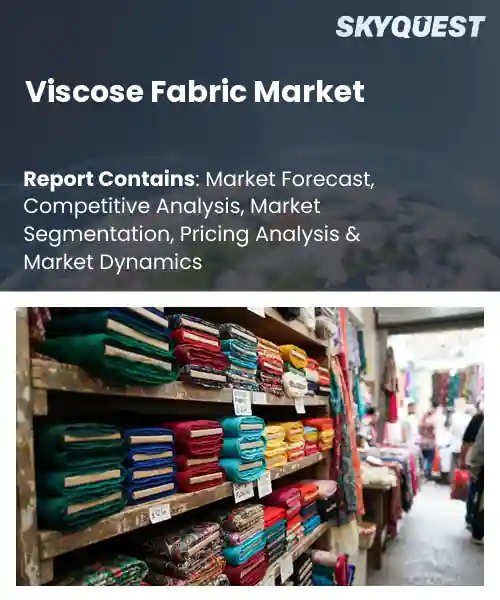
Viscose Fabric Market
Report ID: SQMIG25M2155
Report ID: SQMIG25M2155
[email protected]
USA +1 351-333-4748
Report ID:
SQMIG25M2155 |
Region:
Global |
Published Date: August, 2026
Pages:
157
|Tables:
175
|Figures:
79


Global Viscose Fabric Market size was valued at USD 17.6 Billion in 2024 and is poised to grow from USD 18.62 Billion in 2025 to USD 29.24 Billion by 2033, growing at a CAGR of 5.8% during the forecast period (2026-2033).
The global viscose fabric market encompasses the production and sale of regenerated cellulose fibers derived from wood pulp, woven into textiles for apparel and home furnishings. Its importance lies in the material’s softness, breathability, and cost efficiency, making it an alternative to cotton and synthetic polyester. Over the past two decades, heightened environmental awareness and rising disposable incomes in emerging economies have driven demand, prompting manufacturers in China, India, and Brazil to expand capacity. A 2018 joint venture between a Vietnamese textile group and a European pulp supplier doubled output, showing how policy incentives and consumer trends reshaped the market. One key factor driving the viscose fabric market is the rise of circular fashion, which pushes brands to use fibers with lower environmental impact adopt recycling. Consumer demand for biodegradable textiles leads manufacturers to employ solvents and feedstocks, cutting water use and discharge. This shift opens opportunities for certified wood‑pulp suppliers and firms offering enzymatic degumming; a Scandinavian apparel company recently introduced shirts made from 100 % recycled viscose, lowering material costs by 15 % and reducing carbon emissions by 30 %. Cause‑effect chain consumer pressure prompting greener production, which spurs investment in supply chains expands market size and draws entrants seeking compliance and advantage.
How is AI-driven automation influencing sustainability practices in the viscose fabric market?
AI driven automation is reshaping how viscose fabric is produced by embedding sensors, predictive analytics and robotic handling into every stage of the supply chain. The technology monitors pulp quality, optimises chemical dosing and adjusts spinning speed in real time, which reduces water use and cuts chemical waste. Brands demand traceable and responsibly sourced fibers, prompting mills to adopt digital dashboards that flag deviations before they become costly. Adopters report smoother workflows, lower energy consumption and higher yield, creating a virtuous loop where efficiency fuels further investment in sustainable practices. This shift aligns with the broader move toward greener textiles and meets consumer expectations for eco friendly apparel.In April 2026 a leading viscose producer announced an AI driven fiber quality monitoring system that automatically adjusts processing parameters, cutting waste and improving sustainable output while supporting market growth. The solution integrates real time data from mills and provides brands with transparent reports, helping them meet eco standards and accelerate adoption of responsible viscose.
Market snapshot - (2026-2033)
Global Market Size
USD 17.6 Billion
Largest Segment
Woven Viscose Fabric
Fastest Growth
Blended Viscose Fabric
Growth Rate
5.8% CAGR
To get more insights on this market click here to Request a Free Sample Report
Global viscose fabric market is segmented by product type, finish type, application, end user, weight, distribution channel and region. Based on product type, the market is segmented into Woven Viscose Fabric, Knitted Viscose Fabric, Blended Viscose Fabric and Others. Based on finish type, the market is segmented into Dyed, Printed, Finished and Others. Based on application, the market is segmented into Apparel, Home Textiles, Industrial Textiles and Others. Based on end user, the market is segmented into Garment Manufacturers, Home Furnishing Manufacturers, Industrial Textile Manufacturers and Others. Based on weight, the market is segmented into Lightweight, Medium Weight and Heavyweight. Based on distribution channel, the market is segmented into Direct Sales, Textile Distributors and Others. Based on region, the market is segmented into North America, Europe, Asia Pacific, Latin America and Middle East & Africa.
Woven viscose fabric segment dominates because it offers a balanced combination of drape, breathability, and structural stability that meets the core performance expectations of garment manufacturers and fashion designers. Its inherent smooth surface facilitates high quality printing and dyeing, while the weave construction provides durability for both casual and premium collections. Consequently, designers prioritize woven viscose for versatile silhouettes, reinforcing its central position in the global market future continually expanding significantly.
However, knitted viscose fabric segment is witnessing the strongest growth momentum because its inherent stretch and softness align with rising consumer demand for comfortable athleisure and casual wear. Innovations in yarn technology enable integration with performance finishes, expanding its appeal across fast fashion cycles and driving sourcing opportunities for manufacturers.
Apparel segment dominates because it serves as demand engine for viscose fabrics, where designers seek a blend of elegance, drape, and sustainability. The textile’s natural feel and ability to mimic silk attract premium and fast fashion brands alike, prompting material refinement. Moreover, consumer preference for eco friendly garments amplifies relevance of viscose, reinforcing its pivotal role in shaping market dynamics. Retailers prioritize turnaround times, encouraging manufacturers to adopt processing techniques.
Meanwhile, home textiles segment emerges as the key high growth area because rising design trends favor furnishings, and viscose’s absorbency and dye affinity suit towels, curtains, and upholstery. Manufacturers are launching eco certified lines, expanding distribution channels, and leveraging the fabric’s comfort attributes to capture consumer spending on home décor.
To get detailed segments analysis, Request a Free Sample Report
Asia Pacific leads the global viscose fabric market through a combination of deep textile heritage, highly integrated supply chains, and cost‑effective manufacturing capabilities. The region benefits from abundant raw material sources and a concentration of experienced producers that can rapidly scale output while maintaining quality. Strong government incentives encourage sustainable fiber development, and consumer preferences for soft, breathable textiles drive steady demand across apparel and home‑textile segments. Advances in processing technology, coupled with a skilled labor pool, enhance product innovation and reduce environmental impact, reinforcing the region’s competitive edge. Collaborative ecosystems linking growers, converters, and fashion brands further accelerate market responsiveness, cementing Asia Pacific’s dominant position.
Viscose Fabric Market in Japan is shaped by a premium‑oriented consumer base that values high‑quality, refined textiles for both fashion and interior applications. Domestic manufacturers leverage sophisticated engineering and stringent quality standards to produce fine‑grade viscose, while strong retailer networks facilitate rapid market diffusion. Ongoing emphasis on sustainable sourcing and closed‑loop processing aligns with national environmental goals, reinforcing Japan’s reputation for innovative yet responsible viscose production.
Viscose Fabric Market in South Korea thrives on the nation’s blend of technological expertise and fast‑fashion agility. Local producers adopt advanced fiber‑spinning techniques that yield consistent texture and durability, meeting the high expectations of style‑forward consumers. Close collaboration between textile firms and design houses accelerates trend adoption, while governmental support for green manufacturing encourages eco‑friendly practices. This synergy sustains South Korea’s role as a dynamic contributor within the broader Asia Pacific landscape.
Europe’s viscose fabric market expands rapidly due to heightened consumer focus on comfort, sustainability, and design versatility. Robust regulatory frameworks promote responsible sourcing and lower environmental footprints, prompting manufacturers to adopt cleaner production methods. Collaborative research initiatives across the continent accelerate fiber innovation, delivering blends that meet both performance and ecological criteria. Strong fashion capitals foster demand for high‑quality, adaptable textiles, while retail channels prioritize transparency and traceability. Integration of circular‑economy principles into supply chains enhances material efficiency, encouraging broader adoption across apparel, upholstery, and technical textiles. Collectively, these forces position Europe as a hub of progressive growth and market leadership.
Viscose Fabric Market in Germany is anchored by a tradition of engineering excellence and stringent environmental standards. Producers combine precision manufacturing with rigorous sustainability certifications, delivering viscose that meets demanding performance specifications. Close ties between textile mills and automotive or technical textile sectors broaden application horizons, while strong export capabilities reinforce Germany’s market influence. Continuous investment in process optimization sustains the country’s leadership within the European viscose landscape.
Viscose Fabric Market in United Kingdom benefits from a vibrant design ecosystem and accelerated adoption of sustainable fibers. Innovative startups collaborate with established manufacturers to create fashion‑forward viscose blends that resonate with eco‑conscious consumers. Policy incentives supporting low‑impact production encourage rapid capacity expansion, while retail channels emphasize provenance and circularity. This dynamic environment propels the United Kingdom’s rapid market ascent, positioning it as a leading growth engine in Europe.
Viscose Fabric Market in France is emerging through a strong emphasis on artistic heritage and eco‑friendly textile development. Designers integrate viscose into haute‑couture and contemporary collections, highlighting its softness and drape. Governmental programs fostering green chemistry and renewable raw material sourcing stimulate domestic production capabilities. Growing consumer awareness of sustainable fashion further fuels demand, allowing France to carve out a distinctive niche within the European viscose sector.
North America strengthens its position in the viscose fabric market by leveraging extensive research infrastructure, diverse consumer preferences, and increasing commitment to sustainable textile practices. Leading universities and industry labs collaborate to refine fiber chemistry, enhancing strength, moisture management, and biodegradability. Major apparel and home‑goods brands prioritize transparent sourcing, driving demand for responsibly produced viscose. Investment in modernized manufacturing facilities reduces energy consumption and waste, aligning with evolving regulatory expectations. The region’s vast distribution networks and digital retail platforms accelerate product accessibility, while cross‑border trade facilitates efficient material flow. Together, these initiatives elevate North America’s role as a key contributor to global viscose growth.
Viscose Fabric Market in United States is characterized by a large, diverse consumer base that values both performance and sustainability. Advanced research institutions partner with textile producers to develop high‑function viscose blends suitable for activewear, denim, and interior décor. Retail chains emphasize traceability and eco‑certifications, encouraging manufacturers to adopt low‑impact processes. Strong investment in renewable feedstock and recycling initiatives further solidifies the United States’ influence within the global viscose ecosystem.
Viscose Fabric Market in Canada benefits from a supportive policy environment and abundant renewable resources. Manufacturers adopt clean‑technology approaches that minimize water usage and emissions, aligning with national sustainability goals. Collaborative projects between academic centers and industry foster innovation in fiber quality and processing efficiency. Growing consumer demand for environmentally responsible apparel and furnishings drives market expansion, positioning Canada as an emerging yet significant player in the North American viscose sector.
To know more about the market opportunities by region and country, click here to
Buy The Complete Report
Sustainable Fashion Demand
Advancements In Production Technology
High Energy Consumption
Regulatory Compliance Costs
Request Free Customization of this report to help us to meet your business objectives.
Intense rivalry among viscose producers drives rapid adoption of sustainable technologies and strategic collaborations. Large textile groups are acquiring niche fiber innovators, while startups such as ZERØTEC and Fantail secure funding to introduce AI‑enabled waste‑tracking and digital printing solutions. These moves intensify competition to lower production costs, improve environmental performance, and capture market share in the expanding viscose fabric segment.
Top Player’s Company Profile
Recent Developments
SkyQuest’s ABIRAW (Advanced Business Intelligence, Research & Analysis Wing) is our Business Information Services team that Collects, Collates, Correlates, and Analyses the Data collected by means of Primary Exploratory Research backed by robust Secondary Desk research. As per SkyQuest analysis, the market is propelled by sustainable fashion demand, which pushes brands toward renewable viscose, while a second driver comes from advancements in production technology and AI‑driven automation that improve yields and lower waste. The principal restraint is high energy consumption, which raises costs and clashes with the fabric’s green image. Asia Pacific dominates the market thanks to its integrated supply chain and cost‑effective manufacturing, and woven viscose fabric emerges as the leading segment because of its balanced drape, breathability and suitability for printing. These dynamics together shape the growth trajectory through 2033. Investors and manufacturers are therefore focusing on eco‑certifications and digital monitoring to mitigate the energy challenge and capture the region’s expanding demand.
| Report Metric | Details |
|---|---|
| Market size value in 2024 | USD 17.6 Billion |
| Market size value in 2033 | USD 29.24 Billion |
| Growth Rate | 5.8% |
| Base year | 2024 |
| Forecast period | (2026-2033) |
| Forecast Unit (Value) | USD Billion |
| Segments covered |
|
| Regions covered | North America (US, Canada), Europe (Germany, France, United Kingdom, Italy, Spain, Rest of Europe), Asia Pacific (China, India, Japan, Rest of Asia-Pacific), Latin America (Brazil, Rest of Latin America), Middle East & Africa (South Africa, GCC Countries, Rest of MEA) |
| Companies covered |
|
| Customization scope | Free report customization with purchase. Customization includes:-
|
To get a free trial access to our platform which is a one stop solution for all your data requirements for quicker decision making. This platform allows you to compare markets, competitors who are prominent in the market, and mega trends that are influencing the dynamics in the market. Also, get access to detailed SkyQuest exclusive matrix.
Table Of Content
Executive Summary
Market overview
Parent Market Analysis
Market overview
Market size
KEY MARKET INSIGHTS
COVID IMPACT
MARKET DYNAMICS & OUTLOOK
Market Size by Region
KEY COMPANY PROFILES
Methodology
For the Viscose Fabric Market, our research methodology involved a mixture of primary and secondary data sources. Key steps involved in the research process are listed below:
1. Information Procurement: This stage involved the procurement of Market data or related information via primary and secondary sources. The various secondary sources used included various company websites, annual reports, trade databases, and paid databases such as Hoover's, Bloomberg Business, Factiva, and Avention. Our team did 45 primary interactions Globally which included several stakeholders such as manufacturers, customers, key opinion leaders, etc. Overall, information procurement was one of the most extensive stages in our research process.
2. Information Analysis: This step involved triangulation of data through bottom-up and top-down approaches to estimate and validate the total size and future estimate of the Viscose Fabric Market.
3. Report Formulation: The final step entailed the placement of data points in appropriate Market spaces in an attempt to deduce viable conclusions.
4. Validation & Publishing: Validation is the most important step in the process. Validation & re-validation via an intricately designed process helped us finalize data points to be used for final calculations. The final Market estimates and forecasts were then aligned and sent to our panel of industry experts for validation of data. Once the validation was done the report was sent to our Quality Assurance team to ensure adherence to style guides, consistency & design.
Analyst Support
Customization Options
With the given market data, our dedicated team of analysts can offer you the following customization options are available for the Viscose Fabric Market:
Product Analysis: Product matrix, which offers a detailed comparison of the product portfolio of companies.
Regional Analysis: Further analysis of the Viscose Fabric Market for additional countries.
Competitive Analysis: Detailed analysis and profiling of additional Market players & comparative analysis of competitive products.
Go to Market Strategy: Find the high-growth channels to invest your marketing efforts and increase your customer base.
Innovation Mapping: Identify racial solutions and innovation, connected to deep ecosystems of innovators, start-ups, academics, and strategic partners.
Category Intelligence: Customized intelligence that is relevant to their supply Markets will enable them to make smarter sourcing decisions and improve their category management.
Public Company Transcript Analysis: To improve the investment performance by generating new alpha and making better-informed decisions.
Social Media Listening: To analyze the conversations and trends happening not just around your brand, but around your industry as a whole, and use those insights to make better Marketing decisions.
REQUEST FOR SAMPLE
 REQUEST FREE CUSTOMIZATION


Want to customize this report? This report can be personalized according to your needs. Our analysts and industry experts will work directly with you to understand your requirements and provide you with customized data in a short amount of time. We offer $1000 worth of FREE customization at the time of purchase.
Feedback From Our Clients


 USA (+1) 351-333-4748

