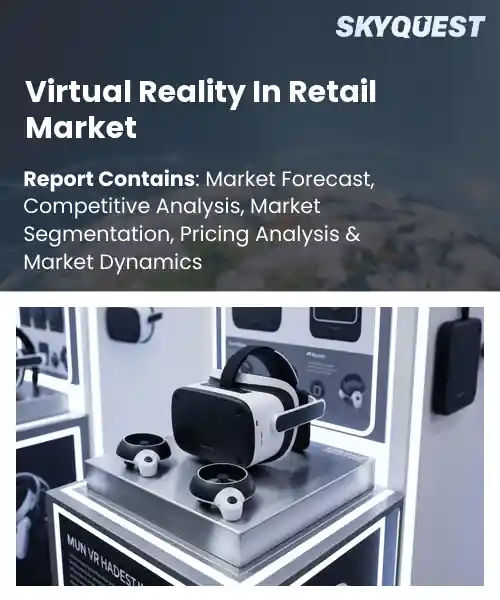
Virtual Reality In Retail Market
Report ID: SQMIG45E2911
Report ID: SQMIG45E2911
[email protected]
USA +1 351-333-4748
Report ID:
SQMIG45E2911 |
Region:
Global |
Published Date: June, 2026
Pages:
157
|Tables:
94
|Figures:
76


Global Virtual Reality In Retail Market size was valued at USD 76.5 Billion in 2024 and is poised to grow from USD 97.77 Billion in 2025 to USD 695.73 Billion by 2033, growing at a CAGR of 27.8% during the forecast period (2026-2033).
The main driver for virtual reality in retail is the requirement to offer immersive shopping experiences to reduce purchase uncertainty and lift conversion rates. Virtual reality in retail market is important as these capabilities change consumer expectations and reduce return costs. The virtual reality in retail market includes headset and mobile VR solutions and mixed reality tools to replicate stores, visualize products in context and facilitate virtual try-ons. Over the past decade the space has moved from isolated pilots to integrated omnichannel offerings as hardware has become affordable and software has matured. Today we see measurable impact in examples like IKEA’s kitchen planner and L’Oréal’s makeup try-on.
This commercialization is a key piece in the global growth story. Retailers are incentivized to invest in better content ecosystems that facilitate personalized experiences, as customized virtual interactions lead to increased loyalty and the average order value. Developers are creating modular catalogs and analytics layers that allow retailers to virtually test assortments, reducing inventory risk and enabling faster localization; for example, fast-fashion chains are using VR runways to assess demand prior to production. And cheaper headsets and cross-platform interoperability broaden the customer base, unlocking new revenue streams from virtual storefronts and experiential marketing, and attracting legacy brands looking for measurable ROI from global immersive campaigns.
How is AI enhancing virtual reality experiences in the retail market?
AI is transforming VR shopping by blending immersive display with smart personalization. Key elements include photorealistic product rendering that conforms to the shopper’s body and environment, real-time style recommendations and conversational AI to help with discovery and checkout. In this market, brands are layering generative try on tools and cloud powered virtual showrooms to bridge online and in store experiences. This change helps reduce styling uncertainty, improve the presentation of products and help merchants make assortment decisions based on richer behavioral signals. With retailers using these systems more and more to build more confident shopping journeys and tighter customer engagement.
In February 2026 Perfect Corp. launched an immersive AI virtual fitting room with Nicole Miller offering generative clothing try on in a on site experience. This innovation reduces fit doubt, speeds up decision-making and enables retail efficiency through higher engagement and richer digital feedback to inform merchandising.
Market snapshot - (2026-2033)
Global Market Size
USD 76.5 Billion
Largest Segment
Hardware
Fastest Growth
Software
Growth Rate
27.8% CAGR
To get more insights on this market click here to Request a Free Sample Report
Global virtual reality in retail market is segmented by component, application, retail type and region. Based on component, the market is segmented into Hardware, Software and Services. Based on application, the market is segmented into Virtual Showrooms, Virtual Fitting Rooms, In-store Navigation, Employee Training and Others. Based on retail type, the market is segmented into Apparel and Fashion, Home Decor and Furniture, Electronics, Grocery and FMCG and Others. Based on region, the market is segmented into North America, Europe, Asia Pacific, Latin America and Middle East & Africa.
The hardware segment dominates with robust head mounted displays, depth sensors, motion trackers and haptic peripherals forming the physical foundation that enables believable retail experiences. High fidelity devices can reduce latency and improve spatial accuracy. Retailers can use experiential applications to replicate interactions in store. Reliability and interoperability with point-of-sale systems and peripherals, lower integration friction, driving enterprise investment and widespread adoption in use cases requiring immersive presence and precise customer interaction.
However, the fastest growing segment is taking shape as Software, powered by modular platforms, analytics and personalization engines enabling dynamic merchandising and remote customization. With new content tools and cloud rendering, development cycles are shorter and cross-device delivery is possible, and retailers are able to scale immersive offerings and monetize interactive experiences.
The virtual fitting rooms segment is expected to hold the largest share of the market. This is because virtual try-on reduces uncertainty of fit, which is one of the biggest pain points of online apparel purchases. Accurate body scanning and realistic garment simulation builds shopper confidence, reduces returns and allows higher value purchases. Better fitting guidance helps retailers to create personalized assortments, improve conversion and satisfaction and optimize omnichannel fulfillment with seamless integration with inventory systems and personalized recommendations.
The fastest-growing segment is virtual showrooms, which can hold vast inventories and tell immersive brand stories that go far beyond individual fittings. Retailers want interactive, store-like environments that support curated merchandising, social shopping and click-to-purchase flows, and their investments in content ecosystems that scale experiential commerce across categories.
To get detailed segments analysis, Request a Free Sample Report
North America leads the global virtual reality in retail market, owing to the presence of sophisticated technology ecosystem, early adopter consumer base, and large investments made by leading retailers and technology companies. Strong retail chain collaborations with immersive tech providers, together with a well-established support network of system integrators and creative agencies, and strong retail infrastructure will accelerate the deployment of immersive store concepts and virtual shopping experiences. High interoperability between platforms, availability of skilled talent and close links between research institutions and commercial players are the main drivers of rapid innovation. Regulatory clarity around data use and established payment ecosystems also lower barriers to large scale trials and rollouts, enabling leading retail brands to fine tune omnichannel strategies and translate experimental pilots into scalable customer engagement models.
Retailers are broadly testing virtual reality across the United States. It integrates closely with digital commerce platforms. Tech vendors and retail chains are working hand in glove. Pilots can be scaled into offerings thanks to consumer receptiveness to immersive product trials, broad omnichannel operations and marketing sophistication. Major hardware and software developers are there to improve solution customization, while entertainment ecosystems support compelling content creation for retail experiences.
Virtual Reality In Retail Market in Canada is aided by the fact that there is close alignment between regional retailers and technology incubators which helps in pilots and customer centric solutions. Smaller chains can tap into immersive capabilities through a focus on cross border partnerships and scalable proofs of concept. Focus on accessibility, localized content and integration with existing loyalty systems encourages adoption. We work with design studios and academic labs to support adaptive experiences that are suited to the shopping environment and to consumer expectations.
Europe’s retail industry is experiencing a rapid growth in virtual reality driven by a cocktail of a strong retail legacy, concentrated innovation hubs and collaborative industry ecosystems on a quest to differentiate the customer experience. We are seeing many retailers across the region using immersive technologies to overcome space constraints, to enrich product storytelling, and to respond to changing consumer expectations for experiential shopping. Public-private partnerships support skill development and pilot funding. Designers and content studios translate cultural nuance into localized experiences. Successful models are transmitted quickly by cross border retail groups and the interoperability between local technology providers and international platforms makes deployment easier. This environment is a crucible for both mainstream rollouts and experimental formats, and positions Europe as a dynamic market where creativity meets operational rigor to scale immersive retail solutions.
The Virtual Reality In Retail Market in Germany combines strong engineering capability with rapid adoption by specialty retailers spurring focused innovation in hardware and tailoring of software. Manufacturing strengths enable the combination of immersive experiences with store logistics and product customization. Rigorous testing, regulatory and privacy compliance, and close collaboration between retailers, automation suppliers and creative agencies push pilots into operations and ensure that solutions meet operational and consumer expectations.
In United Kingdom, Virtual Reality In Retail Market composes of key retailers, advanced digital commerce capabilities, and a developed content production industry that fuel immersive retail stories. Retail groups are well resourced and high platform interoperability allows for wide ranging experimentation. And the integration of virtual experiences with loyalty, payment and fulfillment networks allows for seamless customer journeys. Creative agencies, retail technology vendors and measurement firms collaborate closely to enable fast learning and iteration of immersive offerings.
Fashion retail in France is experimenting with virtual reality in retail and creating innovative content, with regional incubators helping boutiques to deploy it. Immersive Experiences supports flagship retail concepts with an emphasis on storytelling and high quality visual presentation. Creative studios can work with small and mid-size retailers to create experiences that really hit the culture sweet spot. Pilots focus on personalization and aesthetic differentiation, while respecting local consumer preferences and regulatory norms.
Asia Pacific is breaking into virtual reality retail, driven by targeted investments in consumer electronics, a fast-paced technology adoption culture and strong retailer and local technology vendor relationships. Mobile first consumer behaviour develops lightweight immersive applications and integrated seamless experiences with social commerce and payment ecosystem. The leading regional markets marry manufacturing muscle with advanced content studios to lower deployment barriers and accelerate development cycles. Successful concepts can be rapidly spread thanks to cross border retail platforms and regional logistics networks. In addition, government support for innovation clusters and skilled talent pipelines further underpins growth, allowing the region to balance scalable commercial deployments with culturally tailored customer experiences that resonate across diverse markets. University research centers and design agencies feed refined user experience methodologies. Retail conglomerates conduct pilots for omni channel concepts between physical and virtual touch points, which enhances consumer trust and operational maturity.
Japan’s Virtual Reality In Retail Market is aided by a strong consumer electronics industry and manufacturing base, along with a culture that embraces immersive brand experiences. Retailers, department store and specialty brands Play with high fidelity simulations and virtual showrooms that capture craftsmanship and detail. Engaging consumer experiences are created through close cooperation between hardware makers, software developers and creative studios. It connects to mobile platforms, loyalty programs and makes it easy to move between virtual and physical shopping environments.
South Korea is dominating the Virtual Reality In Retail Market due to its strong mobile commerce, leading display industries and partnerships with retailer technologies. The markets are looking at slick user interface, social commerce integration and entertainment driven content to engage the shoppers. Retail platforms and media companies are joining forces with startups to create immersive storefronts and live shopping events. Virtual showcases with smooth fulfillment and payment integration make the experience even better, by focus on iteration and consumer feedback.
To know more about the market opportunities by region and country, click here to
Buy The Complete Report
Enhanced Customer Experience and Engagement
Cost Effective Virtual Store Implementations
High Initial Development Costs
Privacy Concerns and Data Security
Request Free Customization of this report to help us to meet your business objectives.
There is competition around retailers, platform vendors and specialist studios deploying partnerships, incubator launches and selective acquisitions to grab immersive commerce budgets. Walmart Store No.8 launched Spatial& as a VR merchandising arm. Brands collaborate with Obsess to trial virtual stores. Startups use venture financing and strategic exits (like Emperia’s Series A) to scale platform features and win enterprise retail contracts.
SkyQuest’s ABIRAW (Advanced Business Intelligence, Research & Analysis Wing) is our Business Information Services team that Collects, Collates, Correlates, and Analyses the Data collected by means of Primary Exploratory Research backed by robust Secondary Desk research.
As per SkyQuest analysis, the global virtual reality in retail market is driven primarily by demand for immersive shopping experiences that reduce purchase uncertainty and boost conversion, while a parallel driver is AI-enabled personalization and richer content ecosystems that enable tailored virtual try-ons and analytics. Growth is supported by maturing hardware and software but restrained by high initial development costs that challenge smaller retailers. North America remains the dominating region thanks to advanced tech ecosystems, retailer investments and interoperability, and the hardware segment continues to dominate as headsets, sensors and peripherals form the physical foundation for believable retail experiences. Overall, retailers prioritize scalable, measurable immersive deployments to cut returns and deepen engagement.
| Report Metric | Details |
|---|---|
| Market size value in 2024 | USD 76.5 Billion |
| Market size value in 2033 | USD 695.73 Billion |
| Growth Rate | 27.8% |
| Base year | 2024 |
| Forecast period | (2026-2033) |
| Forecast Unit (Value) | USD Billion |
| Segments covered |
|
| Regions covered | North America (US, Canada), Europe (Germany, France, United Kingdom, Italy, Spain, Rest of Europe), Asia Pacific (China, India, Japan, Rest of Asia-Pacific), Latin America (Brazil, Rest of Latin America), Middle East & Africa (South Africa, GCC Countries, Rest of MEA) |
| Companies covered |
|
| Customization scope | Free report customization with purchase. Customization includes:-
|
To get a free trial access to our platform which is a one stop solution for all your data requirements for quicker decision making. This platform allows you to compare markets, competitors who are prominent in the market, and mega trends that are influencing the dynamics in the market. Also, get access to detailed SkyQuest exclusive matrix.
Table Of Content
Executive Summary
Market overview
Parent Market Analysis
Market overview
Market size
KEY MARKET INSIGHTS
COVID IMPACT
MARKET DYNAMICS & OUTLOOK
Market Size by Region
KEY COMPANY PROFILES
Methodology
For the Virtual Reality In Retail Market, our research methodology involved a mixture of primary and secondary data sources. Key steps involved in the research process are listed below:
1. Information Procurement: This stage involved the procurement of Market data or related information via primary and secondary sources. The various secondary sources used included various company websites, annual reports, trade databases, and paid databases such as Hoover's, Bloomberg Business, Factiva, and Avention. Our team did 45 primary interactions Globally which included several stakeholders such as manufacturers, customers, key opinion leaders, etc. Overall, information procurement was one of the most extensive stages in our research process.
2. Information Analysis: This step involved triangulation of data through bottom-up and top-down approaches to estimate and validate the total size and future estimate of the Virtual Reality In Retail Market.
3. Report Formulation: The final step entailed the placement of data points in appropriate Market spaces in an attempt to deduce viable conclusions.
4. Validation & Publishing: Validation is the most important step in the process. Validation & re-validation via an intricately designed process helped us finalize data points to be used for final calculations. The final Market estimates and forecasts were then aligned and sent to our panel of industry experts for validation of data. Once the validation was done the report was sent to our Quality Assurance team to ensure adherence to style guides, consistency & design.
Analyst Support
Customization Options
With the given market data, our dedicated team of analysts can offer you the following customization options are available for the Virtual Reality In Retail Market:
Product Analysis: Product matrix, which offers a detailed comparison of the product portfolio of companies.
Regional Analysis: Further analysis of the Virtual Reality In Retail Market for additional countries.
Competitive Analysis: Detailed analysis and profiling of additional Market players & comparative analysis of competitive products.
Go to Market Strategy: Find the high-growth channels to invest your marketing efforts and increase your customer base.
Innovation Mapping: Identify racial solutions and innovation, connected to deep ecosystems of innovators, start-ups, academics, and strategic partners.
Category Intelligence: Customized intelligence that is relevant to their supply Markets will enable them to make smarter sourcing decisions and improve their category management.
Public Company Transcript Analysis: To improve the investment performance by generating new alpha and making better-informed decisions.
Social Media Listening: To analyze the conversations and trends happening not just around your brand, but around your industry as a whole, and use those insights to make better Marketing decisions.
REQUEST FOR SAMPLE
 REQUEST FREE CUSTOMIZATION
Global Virtual Reality In Retail Market size was valued at USD 76.5 Billion in 2024 and is poised to grow from USD 97.77 Billion in 2025 to USD 695.73 Billion by 2033, growing at a CAGR of 27.8% during the forecast period (2026-2033).
Competition centers on retailers, platform vendors, and specialist studios deploying partnerships, incubator launches, and selective acquisitions to capture immersive commerce budgets. Walmart Store No.8 launched Spatial& as a VR merchandising arm. Brands partner with Obsess to trial virtual storefronts. Startups use venture financing and strategic exits, as seen with Emperia’s Series A, to scale platform features and win enterprise retail contracts. 'Roche Holding', 'Danone', 'Kweichow Moutai', 'DSM-Firmenich', 'Wuliangye Yibin', 'Novozymes', 'United Breweries', 'Lonza Group', 'Corbion', 'Angel Yeast', 'Biocon', 'Kingdomway Group', 'Vtr Bio-Tech', 'Bloomage Biotechnology', 'Cathay Biotech', 'BioVectra', 'Jindan Lactic Acid', 'Vland Biotech', 'Amyris', 'Kerry Group'
Virtual reality enables retailers to create immersive, lifelike shopping environments that allow consumers to visualize products, compare options, and experience services before purchase, which enhances confidence and reduces perceived risk. By offering personalized, interactive demonstrations and simulated try-ons, brands can deepen customer engagement and strengthen brand recall. Improved sensory-rich interactions facilitate clearer product understanding and support decision-making, prompting retailers to invest in VR as a tool to differentiate their offerings and foster more meaningful, emotionally resonant connections with shoppers across channels.
Immersive Product Discovery: Retailers are adopting virtual reality to create immersive product discovery journeys that allow customers to examine, customize, and experience items in lifelike virtual environments. These experiences emphasize tactile simulation, contextual use cases, and narrative presentation to strengthen emotional connection and accelerate purchase intent. By showcasing products in realistic settings, brands differentiate offerings, improve merchandising, and support informed decision making. Teams focus on content fidelity, seamless navigation, integration with commerce systems and maintaining consistent customer experiences across digital and physical touchpoints.
Why does North America Dominate the Global Virtual Reality In Retail Market? |@12


Want to customize this report? This report can be personalized according to your needs. Our analysts and industry experts will work directly with you to understand your requirements and provide you with customized data in a short amount of time. We offer $1000 worth of FREE customization at the time of purchase.
Feedback From Our Clients


 USA (+1) 351-333-4748

