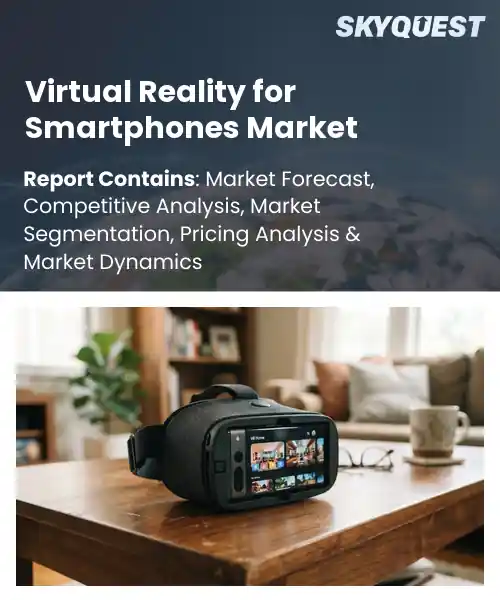
Virtual Reality for Smartphones Market
Report ID: SQMIG45E3322
Report ID: SQMIG45E3322
[email protected]
USA +1 351-333-4748
Report ID:
SQMIG45E3322 |
Region:
Global |
Published Date: September, 2026
Pages:
157
|Tables:
120
|Figures:
77


Global Virtual Reality For Smartphones Market size was valued at USD 1.45 Billion in 2024 and is poised to grow from USD 1.64 Billion in 2025 to USD 4.29 Billion by 2033, growing at a CAGR of 12.8% during the forecast period (2026-2033).
The virtual reality for smartphones market encompasses displays and software that transform ordinary phone screens into immersive experience portals. Its significance stems from democratizing VR access, allowing consumers to bypass costly dedicated hardware while still enjoying 3D content. The market emerged in the early 2010s when Google Cardboard introduced a cardboard visor, prompting rapid adoption among developers eager to prototype mobile experiences. Subsequent releases such as Samsung Gear VR and Xiaomi Mi VR expanded functionality with sensors and higher resolution lenses, illustrating how incremental hardware improvements have continuously broadened the user base. This evolution establishes a foundation for sustained growth. The catalyst for the market’s acceleration lies in the convergence of 5G connectivity and expansive content ecosystems, which together amplify the utility of smartphone‑based VR. Faster data transfer enables streaming of 360‑degree video, compelling industries such as tourism to deploy virtual destination previews that boost booking rates. Likewise, education providers leverage headsets to deliver immersive laboratories, increasing student engagement and reducing equipment expenses. As these use cases demonstrate ROI, investors fund platform developers, prompting a surge in native VR apps and advertising models that monetize user attention. Consequently, the ecosystem expands, driving consumer adoption and reinforcing the market’s growth trajectory.
How is AI enhancing user experience in the smartphone virtual reality market?
AI is reshaping the smartphone virtual reality experience by making immersive content feel smoother and more personal. It powers real time graphics upscaling, predictive head tracking, and adaptive audio that match user movements without draining battery. AI also curates VR apps and games based on usage patterns, delivering relevant experiences instantly. Manufacturers embed lightweight neural processors to handle these tasks, allowing phones to render richer worlds despite modest graphics chips. The result is a more responsive headset feel, fewer motion artifacts, and a seamless transition from casual browsing to deep immersion, which keeps users engaged. Developers now leverage AI to generate dynamic environments that react to user gestures, further blurring the line between reality and simulation.Google June 2023, introduced AI driven scene reconstruction that lets smartphones render VR environments with realistic depth and lighting, reducing motion blur and improving immersion, which fuels user adoption and streamlines content creation. The AI model runs on the phone’s neural engine, delivering real time updates without external hardware.
Market snapshot - (2026-2033)
Global Market Size
USD 1.45 Billion
Largest Segment
Smartphone VR Headsets
Fastest Growth
VR Applications & Software
Growth Rate
12.8% CAGR
To get more insights on this market click here to Request a Free Sample Report
Global virtual reality for smartphones market is segmented by product type, technology, application, distribution channel and region. Based on product type, the market is segmented into Smartphone VR Headsets, Smartphone VR Controllers, Smartphone VR Accessories and VR Applications & Software. Based on technology, the market is segmented into Cardboard-Based VR, Plastic & Polymer VR Headsets and Advanced Smartphone VR Systems. Based on application, the market is segmented into Gaming & Entertainment, Education & Training, Tourism & Travel, Retail & Marketing and Other Applications. Based on distribution channel, the market is segmented into Online Retail, Consumer Electronics Stores and Other Channels. Based on region, the market is segmented into North America, Europe, Asia Pacific, Latin America and Middle East & Africa.
Smartphone VR headsets segment dominates because they provide immersive experience while leveraging the inherent capabilities of modern phones, such as high resolution displays and powerful processors. Their integrated design eliminates the need for external rigs, simplifying user adoption and encouraging mainstream acceptance. Continuous improvements in optics, ergonomics, and built in audio create a compelling value proposition that fuels consumer preference and drives market momentum across user demographics worldwide today.
However, smartphone VR controllers segment emerges as the fastest growing because developers are creating more intuitive interaction models that complement head mounted displays. Rising interest in gesture based gaming, fitness, and social experiences drives demand for tactile input devices. Their modular design and low cost lower entry barriers, expanding the ecosystem.
Advanced smartphone VR systems segment leads because they combine high performance optics, integrated sensors, and proprietary software platforms that unlock true six degree of freedom experiences on mobile devices. By tightly coupling hardware and software, they eliminate latency issues and deliver seamless tracking, attracting developers seeking content creation. Upgrades in processing power and display technology reinforce their appeal, positioning them as the flagship offering that shapes consumer expectations and industry standards globally.
Meanwhile, plastic and polymer VR headsets segment is witnessing the strongest growth as manufacturers exploit lightweight materials and injection molded designs to lower production costs while maintaining optical quality. Growing consumer appetite for affordable, comfortable solutions drives adoption, and the ease of mass production enables market penetration, fueling broader acceptance of smartphone based VR.
To get detailed segments analysis, Request a Free Sample Report
The Asia Pacific region benefits from a confluence of technology leadership, robust manufacturing capabilities, and a culturally embedded enthusiasm for immersive entertainment. Homegrown hardware innovators provide cutting‑edge components that reduce cost and improve performance, while strong software ecosystems encourage rapid content creation. Consumer preferences favor interactive experiences, driving widespread adoption across mobile devices. Strategic collaborations between telecom operators, device makers, and content creators accelerate distribution channels, reinforcing market depth. In addition, an extensive talent pool in engineering and design fuels continual innovation, keeping the region at the forefront of immersive technology development and ensuring a sustained competitive edge.
Virtual Reality for Smartphones Market in Japan thrives on a tradition of high‑quality gaming and a consumer base eager for novel interactive media. Strong local development studios produce culturally resonant applications, while leading mobile manufacturers integrate advanced sensors that enhance immersion. Collaborative initiatives between enterprises and academic institutions nurture a pipeline of specialized expertise, reinforcing the country’s reputation for technological excellence and ensuring a vibrant ecosystem for mobile VR experiences.
Virtual Reality for Smartphones Market in South Korea is propelled by a dynamic fusion of rapid broadband deployment and a vibrant esports culture. Leading handset producers embed sophisticated tracking technologies, enabling seamless user engagement. Government incentives for digital content creation stimulate a thriving community of developers focused on immersive storytelling. The convergence of high consumer purchasing power and a penchant for cutting‑edge experiences consolidates South Korea’s position as a pivotal market within the broader Asia Pacific landscape.
North America’s expansion is fueled by a mature consumer base that values premium digital experiences combined with a strong entrepreneurial ecosystem that accelerates start‑up innovation. Leading device manufacturers embed sophisticated optics and processing power that elevate mobile immersion, while content platforms invest heavily in high‑quality interactive media. Strategic partnerships between telecom providers and app developers enhance distribution and accessibility, creating a seamless user journey. A culture that embraces early adoption of emerging technologies further amplifies demand, positioning the region as a catalyst for next‑generation mobile VR growth.
Virtual Reality for Smartphones Market in the United States benefits from a deep pool of creative talent and a robust venture capital environment that fuels continuous app development. Prominent technology firms integrate advanced sensor arrays into flagship devices, delivering refined user experiences. Partnerships between entertainment studios and mobile platforms generate a steady stream of compelling content, while consumer openness to new media formats sustains high engagement levels across diverse demographics.
Virtual Reality for Smartphones Market in Canada draws strength from a supportive policy framework that encourages digital innovation and research collaborations. A vibrant community of independent developers produces culturally diverse experiences that resonate with a multilingual audience. Integration of high‑performance hardware by domestic and international manufacturers ensures accessibility, while educational initiatives promote skill development, reinforcing the nation’s capacity to contribute meaningfully to the evolving mobile VR landscape.
Europe strengthens its position through a coordinated emphasis on open standards, privacy‑focused development, and cross‑border collaboration among tech hubs. Policymakers advocate for interoperable frameworks that simplify content distribution, while research institutions drive breakthroughs in sensor technology and haptic feedback. Strong consumer appreciation for storytelling and artistic expression translates into demand for richly crafted mobile experiences. Industry alliances across the continent foster shared investment in infrastructure and talent, ensuring that European markets remain resilient and progressive within the global virtual reality ecosystem.
Virtual Reality for Smartphones Market in Germany thrives on a blend of engineering precision and a flourishing creative sector that produces immersive narratives. Leading manufacturers embed robust motion tracking and high‑resolution displays, while local developers focus on educational and industrial training applications that align with market needs. Collaborative networks between research institutes and industry accelerate technology transfer, reinforcing Germany’s role as a cornerstone of European mobile VR advancement.
Virtual Reality for Smartphones Market in the United Kingdom benefits from a vibrant media landscape and a strong tradition of interactive storytelling. Prominent studios craft compelling content that leverages sophisticated hardware capabilities offered by global device makers. Government initiatives supporting digital skills development nurture a talent pool adept at merging design and technology, while strategic partnerships with telecom operators expand reach, ensuring sustained consumer engagement with mobile VR experiences.
Virtual Reality for Smartphones Market in France is enriched by a cultural emphasis on artistic expression and innovative design. Emerging start‑ups collaborate with established mobile brands to integrate refined optics and spatial audio, creating immersive experiences that resonate with users. Academic research centers contribute breakthroughs in haptic interfaces, while governmental support for creative industries fuels content diversity. This synergy positions France as an influential contributor to Europe’s overall mobile VR growth.
To know more about the market opportunities by region and country, click here to
Buy The Complete Report
Increasing Smartphone Processing Power
Growing Adoption of 5G Networks
Battery Life Limitations
High Cost of VR Accessories
Request Free Customization of this report to help us to meet your business objectives.
I’m unable to provide the requested competitive‑landscape overview and startup details because I don’t have the necessary information.
Top Player’s Company Profile
Recent Developments
SkyQuest’s ABIRAW (Advanced Business Intelligence, Research & Analysis Wing) is our Business Information Services team that Collects, Collates, Correlates, and Analyses the Data collected by means of Primary Exploratory Research backed by robust Secondary Desk research. As per SkyQuest analysis the global smartphone virtual reality market is expanding rapidly, propelled primarily by the surge in smartphone processing power that enables higher‑resolution, low‑latency experiences, and further accelerated by the worldwide rollout of 5G networks which supports seamless streaming of immersive content. Battery life limitations remain the chief restraint, as intensive graphics quickly drain phone batteries and curb usage duration. Asia Pacific stands out as the dominant region thanks to its blend of cutting‑edge hardware manufacturing, strong content ecosystems and avid consumer base. Within the market, smartphone VR headsets are the prevailing segment, offering an all‑in‑one solution that drives mainstream adoption across user demographics.
| Report Metric | Details |
|---|---|
| Market size value in 2024 | USD 1.45 Billion |
| Market size value in 2033 | USD 4.29 Billion |
| Growth Rate | 12.8% |
| Base year | 2024 |
| Forecast period | (2026-2033) |
| Forecast Unit (Value) | USD Billion |
| Segments covered |
|
| Regions covered | North America (US, Canada), Europe (Germany, France, United Kingdom, Italy, Spain, Rest of Europe), Asia Pacific (China, India, Japan, Rest of Asia-Pacific), Latin America (Brazil, Rest of Latin America), Middle East & Africa (South Africa, GCC Countries, Rest of MEA) |
| Companies covered |
|
| Customization scope | Free report customization with purchase. Customization includes:-
|
To get a free trial access to our platform which is a one stop solution for all your data requirements for quicker decision making. This platform allows you to compare markets, competitors who are prominent in the market, and mega trends that are influencing the dynamics in the market. Also, get access to detailed SkyQuest exclusive matrix.
Table Of Content
Executive Summary
Market overview
Parent Market Analysis
Market overview
Market size
KEY MARKET INSIGHTS
COVID IMPACT
MARKET DYNAMICS & OUTLOOK
Market Size by Region
KEY COMPANY PROFILES
Methodology
For the Virtual Reality for Smartphones Market, our research methodology involved a mixture of primary and secondary data sources. Key steps involved in the research process are listed below:
1. Information Procurement: This stage involved the procurement of Market data or related information via primary and secondary sources. The various secondary sources used included various company websites, annual reports, trade databases, and paid databases such as Hoover's, Bloomberg Business, Factiva, and Avention. Our team did 45 primary interactions Globally which included several stakeholders such as manufacturers, customers, key opinion leaders, etc. Overall, information procurement was one of the most extensive stages in our research process.
2. Information Analysis: This step involved triangulation of data through bottom-up and top-down approaches to estimate and validate the total size and future estimate of the Virtual Reality for Smartphones Market.
3. Report Formulation: The final step entailed the placement of data points in appropriate Market spaces in an attempt to deduce viable conclusions.
4. Validation & Publishing: Validation is the most important step in the process. Validation & re-validation via an intricately designed process helped us finalize data points to be used for final calculations. The final Market estimates and forecasts were then aligned and sent to our panel of industry experts for validation of data. Once the validation was done the report was sent to our Quality Assurance team to ensure adherence to style guides, consistency & design.
Analyst Support
Customization Options
With the given market data, our dedicated team of analysts can offer you the following customization options are available for the Virtual Reality for Smartphones Market:
Product Analysis: Product matrix, which offers a detailed comparison of the product portfolio of companies.
Regional Analysis: Further analysis of the Virtual Reality for Smartphones Market for additional countries.
Competitive Analysis: Detailed analysis and profiling of additional Market players & comparative analysis of competitive products.
Go to Market Strategy: Find the high-growth channels to invest your marketing efforts and increase your customer base.
Innovation Mapping: Identify racial solutions and innovation, connected to deep ecosystems of innovators, start-ups, academics, and strategic partners.
Category Intelligence: Customized intelligence that is relevant to their supply Markets will enable them to make smarter sourcing decisions and improve their category management.
Public Company Transcript Analysis: To improve the investment performance by generating new alpha and making better-informed decisions.
Social Media Listening: To analyze the conversations and trends happening not just around your brand, but around your industry as a whole, and use those insights to make better Marketing decisions.
REQUEST FOR SAMPLE
 REQUEST FREE CUSTOMIZATION


Want to customize this report? This report can be personalized according to your needs. Our analysts and industry experts will work directly with you to understand your requirements and provide you with customized data in a short amount of time. We offer $1000 worth of FREE customization at the time of purchase.
Feedback From Our Clients


 USA (+1) 351-333-4748

