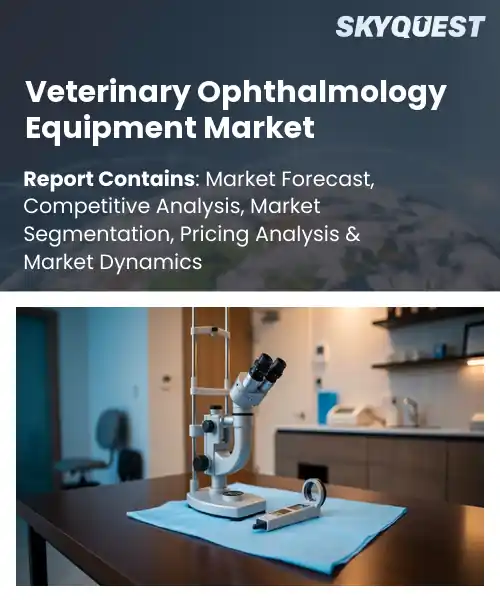
Veterinary Ophthalmology Equipment Market
Report ID: SQMIG35A3584
Report ID: SQMIG35A3584
[email protected]
USA +1 351-333-4748
Report ID:
SQMIG35A3584 |
Region:
Global |
Published Date: June, 2026
Pages:
157
|Tables:
178
|Figures:
79


Global Veterinary Ophthalmology Equipment Market size was valued at USD 0.78 Billion in 2024 and is poised to grow from USD 0.84 Billion in 2025 to USD 1.51 Billion by 2033, growing at a CAGR of 7.6% during the forecast period (2026-2033).
Veterinary ophthalmology equipment market encompasses diagnostic devices and surgical tools used to assess and treat eye conditions in animals, and its significance has grown alongside rising pet ownership, specialized practices, and translational research linking human and animal ocular care. Historically the sector evolved from basic ophthalmoscopes and topical treatments toward advanced slit-lamp biomicroscopes, portable tonometers, ocular ultrasound, and phacoemulsification systems adapted for small animals, enabling cataract surgery previously uncommon in general practice. As owners demand higher standards of care and veterinary schools incorporate ophthalmology into curricula, clinics have increasingly adopted sophisticated instrumentation, transforming routine screenings into revenue-generating specialty services today.Building on that clinical adoption, the dominant factor propelling global expansion is the combined effect of rapid device innovation and higher owner willingness to pay, since technologies like compact digital imaging, portable tonometry, and small-animal phacoemulsification reduce procedural risk and expand treatable caseloads, prompting clinics to invest in instruments. For instance, when a referral hospital installs a surgical microscope and ocular ultrasound it can perform cataract and retinal repairs, win referrals, and boost revenue. Concurrently, rising pet insurance uptake and financing options lower cost barriers, which increases elective ocular interventions and opens supplier growth opportunities in developing regions worldwide now.
How is AI improving diagnostic accuracy in the veterinary ophthalmology equipment market?
AI is improving diagnostic accuracy in the veterinary ophthalmology equipment market by bringing automated image analysis and consistent decision support to routine exams. Key aspects include deep learning models trained on fundus and anterior segment images and systems that combine imaging with clinical notes to flag subtle pathology. The current state shows faster identification of early disease that might be missed on manual review and more reproducible findings across clinics. In context this reduces diagnostic variability, shortens time to referral and helps specialists focus on complex cases. Examples include AI classifiers and multimodal agents that assist clinicians at the point of care.Penn Vet December 2025, the release of DogAEye highlights a practical advance where an AI based clinical support tool improves early detection of retinal degeneration in dogs and supports wider screening. This innovation promotes market growth by increasing clinic efficiency and enabling earlier interventions for patients.
Market snapshot - (2026-2033)
Global Market Size
USD 0.78 Billion
Largest Segment
Ophthalmoscopes
Fastest Growth
Retinal Imaging Systems
Growth Rate
7.6% CAGR
To get more insights on this market click here to Request a Free Sample Report
Global veterinary ophthalmology equipment market is segmented by product type, application, animal type, end user, technology, distribution channel and region. Based on product type, the market is segmented into Ophthalmoscopes, Tonometers, Slit Lamps, Fundus Cameras, Retinal Imaging Systems and Others. Based on application, the market is segmented into Eye Examination, Glaucoma Diagnosis, Retinal Disease Diagnosis, Cataract Evaluation and Others. Based on animal type, the market is segmented into Companion Animals, Equine, Livestock Animals and Exotic Animals. Based on end user, the market is segmented into Veterinary Hospitals, Veterinary Clinics, Veterinary Specialty Centers and Academic & Research Institutes. Based on technology, the market is segmented into Portable Equipment, Benchtop Equipment and Digital Imaging Systems. Based on distribution channel, the market is segmented into Direct Sales, Veterinary Distributors and Online Sales. Based on region, the market is segmented into North America, Europe, Asia Pacific, Latin America and Middle East & Africa.
Tonometers segment dominates because tonometry is central to routine ocular health assessment and glaucoma management in veterinary practice, creating consistent demand across clinical settings. Their straightforward operation, clinician familiarity, and compatibility with varied animal patients drive procurement decisions, while proven diagnostic utility reduces perceived risk for buyers. As a result, manufacturers prioritize reliability and calibration support, reinforcing clinical preference and sustaining tonometer leadership in equipment purchasing and training cycles.
However, retinal imaging systems are witnessing the strongest growth momentum as advanced noninvasive visualization and image analytics expand retinal disease management and telemedicine. Innovation in sensor resolution and software driven diagnostics drives capital investment and creates opportunities for equipment upgrades, workflow integration, and new service offerings within veterinary ophthalmic practices.
Digital Imaging Systems segment dominates because integrated digital capture and analysis have become central to modern veterinary ophthalmic diagnostics, enabling detailed documentation, longitudinal monitoring, and remote consultation workflows. Their ability to link high resolution imagery with image analytics and patient records reduces diagnostic uncertainty and supports specialist collaboration, prompting clinics to prioritize digital capable investments. Vendor focus on interoperability and software updates further strengthens clinical reliance on digital imaging as a foundational technology.
On the other hand, portable equipment is emerging as the fastest growing technology due to demand for point of care diagnostics and flexible workflows across practice types. Improvements in miniaturized optics and battery efficiency, plus user friendly interfaces, lower adoption barriers and enable mobile clinics, rapid triage, and expanded service offerings.
To get detailed segments analysis, Request a Free Sample Report
North America dominates due to a mature veterinary healthcare ecosystem that emphasizes specialty care and early adoption of advanced diagnostic and surgical ophthalmic equipment. A strong presence of leading equipment manufacturers and specialized distributors accelerates product availability and aftersales support. Demand is reinforced by a concentration of referral veterinary hospitals and trained ophthalmology specialists who drive clinical adoption and technology diffusion. Supportive regulatory and reimbursement environments, combined with collaborative research between clinical centers and industry, foster continuous innovation and validation of new devices. Established training programs and professional associations promote uptake through education and guidelines. Robust clinical support and service networks underpin long term equipment utilization, creating a market environment favoring rapid integration of sophisticated ophthalmology equipment across private and institutional veterinary care settings.
Veterinary Ophthalmology Equipment Market in United States is defined by a dense network of referral hospitals and specialty clinics that favor advanced diagnostic and surgical technologies. Strong links between manufacturers and clinical centers support adoption and product refinement. Training programs for veterinary ophthalmologists enable uptake of complex equipment. Robust service and maintenance infrastructure enhances equipment longevity and clinician confidence, sustaining demand for high end ophthalmic solutions in companion animal care.
Veterinary Ophthalmology Equipment Market in Canada reflects an established base with concentration of specialty practices in urban centers and expanding access in regional clinics via robust referral networks. Collaboration between veterinary colleges and industry supports technology evaluation. Practitioners prioritize devices that combine diagnostic precision with ease of use for varied practice settings. Local distribution and maintenance services provide assurance for investment, encouraging modernization of ophthalmic equipment across animal care providers.
Europe sees rapid expansion driven by convergence of clinical expertise, robust manufacturing capacities, and an increasingly sophisticated veterinary care landscape that values specialty ophthalmic services. Strong networks of academic hospitals and private referral centers support clinical evaluation and adoption of advanced diagnostic and surgical equipment. Manufacturers in the region benefit from efficient distribution channels and collaborative ties with clinicians, enabling localized product adaptation and service support. Regulatory alignment and professional training across national boundaries facilitate market access and clinician confidence. Growing awareness among pet owners and wider availability of specialized care options stimulate demand. Combined with targeted investment in training and clinical research, these factors position Europe as a dynamic market where innovation and clinical need intersect to accelerate uptake of veterinary ophthalmology equipment.
Veterinary Ophthalmology Equipment Market in Germany derives strength from an established manufacturing base and active collaboration between industry and academic veterinary centers. Referral hospitals and clinics drive adoption of sophisticated diagnostic and surgical platforms. Technical expertise among clinicians supports complex procedures and device evaluation. Efficient logistics networks ensure reliable aftersales support. A culture of clinical research and education reinforces market leadership and motivates modernization of ophthalmic equipment in veterinary care.
Veterinary Ophthalmology Equipment Market in United Kingdom is driven by private practice expansion and emphasis on specialty referral services. Adoption of innovative diagnostic modalities is supported by strong professional training and education. Collaborative relationships between clinics and manufacturers enable product evaluation and iterative improvement. Accessible financing and increasing owner demand for advanced care promote procurement. Comprehensive service and training offerings assist clinicians in integrating complex ophthalmic equipment into routine practice.
Veterinary Ophthalmology Equipment Market in France is emerging with expansion of referral centers and clinician focus on specialized ocular care. Manufacturers favor adaptable, cost effective diagnostic and therapeutic platforms for varied practice settings. Academic institutions and professional associations strengthen training and clinical evaluation pathways. Distribution partners provide accessible service and maintenance to encourage adoption. Rising owner awareness of advanced treatment options motivates clinics to modernize ophthalmic equipment and clinical protocols.
Asia Pacific is strengthening its position through a combination of growing clinical expertise, expanding domestic manufacturing capabilities, and closer collaboration with global technology providers. Regional veterinary centers increasingly adopt advanced diagnostic and surgical ophthalmology equipment, supported by enhanced clinician training and knowledge exchange. Local manufacturers and distributors focus on adapting products to regional practice patterns while improving service and maintenance networks. Cross border partnerships and investment in clinical research accelerate validation of new devices in diverse animal populations. Market maturation is further supported by rising owner demand for specialty care and improving access to financing and procurement channels, creating favorable conditions for broader adoption of sophisticated ophthalmic solutions across the region. Regulatory harmonization efforts and the emergence of regional centers of excellence enhance clinician confidence in adopting new technologies. Strong aftermarket support and localized training programs reduce barriers to implementation.
Veterinary Ophthalmology Equipment Market in Japan leverages precision engineering and close collaboration between manufacturers and academic veterinary centers. Clinical focus on quality diagnostics and surgical techniques fuels demand for advanced ophthalmic instruments. Manufacturers emphasize product refinement and dependable aftersales service to meet clinician needs. Research initiatives support device validation in practice settings. Developed distribution channels and professional training build clinician confidence and encourage modernization of ophthalmic equipment in veterinary practices.
Veterinary Ophthalmology Equipment Market in South Korea benefits from integration with the national electronics and medical device industry and strong uptake of advanced imaging technologies. Local manufacturers work with veterinary centers to tailor equipment for clinical workflows while offering robust service and maintenance. Emphasis on clinician training supports practical evaluation and refinement. Expansion of specialty clinics and referral networks increases demand for high performance ophthalmic devices and underpins market development.
To know more about the market opportunities by region and country, click here to
Buy The Complete Report
Increasing Pet Ownership Trends
Technological Advancements In Devices
High Equipment Acquisition Costs
Limited Trained Personnel Availability
Request Free Customization of this report to help us to meet your business objectives.
Competitive landscape in the global veterinary ophthalmology equipment market is shaped by targeted M&A, distribution and referral partnerships, and rapid device innovation that wins conference adoption. Dômes Pharma’s acquisition of Sentrx Animal Care expanded veterinary ophthalmic product lines and market reach. Smart smartphone imaging developers such as OUI Inc. are exhibiting at veterinary ophthalmology meetings, while new ophthalmology-only clinics increase competition for equipment placements and service contracts.
Top Player’s Company Profile
Recent Developments
SkyQuest’s ABIRAW (Advanced Business Intelligence, Research & Analysis Wing) is our Business Information Services team that Collects, Collates, Correlates, and Analyses the Data collected by means of Primary Exploratory Research backed by robust Secondary Desk research. As per SkyQuest analysis, the global veterinary ophthalmology equipment market is poised for steady growth driven primarily by rising pet ownership and stronger owner willingness to pay, which expand demand for specialty ocular care. Technological advancements in compact imaging, portable tonometers and AI-enabled diagnostics serve as a secondary driver by improving diagnostic accuracy and enabling new service lines. High equipment acquisition costs remain a key restraint that limits uptake among smaller clinics. North America currently dominates the market thanks to its mature referral network, strong manufacturers and training programs, while digital imaging systems are the leading segment as clinics prioritize integrated capture, longitudinal monitoring and tele-consultation capabilities.
| Report Metric | Details |
|---|---|
| Market size value in 2024 | USD 0.78 Billion |
| Market size value in 2033 | USD 1.51 Billion |
| Growth Rate | 7.6% |
| Base year | 2024 |
| Forecast period | (2026-2033) |
| Forecast Unit (Value) | USD Billion |
| Segments covered |
|
| Regions covered | North America (US, Canada), Europe (Germany, France, United Kingdom, Italy, Spain, Rest of Europe), Asia Pacific (China, India, Japan, Rest of Asia-Pacific), Latin America (Brazil, Rest of Latin America), Middle East & Africa (South Africa, GCC Countries, Rest of MEA) |
| Companies covered |
|
| Customization scope | Free report customization with purchase. Customization includes:-
|
To get a free trial access to our platform which is a one stop solution for all your data requirements for quicker decision making. This platform allows you to compare markets, competitors who are prominent in the market, and mega trends that are influencing the dynamics in the market. Also, get access to detailed SkyQuest exclusive matrix.
Table Of Content
Executive Summary
Market overview
Parent Market Analysis
Market overview
Market size
KEY MARKET INSIGHTS
COVID IMPACT
MARKET DYNAMICS & OUTLOOK
Market Size by Region
KEY COMPANY PROFILES
Methodology
For the Veterinary Ophthalmology Equipment Market, our research methodology involved a mixture of primary and secondary data sources. Key steps involved in the research process are listed below:
1. Information Procurement: This stage involved the procurement of Market data or related information via primary and secondary sources. The various secondary sources used included various company websites, annual reports, trade databases, and paid databases such as Hoover's, Bloomberg Business, Factiva, and Avention. Our team did 45 primary interactions Globally which included several stakeholders such as manufacturers, customers, key opinion leaders, etc. Overall, information procurement was one of the most extensive stages in our research process.
2. Information Analysis: This step involved triangulation of data through bottom-up and top-down approaches to estimate and validate the total size and future estimate of the Veterinary Ophthalmology Equipment Market.
3. Report Formulation: The final step entailed the placement of data points in appropriate Market spaces in an attempt to deduce viable conclusions.
4. Validation & Publishing: Validation is the most important step in the process. Validation & re-validation via an intricately designed process helped us finalize data points to be used for final calculations. The final Market estimates and forecasts were then aligned and sent to our panel of industry experts for validation of data. Once the validation was done the report was sent to our Quality Assurance team to ensure adherence to style guides, consistency & design.
Analyst Support
Customization Options
With the given market data, our dedicated team of analysts can offer you the following customization options are available for the Veterinary Ophthalmology Equipment Market:
Product Analysis: Product matrix, which offers a detailed comparison of the product portfolio of companies.
Regional Analysis: Further analysis of the Veterinary Ophthalmology Equipment Market for additional countries.
Competitive Analysis: Detailed analysis and profiling of additional Market players & comparative analysis of competitive products.
Go to Market Strategy: Find the high-growth channels to invest your marketing efforts and increase your customer base.
Innovation Mapping: Identify racial solutions and innovation, connected to deep ecosystems of innovators, start-ups, academics, and strategic partners.
Category Intelligence: Customized intelligence that is relevant to their supply Markets will enable them to make smarter sourcing decisions and improve their category management.
Public Company Transcript Analysis: To improve the investment performance by generating new alpha and making better-informed decisions.
Social Media Listening: To analyze the conversations and trends happening not just around your brand, but around your industry as a whole, and use those insights to make better Marketing decisions.
REQUEST FOR SAMPLE
 REQUEST FREE CUSTOMIZATION


Want to customize this report? This report can be personalized according to your needs. Our analysts and industry experts will work directly with you to understand your requirements and provide you with customized data in a short amount of time. We offer $1000 worth of FREE customization at the time of purchase.
Feedback From Our Clients


 USA (+1) 351-333-4748

