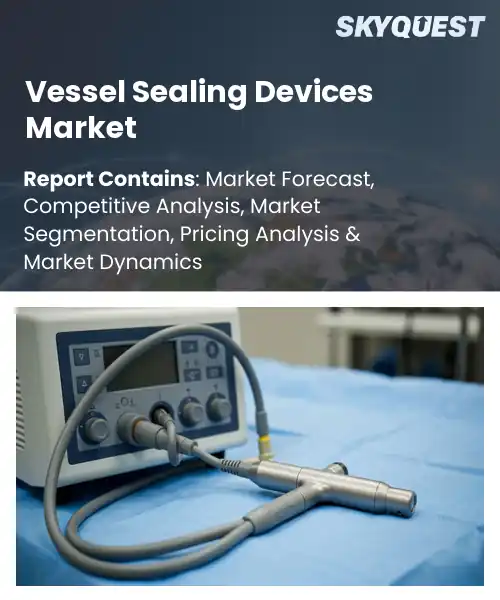
Vessel Sealing Devices Market
Report ID: SQMIG35A3461
Report ID: SQMIG35A3461
[email protected]
USA +1 351-333-4748
Report ID:
SQMIG35A3461 |
Region:
Global |
Published Date: May, 2026
Pages:
157
|Tables:
147
|Figures:
78


Global Vessel Sealing Devices Market size was valued at USD 2.4 Billion in 2024 and is poised to grow from USD 2.58 Billion in 2025 to USD 4.6 Billion by 2033, growing at a CAGR of 7.5% during the forecast period (2026-2033).
The AI application relates to enhancing surgical precision of vessel sealing devices by providing better recognition of tissue, and generates real-time tracking of instruments, and further enhances the ability to integrate with imaging / robotic systems. Vessel sealing devices are tools used during surgery to seal blood vessels; they do this so that blood can be controlled quickly, thereby decreasing total surgery time. For the last 20 years, there has been an evolution from using manual ligatures and clips to more advanced methods, such as energy-based platforms with two or more advanced technologies combined together. Examples like LigaSure and Harmonic Scalpel help show this change. The increased focus on improving efficiency and patient safety by hospitals has accelerated the adoption of these products by ensuring regulatory approvals/process and providing clinician training.
Technological innovation in energy delivery and device ergonomics has been the key trend driving the global vessel sealing devices sector expansion because improved sealing consistency reduces blood loss and shortens operative time, leading hospitals to prefer these systems. When reducing complications from surgical procedures, insurance companies and hospital administrators see reduced expenses, which increases the purchasing of devices further leading manufacturers to develop new products that are compatible with both disposable instruments and robotics. For example, using advanced bipolar or ultrasonic tools to ligate vessels results in fewer transfusions when performing laparoscopic hysterectomy and colorectal resection, enabling faster vessel ligation. This created a cascade of clinical benefits, economic incentives and product differentiation that will generate many growth opportunities throughout emerging regions and ambulatory surgical centres.
How is AI Improving Surgical Precision in the Vessel Sealing Devices Market?
AI is enhancing surgical precision within the vessel sealing devices industry, improving tissue recognition and adaptive energy control through innovative technologies like real-time tracking of instruments and increased integration with imaging and robotic equipment. This will produce fewer unintended effects due to overheating, improve sealing criteria, and assist in guiding surgeons when performing a critical incision. Today AI models assist with instrument segmentation and workflow optimization and are being incorporated into robotic assisted systems, making vessel sealers more precise and consistent. Market demand is driven by growth in minimally invasive procedures and the need for devices that combine energy delivery with data driven guidance, for example AI based instrument recognition and adaptive energy algorithms that tune delivery to tissue characteristics.
In July 2025, Intuitive received FDA clearance for Vessel Sealer Curved, expanding robotic compatible sealing tools and enabling better pairing with AI driven image guidance and instrument tracking to improve precision and operating room efficiency.
Market snapshot - (2026-2033)
Global Market Size
USD 2.4 Billion
Largest Segment
Bipolar Vessel Sealing Devices
Fastest Growth
Hybrid Vessel Sealing Devices
Growth Rate
7.5% CAGR
To get more insights on this market click here to Request a Free Sample Report
Global vessel sealing devices market is segmented by product type, surgery type, application, end user, technology and region. Based on product type, the market is segmented into Bipolar Vessel Sealing Devices, Ultrasonic Vessel Sealing Devices and Hybrid Vessel Sealing Devices. Based on surgery type, the market is segmented into General Surgery, Gynecological Surgery, Urological Surgery, Cardiovascular Surgery, Orthopedic Surgery and Oncological Surgery. Based on application, the market is segmented into Open Surgery, Laparoscopic Surgery and Robotic-Assisted Surgery. Based on end user, the market is segmented into Hospitals, Ambulatory Surgical Centers, Specialty Clinics and Others. Based on technology, the market is segmented into Disposable Devices and Reusable Devices. Based on region, the market is segmented into North America, Europe, Asia Pacific, Latin America and Middle East & Africa.
Based on the global vessel sealing devices market growth, bipolar vessel sealing devices segment dominates because its energy delivery profile and intuitive handling match diverse surgical workflows, enabling predictable hemostasis and fewer instrument exchanges. This reliability shortens operative time and reduces intraoperative interruptions, prompting clinicians and procurement teams to favor bipolar systems. Extensive familiarity with and compatibility between existing electrosurgical infrastructure and established clinical practices will create standardized adoption, which will result in investment from suppliers that will reinforce market leadership through clinical use.
However, ultrasonic vessel sealing devices are emerging as the most rapidly expanding area due to precise cutting and coagulation in delicate tissues, appealing to minimally invasive surgeons. Innovation in instrument tip design and integration with laparoscopic and robotic platforms is accelerating adoption and creating new procedural indications and commercial opportunities across specialties.
Laparoscopic surgery segment dominates because the shift toward minimally invasive approaches increases reliance on compact, reliable sealing instruments that perform within constrained operative fields. Surgeons have a need for tools that lead to rapid hemostasis and are also able to sustain visual clarity and dexterity with the instrument, leading to the need for sealing devices in everyday laparoscopic cases. Hospitals that procure technology will prioritize technology that reduces complications and allows for speedy recovery from surgery, guiding suppliers toward developing devices that are compatible with laparoscopic procedures and establishing a long-term market for these type of products.
Meanwhile, robotic-assisted surgery is emerging as the fastest growing area because integrated platform ecosystems require advanced sealing tools that match robotic precision and articulation. Collaborations between platform providers and device manufacturers, along with escalating procedural complexity, are driving investment in robotic-compatible sealing solutions, expanding clinical applications and creating high-value opportunities for novel instrument designs.
To get detailed segments analysis, Request a Free Sample Report
As per the global vessel sealing devices market share, North America dominates the industry due to a concentrated combination of advanced clinical expertise, widespread adoption by high-volume surgical centers, and close proximity to innovative device manufacturers. Strong collaboration between academic hospitals and industry accelerates clinical validation and early adoption of new technologies. Procedural uptake in diverse specialties is created by skilled surgical staff working within well-defined reimbursement systems to build procedural uptake. Ongoing enhancements to the performance and safety of devices occur due to clearly defined rules for regulatory approval and access to clinical research infrastructure. Together, these strengths create a favorable environment for both established medical device companies and emerging firms to scale operations and influence global standards in vessel sealing technology. Market maturity is complemented by investment in surgeon training and device servicing capabilities.
Vessel sealing devices market in United States benefits from concentrated expertise across leading academic medical centers, strong ties to device innovators, and a dense network of clinical trials and training programs. High procedural volumes and established surgical teams favor rapid integration of refined sealing technologies. Commercial ecosystems focus on postmarket support, clinician education, and supply chain resilience, which together sustain adoption and incremental product improvements across diverse surgical specialties.
Vessel sealing devices market in Canada is characterized by strong hospital networks, emphasis on clinical evidence generation and collaborative initiatives between healthcare institutions and manufacturers. Procurement methodologies give priority to value and safety to drive the use of proven sealing systems. Training programs and regionally located centers of excellence support clinician's proficiency and distribution partnerships support both appliance consistency and the availability of the device. These elements support controlled adoption and foster local innovation in appliance application, service and maintenance.
Based on global vessel sealing devices regional forecast, Europe is experiencing rapid expansion in the industry driven by concerted emphasis on minimally invasive surgery, increased procedural specialization, and harmonized regulatory pathways that streamline product entry across multiple national systems. Healthcare organizations are focused on ways to cut down the time spent in the operating room and make recovery quicker. This has increased the need for better sealing solutions. Large medical device clusters, mainly located in central and western Europe support research collaboration as well as manufacturing at the local level. Purchasing frameworks favor vendors who show they provide clinical value and have long-term cost savings. Investment in training for surgeons and Centers of Excellence facilitates early acceptance of new products in clinical settings. The establishment of strategic distribution networks and cross-border partnerships further helps manufacturers create and execute a plan that should enable them to grow their own market presence.
Vessel sealing devices market in Germany is shaped by a strong industrial base, advanced clinical research infrastructure, and close collaboration between hospitals and domestic manufacturers. Preference for high quality, durable instruments encourages adoption of sophisticated sealing platforms. In addition, expert training centres provide well-developed, skillful clinicians with experience from all specialty areas of practice regardless of where the clinician works. These attributes reinforce Germany position in Europe, promoting product refinement and postmarket evaluations and clinical benchmarking.
Vessel sealing devices market in United Kingdom is marked by rapid clinical adoption driven by dynamic private hospital systems, proactive procurement strategies, and strong engagement between surgical societies and industry. Investments made in training and simulation provide the surgeons with greater levels of confidence in performing these surgical techniques through better technology that is agile and available to them when needed. These forces accelerate market uptake and attract innovation tailored to clinical needs locally.
Vessel sealing devices market in France is emerging with growing emphasis on minimally invasive surgery and selective adoption in major hospitals and private clinics. Devices are evaluated and clinicians are trained through partnerships with national centers and academic institutions, while local distributors modify commercial strategies based on regional customer preferences. All these dynamics contribute to a supportive environment for both new and existing businesses who are looking to grow.
As per the global vessel sealing devices regional outlook, Asia Pacific is strengthening its role in the industry through a multifaceted approach combining increasing procedural volumes, advancing clinical expertise, and strategic local manufacturing. By developing regional centers of excellence and increasing surgical training opportunities, clinicians can experience modern sealing technology first-hand. In addition, governments and healthcare systems in key markets support the modernization of operating rooms and collaborate with global manufacturers for the provision of customized products. Domestic medical technology manufacturers have established a growing base of operations that provide cost-competitive solutions and localized services to supplement the services of international manufacturers. The enhancement of distribution and post-sale support reduces the barriers to adoption of technology. Increased collaboration in clinical studies.
Vessel sealing devices market in Japan combines advanced surgical infrastructure with strong research institutions and a discerning clinical community that values precision and reliability. Training programs for clinicians on how to use the devices are extensive, and higher levels of procedural standards will help to actually adopt sophisticated sealing platforms. The distribution network of hospitals and the service capabilities that they provide allow for continued utilization of the devices and the ability to improve the products to meet the needs of the surgeon based on their feedback.
Vessel sealing devices market in South Korea is advancing through strong technology adoption, participation in clinical research, and partnerships between domestic and global manufacturers. The efficiency and effectiveness of a medical institution's operations serve as important considerations when creating a demand for flexible sealing alternatives. Training programs and facilities are used to distribute knowledge about procedural excellence, and local suppliers are generally competitive and provide a wide range of custom designed components and services.
To know more about the market opportunities by region and country, click here to
Buy The Complete Report
Technological Advancements In Sealing
Increased Adoption Of Minimally Invasive Procedures
High Upfront And Maintenance Costs
Stringent Regulatory Approval Requirements
Request Free Customization of this report to help us to meet your business objectives.
Competition in the global vessel sealing devices market outlook is intensifying as incumbents deploy acquisitions, partnerships, and focused product innovation to secure platform integration in operating rooms. Hologic acquired Bolder Surgical in November 2021 and Intuitive obtained clearance for SynchroSeal and its E 100 generator in 2019. Established firms pursue co development deals while startups target low cost and articulation advantages to win OR adoption.
Top Player’s Company Profile
Recent Developments
SkyQuest’s ABIRAW (Advanced Business Intelligence, Research & Analysis Wing) is our Business Information Services team that Collects, Collates, Correlates, and Analyses the Data collected by means of Primary Exploratory Research backed by robust Secondary Desk research.
As per SkyQuest analysis, the global vessel sealing devices industry is driven primarily by the ongoing shift to minimally invasive surgery, with technological advancements in energy delivery and AI-enabled precision serving as a second significant driver. Bipolar vessel sealing devices remain the dominating segment due to predictable hemostasis and workflow compatibility, and North America leads the market supported by advanced clinical infrastructure and rapid adoption. Adoption is tempered by high upfront and maintenance costs that constrain procurement in resource-limited settings. Developers have multiple development opportunities due to improvements in ergonomics, robotic platform integration, and data-driven device characteristics, which provide opportunities for developers to grow into emerging markets and to grow in the mobile surgical market.
| Report Metric | Details |
|---|---|
| Market size value in 2024 | USD 2.4 Billion |
| Market size value in 2033 | USD 4.6 Billion |
| Growth Rate | 7.5% |
| Base year | 2024 |
| Forecast period | (2026-2033) |
| Forecast Unit (Value) | USD Billion |
| Segments covered |
|
| Regions covered | North America (US, Canada), Europe (Germany, France, United Kingdom, Italy, Spain, Rest of Europe), Asia Pacific (China, India, Japan, Rest of Asia-Pacific), Latin America (Brazil, Rest of Latin America), Middle East & Africa (South Africa, GCC Countries, Rest of MEA) |
| Companies covered |
|
| Customization scope | Free report customization with purchase. Customization includes:-
|
To get a free trial access to our platform which is a one stop solution for all your data requirements for quicker decision making. This platform allows you to compare markets, competitors who are prominent in the market, and mega trends that are influencing the dynamics in the market. Also, get access to detailed SkyQuest exclusive matrix.
Table Of Content
Executive Summary
Market overview
Parent Market Analysis
Market overview
Market size
KEY MARKET INSIGHTS
COVID IMPACT
MARKET DYNAMICS & OUTLOOK
Market Size by Region
KEY COMPANY PROFILES
Methodology
For the Vessel Sealing Devices Market, our research methodology involved a mixture of primary and secondary data sources. Key steps involved in the research process are listed below:
1. Information Procurement: This stage involved the procurement of Market data or related information via primary and secondary sources. The various secondary sources used included various company websites, annual reports, trade databases, and paid databases such as Hoover's, Bloomberg Business, Factiva, and Avention. Our team did 45 primary interactions Globally which included several stakeholders such as manufacturers, customers, key opinion leaders, etc. Overall, information procurement was one of the most extensive stages in our research process.
2. Information Analysis: This step involved triangulation of data through bottom-up and top-down approaches to estimate and validate the total size and future estimate of the Vessel Sealing Devices Market.
3. Report Formulation: The final step entailed the placement of data points in appropriate Market spaces in an attempt to deduce viable conclusions.
4. Validation & Publishing: Validation is the most important step in the process. Validation & re-validation via an intricately designed process helped us finalize data points to be used for final calculations. The final Market estimates and forecasts were then aligned and sent to our panel of industry experts for validation of data. Once the validation was done the report was sent to our Quality Assurance team to ensure adherence to style guides, consistency & design.
Analyst Support
Customization Options
With the given market data, our dedicated team of analysts can offer you the following customization options are available for the Vessel Sealing Devices Market:
Product Analysis: Product matrix, which offers a detailed comparison of the product portfolio of companies.
Regional Analysis: Further analysis of the Vessel Sealing Devices Market for additional countries.
Competitive Analysis: Detailed analysis and profiling of additional Market players & comparative analysis of competitive products.
Go to Market Strategy: Find the high-growth channels to invest your marketing efforts and increase your customer base.
Innovation Mapping: Identify racial solutions and innovation, connected to deep ecosystems of innovators, start-ups, academics, and strategic partners.
Category Intelligence: Customized intelligence that is relevant to their supply Markets will enable them to make smarter sourcing decisions and improve their category management.
Public Company Transcript Analysis: To improve the investment performance by generating new alpha and making better-informed decisions.
Social Media Listening: To analyze the conversations and trends happening not just around your brand, but around your industry as a whole, and use those insights to make better Marketing decisions.
REQUEST FOR SAMPLE
 REQUEST FREE CUSTOMIZATION
Global Vessel Sealing Devices Market size was valued at USD 2.4 Billion in 2024 and is poised to grow from USD 2.58 Billion in 2025 to USD 4.6 Billion by 2033, growing at a CAGR of 7.5% during the forecast period (2026-2033).
Competition in the global vessel sealing devices market is intensifying as incumbents deploy acquisitions, partnerships, and focused product innovation to secure platform integration in operating rooms. Hologic acquired Bolder Surgical in November 2021 and Intuitive obtained clearance for SynchroSeal and its E 100 generator in 2019. Established firms pursue co development deals while startups target low cost and articulation advantages to win OR adoption. 'Medtronic', 'Johnson & Johnson', 'Olympus Corporation', 'Stryker Corporation', 'B. Braun', 'CONMED Corporation', 'Erbe Elektromedizin', 'BOWA-electronic', 'Integra LifeSciences', 'KLS Martin Group', 'OmniGuide Holdings', 'Applied Medical Resources', 'Teleflex', 'Smith & Nephew', 'Karl Storz', 'Zimmer Biomet', 'CooperCompanies', 'Boston Scientific', 'Fujifilm Holdings', 'Surgical Innovations Group'
Technological improvements in vessel sealing devices have enabled more precise tissue management, enhanced hemostasis, and reduced collateral thermal injury, which in turn increases clinical confidence among surgeons and encourages institutional adoption. Innovations such as refined energy control, ergonomic instrument design, and improved feedback mechanisms support easier integration into diverse surgical workflows and broaden the range of applicable procedures. As clinical teams perceive clearer benefits in patient outcomes and operational efficiency, purchasing decisions and training priorities shift toward these advanced devices, fostering market expansion.
Robotic And Minimally Invasive Integration: Adoption of minimally invasive and robotic platforms is reshaping demand for vessel sealing devices, prompting design focus on articulation, instrument profile, and precise thermal control. Manufacturers prioritize compatibility with console interfaces and endoscopic access while enhancing sealing reliability in confined anatomies. Surgeons value devices that deliver consistent hemostasis with intuitive ergonomics and feedback, enabling broader procedure applicability across specialties. Strategic partnerships with robotic system providers and modular product lines support rapid clinical integration and procurement preference in hospital technology roadmaps.
Why does North America Dominate the Global Vessel Sealing Devices Market? |@12


Want to customize this report? This report can be personalized according to your needs. Our analysts and industry experts will work directly with you to understand your requirements and provide you with customized data in a short amount of time. We offer $1000 worth of FREE customization at the time of purchase.
Feedback From Our Clients


 USA (+1) 351-333-4748

