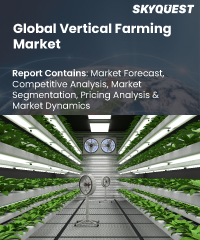
Vertical Farming Market
Report ID: SQMIG20H2057
Report ID: SQMIG20H2057
[email protected]
USA +1 351-333-4748
Report ID:
SQMIG20H2057 |
Region:
Global |
Published Date: July, 2025
Pages:
174
|Tables:
91
|Figures:
71


Global Vertical Farming Market size was valued at USD 10.63 Billion in 2024 poised to grow between USD 12.84 Billion in 2025 to USD 58.23 Billion by 2033, growing at a CAGR of 20.8% in the forecast period (2026–2033).
Key Takeaways: Market Trends & Insights
Rapid urbanization has led to the depletion of available agricultural land, especially in densely populated cities. As more people move into urban centers, the demand for fresh, locally grown produce rises while available farmland shrinks. Vertical farming offers an efficient, space-saving solution by growing crops in vertically stacked layers within indoor environments. This method drastically reduces land requirements and brings food production closer to urban consumers, minimizing transportation costs and emissions. The controlled environment ensures consistent yields regardless of external weather conditions, making vertical farming an essential response to the growing challenge of feeding urban populations with limited space.
Cutting-edge innovations in controlled environment agriculture (CEA) have been key trend driving the global vertical farming sector from concept to scalable reality. Advanced hydroponic and aeroponic systems allow soil-less cultivation with minimal water use, while LED grow lights simulate sunlight, promoting photosynthesis efficiently. Smart sensors and automation technologies monitor and regulate critical variables like light, temperature, CO₂, and nutrient levels in real time. These systems enable optimal plant growth and reduce waste, labor, and energy costs. As CEA technologies become more affordable and accessible, they play a crucial role in making vertical farming more profitable, sustainable, and attractive to both investors and agricultural innovators worldwide.
What are the Sustainability Benefits of AI-Powered Farming?
The integration of artificial intelligence directly enhances operational efficiency in vertical farming by enabling real-time monitoring and automated adjustments of environmental variables such as light, temperature, and humidity. This precision ensures optimal plant growth, reduces resource waste, and minimizes human intervention. Indirectly, AI also supports predictive analytics to detect early signs of disease or equipment failure, reducing crop loss. For instance, in March 2024, Indian agri-startup Krop AI deployed AI-powered container farms capable of producing 40 times more yield using 95% less water, showcasing how AI-driven climate control can revolutionize scalability, profitability, and sustainability in urban agriculture.
In September 2024, U.S. vertical-farming pioneer Plenty launched the world’s first AI-powered vertical berry farm in Richmond, Virginia. The facility utilizes AI to monitor over 10 million daily data points—automatically adjusting temperature, light, moisture, and pollination—to grow Driscoll’s strawberries year-round. This AI-driven ecosystem enables > 90 % water savings and stable crop quality, producing over 4 million pounds annually from just 40,000 ft².
Market snapshot - 2026–2033
Global Market Size
USD 8.8 Billion
Largest Segment
Hardware
Fastest Growth
Software
Growth Rate
20.8% CAGR
To get more insights on this market click here to Request a Free Sample Report
The global vertical farming market is segmented based on component, growing mechanism, crop category, and region. In terms of components, the market is trifurcated into hardware, software, and services. Based on the growth mechanisms, the market is trifurcated into aeroponics, hydroponics, and aquaponics. Based on crop category, the market is segmented into fruits-vegetables, herbs, flowers & ornamentals, and others. Based on region, the market is segmented into North America, Europe, Asia-Pacific, Central & South America and the Middle East & Africa.
What Drives Continued Investment in Vertical Farming Hardware?
Based on global vertical farming market forecast, the hardware component dominates the industry due to its essential role in enabling controlled environment agriculture. Innovations in LED lighting, climate control systems, sensors, and automated irrigation technologies directly influence crop quality, yield, and energy efficiency. These physical systems are indispensable for replicating optimal growing conditions indoors. As vertical farms scale globally, reliance on precise, durable, and high-performing hardware drives the segment's market leadership and continued investment focus.
The software component is projected to be the fastest-growing in the global vertical farming market due to its role in data-driven decision-making. As farms integrate more sensors and automation, software enables real-time monitoring, predictive analytics, and remote control, enhancing efficiency, reducing operational costs, and ensuring consistent, high-quality crop production at scale.
How do Hydroponics Save Resources Compared to Traditional Farming?
Hydroponics dominates the global vertical farming market due to its high efficiency, resource savings, and adaptability to urban environments. By delivering nutrient-rich water directly to plant roots without soil, hydroponics enables faster growth, higher yields, and up to 90% water savings. Innovations such as closed-loop systems and modular NFT designs have enhanced scalability and control, making hydroponics the most reliable and commercially viable growing method for modern vertical farms.
The software component is becoming the fastest-growing segment in the global vertical farming market because it transforms raw sensor data into intelligent control systems. As farms deploy more IoT devices and automation, software enables predictive analytics, remote management, and process optimization—reducing labor, cutting energy use, and improving yields—making scalability efficient and cost-effective.
To get detailed segments analysis, Request a Free Sample Report
How does Technological Adoption Impact Vertical Farming in North America?
As per the global vertical farming market analysis, North America leads the industry due to strong technological adoption, urbanization, and growing demand for locally sourced produce. The U.S. dominates the region with large-scale commercial farms and significant investments in hydroponics and AI-driven solutions. Supportive government policies, rising consumer awareness of sustainable food, and increasing focus on food security drive market expansion, positioning North America as a hub for innovation and vertical farming growth.
US Vertical Farming Market
The United States dominates North America’s vertical farming market due to its advanced technological infrastructure and rising urban food demand. Limited arable land and increasing climate unpredictability have accelerated the shift toward controlled-environment agriculture. Major cities support large-scale, building-based vertical farms that utilize hydroponics, LED lighting, and AI-based monitoring. Government initiatives and private investments further fuel the sector, making the U.S. the largest contributor to regional vertical farming development.
Canada Vertical Farming Market
Canada is rapidly emerging in North America’s vertical farming market due to its focus on sustainable agriculture and food security. Cold climate and short growing seasons drive the adoption of indoor farming, particularly hydroponic and container-based systems. Urban centers like Montreal and Vancouver are witnessing significant infrastructure development. Support from government grants and innovations like rooftop greenhouses enable year-round production, positioning Canada as a key growth contributor with high future potential.
How does Asia Pacific Compare to Other Regions in Vertical Farming Development?
Asia Pacific is the fastest-growing region in the global vertical farming market due to rapid urbanization, limited arable land, and increasing demand for safe, locally grown produce. Countries like China, Japan, and Singapore are investing in hydroponics, automation, and energy-efficient technologies. Government initiatives supporting food security and smart agriculture further accelerate adoption, positioning Asia Pacific as a leading hub for innovation, scalability, and sustainable vertical farming development.
Japan Vertical Farming Market
Japan is a key contributor to the Asia Pacific vertical farming market due to its technological advancements and limited arable land. The country’s aging agricultural workforce and frequent natural disasters have prompted large-scale investment in plant factories using hydroponics and automation. Companies like Spread Co. lead with high-yield, fully automated farms. Government support and strong demand for pesticide-free produce enable Japan to scale vertical farming efficiently, making it a leader in Asia’s indoor agriculture landscape.
South Korea Vertical Farming Market
South Korea contributes significantly to the Asia Pacific vertical farming market through its smart farming initiatives and urban agriculture strategies. Faced with space constraints and food security concerns, the country promotes container-based and building-integrated vertical farms. Government incentives and technological innovation in IoT, robotics, and hydroponics drive adoption. Companies like N.Thing and Farm8 are pioneering scalable models, positioning South Korea as a regional leader in compact, tech-driven vertical farming solutions.
What is the Role of Agri-Tech Startups in Europe’s Vertical Farming Market?
Europe is emerging as a major player in the global vertical farming market due to strong sustainability goals, limited arable land, and high demand for pesticide-free produce. Countries like Germany, the Netherlands, and the UK are investing heavily in container and building-based farms. Supportive government policies, innovative agri-tech startups, and urban food security concerns are accelerating market growth, positioning Europe as a leader in controlled-environment agriculture and vertical farming innovation.
Germany Vertical Farming Market
Germany plays a leading role in Europe’s vertical farming market due to its strong focus on sustainability, renewable energy, and precision agriculture. High urban population density and limited farmland have driven investment in hydroponic and building-based farms. Government support for clean technologies and R&D has led to innovations in automation and energy-efficient systems, positioning Germany as a dominant contributor to the European market with scalable models for urban food production.
France Vertical Farming Market
France is expanding its vertical farming efforts in response to rising demand for pesticide-free produce and the need for sustainable food systems. Urban areas like Paris are adopting hydroponic and aeroponic technologies to meet local food needs. Government initiatives, including the Ecophyto Plan aimed at reducing pesticide use, are supporting the growth of controlled-environment agriculture. These efforts make France an emerging contributor to vertical farming in Europe with strong policy backing.
Italy Vertical Farming Market
The United Kingdom contributes significantly to the European vertical farming market through large-scale urban farms and container-based systems. Limited agricultural space and rising food import costs have encouraged local production initiatives. Investment in automation, energy efficiency, and AI-driven systems enhances productivity and sustainability. Despite energy cost challenges, vertical farming in cities like London and Manchester continues to expand, making the UK a major innovator and revenue contributor in the region.
To know more about the market opportunities by region and country, click here to
Buy The Complete Report
Vertical Farming Market Drivers
Rising Demand for Pesticide-Free Produce
Limited Availability of Arable Land
Vertical Farming Market Restraints
High Energy Consumption
Limited Crop Variety
Request Free Customization of this report to help us to meet your business objectives.
The global vertical farming market outlook is highly competitive, driven by innovation, scalability, and sustainability. Key international players include AeroFarms, Plenty, Signify, Freight Farms, and Bowery Farming. AeroFarms focuses on precision aeroponics and global expansion. Plenty uses AI-driven farms to grow diverse crops efficiently. Freight Farms offers modular container farms targeting urban areas. These companies emphasize technological advancements, strategic partnerships, and sustainable models to strengthen market presence and meet rising demand for fresh, local produce.
As per the global vertical farming industry analysis, the startup landscape is expanding rapidly due to rising urban food demand, climate concerns, and land scarcity. Startups are capitalizing on advancements in hydroponics, automation, and AI to create compact, resource-efficient farms. Their focus on local food production, reduced water usage, and clean technology attracts investors and policymakers. As they scale operations and refine modular systems, these startups are reshaping how cities approach sustainable, year-round crop production.
Top Player’s Company Profiles
Recent Developments in Vertical Farming Market
SkyQuest’s ABIRAW (Advanced Business Intelligence, Research & Analysis Wing) is our Business Information Services team that Collects, Collates, Correlates, and Analyses the Data collect ed by means of Primary Exploratory Research backed by robust Secondary Desk research.
As per SkyQuest analysis, the global vertical farming industry is undergoing rapid transformation, driven by urbanization, technological innovation, and growing food security concerns. Advancements in controlled-environment agriculture, AI, and hardware-software integration enhance efficiency, scalability, and profitability. Hydroponics and renewable energy adoption are making vertical farms more sustainable, while smart farming technologies attract investment and reduce operational risks.
Regional leaders like the U.S., Japan, and South Korea are shaping market momentum through supportive policies and innovative models. Meanwhile, startups and global companies alike are redefining crop production with precision farming systems and modular solutions. Although high energy demands and crop variety limitations remain challenges, continuous R&D and digital integration ensure that the global vertical farming market strategies will play a pivotal role in the future of global agriculture.
| Report Metric | Details |
|---|---|
| Market size value in 2024 | USD 10.63 Billion |
| Market size value in 2033 | USD 58.23 Billion |
| Growth Rate | 20.8% |
| Base year | 2024 |
| Forecast period | 2026–2033 |
| Forecast Unit (Value) | USD Billion |
| Segments covered |
|
| Regions covered | North America (US, Canada), Europe (Germany, France, United Kingdom, Italy, Spain, Rest of Europe), Asia Pacific (China, India, Japan, Rest of Asia-Pacific), Latin America (Brazil, Rest of Latin America), Middle East & Africa (South Africa, GCC Countries, Rest of MEA) |
| Companies covered |
|
| Customization scope | Free report customization with purchase. Customization includes:-
|
To get a free trial access to our platform which is a one stop solution for all your data requirements for quicker decision making. This platform allows you to compare markets, competitors who are prominent in the market, and mega trends that are influencing the dynamics in the market. Also, get access to detailed SkyQuest exclusive matrix.
Table Of Content
Executive Summary
Market overview
Parent Market Analysis
Market overview
Market size
KEY MARKET INSIGHTS
COVID IMPACT
MARKET DYNAMICS & OUTLOOK
Market Size by Region
KEY COMPANY PROFILES
Methodology
For the Vertical Farming Market, our research methodology involved a mixture of primary and secondary data sources. Key steps involved in the research process are listed below:
1. Information Procurement: This stage involved the procurement of Market data or related information via primary and secondary sources. The various secondary sources used included various company websites, annual reports, trade databases, and paid databases such as Hoover's, Bloomberg Business, Factiva, and Avention. Our team did 45 primary interactions Globally which included several stakeholders such as manufacturers, customers, key opinion leaders, etc. Overall, information procurement was one of the most extensive stages in our research process.
2. Information Analysis: This step involved triangulation of data through bottom-up and top-down approaches to estimate and validate the total size and future estimate of the Vertical Farming Market.
3. Report Formulation: The final step entailed the placement of data points in appropriate Market spaces in an attempt to deduce viable conclusions.
4. Validation & Publishing: Validation is the most important step in the process. Validation & re-validation via an intricately designed process helped us finalize data points to be used for final calculations. The final Market estimates and forecasts were then aligned and sent to our panel of industry experts for validation of data. Once the validation was done the report was sent to our Quality Assurance team to ensure adherence to style guides, consistency & design.
Analyst Support
Customization Options
With the given market data, our dedicated team of analysts can offer you the following customization options are available for the Vertical Farming Market:
Product Analysis: Product matrix, which offers a detailed comparison of the product portfolio of companies.
Regional Analysis: Further analysis of the Vertical Farming Market for additional countries.
Competitive Analysis: Detailed analysis and profiling of additional Market players & comparative analysis of competitive products.
Go to Market Strategy: Find the high-growth channels to invest your marketing efforts and increase your customer base.
Innovation Mapping: Identify racial solutions and innovation, connected to deep ecosystems of innovators, start-ups, academics, and strategic partners.
Category Intelligence: Customized intelligence that is relevant to their supply Markets will enable them to make smarter sourcing decisions and improve their category management.
Public Company Transcript Analysis: To improve the investment performance by generating new alpha and making better-informed decisions.
Social Media Listening: To analyze the conversations and trends happening not just around your brand, but around your industry as a whole, and use those insights to make better Marketing decisions.
REQUEST FOR SAMPLE
 REQUEST FREE CUSTOMIZATION
Global Vertical Farming Market size was valued at USD 10.63 Billion in 2024 poised to grow between USD 12.84 Billion in 2025 to USD 58.23 Billion by 2033, growing at a CAGR of 20.8% in the forecast period (2026–2033).
The global vertical farming market outlook is highly competitive, driven by innovation, scalability, and sustainability. Key international players include AeroFarms, Plenty, Signify, Freight Farms, and Bowery Farming. AeroFarms focuses on precision aeroponics and global expansion. Plenty uses AI-driven farms to grow diverse crops efficiently. Freight Farms offers modular container farms targeting urban areas. These companies emphasize technological advancements, strategic partnerships, and sustainable models to strengthen market presence and meet rising demand for fresh, local produce. 'AeroFarms (USA)', 'Plenty Unlimited Inc. (USA)', 'Bowery Farming (USA)', 'Infarm (Germany)', 'Freight Farms (USA)', 'Agricool (France)', 'Crop One Holdings (USA)', 'Spread Co., Ltd. (Japan)', 'N.Thing Inc. (South Korea)', 'Sky Greens (Singapore)', 'Vertical Future (United Kingdom)', 'iFarm (Finland)', 'Kalera (Norway)', 'Mirai Co., Ltd. (Japan)', 'Urban Crop Solutions (Belgium)'
Growing consumer awareness of food safety and health is increasing the demand for pesticide-free and organic produce. Vertical farming offers controlled environments that eliminate the need for harmful chemicals. This ability to produce clean, traceable crops year-round directly fuels adoption among health-conscious consumers and premium retail markets.
Integration of Renewable Energy Solutions: The global vertical farming market trends are increasingly incorporating solar panels, wind energy, and energy storage systems to reduce operational costs and carbon footprints. This shift toward clean energy supports sustainability goals and makes vertical farming more viable in regions with high electricity costs, strengthening its appeal among eco-conscious investors and urban planners.
How does Technological Adoption Impact Vertical Farming in North America?
The growth of the vertical farming market is primarily driven by rising consumer demand for pesticide-free and organic produce. Increasing awareness of food safety and health is encouraging the adoption of controlled-environment agriculture, which enables year-round production of clean and traceable crops. Additionally, the limited availability of arable land due to urbanization and climate change is further boosting the adoption of vertical farming solutions.
One of the major challenges in the vertical farming market is high energy consumption, as operations require continuous electricity for lighting, climate control, and automation systems. Another limitation is the restricted crop variety, as vertical farming is currently more suitable for leafy greens, herbs, and microgreens, while crops like grains and root vegetables remain difficult to cultivate efficiently.


Want to customize this report? This report can be personalized according to your needs. Our analysts and industry experts will work directly with you to understand your requirements and provide you with customized data in a short amount of time. We offer $1000 worth of FREE customization at the time of purchase.
Feedback From Our Clients


 USA (+1) 351-333-4748

