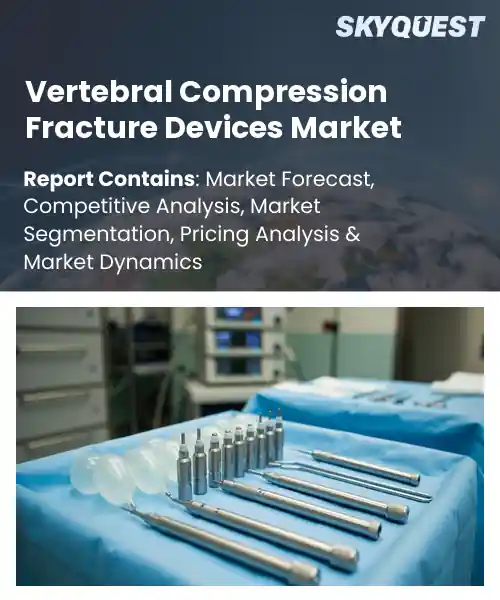
Vertebral Compression Fracture Devices Market
Report ID: SQMIG35A3957
Report ID: SQMIG35A3957
[email protected]
USA +1 351-333-4748
Report ID:
SQMIG35A3957 |
Region:
Global |
Published Date: June, 2026
Pages:
157
|Tables:
117
|Figures:
77


Global Vertebral Compression Fracture Devices Market size was valued at USD 1.22 Billion in 2024 and is poised to grow from USD 1.3 Billion in 2025 to USD 2.22 Billion by 2033, growing at a CAGR of 6.91% during the forecast period (2026-2033).
The vertebral compression fracture (VCF) devices market is made up of implants , balloon kyphoplasty systems, and vertebroplasty kits, which are used to shore up fragile vertebrae and help with pain. It matters a lot because osteoporosis related fractures are showing up more often, and that stuff taxes health systems with long term disability plus costly care.
Moreover, another factor for the vertebral compression fracture devices market growth is how an ageing population collides with broader insurance coverage for minimally invasive options. As baby-boomers move into older age, bone density fades and the demand for quick, low risk pain relief grows, so many hospitals choose to install kyphoplasty suites that can shorten stays and lower overall spending. Due to this cause and effect, manufacturers feel pushed to upgrade the tech. One example is the more recent radio‑frequency‑assisted vertebroplasty systems, which aim to give more precise cement control and fewer leakage issues. As a result, care teams report better outcomes , payers often see reduced expense, and the market gets fresh growth paths in emerging regions where spine centers are rapidly expanding.
AI is reshaping the vertebral compression fracture devices market outlook in a few key ways, mainly by improving diagnosis, tailoring treatment, and speeding up device development. Machine learning models sift through imaging to spot fracture patterns that are easy to miss, and they can do it faster than standard manual review. Predictive systems also support clinicians in selecting the best cement volume plus placement, which can lower the chance of complications. On the manufacturing side, AI driven design tools let companies model biomechanical performance and test prototypes with less delay, so iterations happen quickly. Then when these systems connect with hospital information systems, workflow gets more automated, freeing staff to focus on patient care instead of admin load. Altogether, these tools help increase the take up of minimally invasive solutions and keep the market moving forward.
Market snapshot - (2026-2033)
Global Market Size
USD 1.22 Billion
Largest Segment
Vertebroplasty
Fastest Growth
Mechanical Vertebral Augmentation
Growth Rate
6.91% CAGR
To get more insights on this market click here to Request a Free Sample Report
The global vertebral compression fracture devices market is segmented based on procedure, product, application, end-user, and region. By procedure, the market is categorized into Vertebroplasty, Balloon Kyphoplasty, and Mechanical Vertebral Augmentation. Based on product, the market is divided into Bone Cement (PMMA), Balloon Tamps, and Delivery Systems. By application, the market is segmented into Osteoporotic Vertebral Compression Fractures (VCFs), Traumatic VCFs, and Malignant VCFs. Based on end-user, the market is classified into Hospitals, Interventional Radiology Centers, and Spine Surgery Centers. Geographically, the market is analyzed across North America, Europe, Asia Pacific, Latin America, and the Middle East & Africa.
As per the vertebral compression fracture devices market analysis, the Vertebroplasty segment dominates, because it offers the most established, straightforward way to stabilize fractured vertebrae, so clinicians can restore mobility relatively fast with less procedural complexity. There’s long‑standing clinical evidence, physician familiarity, and lower equipment costs, which together feel like a trusted solution and it drives more consistent uptake across treatment facilities. The injection seems simple and pain relief can be immediate, so it keeps that preferred position, and ends up anchoring the market’s core revenue stream.
However, the Balloon Kyphoplasty segment is the one growing faster, because the inflatable balloons can restore vertebral height, and that appeals to surgeons who want stronger anatomical correction. Updates in balloon materials, plus more refined height restoration protocols, nudge broader clinical adoption. So the use keeps expanding past just simple stabilization, and that supports future market growth.
According to the vertebral compression fracture devices market forecast, the Bone cement (PMMA) segment leads, mainly because it acts as the essential filler that hardens quickly, giving immediate structural support after the vertebral injection. Its proven biocompatibility matters, polymerization is reliable, and it can work with different delivery devices, which makes it feel indispensable to clinicians. The material is versatile across multiple procedural approaches, and it helps deliver durable pain relief, so it stays central to market dynamics, and performance stays consistent even when clinical scenarios vary.
Meanwhile, the delivery systems segment is anticipated to have the largest vertebral compression fracture devices market share. That’s because catheter designs are improving, and precision control mechanisms make cement placement more accurate. This reduces complications, and it makes the procedures feel more attractive overall. When imaging guidance integration and modular platforms added, adoption across different clinical environments becomes easier, which speeds up market expansion and also opens up additional revenue opportunities.
To get detailed segments analysis, Request a Free Sample Report
As per the vertebral compression fracture devices market regional forecast, North America keeps a leading because of a mix of mature healthcare ecosystems, a wide acceptance of “less cut” spinal procedures , and reimbursement systems that basically back advanced device use. A dense presence of original equipment manufacturers and research groups working in parallel can be seen, which helps keep new clinically verified solutions moving through the pipeline. A high occurrence of age related bone problems, plus doctors who are well aware of compression fracture options, also pushes adoption forward. In practice, coordinated care networks make patient routing faster so vertebral compression fracture technologies reach people sooner. Altogether, these pieces form a sturdy market setting, one that usually beats other regions on both product uptake, and real clinical integration.
United States Vertebral Compression Fracture Devices Market
The Vertebral Compression Fracture Devices sector in the United States benefits from a deep pool of spine specialists, and a regulatory setup that can speed up product clearance. Big hospital systems and specialty clinics provide multiple access points, while payer structures tend to reward value based treatment. When academic centers team up with industry on research, evidence production also speeds up, which strengthens trust for clinicians and patients. The push toward minimally invasive methods also matches hospital cost control goals , so procurement of advanced fixation and augmentation systems becomes easier.
Canada Vertebral Compression Fracture Devices Market
The Vertebral Compression Fracture Devices industry in Canada is supported by a publicly funded health system that leans toward evidence based adoption for spinal technologies. National clinical guidance often supports earlier intervention for compression fractures, so acute plus community hospitals see steadier demand. Orthopedic and radiology specialists working together help produce multidisciplinary treatment plans , and regional purchasing models help simplify device acquisition. Meanwhile, ongoing involvement in international research consortia helps maintain local know how, and it keeps teams aligned with newer best practices.
Europe is seeing faster vertebral compression fracture devices market penetration due to more aligned regulatory pathways that make cross border product availability simpler, plus public health programs aimed at bone health in ageing groups. Across member states, reimbursement structures encourage uptake of minimally invasive solutions, and major academic hospitals keep clinical trials running that verify new technologies. Germany also brings a strong manufacturing base, so supply continuity is generally more reliable. The United Kingdom, meanwhile, is pushing innovative care models , which helps market penetration move along. France is showing a more specific and emerging appetite for specialized spinal care, so the overall scene becomes more varied. Industry government education initiatives, plus training support, keep clinicians updated on how to use evolving devices, and that helps keep demand consistent across the region.
Germany Vertebral Compression Fracture Devices Market
The Vertebral Compression Fracture Devices industry in Germany benefits from a clustered landscape of medical device manufacturers that blend engineering know how with real clinical feedback. With insurance coverage and defined treatment pathways in place, vertebral augmentation procedures are used in a fairly routine way. Research universities and industry teams working closely together supports continuous refinement of products, while national guidelines stress early diagnosis and early intervention. This ecosystem supports strong clinician confidence, and predictable procurement across both public, and private hospitals.
United Kingdom Vertebral Compression Fracture Devices Market
The Vertebral Compression Fracture Devices market in the United Kingdom shows rapid growth as healthcare providers move toward creative care pathways, with outpatient management of spinal injuries getting more emphasis. NHS reforms are also nudging the system toward cost effective minimally invasive options, which makes device adoption feel more practical. Close relationships between academic centers and industry help with quick clinical evaluation and technology transfer. At the same time, continuing professional development programs raise awareness among orthopedic and radiology specialists, and that tends to broaden acceptance of advanced vertebral stabilization approaches.
France Vertebral Compression Fracture Devices Market
The Vertebral Compression Fracture Devices market in France is emerging as more of a specialized hub where dedicated spine clinics are leaning into newer augmentation devices. Reimbursement rules are shifting to include minimally invasive procedures, which gradually improves patient access. Collaborative networks that connect university hospitals with technology partners support earlier adoption, and they help build evidence sooner. Patient awareness is also rising, particularly around quality of life improvements when fractures are managed promptly, and that underpins increasing demand across urban healthcare centers.
Asia Pacific is getting more solid by the way awareness is rising about osteoporosis, plus more specialist training programs, and then those strategic investments into local manufacturing know how. The bigger, growing middle class seems to be wanting better spinal care standards too , so hospitals are starting to bring in advanced vertebral compression fracture solutions as part of what they offer. Several partnerships between multinational companies and regional distributors broaden coverage. At the same time, government health initiatives are pushing early detection and minimally invasive care, so the whole region is shifting from just being a buyer of imported technologies to more of an active participant in product development and clinical research, like they’re not only consuming but actually contributing.
Japan Vertebral Compression Fracture Devices Market
The Vertebral Compression Fracture Devices Market in Japan leans on its high tech medical ecosystem, and this helps adoption of more sophisticated spinal fixation and augmentation systems. National health insurance coverage supports evidence based procedures, and that nudges hospitals to invest in newer, cutting edge devices. There’s also strong cooperation between university hospitals and device innovators, which speeds up clinical trials, and that means faster uptake of new technologies. On top of that educational seminars and practical, in person workshops help keep spine surgeons highly skilled. So the market keeps growing steadily, even if it feels slow at times.
South Korea Vertebral Compression Fracture Devices Market
The Vertebral Compression Fracture Devices Market in South Korea is helped by a health policy setup that focuses on early intervention for bone fragility. Private hospital networks are organized and they tend to prioritize minimally invasive approaches, which keeps the demand high for innovative vertebral devices. Domestic manufacturers are also expanding their ability to produce implants that are high quality, and this gradually cuts down reliance on imports. Close coordination between clinical societies and industry supports guideline development, plus ongoing professional education, which builds trust in emerging treatment options.
To know more about the market opportunities by region and country, click here to
Buy The Complete Report
Aging Population Increases Demand
Technological Innovations Enhance Efficacy
High Procedure Costs Limit Adoption
Regulatory Approvals Extend Timelines
Request Free Customization of this report to help us to meet your business objectives.
The vertebral compression fracture devices market feels cutthroat, because the long‑standing manufacturers are bumping into nimbler newcomers, who seem to use digital health integration, new implant design choices and targeted clinical evidence to grab share; this can be seen in a couple recent moves, Lenoss Medical got an oversubscribed Series A round that is basically fueling a fast product rollout, and Amber Implants put out first‑in‑human VCFix trial data that helped clinicians warm up to it. Meanwhile, the bigger players are still doing the usual, strategic collaborations and selective acquisitions, to keep their portfolio reinforced, it’s a bit of back and forth.
Top Player’s Company Profile
Recent Developments in the Vertebral Compression Fracture Devices Market
SkyQuest’s ABIRAW (Advanced Business Intelligence, Research & Analysis Wing) is our Business Information Services team that Collects, Collates, Correlates, and Analyses the Data collected by means of Primary Exploratory Research backed by robust Secondary Desk research.
As per SkyQuest analysis, the global vertebral compression fracture devices market is being pushed mainly by an ageing population that raises osteoporotic fracture incidence, while high procedure costs are still a visible restraint and can limit adoption in budget constrained facilities. North America leads, largely because reimbursement systems are mature there, and the innovation ecosystem is strong, with vertebroplasty staying the leading segment, mostly due to simplicity and the depth of clinical evidence. A second driver is rapid technological innovation , including newer bone cements and integrated digital imaging, which raises safety levels, shortens recovery periods and fuels clinician preference for less disruptive minimally invasive solutions across both developed and emerging regions.
| Report Metric | Details |
|---|---|
| Market size value in 2024 | USD 1.22 Billion |
| Market size value in 2033 | USD 2.22 Billion |
| Growth Rate | 6.91% |
| Base year | 2024 |
| Forecast period | (2026-2033) |
| Forecast Unit (Value) | USD Billion |
| Segments covered |
|
| Regions covered | North America (US, Canada), Europe (Germany, France, United Kingdom, Italy, Spain, Rest of Europe), Asia Pacific (China, India, Japan, Rest of Asia-Pacific), Latin America (Brazil, Rest of Latin America), Middle East & Africa (South Africa, GCC Countries, Rest of MEA) |
| Companies covered |
|
| Customization scope | Free report customization with purchase. Customization includes:-
|
To get a free trial access to our platform which is a one stop solution for all your data requirements for quicker decision making. This platform allows you to compare markets, competitors who are prominent in the market, and mega trends that are influencing the dynamics in the market. Also, get access to detailed SkyQuest exclusive matrix.
Table Of Content
Executive Summary
Market overview
Parent Market Analysis
Market overview
Market size
KEY MARKET INSIGHTS
COVID IMPACT
MARKET DYNAMICS & OUTLOOK
Market Size by Region
KEY COMPANY PROFILES
Methodology
For the Vertebral Compression Fracture Devices Market, our research methodology involved a mixture of primary and secondary data sources. Key steps involved in the research process are listed below:
1. Information Procurement: This stage involved the procurement of Market data or related information via primary and secondary sources. The various secondary sources used included various company websites, annual reports, trade databases, and paid databases such as Hoover's, Bloomberg Business, Factiva, and Avention. Our team did 45 primary interactions Globally which included several stakeholders such as manufacturers, customers, key opinion leaders, etc. Overall, information procurement was one of the most extensive stages in our research process.
2. Information Analysis: This step involved triangulation of data through bottom-up and top-down approaches to estimate and validate the total size and future estimate of the Vertebral Compression Fracture Devices Market.
3. Report Formulation: The final step entailed the placement of data points in appropriate Market spaces in an attempt to deduce viable conclusions.
4. Validation & Publishing: Validation is the most important step in the process. Validation & re-validation via an intricately designed process helped us finalize data points to be used for final calculations. The final Market estimates and forecasts were then aligned and sent to our panel of industry experts for validation of data. Once the validation was done the report was sent to our Quality Assurance team to ensure adherence to style guides, consistency & design.
Analyst Support
Customization Options
With the given market data, our dedicated team of analysts can offer you the following customization options are available for the Vertebral Compression Fracture Devices Market:
Product Analysis: Product matrix, which offers a detailed comparison of the product portfolio of companies.
Regional Analysis: Further analysis of the Vertebral Compression Fracture Devices Market for additional countries.
Competitive Analysis: Detailed analysis and profiling of additional Market players & comparative analysis of competitive products.
Go to Market Strategy: Find the high-growth channels to invest your marketing efforts and increase your customer base.
Innovation Mapping: Identify racial solutions and innovation, connected to deep ecosystems of innovators, start-ups, academics, and strategic partners.
Category Intelligence: Customized intelligence that is relevant to their supply Markets will enable them to make smarter sourcing decisions and improve their category management.
Public Company Transcript Analysis: To improve the investment performance by generating new alpha and making better-informed decisions.
Social Media Listening: To analyze the conversations and trends happening not just around your brand, but around your industry as a whole, and use those insights to make better Marketing decisions.
REQUEST FOR SAMPLE
 REQUEST FREE CUSTOMIZATION
Global Vertebral Compression Fracture Devices Market size was valued at USD 1.22 Billion in 2024 and is poised to grow from USD 1.3 Billion in 2025 to USD 2.22 Billion by 2033, growing at a CAGR of 6.91% during the forecast period (2026-2033).
The vertebral compression fracture devices market is marked by intense competition as established manufacturers confront agile newcomers that leverage digital health integration, novel implant designs, and targeted clinical data to capture market share; recent examples include Lenoss Medical’s oversubscribed Series A round fueling rapid product rollout and Amber Implants’ first‑in‑human VCFix trial data driving clinician adoption, while incumbents pursue strategic collaborations and selective acquisitions to reinforce their portfolios. 'Medtronic plc (Kyphon)', 'DePuy Synthes (J&J)', 'Stryker Corporation', 'Globus Medical', 'Alphatec Holdings', 'Vertos Medical', 'Benvenue Medical', 'OrthoSoft (Zimmer Biomet)', 'Cardinal Health (Vertebroplasty)', 'Osstem Implant', 'Heraeus Medical GmbH', 'Teknimed SAS', 'BiOptio Diagnostics', 'Spineology', 'Spine Wave', 'Xtant Medical', 'Amendia Inc.', 'Spine Align', 'RTI Surgical', 'Genesys Spine'
The growing proportion of elderly individuals worldwide leads to a higher incidence of osteoporotic vertebral compression fractures, which in turn drives the need for advanced therapeutic devices. As clinicians seek effective solutions to restore spinal stability and improve patient outcomes, manufacturers expand product portfolios and invest in research. This heightened clinical demand stimulates market expansion through increased adoption across hospitals, outpatient centers, and specialized clinics, reinforcing a positive growth trajectory for the industry and contributes to broader healthcare improvements globally.
Minimally Invasive Technology Adoption: The shift toward minimally invasive techniques is reshaping vertebral compression fracture treatment, as surgeons favor percutaneous cement augmentation and expandable implants that reduce operative time and hospital stay, thereby enhancing patient comfort and accelerating recovery. This trend is driven by growing clinician awareness of procedural benefits, patient preference for less disruptive interventions, and manufacturers’ investment in ergonomic device designs that simplify deployment while maintaining structural support, ultimately expanding market penetration across both high- and low-volume centers globally and sustainably today.
Why does North America Dominate the Global Vertebral Compression Fracture Devices Market? |@12


Want to customize this report? This report can be personalized according to your needs. Our analysts and industry experts will work directly with you to understand your requirements and provide you with customized data in a short amount of time. We offer $1000 worth of FREE customization at the time of purchase.
Feedback From Our Clients


 USA (+1) 351-333-4748

