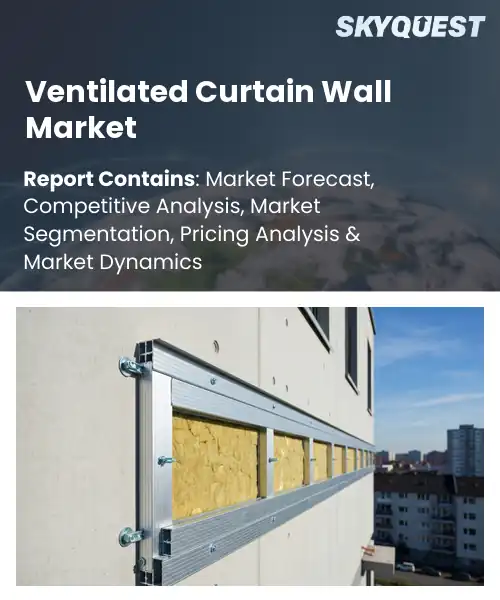
Ventilated Curtain Wall Market
Report ID: SQMIG20B2291
Report ID: SQMIG20B2291
[email protected]
USA +1 351-333-4748
Report ID:
SQMIG20B2291 |
Region:
Global |
Published Date: August, 2026
Pages:
157
|Tables:
120
|Figures:
77


Global Ventilated Curtain Wall Market size was valued at USD 8.74 Billion in 2024 and is poised to grow from USD 9.37 Billion in 2025 to USD 16.35 Billion by 2033, growing at a CAGR of 7.2% during the forecast period (2026-2033).
Ventilated curtain wall market trends systems, where the outer glazed facade is separated from the structural frame by an air cavity, have become a staple of construction. Their relevance stems from the possibility of combining esthetic transparency and passive cooling, thus decreasing dependence on mechanical HVAC, while maintaining daylight penetration. The segment has its roots in the 1970s in Europe, where energy-efficiency regulations led architects to incorporate vented cavities in aluminum facades. In the 2000s, rapid urbanization in Asia saw a surge in adoption as developers looked for faster and efficient envelope solutions. Today the market includes residential towers, commercial complexes and institutional buildings, in line with a move to sustainable design.
The main driver for ventilated curtain wall market growth in the ventilated curtain wall market is the tightening of energy codes that require owners to lower cooling loads and carbon footprints. The demand for better U-values is pushing the design of vented façades where the airflow takes the solar heat away and directly reduces the chiller demand. A recent office tower in Singapore has shown a drop of 15 % in annual energy bills after the retrofitting of the envelope. Due to improved extrusion and sealing, material costs were reduced at the time, which has enabled developers in emerging economies to take up the system. This change opens the market for mixed-use projects, other than skyscrapers, providing sources of income for façade contractors and HVAC firms.
How is AI-driven Automation Influencing Design Efficiency in the Ventilated Curtain Wall Market?
AI-driven automation is improving the design and engineering of ventilated curtain wall systems market share by enabling faster analysis of façade performance, airflow, solar exposure, and thermal loads. AI tools can evaluate multiple design configurations and identify combinations of glazing, cavity depth, shading, and ventilation strategies that improve energy efficiency while reducing material use and design iterations. Automation also supports digital workflows by connecting building information modeling (BIM), parametric design, and simulation tools, allowing façade engineers to detect potential design conflicts and optimize components before construction begins.
As a result, AI-driven design automation can shorten development cycles, improve coordination between architects, façade contractors, and HVAC teams, and support the development of more energy-efficient curtain wall systems. This is creating opportunities for software providers and façade manufacturers to integrate AI-based optimization into next-generation building-envelope design platforms.
Market snapshot - (2026-2033)
Global Market Size
USD 8.74 Billion
Largest Segment
Glass
Fastest Growth
Composite Panels
Growth Rate
7.2% CAGR
To get more insights on this market click here to Request a Free Sample Report
Global ventilated curtain wall market is segmented by material, system type, application, end user and region. Based on material, the market is segmented into glass, aluminum, stone, ceramic, composite panels and others. Based on system type, the market is segmented into unitized, stick-built and semi-unitized. Based on application, the market is segmented into commercial buildings, residential buildings, institutional buildings and industrial buildings. Based on end user, the market is segmented into new construction and renovation & retrofit. Based on region, the market is segmented into North America, Europe, Asia Pacific, Latin America and Middle East & Africa.
Glass segment dominates because it offers unparalleled transparency, allowing natural daylight to penetrate interiors while maintaining thermal performance through advanced low emissivity coatings. Architects prioritize glass for its aesthetic appeal and ability to create visual continuity, driving widespread specification in high rise façades. The material’s adaptability to various performance grades and compatibility with modern framing systems further consolidates its leadership in the ventilated curtain wall market across diverse climatic regions.
However, composite panels segment is witnessing the strongest growth momentum because manufacturers integrate cores with sustainable skins, delivering superior insulation and reduced weight. This innovation enables quicker installation and lower structural demands, attracting developers focused on green certifications and efficient timelines. Expanding versatile finishes accelerate its adoption across new projects, creating fresh market opportunities.
Unitized segment leads because prefabricated panels are assembled in controlled factory environments, guaranteeing consistent quality and precise sealing that mitigate air infiltration. This method streamlines on site installation, reducing labor hours and minimizing construction waste, which resonates with project owners seeking schedule certainty. The integrated thermal break technology inherent in many unitized systems further elevates energy efficiency, cementing its leadership within the ventilated curtain wall market across diverse climatic regions.
Meanwhile, stick built segment is emerging as a key growth area because its flexibility accommodates complex geometries and phased construction schedules. Architects favor stick built solutions for bespoke designs requiring customized framing and glazing sequences. The ability to adapt to project scopes fuels its adoption in renovation and retrofit projects, expanding market reach and generating business opportunities.
To get detailed segments analysis, Request a Free Sample Report
The region’s strengths are advanced manufacturing capabilities, high urbanization rates and a strong focus on energy-efficient building design. Urban environments that are dense and encourage architectural innovation are now demanding curtain wall systems that offer the benefits of thermal performance while providing esthetic flexibility. Local producers have strong supply chains and a long history of precision engineering to meet stringent quality expectations and still be cost competitive. Demand is also fueled by government incentives that encourage green building standards, setting the region as a leader in both production capacity and market consumption. Collaborative research initiatives between academia and industry accelerate further technology improvements, providing an evolving façade solution that corresponds to evolving sustainability goals.
Ventilated curtain wall market outlook in Japan is shaped by a legacy of meticulous construction practices and an intense focus on durability against seismic forces. Architects prioritize systems that combine high performance with minimal maintenance, and manufacturers respond with sophisticated fabrication techniques that meet exacting standards. Regulatory frameworks encouraging low‑energy buildings also drive integration of ventilated façades, while a culture of innovation supports the development of bespoke solutions for mixed‑use and high‑rise projects.
Ventilated curtain wall market forecast in South Korea is propelled by rapid urban development and a national agenda emphasizing smart, sustainable infrastructure. Industry clusters concentrate expertise in glass processing and metalwork, facilitating swift adoption of advanced curtain wall technologies. The market responds to a preference for sleek, transparent building envelopes that enhance natural lighting while ensuring thermal regulation. Strong collaboration between construction firms and research institutions accelerates the introduction of next‑generation ventilation concepts that align with the country’s green building aspirations.
Europe’s growth rests on tough environmental rules and a well-developed architectural tradition that stresses function as well as form. The demand for facades that enhance thermal performance whilst retaining daylight quality is driven by the push toward nearly zero-energy buildings. There is a well-developed network of specialist manufacturers and design consultants that encourages fast cross-border diffusion of innovative curtain wall solutions. Strong financing mechanisms and incentives for retrofit projects are also contributing to the replacement of legacy facades with high-efficiency systems. EU members work on collaborative platforms to ensure common standards, allowing for an easy integration of ventilated technologies, in applications ranging from commercial towers to the renovation of heritage buildings.
Ventilated curtain wall market regional outlook in Germany is characterized by a strong engineering culture and a deep commitment to sustainability. Manufacturers leverage precision machining and high‑performance material science to produce systems that meet rigorous energy standards. Architects favor modular designs that allow for rapid installation on complex building geometries, while developers appreciate the long‑term operational savings associated with improved façade ventilation. The market benefits from a coordinated approach between industry bodies and governmental agencies that streamline certification processes.
Ventilated curtain wall market regional forecast in the United Kingdom is driven by an ambitious agenda for net‑zero emissions and a vibrant construction sector that embraces innovative building skins. Design firms prioritize lightweight, thermally efficient curtain walls that support flexible interior planning and enhance occupant comfort. Supply chains emphasize rapid prototyping and digital fabrication, allowing for bespoke solutions tailored to historic retrofit projects as well as new high‑rise developments. Policy incentives further encourage the adoption of technologies that reduce heating demand.
Ventilated curtain wall market penetration in France is emerging alongside a resurgence of interest in contemporary urban architecture that blends aesthetic elegance with ecological responsibility. Manufacturers focus on integrating high‑performance glazing with adaptable frame systems that accommodate diverse climatic zones across the country. Architectural education emphasizes sustainable façade design, fostering demand for curtain walls that balance natural ventilation with energy conservation. Public‑private partnerships support pilot projects that showcase the benefits of ventilated solutions in both commercial and residential contexts.
North America’s role continues to solidify with the ecosystem of innovative material suppliers, progressive building codes, and large scale commercial construction. The focus on green building certification drives architects to focus on curtain wall systems that offer better thermal performance and improve daylight penetration. The region has a long history of research collaborations using advanced simulation tools for the development of practical design guidelines. Supply chain flexibility allows quick customization to meet a range of climatic zones from coastal to interior markets. Retrofit projects also contribute to the installed base, further solidifying ventilated curtain wall technology as a staple of new construction and building modernization strategies.
Ventilated curtain wall market analysis in the United States are shaped by a vast portfolio of commercial skyscrapers and a growing emphasis on energy‑efficient building envelopes. Industry leaders integrate sophisticated ventilation channels that mitigate heat gain while preserving expansive views. Design trends favor sleek, transparent façades that align with corporate branding, prompting manufacturers to deliver high‑performance glass and aluminum systems. Regulatory frameworks encouraging reduced carbon footprints further incentivize adoption of ventilated technologies across diverse project types.
Ventilated curtain wall industry in Canada reflects a focus on performance in harsh climatic conditions and a national commitment to sustainable construction. Manufacturers prioritize robust insulation and moisture‑management features that ensure durability during extreme temperature fluctuations. Architectural practices emphasize daylighting solutions that reduce reliance on artificial lighting while maintaining indoor comfort. Collaborative initiatives between provincial authorities and industry groups support the integration of ventilated curtain walls into both new builds and renovation projects, reinforcing the market’s trajectory toward greener building standards.
To know more about the market opportunities by region and country, click here to
Buy The Complete Report
Increasing Energy Efficiency Standards
Growing Demand for Aesthetic Flexibility
High Initial Installation Costs
Complex Maintenance Requirements
Request Free Customization of this report to help us to meet your business objectives.
The global ventilated curtain wall market is characterized by competition among established façade contractors, aluminum-system manufacturers, glass producers, and building-envelope specialists. Companies are differentiating through thermally efficient façade systems, high-performance glazing, lightweight aluminum structures, improved weather resistance, prefabrication, and digitally enabled building-envelope solutions. Sustainability requirements and increasingly stringent building-energy standards are encouraging manufacturers to invest in low-carbon materials, high-performance glazing, and systems that improve the thermal performance of commercial and high-rise buildings. Strategic partnerships, project contracts, product development, and expansion into regional façade markets remain important strategies for strengthening competitive positioning.
Top Player’s Company Profile
Recent Developments in the Ventilated Curtain Wall Market
SkyQuest’s ABIRAW (Advanced Business Intelligence, Research & Analysis Wing) is our Business Information Services team that Collects, Collates, Correlates, and Analyses the Data collected by means of Primary Exploratory Research backed by robust Secondary Desk research. As per SkyQuest analysis the ventilated curtain wall market is driven primarily by tightening energy efficiency standards that push developers toward systems that cut cooling loads and lower operating costs. A second driver is the growing demand for aesthetic flexibility, with architects seeking sleek transparent façades that also meet performance goals. The market is led by the Asia Pacific region, where rapid urbanization and strong manufacturing bases fuel adoption. Within the segment hierarchy the glass material segment holds the largest share thanks to its superior daylight transmission and advanced low‑emissivity coatings, while high upfront installation costs act as a restraint limiting broader uptake.
| Report Metric | Details |
|---|---|
| Market size value in 2024 | USD 8.74 Billion |
| Market size value in 2033 | USD 16.35 Billion |
| Growth Rate | 7.2% |
| Base year | 2024 |
| Forecast period | (2026-2033) |
| Forecast Unit (Value) | USD Billion |
| Segments covered |
|
| Regions covered | North America (US, Canada), Europe (Germany, France, United Kingdom, Italy, Spain, Rest of Europe), Asia Pacific (China, India, Japan, Rest of Asia-Pacific), Latin America (Brazil, Rest of Latin America), Middle East & Africa (South Africa, GCC Countries, Rest of MEA) |
| Companies covered |
|
| Customization scope | Free report customization with purchase. Customization includes:-
|
To get a free trial access to our platform which is a one stop solution for all your data requirements for quicker decision making. This platform allows you to compare markets, competitors who are prominent in the market, and mega trends that are influencing the dynamics in the market. Also, get access to detailed SkyQuest exclusive matrix.
Table Of Content
Executive Summary
Market overview
Parent Market Analysis
Market overview
Market size
KEY MARKET INSIGHTS
COVID IMPACT
MARKET DYNAMICS & OUTLOOK
Market Size by Region
KEY COMPANY PROFILES
Methodology
For the Ventilated Curtain Wall Market, our research methodology involved a mixture of primary and secondary data sources. Key steps involved in the research process are listed below:
1. Information Procurement: This stage involved the procurement of Market data or related information via primary and secondary sources. The various secondary sources used included various company websites, annual reports, trade databases, and paid databases such as Hoover's, Bloomberg Business, Factiva, and Avention. Our team did 45 primary interactions Globally which included several stakeholders such as manufacturers, customers, key opinion leaders, etc. Overall, information procurement was one of the most extensive stages in our research process.
2. Information Analysis: This step involved triangulation of data through bottom-up and top-down approaches to estimate and validate the total size and future estimate of the Ventilated Curtain Wall Market.
3. Report Formulation: The final step entailed the placement of data points in appropriate Market spaces in an attempt to deduce viable conclusions.
4. Validation & Publishing: Validation is the most important step in the process. Validation & re-validation via an intricately designed process helped us finalize data points to be used for final calculations. The final Market estimates and forecasts were then aligned and sent to our panel of industry experts for validation of data. Once the validation was done the report was sent to our Quality Assurance team to ensure adherence to style guides, consistency & design.
Analyst Support
Customization Options
With the given market data, our dedicated team of analysts can offer you the following customization options are available for the Ventilated Curtain Wall Market:
Product Analysis: Product matrix, which offers a detailed comparison of the product portfolio of companies.
Regional Analysis: Further analysis of the Ventilated Curtain Wall Market for additional countries.
Competitive Analysis: Detailed analysis and profiling of additional Market players & comparative analysis of competitive products.
Go to Market Strategy: Find the high-growth channels to invest your marketing efforts and increase your customer base.
Innovation Mapping: Identify racial solutions and innovation, connected to deep ecosystems of innovators, start-ups, academics, and strategic partners.
Category Intelligence: Customized intelligence that is relevant to their supply Markets will enable them to make smarter sourcing decisions and improve their category management.
Public Company Transcript Analysis: To improve the investment performance by generating new alpha and making better-informed decisions.
Social Media Listening: To analyze the conversations and trends happening not just around your brand, but around your industry as a whole, and use those insights to make better Marketing decisions.
REQUEST FOR SAMPLE
 REQUEST FREE CUSTOMIZATION
Global Ventilated Curtain Wall Market size was valued at USD 8.74 Billion in 2024 and is poised to grow from USD 9.37 Billion in 2025 to USD 16.35 Billion by 2033, growing at a CAGR of 7.2% during the forecast period (2026-2033).
The ventilated curtain wall market is shaped by intense competition among established façade specialists and emerging technology‑focused firms, driving rapid product differentiation and cost efficiencies. Recent strategic moves such as Schüco’s acquisition of a structural‑glass design studio, YKK AP’s partnership with a leading low‑emissivity coating supplier, and AluK’s launch of an IoT‑enabled façade monitoring system illustrate how players are leveraging M&A, collaborations and tech innovation to capture premium projects and respond to sustainability mandates. 'Compagnie de Saint-Gobain S.A.', 'Kingspan Group plc', 'Etex NV', 'Rockwool A/S', 'Arconic Corporation', 'Schüco International KG', 'Reynaers Aluminium NV', 'Hydro ASA', 'AGC Inc.', 'Nippon Sheet Glass Co., Ltd.', 'Guardian Industries Holdings LLC', 'Permasteelisa S.p.A.', 'LIXIL Corporation', 'YKK AP Inc.', 'Lindner Group KG', 'Josef Gartner GmbH', 'Enclos Corporation', 'Kawneer Company, Inc.', 'Alumil S.A.', 'EFCO Corporation'
Sustainable Urbanization Drive: Sustainable urbanization drive is prompting architects and developers to prioritize energy‑efficient façades, positioning ventilated curtain walls as a preferred solution for high‑rise projects. The system’s ability to reduce cooling loads while delivering natural daylight aligns with green building certifications and corporate ESG commitments. As city planners enforce stricter carbon‑reduction targets, project specifications increasingly mandate high‑performance envelope technologies, creating a steady pipeline of demand for ventilated curtain wall installations across commercial and mixed‑use developments throughout the region’s expanding skyline and beyond.
Why does Asia Pacific Dominate the Global Ventilated Curtain Wall Market? |@12


Want to customize this report? This report can be personalized according to your needs. Our analysts and industry experts will work directly with you to understand your requirements and provide you with customized data in a short amount of time. We offer $1000 worth of FREE customization at the time of purchase.
Feedback From Our Clients


 USA (+1) 351-333-4748

